@reflectmoney @reflectmoney codes if anyone needs:
ZHMMEE8L
H4RO3PZ2
LI4QAO5R
English
loadie 🚍
692 posts

@ItsMikeySC
you can find me deep in the trenches with the crew.

Alpha access to USDC+ is now live. Deposits capped at $10M. Speed matters. Confirm eligibility below ⬇️

BTC - Week 22, testing the under-side of 10wma where a declining cycle is often rejected once. If we sweep the late Aug lows ($104-107k) that should be a trap before new weekly Cycle. BUT...we're in the real speculative phase of the 4yr cycle. Dominance dropping is confirming this with many ALT's pushing up hard. Breaking through the 10wma means buckle up! Now historically not the time to be afraid.






Jennifer Lopez steps out on the red carpet with her non-binary daughter, Emme, who uses They/Them pronouns. Emme Maribel Muñiz became non-binary during her mother’s relationship with Ben Affleck. Ben Affleck’s daughter is also non-binary. x.com/JebraFaushay/s…




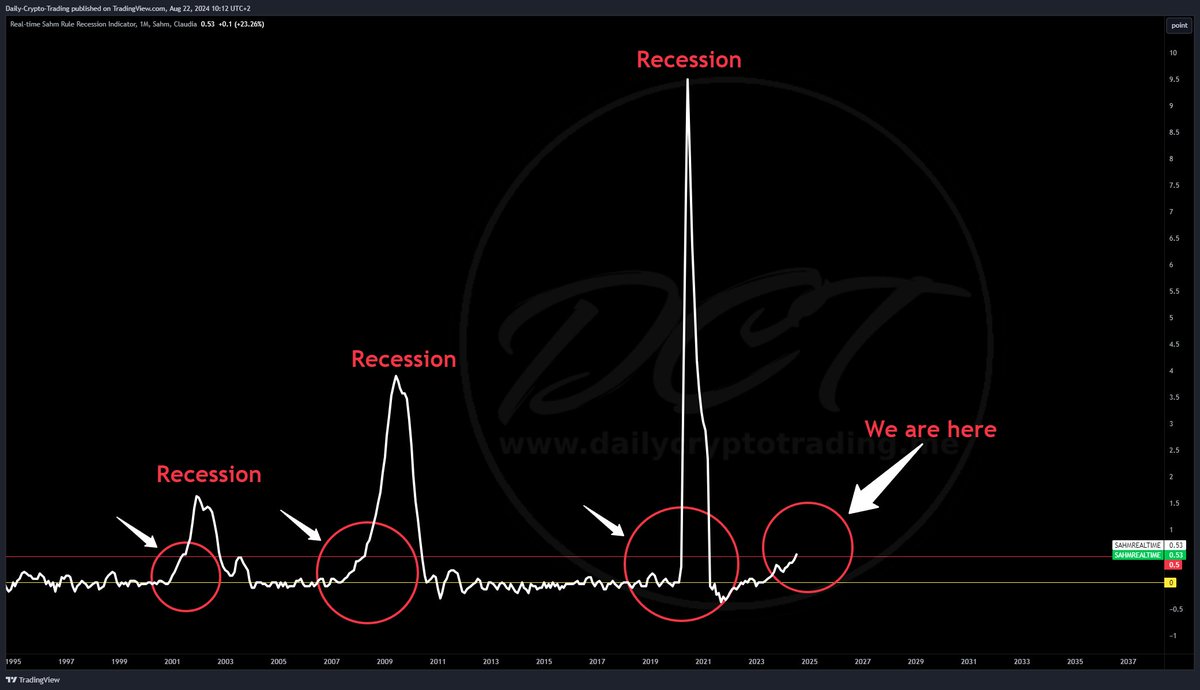
As promised, here's my take on the economy, inflation, and the possible recession - not the most exciting part, but it's crucial. 📚 Before we start, remember these are just my own thoughts and research, so don't use them as buy/sell signals. And if you like what you read, why not give it a like? 👍 Everyone's talking about whether we've dodged the recession. Some are even making jokes, calling it the “Most Anticipated Recession.” Let's get real. With social media, more people are talking about potential recessions. If we have indeed “avoided a recession,” it would be a first since the 2nd World War. The folks who say it's been cancelled are often the same ones cheering on a bull market and saying “this time is different.” But let's focus on the facts, not the hype from some 23-year-old who's never seen a recession and only has dollar signs (or should I say, Lambo signs) in his eyes while pushing NFTs to his followers. 🐸🖼️ First up, let's talk inflation. Has the FED beaten inflation? Not quite! The core CPI is at 4.8%, which is still 2.8% above their 2% target. The drop is slower than expected. The CPI hit 3% and looks good on paper, but if we dig into the report, we see that it was the base impact that brought inflation down. Take those out (which won't be included in the next reading), and we see inflation going UP. Look at Energy going up in June or Services less energy services at 6.2%! Now let's stick with Energy commodities for a sec. If we look at the report of U.S. Crude Oil Inventories -0.708M and the forecast was -2.440M, this means if the increase in crude is less than expected, it implies greater demand and is bullish for crude prices, which is inflationary. What happens when crude oil increases? Transportation energy inflation also goes up. If we look at CORE CPI that excludes all of this, we see 4.8%. Or the FED's favourite indicator, CORE PCE, we see 4.9%. So, how can we say that inflation is over or that we've won? Or that we're going to have a soft landing? 🎯 If the decrease is due to increased demand, this could indeed be bullish for energy prices, including crude oil. Higher demand with the same or lower supply typically leads to higher prices. Higher energy prices, in turn, can contribute to inflation. This is because energy costs are a big part of many goods and services. For example, increased oil prices can lead to higher transportation costs, which can increase the cost of goods (since it's more expensive to transport them). This can lead to higher prices for consumers, which is inflationary. These are the facts I’m laying out, and according to my analysis, we're seeing here we will have a rebound in the inflation, which the forecast also shows. But the question is, will it be higher than the expectations? 📈 What about recession? Let's make this crystal clear. Since World War II, every yield curve inversion has been followed by a recession in the following 6-18 months, and recessions are naturally tied to decreased stock market returns. This is because an inverted yield curve, where short-term interest rates are higher than long-term rates, is often seen as a sign of economic uncertainty. Investors demand higher returns for short-term bonds when they think the economy will perform poorly in the near future. This can lead to decreased investment and spending, which can trigger a recession. Recessions and Stock Market Returns: Recessions are periods when the economy shrinks, characterized by less spending, more unemployment, and lower corporate profits. These factors can lead to decreased stock market returns, as investors expect lower future earnings and become more risk-averse. And what are we seeing now as shown in the chart? We have deep Yield curve inversions as highlighted in red! So I don't believe this time is different, nor do I believe we will get a soft landing. During a recession, certain types of investments tend to perform better than others. Here are a few examples: • Government Bonds: During times of economic uncertainty, investors often flock to the safety of government bonds, especially U.S. Treasuries. • Consumer Staples Stocks: Companies that make consumer staples, like food, drinks, and household goods, often do well during recessions. This is because demand for these products tends to stay stable, even during economic downturns. • Healthcare Stocks: Like consumer staples, healthcare is a must-have, and demand for healthcare services and products often stays stable during a recession. • Utilities Stocks: Utilities are companies that provide essential services like electricity, gas, and water. These companies often have stable cash flows and can offer attractive dividend yields, making them a popular choice during recessions. • Gold and Precious Metals: Gold and other precious metals are often seen as a store of value and can do well during recessions. Investors often turn to gold as a safe haven during times of economic uncertainty. • Cash and Cash Equivalents: Holding cash or cash equivalents (like money market funds) can be a good move during a recession, as it provides flexibility and the ability to jump on investment opportunities as they pop up. (not if we get stagflation though) But what about Bitcoin? Bitcoin was born out of a recession and has never been in one, so there are two types of narratives we have to look at – is it that Bitcoin is digital gold and is a commodity? Then it would appreciate in time like gold during a recession. OR is it a software correlated with Nasdaq and the S&P 500? Then it will bottom out during a recession. No one knows this, however my observation is that Bitcoin is not mature enough to be digital gold. It's too volatile for a safe haven for investors right now; it's more of a speculative risk asset. I hope this cleared a few things up, and I know it's not the most fun thing to read, but this gives you a better idea. If it did, give me a like and a retweet. I would appreciate it! 👍🔄 #Economy #Inflation #Recession #bitcoin #crypto #SPY #DXY #NASDAQ #Cryptocurrency #YieldCurve #NFTs #FOMC #etherum






We're choosing a few NFT communities to airdrop.. Who wants some $M3M3? 👀👇