Jesse Marks جيسي ماركس 马辙新

3.5K posts

Jesse Marks جيسي ماركس 马辙新 banner
Jesse Marks جيسي ماركس 马辙新

Jesse Marks جيسي ماركس 马辙新

@JesCMarks

#Technology #MENA #China | fmr @stimson @DoD | RT≠endorse

Washington / Amman 가입일 Ekim 2013
1.8K 팔로잉1.7K 팔로워
Jesse Marks جيسي ماركس 马辙新
This will be interesting to see if it comes together.
Amit Segal@AmitSegal

Exclusive: America's Proposal for an Israel-Syria Economic Peace A new plan for economic cooperation is being discussed with Syria. What does it involve? It appears to be a sprawling joint economic zone along the current demilitarized strip—complete with energy projects, pharmaceutical plants, and, most Trumpian of all, a ski resort. Let’s just say this comes as a surprise. One would think that after Israel conducted thousands of strikes, and currently sitting on Syrian territory, security would remain the only topic worth negotiating. But it seems the Trump administration and the Syrian government are after something more intimate. According to the American-Syrian proposal, the zone would host a wind power plant, a crude oil pipeline, data centers, and pharmaceutical facilities—and best of all, the area would remain demilitarized. The plan offers quite a bit for Syria: roughly $4 billion in GDP growth—a 20 percent increase on its current output—along with an 800-megawatt boost in power capacity, 15,000 new jobs, and a 40 percent reduction in pharmaceutical dependency. Israel, for its part, gains the chance to transform an arid buffer zone into a “dynamic economic corridor,” while enjoying “reduced military spending” to protect its northern border. Lets just say the imbalance isn’t unusual for Israel’s peace arrangements. Back in 1979, Egypt regained the entire Sinai Peninsula, billions in U.S. aid, and a guarantee that Israel would stop embarrassing it militarily—in exchange for tolerance of its existence. But what would this new zone actually look like? Apparently, something akin to the ski region of Zermatt, Switzerland on the Italian border. Not a one-to-one comparison—Israel and Syria are hardly European in structure or sentiment—but the model gives an idea: independent tax rules, relaxed visa requirements, arbitration mechanisms for financial disputes, maybe even a shared currency framework. Here a question arises: will this whole deal really go through without Syria joining a certain Abrahamic accords? Unfortunately, yes. From what I’ve seen, none of the draft documents make peace a formal condition of the plan. It may make peace more likely, but by no means guaranteed. Now, peace in the Middle East aside—it’s a good deal. Economic prosperity is always welcome, and a demilitarized zone with fewer barbed wires and more ski lifts sounds, frankly, delightful. After all, when Israel first expanded its presence into the DMZ following the Assad regime’s collapse, plenty of Israelis joked—half seriously—about the new skiing opportunities. Still, it needs to be said: however tempting this vision is, Israel should be very careful before it starts trading soldiers for skis.

English
0
0
0
140
Jesse Marks جيسي ماركس 马辙新 리트윗함
Amit Segal
Amit Segal@AmitSegal·
Exclusive: America's Proposal for an Israel-Syria Economic Peace A new plan for economic cooperation is being discussed with Syria. What does it involve? It appears to be a sprawling joint economic zone along the current demilitarized strip—complete with energy projects, pharmaceutical plants, and, most Trumpian of all, a ski resort. Let’s just say this comes as a surprise. One would think that after Israel conducted thousands of strikes, and currently sitting on Syrian territory, security would remain the only topic worth negotiating. But it seems the Trump administration and the Syrian government are after something more intimate. According to the American-Syrian proposal, the zone would host a wind power plant, a crude oil pipeline, data centers, and pharmaceutical facilities—and best of all, the area would remain demilitarized. The plan offers quite a bit for Syria: roughly $4 billion in GDP growth—a 20 percent increase on its current output—along with an 800-megawatt boost in power capacity, 15,000 new jobs, and a 40 percent reduction in pharmaceutical dependency. Israel, for its part, gains the chance to transform an arid buffer zone into a “dynamic economic corridor,” while enjoying “reduced military spending” to protect its northern border. Lets just say the imbalance isn’t unusual for Israel’s peace arrangements. Back in 1979, Egypt regained the entire Sinai Peninsula, billions in U.S. aid, and a guarantee that Israel would stop embarrassing it militarily—in exchange for tolerance of its existence. But what would this new zone actually look like? Apparently, something akin to the ski region of Zermatt, Switzerland on the Italian border. Not a one-to-one comparison—Israel and Syria are hardly European in structure or sentiment—but the model gives an idea: independent tax rules, relaxed visa requirements, arbitration mechanisms for financial disputes, maybe even a shared currency framework. Here a question arises: will this whole deal really go through without Syria joining a certain Abrahamic accords? Unfortunately, yes. From what I’ve seen, none of the draft documents make peace a formal condition of the plan. It may make peace more likely, but by no means guaranteed. Now, peace in the Middle East aside—it’s a good deal. Economic prosperity is always welcome, and a demilitarized zone with fewer barbed wires and more ski lifts sounds, frankly, delightful. After all, when Israel first expanded its presence into the DMZ following the Assad regime’s collapse, plenty of Israelis joked—half seriously—about the new skiing opportunities. Still, it needs to be said: however tempting this vision is, Israel should be very careful before it starts trading soldiers for skis.

Amit Segal tweet media
English
61
116
543
267.3K
Jesse Marks جيسي ماركس 马辙新 리트윗함
Gulf Int'l Forum
Gulf Int'l Forum@GulfIntlForum·
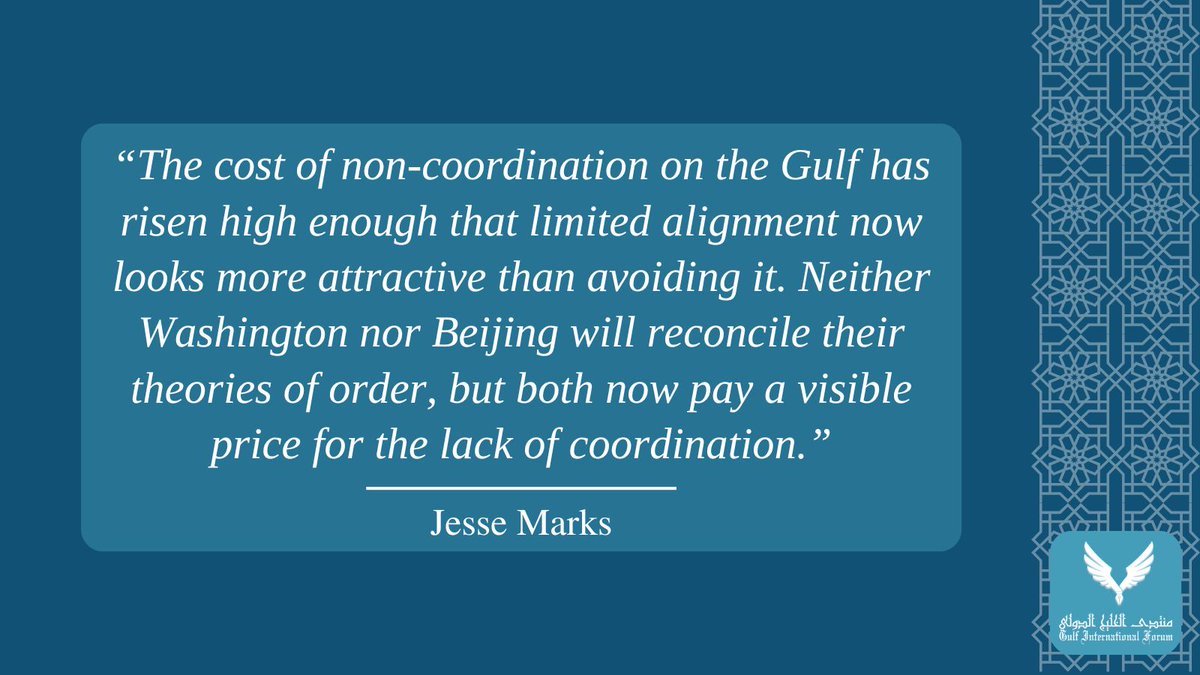
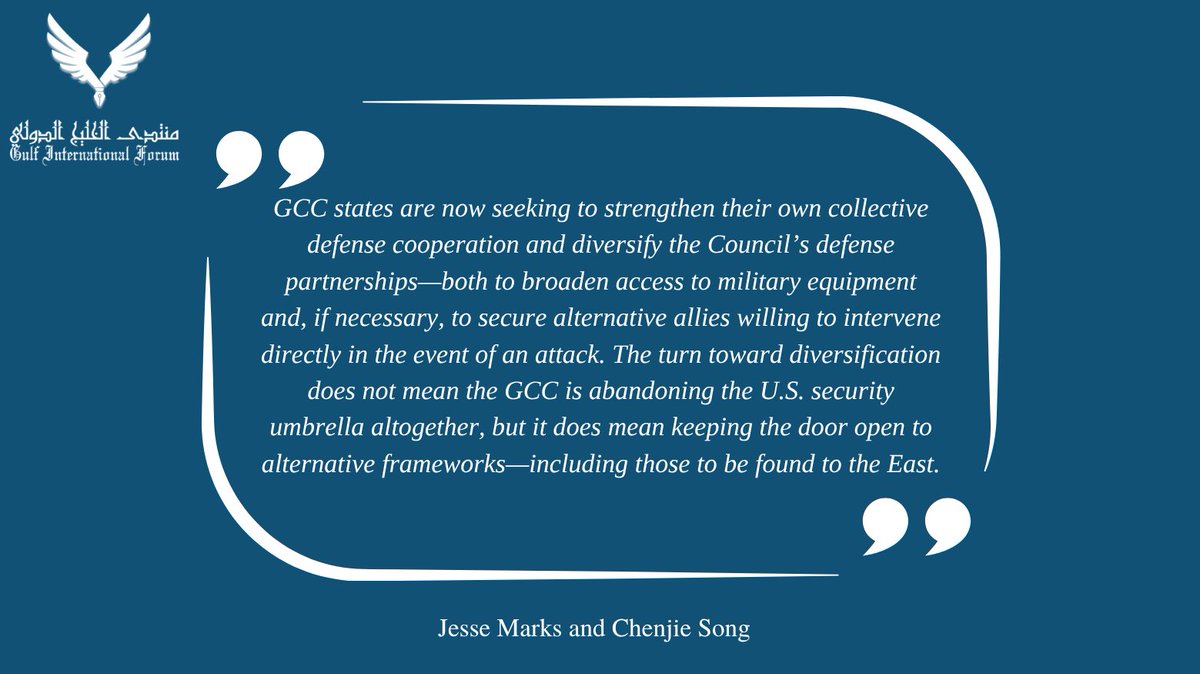
"Parallel, Not Replacement: Why China Can’t Supplant U.S. Security in the Gulf" In their new article, @JesCMarks and Chenjie Song explore the future of security relations in the #Gulf and what it means for #US and #China engagement in the region. Read the full article here: gulfif.org/parallel-not-r…
Gulf Int'l Forum tweet media
English
0
1
0
296
Jesse Marks جيسي ماركس 马辙新 리트윗함
Joe Wilson
Joe Wilson@RepJoeWilson·
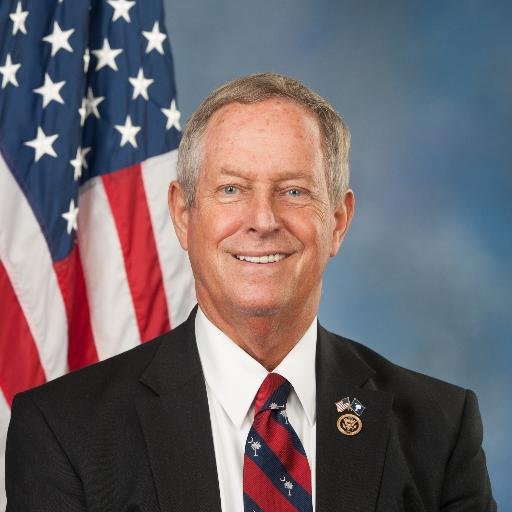
It was my honor to meet with 🇸🇾President Ahmed al-Sharaa as part of a bipartisan delegation with @USAMBTurkiye and Ranking Member Shaheen of @SFRCdems to discuss a bright, unified, and stable future for Syria. This trip was particularly meaningful for me, and I am grateful for the warm reception. The time for FULL Caesar repeal is NOW. As a priority of President Trump’s administration, I remain committed to this critical and bipartisan goal. #MakeSyriaGreatAgain
Joe Wilson tweet media
English
912
606
5.4K
510.9K
Jesse Marks جيسي ماركس 马辙新 리트윗함
ASPI
ASPI@ASPI_org·
'China is moving quickly to shore up its long-term energy ties with Gulf Cooperation Council states through fixed purchasing agreements with Gulf suppliers,' writes @JesCMarks. aspistrategist.org.au/facing-volatil…
English
1
3
2
1.1K
Jesse Marks جيسي ماركس 马辙新 리트윗함
Charles Lister
Charles Lister@Charles_Lister·
In 7 months, #Israel has done the following in #Syria: - 987 air & artillery strikes - 421 ground incursions - Occupied ~180sqkm of land In response, #Syria's govt has done: - 0 attacks - Filed x2 UNSC complaints - Seized 49 #Hezbollah weapons shipments headed to #Lebanon
English
223
868
2.9K
403.2K
Jesse Marks جيسي ماركس 马辙新 리트윗함
Foreign Policy
Foreign Policy@ForeignPolicy·
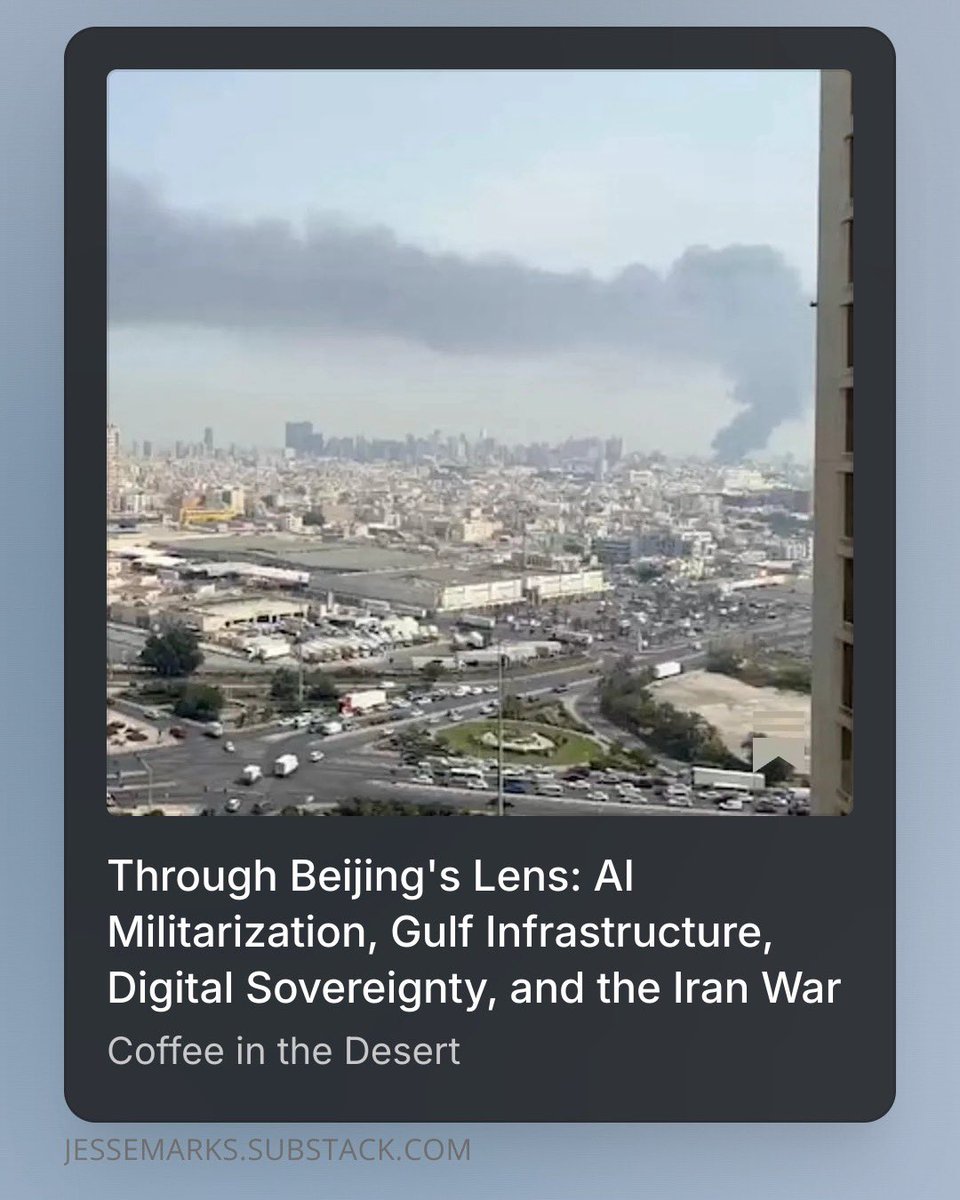
Beijing doesn’t want deeper Middle East entanglements because it knows there’s no clean exit, writes Jesse Marks. foreignpolicy.com/2025/06/23/ira…
English
5
41
94
13.1K
Jesse Marks جيسي ماركس 马辙新 리트윗함
Etan Nechin
Etan Nechin@Etanetan23·
Starving Gazans packed behind fences for a scrap of aid. This isn’t relief—it’s humiliation and dehumanization by design. History won’t forget who watched and did nothing.
Etan Nechin tweet media
English
1K
5K
11.5K
878.5K