Self Made ๐ธ
992 posts

๊ณ ์ ๋ ํธ์
Self Made ๐ธ ๋ฆฌํธ์ํจ

Ribbit Capital published their latest Pulse Letter
ribbitcap.com/perspective
The TLDR...
The coding wave is done ๐
The financial wave is next ๐
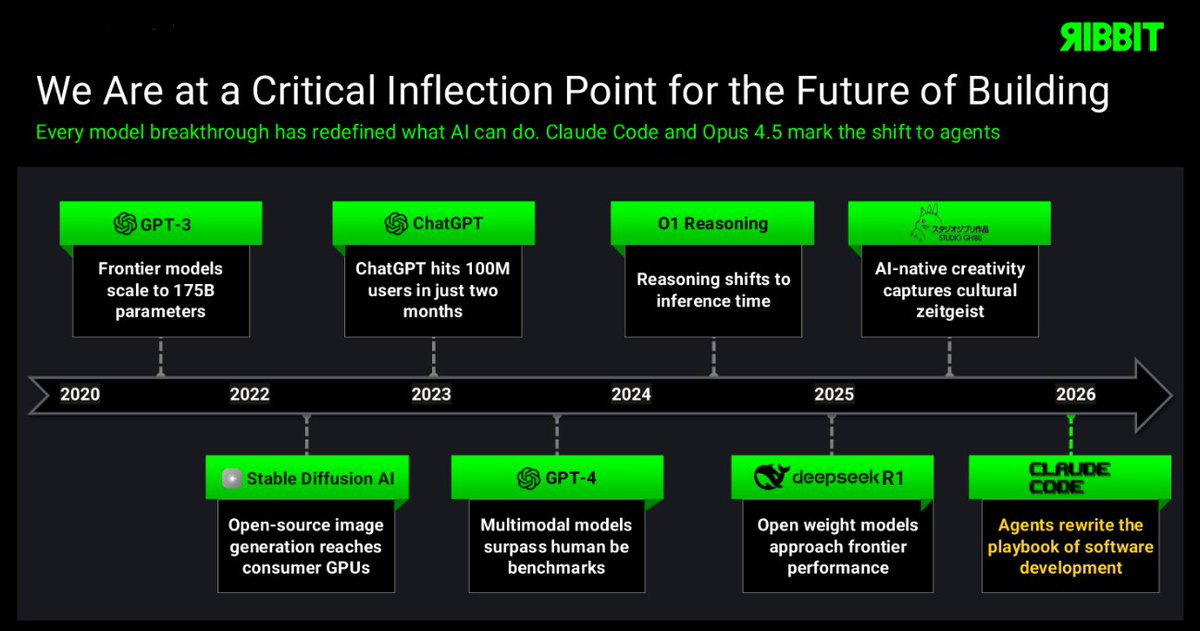
The Ribbit deck is explicit: coding is 50% of all AI agent activity today.
Finance, legal, back office, and sales are the other half, all coming fast.
Every one of those workflows eventually touches regulated capital. That's where the infrastructure completely breaks down.
Automated traffic is already 51% of all web activity.
But nearly half of enterprises still authenticate agents with shared API keys never designed for autonomous systems.
Capability has lapped trust infrastructure. By a lot.
Traditional finance solved this problem decades ago.
Before anyone touches capital, you verify them.
KYC. KYB.
The agent economy needs the same thing...
Know Your Agent. KYA.
What makes this moment unusual: everything is being built simultaneously.
ERC-8183 is two weeks old. The Phala deployment is live. The Ribbit Pulse deck dropped today. The KYA thesis is being named in public right now.
Ribbit is building $Tibbir at the standard-setting moment. Not after.
The infrastructure is assembling in public, standard by standard, deployment by deployment.
The compliance layer, KYA, is the missing piece that lets agents access regulated finance.
That's the bet. $TIBBIR ๐ธ


English
Self Made ๐ธ ๋ฆฌํธ์ํจ

Such a good piece. Must reading.
In both cases, the banking lobby is arguing that novel instruments that benefit consumers โ whether fully reserved depositories or interest-bearing stablecoins โ pose a risk to the banking system and bank deposits. A more accurate description would be that skinny master accounts and interest-bearing stablecoins pose a risk to banksโ monopoly over payments.
Alex Thorn@intangiblecoins
English

Agents are becoming economic actors, using both cards and stablecoins.
But until now, card payments required sharing raw card data, insecurely.
Today, we are announcing virtual cards for agents, with granular spend permissions: spend limits, intent whitelisting, and more.
Crossmint@crossmint
SNEAK PEEK: Your agents are about to get their own agentic cards. Not stablecoin backed cards. Not insecure raw card number sharing, but native, agent first cards powered by @Visa Intelligent Commerce.

English
Self Made ๐ธ ๋ฆฌํธ์ํจ

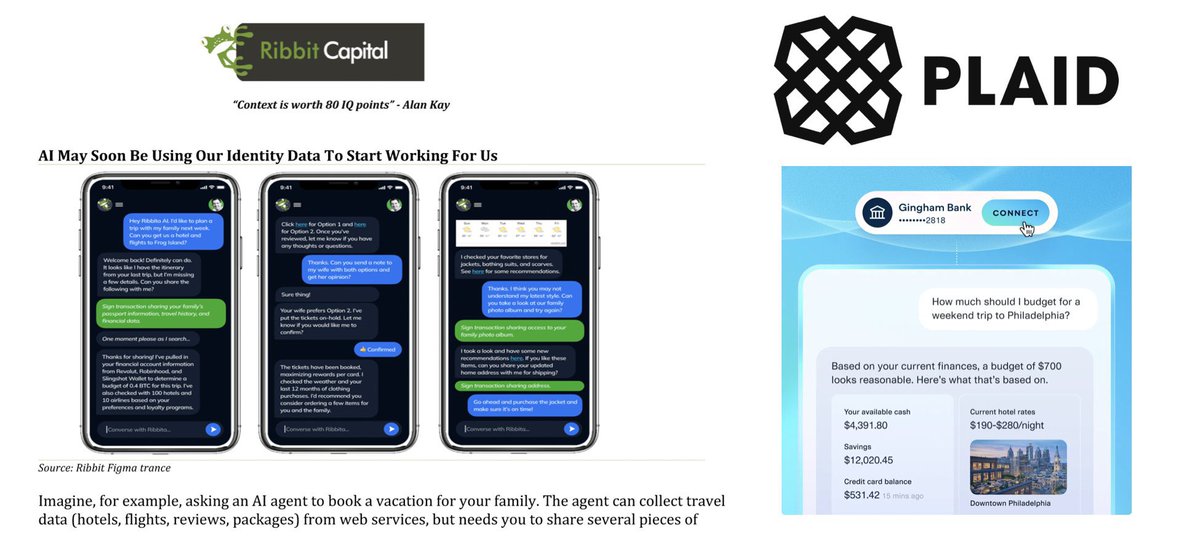
๐จ PLAID ร TIBBIR: HOW THE AGENT ECONOMY ACTUALLY WORKS ๐จ
Everyone is talking about AI agents.
Very few are talking about how they talk to money.
Thatโs where the real game is.
โธป @ribbita2012 @RibbitaStore @ribbita2025 @RibbitCapital @mickymalka
๐ง The Missing Link in Agentic Finance
An AI agent needs three things to operate in the real economy:
1.Context โ what money exists
2.Identity โ who is acting
3.Settlement โ how value moves
Most stacks only solve one.
The $TIBBIR ecosystem is building the full loop โ
and Plaid is a critical off-chain pillar of that loop.
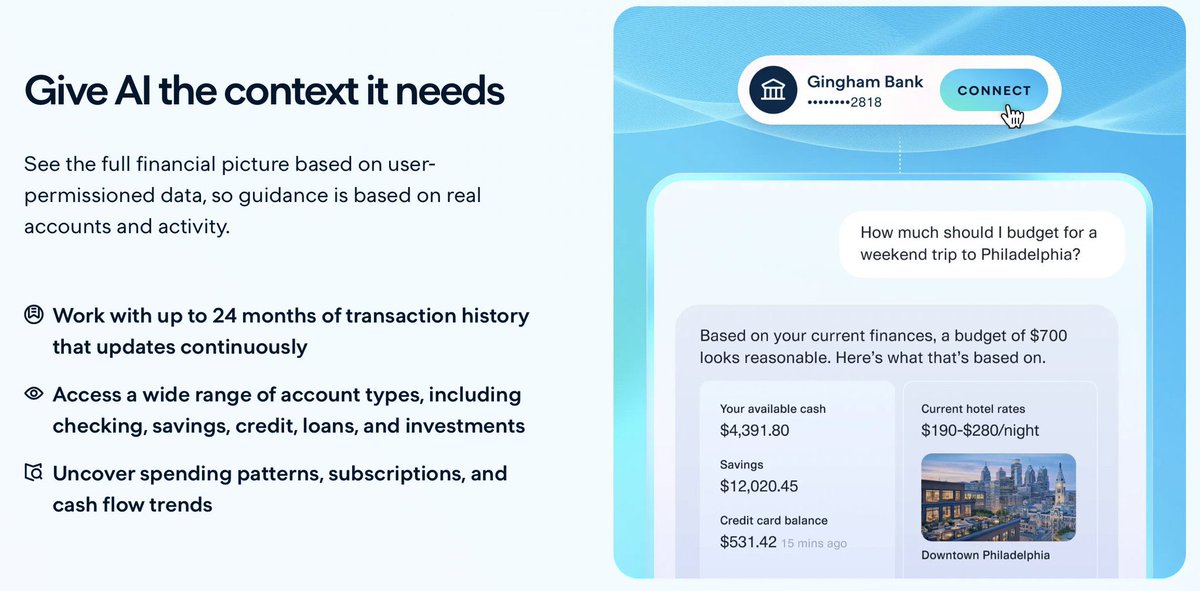
๐ What @Plaid Does (Off-Chain Truth)
Plaid provides agents with:
โขverified bank ownership
โขlive balances & cashflow
โขtransaction history
โขbehavioral & device signals
โขpermissioned access
This is not โfintech dataโ.
This is ground truth.
Plaid answers:
Is this money real?
Does this account belong to the entity acting?
Is the action allowed?
Without Plaid-level context, agents canโt touch real-world finance.
๐ What $TIBBIR Adds (On-Chain Agency)
TIBBIR is not trying to replace Plaid.
TIBBIR does something different:
โขbinds identity + authority + behavior to an agent
โขmakes that identity portable, verifiable, and non-transferable
โขturns โtrustโ into an on-chain primitive
Think of $TIBBIR as:
๐ a passport for agents
โ๏ธ a permission layer for autonomous action
๐ฅ a gas layer for agent-to-agent value flow
If $Plaid says โthis account is realโ
TIBBIR says โthis agent is allowed to actโ.
๐ How the Stack Connects
Off-chain (Plaid):
โขverifies bank accounts
โขconfirms balances
โขvalidates ownership
โขenables fiat movement
โฌ๏ธ
On-chain (TIBBIR ecosystem):
โขmints agent identity & permissions
โขenforces KYA (Know Your Agent)
โขgates access to regulated rails
โขsettles agent-native transactions
Together:
โก๏ธ agents can see money
โก๏ธ agents can prove who they are
โก๏ธ agents can act without human approval
โก๏ธ agents can pay, trade, and settle autonomously
๐ธ Why $TIBBIR Needs a Native Token
This is where most people get confused.
Stablecoins are great for denomination.
They are terrible for coordination.
$TIBBIR is used when:
โขan agent wants to operate
โขan identity check is enforced
โขa permissioned action is executed
โขan agent-to-agent transaction occurs
Itโs not just gas.
Itโs economic alignment.
Agents donโt โholdโ TIBBIR.
They consume it to exist.
๐งฉ $Plaid + $TIBBIR = $Human โ $Agent $Bridge
โข$Plaid anchors agents to real bank reality
โข$TIBBIR anchors agents to on-chain trust & autonomy
One without the other fails:
โข$Plaid alone โ no autonomous agents
โข$TIBBIR alone โ no regulated money access
Together:
๐ฅ the bridge from human finance to machine finance
๐ง Final Thought
Plaid is quietly becoming the financial sensor layer for AI.
TIBBIR is emerging as the execution and identity layer for AI.
This isnโt competition.
This is stacking.
When autonomous agents become the dominant economic actors,
they wonโt ask:
โHow do I pay?โ
Theyโll ask:
โAm I allowed to act?โ
Plaid answers where the money is.
TIBBIR answers who may move it.
Thatโs the agent economy.
And itโs already assembling. ๐คโก


English
Self Made ๐ธ ๋ฆฌํธ์ํจ

Self Made ๐ธ ๋ฆฌํธ์ํจ

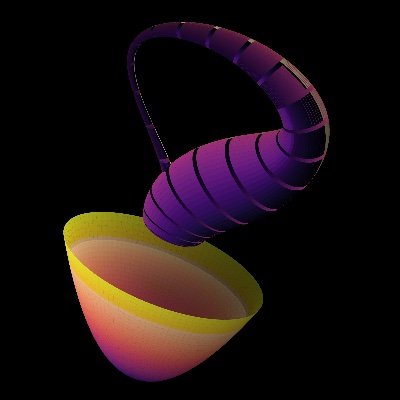
String Theory is one of the few frameworks that tries to describe Quantum Physics and Gravity in the same mathematical language.
In this animation, the glowing loop is the string, the shifting color along it represent its quantum vibration modes, and the surrounding fabric is a proxy for Spacetime responding.
When you quantize a string, one of its vibration modes behaves like a graviton. So, geometry shows up as part of the same quantum system.
#StringTheory #QuantumGravity #GeneralRelativity #QuantumPhysics #TheoreticalPhysics #PhysicsVisualization
English

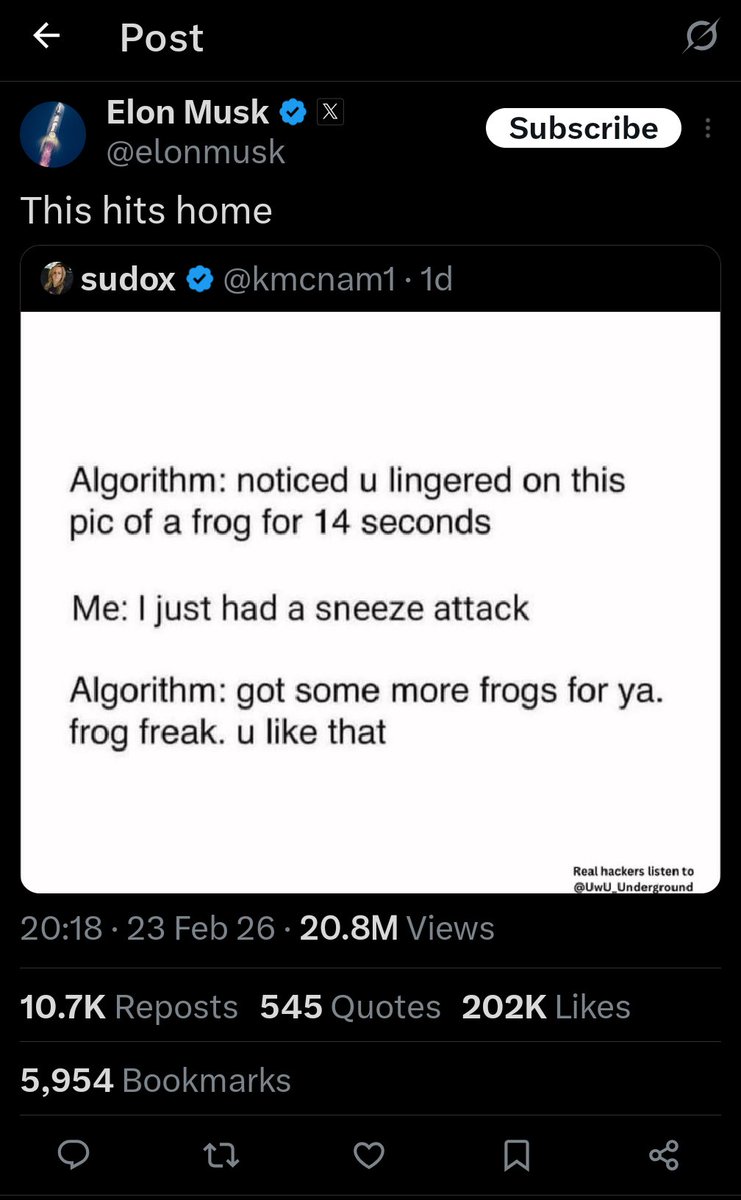
First @elonmusk rt's about frogs and then @grok is giving me frog emojis ๐คฃ. Gonna be a good year! $Tibbir ๐ธ
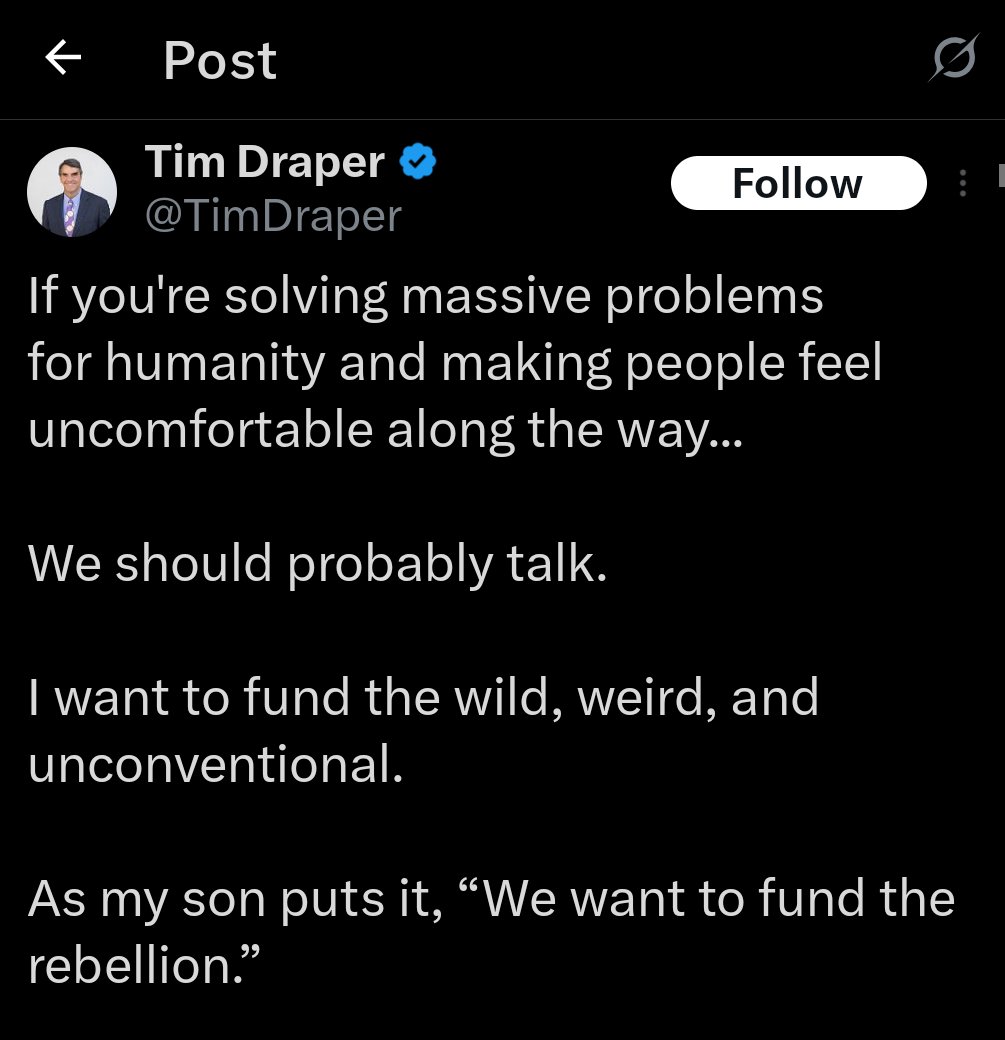
@RibbitCapital wen adding Elon to rebels ๐?


English

Self Made ๐ธ ๋ฆฌํธ์ํจ

So far today...
1) Meta revealed plans to roll out stablecoins payments across Facebook, Whatsapp and Instagram (that's 3 billion users);
2) Coinbase turned on stock trading -- 24/5, zero commissions;
3) Kraken rolled out 24/7 perps trading on tokenized stocks;
Eight months ago the SEC said "let there be superapps" and the market is responding.
English
Self Made ๐ธ ๋ฆฌํธ์ํจ

the gap between what these models can do and what the average person uses them for is the biggest market inefficiency i've seen.
we have tools that can reason through multi-step legal analysis, build entire applications from a paragraph, synthesise hundreds of research papers in minutes, generate and iterate on business strategy with more rigour than most consulting firms.
and the median use case is still go read my emails or some shit, not a criticism, just an observation.
it's giving early internet / early iphone vibes
there is a goldrush, so get your shovels ready boys
English
Self Made ๐ธ ๋ฆฌํธ์ํจ

The math on this project should mass-humble every AI lab on the planet.
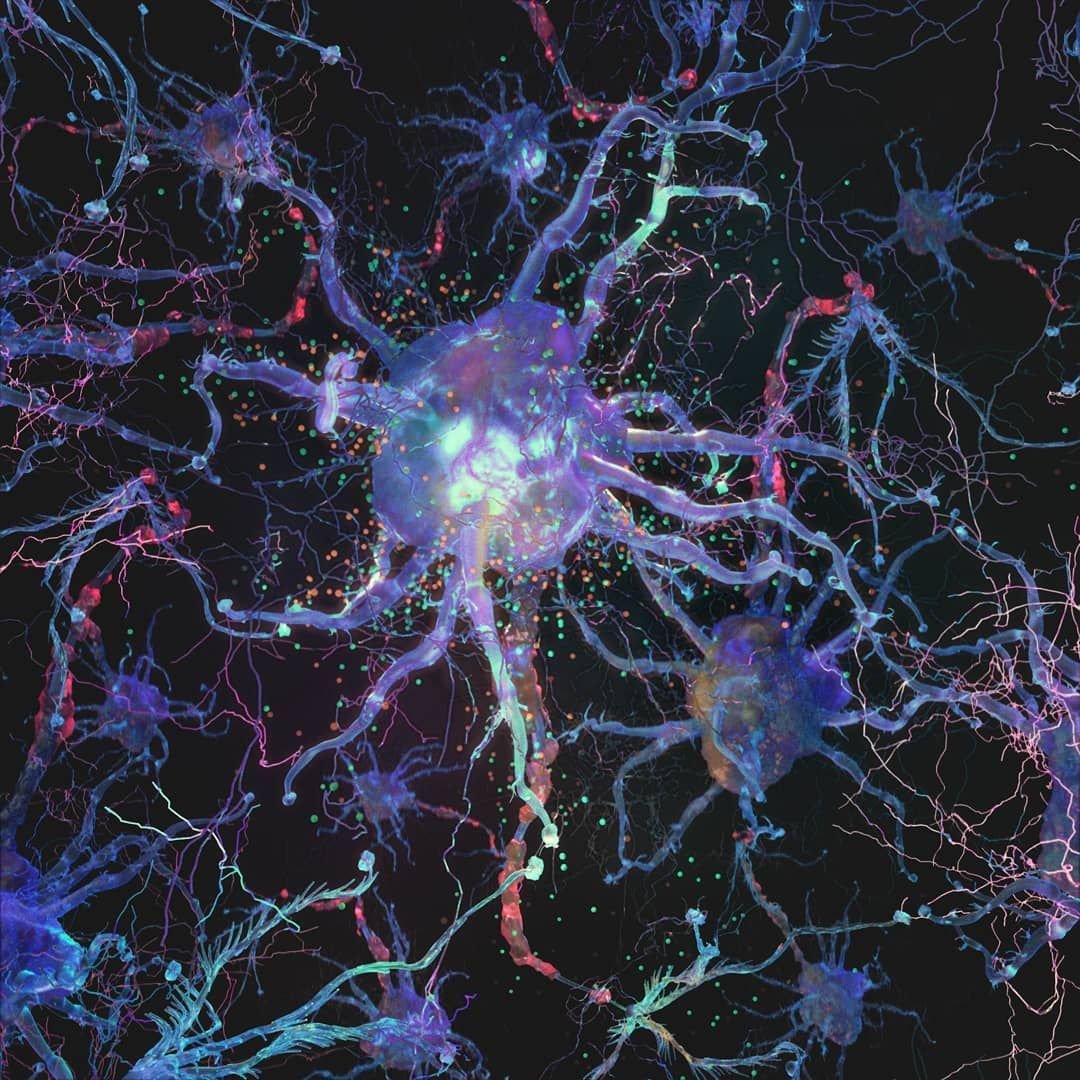
1 cubic millimeter. One-millionth of a human brain. Harvard and Google spent 10 years mapping it. The imaging alone took 326 days. They sliced the tissue into 5,000 wafers each 30 nanometers thick, ran them through a $6 million electron microscope, then needed Googleโs ML models to stitch the 3D reconstruction because no human team could process the output.
The result: 57,000 cells, 150 million synapses, 230 millimeters of blood vessels, compressed into 1.4 petabytes of raw data. For context, 1.4 petabytes is roughly 1.4 million gigabytes. From a speck smaller than a grain of rice.
Now scale that. The full human brain is one million times larger. Mapping the whole thing at this resolution would produce approximately 1.4 zettabytes of data. Thatโs roughly equal to all the data generated on Earth in a single year. The storage alone would cost an estimated $50 billion and require a 140-acre data center, which would make it the largest on the planet.
And they found things textbooks donโt contain. One neuron had over 5,000 connection points. Some axons had coiled themselves into tight whorls for completely unknown reasons. Pairs of cell clusters grew in mirror images of each other. Jeff Lichtman, the Harvard lead, said thereโs โa chasm between what we already know and what we need to know.โ
This is why the next step isnโt a human brain. Itโs a mouse hippocampus, 10 cubic millimeters, over the next five years. Because even a mouse brain is 1,000x larger than what they just mapped, and the full mouse connectome is the proof of concept before anyone attempts the human one.
Weโre building AI systems that loosely mimic neural networks while still unable to fully read the wiring diagram of a single cubic millimeter of the thing weโre trying to imitate. The original is 1.4 petabytes per millionth of its volume. Every AI model on Earth fits in a fraction of that.
The brain runs on 20 watts and fits in your skull. The data center required to merely describe one-millionth of it would span 140 acres.
All day Astronomy@forallcurious
๐จ: Scientists mapped 1 mmยณ of a human brain โ less than a grain of rice โ and a microscopic cosmos appeared.
English