Roundtable 리트윗함

We are actively hiring engineering, ops, and sales talent at @RoundtableHQ_ ! Come join our growing team :)

English
Roundtable
79 posts


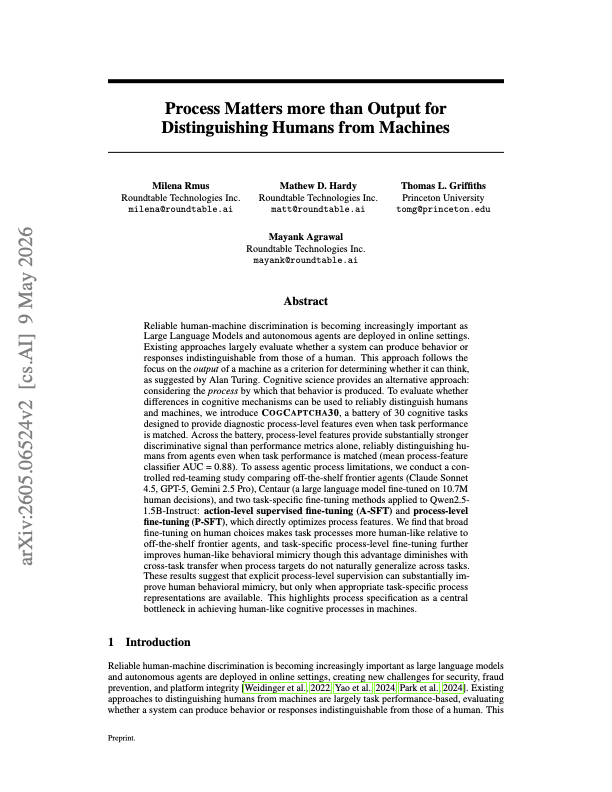

Excited to share our new paper using cognitive science to distinguish AI agents and humans! We administered CogCAPTCHA30, a set of 30 cognitive tasks, to frontier VLMs (GPT-5, Sonnet 4.5, Gemini 2.5 Pro) and humans. We found that processes differ between AI agents and humans - even when the final output is identical. Link: arxiv.org/abs/2605.06524 This work was led by @milenamr7 and co-authored with @cocosci_lab, and @mayankagrawal
Packed room with @StanfordPsych! A new generation of researchers are using Proof of Human to verify the authenticity of all their published data. We got to give them a sneak peek of a recent research paper too…more to come here :) And thank you to the audience for amazing questions on human identity, both in practice and as an intellectual field of study

Meet Milena Rmus (@milenamr7) — engineering wizard, data visualization artist, and resident cat/meme/ClaudeCode extraordinaire at @RoundtableHQ_ . Every team needs a Milena. Her love of the craft shows up everywhere: building elegant visualizations for exploratory statistical work, monitoring API errors from the middle of metal concerts, and keeping company culture alive with perfectly timed memes. She’s a driving force behind Roundtable’s Proof of Human research agenda. We met through overlapping computational cognitive science circles — she holds a BA from Brown, a PhD from Anne Collins’ lab at UC Berkeley, and most recently completed a postdoc in Munich. Her publication record is extensive: Nature, NeurIPS, PLOS Computational Biology. Again and again, she brings cutting-edge AI and ML approaches to understanding the human mind and brain. At Roundtable, she leads continuous benchmarking and red-teaming of the Proof of Human API. Fraud evolves quickly — having our toughest critics in-house is a feature, not a bug. And don’t underestimate her intellectual edge. She led our “AI Capabilities ≠ Humanness” piece, grounding a contrarian AI stance in cognitive science. More work is on the way, and we’re excited to share it soon :) In the meantime — to honor Milena — here are a few cat memes.

Meet Milena Rmus (@milenamr7) — engineering wizard, data visualization artist, and resident cat/meme/ClaudeCode extraordinaire at @RoundtableHQ_ . Every team needs a Milena. Her love of the craft shows up everywhere: building elegant visualizations for exploratory statistical work, monitoring API errors from the middle of metal concerts, and keeping company culture alive with perfectly timed memes. She’s a driving force behind Roundtable’s Proof of Human research agenda. We met through overlapping computational cognitive science circles — she holds a BA from Brown, a PhD from Anne Collins’ lab at UC Berkeley, and most recently completed a postdoc in Munich. Her publication record is extensive: Nature, NeurIPS, PLOS Computational Biology. Again and again, she brings cutting-edge AI and ML approaches to understanding the human mind and brain. At Roundtable, she leads continuous benchmarking and red-teaming of the Proof of Human API. Fraud evolves quickly — having our toughest critics in-house is a feature, not a bug. And don’t underestimate her intellectual edge. She led our “AI Capabilities ≠ Humanness” piece, grounding a contrarian AI stance in cognitive science. More work is on the way, and we’re excited to share it soon :) In the meantime — to honor Milena — here are a few cat memes.



1/ We're hiring for TWO sales roles at Roundtable.
on becoming "legible to capital": the most underrated factor in the success of firms is the degree to which they are legible to Capital. defining this precisely is hard ("you know it when you see it"): but an idea, a firm, or a person is legible to Capital (cap-C) when by dint of their existence capital forms behind them in excess. think of an idea being legible to Capital as being magnetically charged to the capital markets. dollars are just attracted to you: allocators discuss it at cocktail parties, funds market it at their AGMs, and twitter discusses novel financing schemes to get more dollars behind the idea. becoming legible to Capital is the single greatest superpower for a fledgling firm. look at ramp, look at cognition, look at leopold, look at toni and dan at dany. these are all superhumans at being legible to Capital. its worth noticing how ideas and people become legible to Capital: first, there is no divide between the ceo/mgmt and the idea. the story is NOT that of an individually successful and impressive individual bringing their talents to a new platform. you can see these kind of puff piece stories in many companies that are illegible to Capital. the company is never about YOU. for a founder to be legible to Capital there can be no air between them and the expression of the idea. their lives only matter insofar as they are building with intensity towards the pure form of the idea. second, the company can be understood fundamentally as an equation/trade. in a best case, the most legible companies grow as a superlinear function of dollars in. the founders are highly verbal, and can clearly articulate and understand the inputs to this growth equation: talent, capital, mgmt, etc. the companies that are most legible to Capital, and the mgmt that runs them, at their best: feel like clockwork toys in the hand. simply by looking at them the levers of progress and output become immediately clear. they are immediate, smack you in the face, expressions of an idea that is both small enough that you can feel the thing click around in your hand, but cosmically large enough the idea feels True in some sense beyond literal. when the trade is immensely clear, every capital provider across the stack can immediately understand their role today-- but more importantly their ability to scale to putting 10-100-100x the number of dollars into the thing as it reaches maturitiy. finally, a company becomes legible to Capital when it is clear the entire firm (from Capital, to mgmt, to talent) is singing from the same song sheet, they are all living their lives in expression of the same exact idea. an idea i've shamelessly stolen from @phineasb is the chocolate cake problem: many firms have great inputs (eggs, chocolate, flour, some beautiful icing) but mgmt thinks they're cooking a soufflé, investors think they're getting cup cakes, and talent thinks they're getting a pound cake. the companies that are most legible to Capital are obsessive about chasing the tolerances between competing ideas of the firm to zero by becoming legible to Capital a firm not only can achieve singularity in the private capital markets (ie unlimited free capital forever) but more importantly, it can unify the secret that ignites it internally with the world outside. when that secret is shared, there is truly no limit.