Jasper

30.6K posts

Jasper banner
Jasper

Jasper

@Talk2warith

Financial services| MSc Business Analytics || Good Governance Advocate| Critic of Excessive Centralisation || @chelseafc | Kwankwasiyya 🛑

England 가입일 Mayıs 2018
2.4K 팔로잉3.2K 팔로워
고정된 트윗
Jasper
Jasper@Talk2warith·
Smiles! All that glitters is not gold. My friend got married when he was working with N-Power, earning 30k monthly. A few months after their marriage, he got an offer from DSS with his BSc, and he started earning a decent salary.  On the other hand, during that period, one of my Ogas in the bank, who earned N800k monthly, got sacked, and everything changed within a few months. The importance of Istikhara cannot be overemphasised. Istikhara sees what you don’t see. It sees tomorrow, not today. It would capture all your life with that person and summarise it for you in seconds or minutes. May God guide us to the right path.
English
36
160
479
112.8K
Jasper 리트윗함
Abdul-Aziz Na'ibi Abubakar
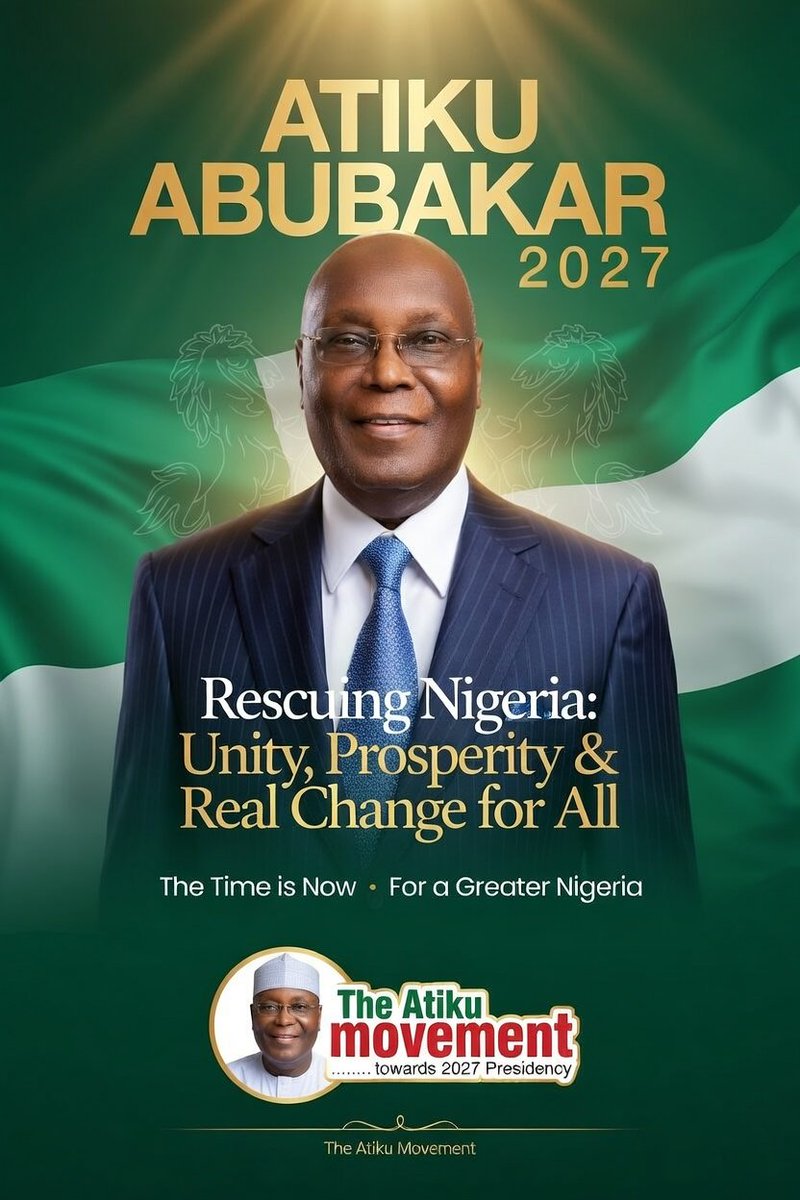
1- By direct primaries: Atiku Abubakar emerges victorious. 2- By consensus: ADC adopts Atiku Abubakar as its candidate. 3- Why? His unmatched political network and formidable national fan base position him as the dominant force in Nigerian politics.
Abdul-Aziz Na'ibi Abubakar tweet media
English
67
46
120
4.6K
Jasper 리트윗함
Nasir Ahmad El-Rufai
NIGERIA UPDATE - Nigeria’s Growth Crisis Is a Talent-Allocation Crisis - by: Nasir Ahmad El-Rufai - 1st April, 2026 - Part 2 4. Sectoral Reality: Why Building Is Harder Than Extracting Consider a few concrete Nigerian constraints. Power Nigeria’s average available grid capacity is just over 5,300 megawatts for a population exceeding 200 million. No serious manufacturing or services economy can scale under such conditions. When power is unreliable, firms remain small by necessity. Ports and Logistics Average vessel turnaround time at Nigerian ports has been around five days—far above global best practice. Each delay creates gatekeeping opportunities, raising costs and uncertainty. Jobs and Firm Structure With wage employment hovering around 16%, most Nigerians work in survival-level activity. This is not because Nigerians lack ambition, but because the system penalizes formal growth. When these constraints persist, entrepreneurship becomes a high-risk, low-reward path. Rational talent looks elsewhere. 5. Evidence from Other Countries—and What It Means for Nigeria Cross-country evidence supports this argument. Countries that channel more of their top talent into engineering, applied science, and production tend to grow faster. Countries where talent concentrates in rent-oriented legal and administrative activity tend to grow more slowly . The lesson is not that law is unimportant. On the contrary: law is essential when it enables commerce. But when legal and regulatory systems become tools for extraction rather than facilitation, they draw talent away from growth-enhancing activity. Nigeria today sits at that crossroads. 6. Signs of What Is Possible There are encouraging signals. Nigeria’s non-oil exports have grown strongly, driven by products such as cocoa, fertiliser, cashew, and processed agricultural goods. This shows that when incentives align—even partially—Nigerian firms can compete and scale. The task before us is to generalise this success, not treat it as an exception. 7. The Real Reform Objective Nigeria’s reform agenda should be summarised in one sentence: Make value creation more rewarding than value capture. Everything else flows from this. This means: •Shrinking discretionary power and rent opportunities in government; •Making rules predictable, transparent, and digital by default; •Ensuring property rights and contracts are enforced quickly and fairly; •Making it easier to scale a business than to stay small and hidden; •Aligning finance with long-term production and exports, not short-term arbitrage. When these conditions exist, the most talented Nigerians will move—naturally and voluntarily—into productive enterprise. 8. What Success Looks Like in 24 Months If Nigeria is serious, progress should be visible and measurable within two years: •Power availability rising from ~5,300 MW toward 8,000–10,000 MW reliably delivered. •Port turnaround times falling below four days, with fewer physical interventions. •Wage employment rising toward 18–20%, signalling firm formalisation and scale. •Tax-to-GDP moving toward 10%, driven by digitisation and base broadening—not harassment. •Manufacturing and tradables expanding their share of GDP and exports. •Non-oil exports growing not just in value, but in the number of exporting firms. These are not technocratic targets. They are signals to talent—telling Nigeria’s brightest minds that building, producing, and exporting now pay better than extracting. 9. The Strategic Choice Before Us Nigeria’s future does not hinge on slogans, nor on personalities. It hinges on who wins in our economy. If the system rewards brokers over builders, we will continue to underperform. If it rewards producers over extractors, growth will follow—rapidly and durably. This is the central lesson of economic history, and it is the challenge of our moment. Nigeria does not lack talent. Nigeria must reallocate it. God Bless our Country.
Nasir Ahmad El-Rufai tweet media
English
43
383
664
16K
Jasper 리트윗함
YabaLeftOnline
YabaLeftOnline@yabaleftonline·
Lagos and Benue top the list as Nigeria records 20,838 new HIV cases in the first quarter of 2026
YabaLeftOnline tweet media
English
262
210
923
56.8K
Jasper 리트윗함
Nasir Ahmad El-Rufai
NIGERIA UPDATE - Nigeria’s Growth Crisis Is a Talent-Allocation Crisis - by: Nasir Ahmad El-Rufai - 1st April, 2026 - Part 1 Nigeria is often described as a paradox. We are a nation of extraordinary human capital—energetic, inventive, resilient—yet our economic outcomes fall persistently short of our potential. Growth remains shallow, productivity weak, firms struggle to scale, and prosperity does not spread widely enough. Today, I want to advance a clear and uncomfortable proposition: Nigeria’s growth problem is not primarily a shortage of talent, capital, or ideas. It is a problem of where our best talent goes—and why. This is not a moral argument about individuals. It is a political-economy argument about incentives. 1. The Core Insight: Talent Follows Returns Across societies and across history, highly capable people choose occupations that offer the highest returns to ability, especially where small differences in skill translate into large rewards. Economists describe this as increasing returns to talent. When those returns are highest in entrepreneurship, innovation, and production, economies grow. When those returns are highest in rent-seeking—activities that redistribute existing wealth rather than create new value—growth slows or stalls . People do not wake up intending to harm their country. They respond rationally to incentives. So the right question for Nigeria is not “Why are people corrupt?” It is: “What activities does our system reward most handsomely?” 2. Nigeria’s Current Incentive Structure Let us be honest about Nigeria’s reality. •GDP growth was about 4.1% in 2024, respectable on paper but insufficient for a country with our demographics. •GDP per capita remains around US$1,084, placing Nigeria among lower-income economies despite our scale. •Informal employment accounts for roughly 93% of the labour force, meaning most firms are small, fragile, and defensive rather than scalable. •Nigeria’s tax-to-GDP ratio is only about 8.2%, one of the lowest in Africa—signalling weak fiscal capacity and heavy reliance on discretionary collection rather than broad, rule-based taxation. These numbers are not abstract. They describe an economy where scale is risky, visibility attracts predation, and long-term investment struggles to compete with short-term access. In such an environment, the most capable Nigerians often find that the fastest and safest returns come not from building large, productive enterprises—but from proximity to state power, regulatory discretion, political brokerage, or legal and administrative contestation. This is exactly the mechanism identified in the economic literature: when the “market” for rent-seeking is large, talent flows there . 3. Why Rent-Seeking Damages Growth Rent-seeking harms an economy in three cumulative ways. First, it absorbs labour and capital without creating output. Resources are spent competing over existing wealth rather than expanding the economic frontier. Second, it acts like a tax on productive activity. Businesses face delays, uncertainty, informal payments, and arbitrary enforcement—raising costs and discouraging investment. Third—and most damaging—it diverts the very people who would otherwise be the most productive entrepreneurs and innovators. When the brightest minds are pulled away from production, the quality of entrepreneurship falls, technological progress slows, and the economy’s long-run growth rate declines . This is why rent-seeking does not merely lower income levels; it can permanently reduce growth.
English
119
865
1.7K
52.7K
Daniel Regha
Daniel Regha@DanielRegha·
Peter Obi wants one term as a president to fix Nigeria, when he failed to transform Anambra for 8 solid years; That's one state in 36. Atiku gave up the chance to lead his people, to become VP. As a governor he could've easily had the power to build his state mind you. Tinubu is seeking a second term when we are barely surviving his first; No promises has been fulfilled and evident to Nigerians. The three major candidates Nigerians bank on.
English
521
265
1.4K
69.1K
Jasper 리트윗함
lobistars🇳🇬
lobistars🇳🇬@john322226·
People will not understand my hatred for gambling until they see their loved ones getting ruined by it Gambling addiction isn’t just about money, it’s about losing yourself to the addiction and losing control of your betting habits. It goes as far as ruining your mental health.
English
235
103
401
5.7K
Hamma
Hamma@HAHayatu·
Tinubu removed Ganduje and brought a Yelwada, Tinubu also removed Badaru and brought Christopher Musa That created a dip in Kano and also Jigawa , now Tinubu is helter skelter doing meeting with those he sent away, so they are now important. Tinubu should rely on his new friends from the north to get the votes for him not those he used and dumped.
English
45
156
643
40.2K
Jasper
Jasper@Talk2warith·
Ko Babanka ne Bisi Akande, Kasan haduwar Atiku, Kwankwaso, El Rufai, Amaechi, da Peter Obi, musifa ce ga APC.
Indonesia
0
0
0
14
Jasper 리트윗함
Oyindamola🙄
Oyindamola🙄@dammiedammie35·
“Peter Obi l!ed to me. I started insult!ng Tinubu and supporting Peter Obi. Now Peter Obi has joined the same Atiku, who they once said was b@d.” - Apostle Kassy Chukwu tells his church members
English
227
284
747
42.8K
Vince™
Vince™@Blue_Footy·
This is why it's nearly impossible to get anything close to optimal counter-press with Enzo and Palmer in attacking midfield. Their reaction time to counter press and their intensity aren't at the required level for optimal counter-press. You can only carry one and play someone beside him who is good at counter pressing to mask the flaw. It's about balance. What Maresca did to hide this was to circulate the ball a lot more and attack mostly from the wings. We only went central when the space is there, not force it. He basically minimised the risk of turnovers. We can't play excessive vertical football through central channels without good counter-pressers.
Vince™@Blue_Footy

Lee Dixon on Palmer’s error: 🗣️ "Cole Palmer is going to lose the ball because he takes chances… not enough tonight. But when he loses it in midfield, he’s got another job and that’s the chase back. He gets level with Mitoma, more or less, and then just puts the brakes on and lets Mitoma run away from him into the space." ~ @itvfootball

English
60
33
866
159.2K
Jasper
Jasper@Talk2warith·
@Blue_Footy I’ve been praising Elliot Anderson for quite some time. In fact, I want Enzo to leave as soon as possible so we can sign Elliot Anderson.
Jasper tweet media
English
2
0
4
535
Vince™
Vince™@Blue_Footy·
I feel sorry for those who don't rate Elliot Anderson.
English
71
58
1.4K
34.3K
Jasper
Jasper@Talk2warith·
Holjund!!! 🤦
Norsk
0
0
0
78
Bashir Ahmad, OON
Bashir Ahmad, OON@BashirAhmaad·
My friend, Shamsudden, told me that someone named Skales has been busy insulting me on this platform. I genuinely asked, “Who is he?” and he told me he is a musician. By God, that was the first time I ever heard his name. Nigeria is truly so big!
English
1.1K
317
2.7K
517.2K
Jasper
Jasper@Talk2warith·
Reports indicate that a violent coup attempt is unfolding in Burundi this evening, with military forces allegedly moving into Bujumbura, the country’s principal city. x.com/adamugarba/sta…
English
0
0
0
160
Jasper
Jasper@Talk2warith·
Anyone saying “Obi or nothing” is secretly working for the APC.
English
0
1
0
27
Jasper 리트윗함
Instablog9ja
Instablog9ja@instablog9ja·
“I’m really happy to be back. Looking forward to what we can achieve at the end of the season.”- Nigerian Footballer Victor Boniface says as he returns to training for Werder Bremen
English
45
53
996
14.7K
Jasper
Jasper@Talk2warith·
Someone who failed to manage the power sector now wants to manage an entire state. I’m sure the people of Oyo Alaaka know what to do.
English
0
0
0
11