Abraham Mathews

1.3K posts

Abraham Mathews

Abraham Mathews

@_AbrahamMathews

가입일 Mart 2020
363 팔로잉50 팔로워
Abraham Mathews 리트윗함
Yuki Mitsufuji
Yuki Mitsufuji@mittu1204·
🌉We reveal a previously hidden yet tight connection between Drifting models and score-based (diffusion) models! 👉 The mean-shift direction in Drifting is actually the score function itself (exact match with Gaussian kernel) 👉 Even with Laplace kernel (the one used in practice), the directions are almost identical in high dimensions 👉 Drifting can be positioned as a "non-parametric score-based model" Title: "A Unified View of Drifting and Score-Based Models" PDF: arxiv.org/abs/2603.07514
Chieh-Hsin (Jesse) Lai@JCJesseLai

[1/D] 🤔 What are drifting models really connected to? 📢 Our new paper, A Unified View of Drifting and Score-Based Models, shows that the bridge to score-based models is clear and precise (w/ team and @mittu1204, @StefanoErmon, @MoleiTaoMath)! ✍️ Main takeaway: drifting is more closely connected to score-based (diffusion) modeling than it may first appear! 🔗 arxiv.org/abs/2603.07514 🎯 Here’s why: Drifting’s mean-shift moves a sample toward the kernel-weighted average of nearby samples. Score function points toward regions of higher density. So both describe local directions that push samples toward where data is denser. We show that this link is exact for Gaussian kernels (Section 4.1): 📌drifting’s mean-shift = a rescaled score-matching field between the Gaussian-smoothed data and model distributions — the vector field underlying score matching (Tweedie!). 📌This also clarifies the bridge to Distribution Matching Distillation (DMD): both use score-based transport directions, but only differ in how the score is realized—drifting does so nonparametrically through kernel neighborhoods, whereas DMD relies on a pretrained diffusion teacher. 🤔 So what happens for the default Laplace kernel used in drifting models? Let’s look below 👇


English
0
11
80
8.8K
Abraham Mathews 리트윗함
Brian Armstrong
Brian Armstrong@brian_armstrong·
If you want to be an innovator, you have to be comfortable looking stupid for a long time. You’re going to piss some people off and you’re going to get a lot of nos. That’s the only way to start having valuable breakthroughs.
English
601
1.1K
8.8K
468.2K
Abraham Mathews 리트윗함
푸린이
푸린이@purinfall·
260307 pick me🫶🏻 #가을 #김가을 #ガウル #GAEUL #IVE #아이브
푸린이 tweet media푸린이 tweet media
English
0
115
626
8.1K
Abraham Mathews 리트윗함
IVE BASE
IVE BASE@DiveBasee·
Kiiikiii presented IVE with a cake and celebrated their Music Show win with them after the encore 🩵
English
13
853
6.3K
65.1K
Abraham Mathews 리트윗함
no context IVE
no context IVE@IVE_nocontext·
no context IVE tweet media
ZXX
1
183
2.2K
24.8K
Abraham Mathews 리트윗함
The Audio Programmer
The Audio Programmer@audioprogrammer·
I've been helping people to learn how to build audio plugins for the past 9 years. Recently, I watched AI do what would take me an entire day in 5 minutes. I'm a little late to vibe coding, and I'll tell you why - I LOVE coding. The thought process. The problem solving. The craft of it. But I've seen winds change before. And as an industry, we have to face that this is happening. Here's the thing though. I don't think developers are finished. Not even close! In fact, I actually think developers will become MORE important. The way I see it, this is like DAWs coming to bedroom producers. Did it kill professional engineers? No. It caused a creative explosion. But the role shifted. Producers needed mixing and mastering engineers more than ever to take their ideas to a professional level. That's what's happening with code. AI will let more people create. Developers become the ones who make it market ready. But for this to happen, developers will need to embrace the tools or risk getting left behind. Scary? A little. Exciting? Absolutely. Here was my first experiment. How are you feeling about these tools? Are you embracing them, or rejecting them? Let me know! youtu.be/qeCYi0pwi3I
YouTube video
YouTube
The Audio Programmer tweet media
English
1
2
15
691
Abraham Mathews 리트윗함
Christian Steinmetz
Christian Steinmetz@csteinmetz1·
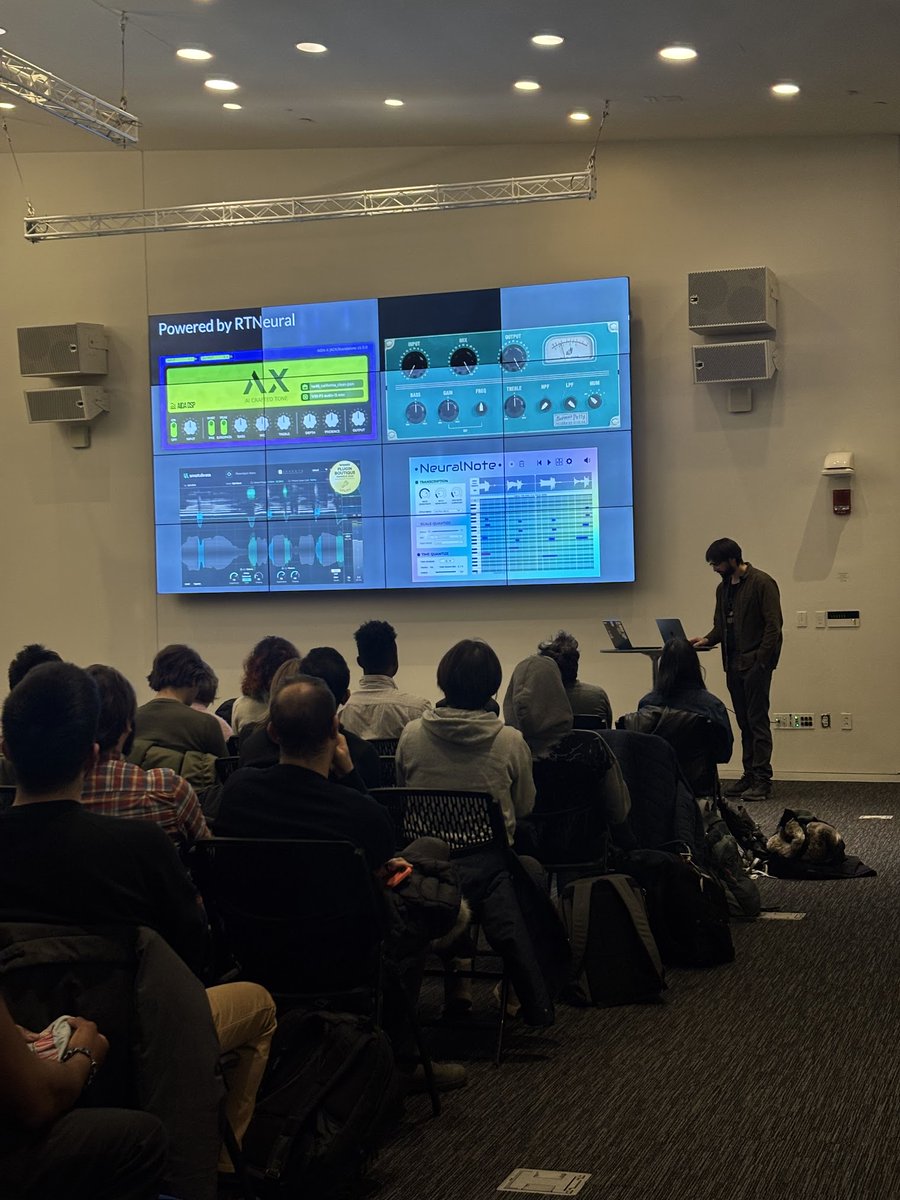
The talks tonight at the Boston AI Music Meetup made me think about where this field is going. Here’s what I learned: Jatin Chowdhury is an expert in getting machine learning models to run in real-time audio systems. He laid out the very real challenges of taking models out of research environments and putting them into actual audio applications. There are many inference solutions out there such as ONNX, TFLite, and libtorch, but none of them really treat audio as a first-class citizen. Real-time audio has strict latency constraints, tiny buffers, and highly variable consumer hardware. You can't just import your model and hope for the best. That is what motivated Jatin to build RTNeural, an open source C++ library designed specifically for audio neural networks. It enables building production-level audio plugins with neural networks that actually run in real time. He shared several real plugins built using this technology. If I were working on neural nets inside audio plugins, this is where I would start. That said, he was clear about the remaining challenges. Scaling to larger models is still difficult. Consumer hardware varies widely. Communication between CPU and GPU adds overhead. Meanwhile, models are getting heavier and more capable. There is a real tension here. Musicians do not want latency to stand in the way of their creativity, but AI models keep pushing toward greater compute requirements. The research field has challenges to address here. Ethan Manilow, a researcher at Google DeepMind, zoomed out completely. His talk traced how music technology has shaped and reshaped our relationship with sound. He focused on how Edison’s phonograph transformed music from an ephemeral experience into something that could be replayed and transported. But it also made people uncomfortable. Early listeners were unsettled by hearing a human voice without a human present. Generative music may be producing a similar reaction today. When we hear the inflection of a generated vocalist, there can be that same uncanny feeling. History gives us perspective, but not a prescription for the future. Ethan’s broader point was that no technology is guaranteed to succeed. History is often told as a linear progression, but many technologies faded while others persisted. We are still in the process of determining what role AI will ultimately play in music. The most exciting part of AI and music today is that there is still so much to figure out. Even the best audio models are still lacking in some capabilities and their latency is far beyond what many musicians desire. If you want to take part in more discussions like this, join us at our next event in March. Details are on our meetup page.
Christian Steinmetz tweet mediaChristian Steinmetz tweet media
Christian Steinmetz@csteinmetz1

The winter storm won't stop us. The next Boston AI Music Meetup is now happening this Wed, Feb 25th at MIT Media Lab. Looking forward to talks from two awesome speakers: Jatin Chowdhury and Ethan Manilow (@ethanmanilow). RSVP at the link in the comments, we have limited spots.

English
3
9
57
4.9K
Abraham Mathews 리트윗함
Scott H. Hawley
Scott H. Hawley@drscotthawley·
Today I'll be at @CTmagazine 's Mini-Summit on Creativity & Vocation in Nashville -- not on the AI panel, just going to meet people. If you're around, HMU.
Scott H. Hawley tweet media
English
2
1
3
224
Abraham Mathews 리트윗함
DAN KOE
DAN KOE@thedankoe·
The primary reason people don't achieve big goals is because they don't realize that the only source of truth is making mistakes. They soak up advice and theory, expecting it to be an exact match to their mind, experience, and situation just to fail once and give up completely.
English
516
983
8.6K
757.3K
Abraham Mathews 리트윗함
Abhijith Neil Abraham
Abhijith Neil Abraham@abhijithneil·
Announcing Datatune: Open source Cursor for Data github.com/vitalops/datat… Datatune lets LLMs and Agents access your entire data without context length limits for more accurate data transformations.
English
0
2
10
540
Abraham Mathews 리트윗함
blue
blue@bluewmist·
i hate how social media makes us forget that life has stages. it’s normal to be broke, to have broke friends or partners and yes it’s even normal to be unemployed at times. these are phases we all go through. some people are lucky enough to find good jobs at a young age and afford a certain lifestyle. others take longer and that’s perfectly okay. we need to stop comparing ourselves and start accepting our journey. i just want all of us to be at peace with where we are in life while still working and striving for better.
English
99
2.6K
13.1K
300.2K
Abraham Mathews 리트윗함
Naruto
Naruto@NarutoNolimits·
He was $900M in debt but he believed in himself;
English
39
766
6.5K
250.8K
Abraham Mathews 리트윗함
Carina Hong
Carina Hong@CarinaLHong·
I promise it's a good blog. Come have a read! Exciting math and fun commentaries written by world-famous mathematicians like Ken Ono and Evan Chen and Lean gurus like Kenny Lau and Jujian Zhang. Proofs by AxiomProver, an engineering effort built fast and executed relentlessly.
Axiom@axiommathai

1/ AxiomProver got 12/12 of Putnam 2025. Today we release the Lean proofs AxiomProver generated autonomously. We also provide our take of the problems, proof visualizations, and compare how humans vs AI approach differently. Tons of fun math and Lean! Our findings in thread.


English
7
14
191
27.6K
Abraham Mathews 리트윗함
The Pets 𝕏
The Pets 𝕏@ThePetsX·
this is the most adorable video you’ll see on the internet today 😍
English
78
1.1K
9.1K
297.1K
Abraham Mathews 리트윗함
DAN KOE
DAN KOE@thedankoe·
Sales is only a bad thing when you refuse to learn it because you think it's bad. You are always selling your ideas, your skillset, your personality, your product, your boss's product. If you don't like sales, you are probably unconsciously manipulating people every single day.
English
175
124
1.4K
65.9K
Abraham Mathews 리트윗함
Paras Chopra
Paras Chopra@paraschopra·
Learn both sales *and* coding. Sales teaches you human psychology and communication, while coding teaches you hard logic and thinking precisely. Master both, and you become a killer.
English
47
65
857
35.1K