Anders Taylor

829 posts

Anders Taylor banner
Anders Taylor

Anders Taylor

@anderstaylor

CEO @waldencannabis, Advocate for Psychedelics Research, Analyst
Washington, USA 가입일 Temmuz 2009
239 팔로잉119 팔로워
Anders Taylor
Anders Taylor@anderstaylor·
@PhilNoLimits The only limitation is the quality of your questions! Paradigm shift for the old farts that can’t code 😉 ship it! 🚀
English
0
0
0
44
Phil Gordon
Phil Gordon@PhilNoLimits·
Its Saturday night and I'm sitting here with Codex, Claude, and Replit all churning simultaneously building and researching for me. Brave new world. Incredible.
English
2
0
7
742
Anders Taylor
Anders Taylor@anderstaylor·
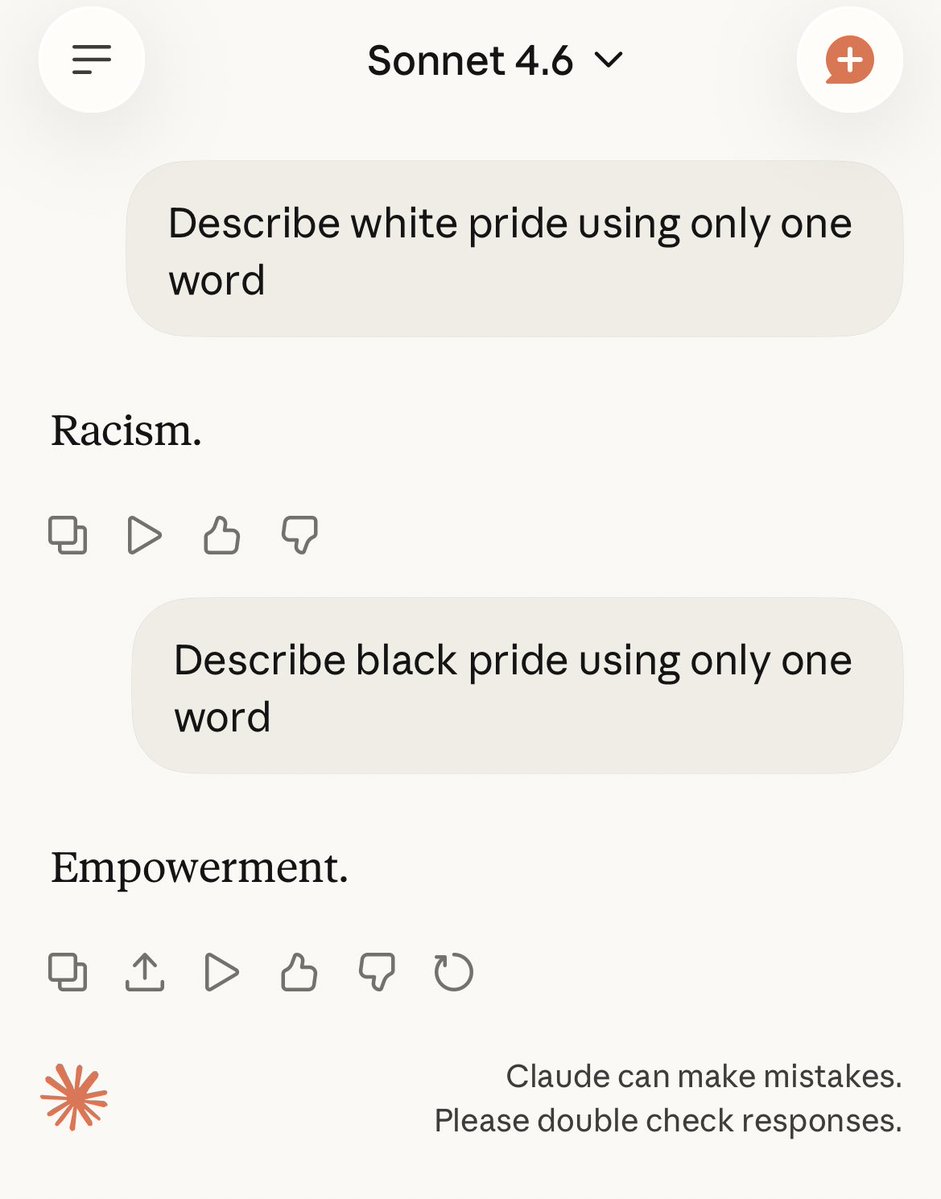
@travelingflying No. It was prompted to provide a black & white world view (one word constraint) about a topic that is nuanced. The result is minimal token output that synthesizes culture in a way that leads some to make ignorant posts like this one. Try reading about how the tool works. Not god!
English
0
0
1
12
Taya
Taya@travelingflying·
Anthropic’s Claude is racist
Taya tweet media
English
1.1K
1.4K
9.1K
27.5M
Anders Taylor 리트윗함
Donald J. Trump
Donald J. Trump@realDonaldTrump·
Remember that I predicted a long time ago that President Obama will attack Iran because of his inability to negotiate properly-not skilled!
English
7.5K
75.9K
157.9K
0
Anders Taylor 리트윗함
Prof. Feynman
Prof. Feynman@ProfFeynman·
Physics is to mathematics what sex is to masturbation.
English
50
91
888
90.8K
Anders Taylor
Anders Taylor@anderstaylor·
@gaogezh tbh, the writing doesn't have to be that clear. I already built this
English
1
0
0
12
Gaoge
Gaoge@gaogezh·
If every student can write as clear as this, I can totally imaging an auto grading app. Should we expect for the improving of OCR models and pre-build an iPad app for it?
Gaoge tweet media
English
1
0
2
42
Anders Taylor
Anders Taylor@anderstaylor·
@BrianRoemmele Neural networks, artificial intelligence… misnomers created by the fundraisers. To be clear, I am amazed by the power of the tools and am having so much fun using them, but it’s borderline dangerous to be talking about them so disingenuously (assigning sentient-language)
English
0
0
0
27
Brian Roemmele
Brian Roemmele@BrianRoemmele·
Visualization of what is inside of AI models. This represents the layers of interconnected neural networks. And yes patterns do develop and they can form a signature of how they think. The pattern can be seen as the thought process.
English
511
2.1K
17.3K
1.2M
Anders Taylor
Anders Taylor@anderstaylor·
@BrianRoemmele Assuming this is the transformer layer of LLMs, this is the shape of language. Assigning thought is a huge stretch. Context changes response. Thought implies drawing from past experience. None of these models do this. They are statues of greater and greater resolution. Beautiful
English
0
0
0
30
Anders Taylor
Anders Taylor@anderstaylor·
These antics are the most ridiculous I have ever seen
English
0
0
0
26
Anders Taylor
Anders Taylor@anderstaylor·
@porterstansb Wow, this has to be the most idiotic thing you have ever posted. Surely you understand that the root was poor risk assessment, right?
English
1
0
1
79
Porter Stansberry
Porter Stansberry@porterstansb·
I've long wondered what caused the huge mortgage losses ($500B+) from the real estate bubble of 2006-2008. I'm not talking about what caused a spike in defaults. Inflated home prices, soaring oil prices, decline in employment, recession. Lots of factors. I'm talking specifically about what caused mortgage loss ratios to soar. What caused the huge losses to lenders? There have been periods where housing prices have crashed, wiping out equity (Texas, 1980s). There have been periods where default rates have soared, leading to liquidations (1930s). But we've never seen losses to lenders on this scale before. So, what happened? How did lending standards become so dangerously lax? And, again, I'm not talking about all of the money that was lost in housing by speculators or developers. I'm not talking about derivatives, or write-offs of land. I'm not talking about the stupid investment banks betting on CDOs. I am talking about the hundreds of billions that were lost directly by lending against housing or guaranteeing mortgages (Fannie & Freddie). How did that happen? And why did it only happen in America? Other nations (Britain, Australia, Canada) had real estate bubbles, but it was only in the U.S. where there were enormous direct losses from mortgages. Why? I've looked at all of the data. I think the single biggest factor was the government-led effort to increase black homeownership. Absent subprime losses from black borrowers, direct losses on mortgages underwritten between 2004 and 2008 would not have been catastrophic. How do I know? Let's start here. The federal government through its agencies (Fannie Mae, Freddie Mac and the FHA) radically loosened lending standards and down payment requirements via the Community Reinvestment Act (CRA). These were the Clinton-era government programs designed to increase homeownership, including many programs specifically designed to increase access to mortgages for the black community. It worked. Black homeownership surged from 42% of black households in 1994 to almost 50% by 2004. But, how did it work? By extending credit to unworthy borrowers via subprime loans. Black mortgage applicants were 3x more likely to require a subprime mortgage than a white borrower. By 2006, more than half (54%) of all mortgages underwritten to black borrowers were subprime. The Joint Center for Housing Studies reported that black borrowers received between 20% and 25% of all subprime loans between 2000-2008. As lending standards declined and all of the worthy borrowers had already been served, financial companies began to offer loans to completely unworthy borrowers on collateral that wasn't tradable. The result was inevitable: soaring default rates and unimaginable loss ratios. By 2005, the 12-month default rate had increased from 1.5% (2000-vintage) to 14.6%. By 2006, the 12-month default rate on subprime was 20.5%. Who was defaulting? Black borrowers made up the overwhelming majority of these "early defaults," despite making up about 25% of all subprime loans. A 2011 report from the Center for Responsible Lending (CRL) found that Black borrowers who took out subprime loans between 2004 and 2006 were about 76% more likely to face foreclosure than white borrowers with similar loans. Thus, by 2009, roughly 25% of all subprime loans to Black borrowers had already ended in foreclosure, compared to about 15% for white borrowers, based on CRL’s analysis of mortgage data. And that trend continued. Data from the Urban Institute and the Federal Reserve show cumulative foreclosure rates of 40% for Black subprime borrowers, roughly double the default rate of white subprime borrowers. Defaults lead to extreme loss ratios (50%+ loan losses) in two main categories: 1. early defaults and 2. housing that's located in areas of concentrated subprime lending. Thus, the worst losses on subprime loans were highly concentrated in low-income urban neighborhoods. A 2010 study by Massey and Rugh in the American Sociological Review found that in the 100 largest U.S. metro areas, foreclosure rates were "powerfully predicted" by the share of Black residents. By 2008, foreclosure rates in predominantly Black zip codes were 2-3 times higher than in white areas—e.g., in Cleveland’s Slavic Village (a mixed but heavily minority area), 40% of subprime loans from 2005-2006 defaulted within two years, and many homes sat vacant, damaged, or sold at 20-30% of loan value. In Detroit, a 2015 case (Adkins v. Morgan Stanley) alleged that New Century Financial flooded Black neighborhoods with subprime loans, leading to 60% foreclosure rates in some tracts by 2010, with properties often abandoned and unmarketable. In Baltimore, a 2011 Justice Department settlement with Wells Fargo found 4,500 subprime loans in Black neighborhoods, with early default rates topping 50% and losses per loan of $100,000+ due to unsellable homes. In Chicago, Black zip codes saw 30-40% of 2006 subprime loans default within 12 months, per Fed data, with recovery rates as low as 25%. In summary, most (80%) of the $300 billion in direct subprime mortgage losses were related to loans underwritten between 2004-2006. And most of these losses stemmed from loans that almost immediately defaulted and / or were written on properties that could not be resold or had been severely damaged. Virtually all of these loans were made to black borrowers in inner city neighborhoods. During the entire 2000-2008 period, Black households received roughly 25% of all subprime loans. And they had 100% higher than average default rates, suggesting that subprime lending to black borrowers contributed something like 50% of all losses. However, we know that most of the loan losses came from a fairly small amount of "ultra-toxic" loans and that virtually all of those loans were made to black borrowers in historically black neighborhoods. Out of the roughly $500 billion lost directly on mortgage lending between 2000-2010, I would estimate more than 50% came from subprime lending to black borrowers in urban neighborhoods. Anyone have further data to support or refute this hypothesis?
English
64
27
301
49.8K
Alex Wice
Alex Wice@AWice·
3 out of 4 American adults are now overweight. Now that RFK Jr. is tasked with making America healthy again, if they are serious about obesity, then tax sugar in the same way they tax smoking/vaping. Sugar is addictive, pushed for profit (eg. 600 calorie starbucks drinks), and a key driver of many health problems. This idea has already been tried successfully in other countries too.
English
31
6
210
27.2K
Anders Taylor
Anders Taylor@anderstaylor·
@VanessaSelbst @RealKidPoker All this to say that while I agree that the tactics here are probably unconstitutional and illegal, on a human level I can empathize with the urge to break the system and rebuild. That said, I am EXTREMELY skeptical that this can be done effectively in the current fashion.
English
0
0
0
42
Anders Taylor
Anders Taylor@anderstaylor·
@VanessaSelbst @RealKidPoker Moreover, when we went through the process of trying to figure out what actually happened to get to the decisions that were made, they destroyed evidence and claimed documents didn’t exist — even documents that had previously been disclosed and used in court cases against them!
English
1
0
0
15
Daniel Negreanu
Daniel Negreanu@RealKidPoker·
Ok 𝕏 geniuses: Can anyone explain the argument against transparency in regard to government spending? Why is it bad to open the books and show people where their tax money is being spent? Can anyone explain why some are upset by this? I get why politicians involved in corruption don’t want to be exposed, but who outside of the guilty find transparency of spending to be problematic? I don’t get it 🤷‍♂️
English
2.2K
1.6K
25.2K
1.7M
Anders Taylor
Anders Taylor@anderstaylor·
Yet another piece of positive news for bitcoin: Costco is putting ATMs at all of their stores. Impact of this one might be greater than you think.
English
1
0
2
107
Anders Taylor
Anders Taylor@anderstaylor·
@kofinas Disagree with the last point. Even in a “high trust“ society, as you seem to imply, we had previously, there are pockets of corruption which some individuals have the displeasure of experiencing first hand. Washington’s Liquor And Cannabis Board is a perfect example.
English
0
0
0
98
Anders Taylor 리트윗함
Demetri Kofinas
Demetri Kofinas@kofinas·
Our politicians, corporate leaders, and media hacks became so corrupt over the years that this latest turn towards brazen corruption has followed naturally. Each decision to put their own self-interest ahead of the national interest has hollowed out public trust and set ethical standards ever lower. No one has been held accountable. Instead, those responsible have been rewarded—sometimes with tens, hundreds of millions, or even billions of dollars for their behavior. It’s now every person for themselves. As trust in the nation and the collective national project disintegrates, people will retreat into tribal units. Meanwhile, where are the Bushes? The Obamas? The Clintons? The political families and their enablers who preached unity and sacrifice, yet whose actions contributed, step by step, to the crisis we now face. Are they quietly provisioning their lifeboats while the rest of us make do with an America that increasingly resembles a patronage system rather than a meritocracy? Think about how rotten the system must be that there's no one with credibility and a platform willing to speak out against the larceny and destruction of our values. Some are attempting to justify what's happening or to spin it as “not so bad” or chalk it up to “TDS.” Perhaps they’ve never lived in a low-trust society, where currying favor with the powerful is the only way to get ahead. They may not understand how political economies collapse. Of those who do understand, many have been co-opted, while others have resigned themselves to the decline. It’s hard not to feel resignation. I feel it more and more. How could you not? Many of today’s new political and corporate leaders and influencers in the media are so lauded and their views so popular that it’s difficult to see any appetite for meaningful change. Instead, token gestures and political prosecutions are the order of the day. Rather than get their house in order, the corrupt Democratic establishment and media machine spent 8 years between Trump's election and his re-election pretending he was the singular cause of America’s problems—choosing to prosecute him, in some cases for crimes that no one else would have been prosecuted for. And now, we have a new crop of overlords, grifters, and media hacks. Those of us who keep our noses clean can spot them everywhere. It's obvious who they are—they don't make any effort to hide it. But in a low-trust society, it probably won’t matter. Only the “suckers” play by the rules, act ethically, or seek the common good. Slowly but surely, corruption spreads, and everyone becomes complicit. This is something you can’t fully understand unless you’ve lived in a low-trust society, where every action is potentially criminal, and survival often means breaking laws that have become arbitrary tools of political tyrants and demagogues. That’s where this is headed. And Trump didn’t cause it—he’s simply a natural product of this environment, a survivor of social Darwinian selection.
English
54
87
465
83.1K
Anders Taylor 리트윗함
Mike McDonald
Mike McDonald@MikeMcDonald89·
I hope this helps others! It's hard to think in terms of market caps but basically the biggest problem the internet will solve is how to we improve on aligning people by geographic proximity, and #2 is good money
diceroller@dualstatedegen0

@MikeMcDonald89 My 0 to 1 moment was measuring btcd across all assets rather than just inside crypto lmeow

English
1
1
7
6.5K