RJ

1.2K posts

RJ banner
RJ

RJ

@c2bsolution

Founder of @FundiProtocol | Building apps onchain for public good starting with Funds for Humanity 🌱🌎 Views are my own

가입일 Mayıs 2022
513 팔로잉1.7K 팔로워
RJ 리트윗함
Fundi Labs
Fundi Labs@FundiProtocol·
Tokenization isn’t just about putting assets onchain. It’s about rethinking trust in every step of a transaction. Today, most ownership transfers rely on emails, approvals, reconciliations, and manual processes. These systems function, until they don’t. A delayed approval, a missing document, or a miscommunication can stall capital, trigger disputes, or undermine confidence in your operations. At Fundi, we design systems where ownership, rights, and impact are verifiable, auditable, and enforceable, even when human error occurs. By embedding operational proof into every process, we make sure that: - Every transfer is traceable - Every right is enforceable - Every outcome is measurable This isn’t just about automation. It’s about reducing reliance on memory, trust, and chance, and creating infrastructure that works reliably, no matter what. Ask yourself, how much of your current system depends on someone remembering to send a PDF, approve a transaction, or reconcile data manually? The organizations that get this right don’t just reduce risk, they unlock confidence, transparency, and scale in the way capital and impact are managed. Follow us to see how operational proof is transforming the way organizations manage capital and impact.
English
7
4
16
2.9K
RJ 리트윗함
Fundi Labs
Fundi Labs@FundiProtocol·
Building real infrastructure doesn’t move at the speed of hype cycles. It moves at the speed of clarity, iteration, and consistency. In fast markets, almost everything looks like it’s working. Ideas get attention, products get traction, and momentum hides a lot of underlying gaps. But over time, you start to see where the real work is. The hardest part isn’t launching something new. It’s building systems that continue to function when activity slows down, when markets shift, and when attention moves elsewhere. That’s where most projects struggle. Processes that depend on manual coordination start to break. Reporting becomes inconsistent. Ownership and agreements become harder to verify. And suddenly, what looked like progress turns into friction. This is why we focus on building systems that are designed to hold up under pressure, not just perform when things are easy. Systems where ownership, transactions, and outcomes remain clear, verifiable, and enforceable regardless of market conditions. Because in the long run, reliability always outlasts hype. Follow us to learn how we’re building infrastructure that supports real ownership, real capital, and real impact. 👇 check the comment to join our Telegram community to stay close to what we’re building.
English
8
6
22
576
RJ 리트윗함
Fundi Labs
Fundi Labs@FundiProtocol·
Over 3+ years ago, we started with a very clear vision of what we wanted to build. We believed that ownership, agreements, and financial contributions should not depend on emails, screenshots, or manual confirmation between parties. They should be verifiable by default, enforced by systems, and transparent to everyone involved. At the time, most of the conversation in the space was focused on speculation and short-term trends, but we were more interested in the infrastructure that would still matter years later. Since then, the vision itself has not changed, but the amount of work behind it has grown significantly. Over the past few years we have focused on building the foundation step by step. We have grown a strong community of supporters who understand why verifiable systems matter. We have worked with different projects and brands, helped structure campaigns through Funds for Humanity, and continued developing Fundi as a framework for handling ownership, contributions, and agreements in a way that remains transparent and enforceable even when multiple parties are involved. This kind of progress is not always visible from the outside. Real infrastructure does not move at the same speed as hype cycles. It takes time to design contracts properly, to test workflows, to coordinate with partners, and to make sure the systems we build can actually handle real use cases, not just demos. There have been periods where growth felt slow, but every step added more stability to what we are building. One thing that has stayed constant through all of this is the direction. The goal has always been to create a future where ownership can be verified without debate, where agreements do not break under pressure, and where impact can be measured without relying on trust alone. That is what continues to guide the work today. Looking back, it is clear that the community has grown stronger, the technology has matured, and the vision has become more practical with every iteration. What started as an idea is now a system that continues to expand, with more people building on it and more use cases being explored. We are still moving forward the same way we started, one contract at a time, one workflow at a time, one collaboration at a time. Slow progress is still progress, and we are still building.
English
7
4
18
1.8K
RJ
RJ@c2bsolution·
Looking back this was the low before a 10% swing up but on the htf this was still near the top. Right now we are in a middle of range where I think if we go just 10% lower we will probably see new lows for our actual bottom. If Bitcoin manages to set another high in this range between 78k-85k, I think the bottom is in for most majors but we will still see a retest close to the lows of this range before we see ATHs again either way. Im waiting to see what happens between these 2 scenarios for confirmation.
English
1
0
1
35
azaztrader (福莫)
azaztrader (福莫)@azaztrader01·
@c2bsolution Interesting take on the timing. What's the one chart or metric you're watching most closely right now to confirm that signal?
English
1
0
0
12
RJ 리트윗함
Fundi Labs
Fundi Labs@FundiProtocol·
One thing we’ve learned while working with real assets and real capital is this: Disputes rarely happen because there was no agreement. They happen because the agreement can’t be verified fast enough when it matters. When value increases, everyone wants clarity. When value drops, everyone wants protection. When participants change, everyone wants proof. In traditional systems, that proof is often scattered across documents, emails, internal records, and different versions of the same file. Finding the truth becomes a process instead of a fact. And the more parties involved, the harder it gets to maintain a single, trusted source of record. This is why onchain infrastructure is becoming important for real-world assets, funds, and shared ownership structures. Not because blockchain is new. Not because tokenization sounds better. But because a system where ownership, rights, and transactions can be independently verified removes a huge amount of friction when decisions need to be made. It reduces the time spent arguing about what happened and increases the time spent moving forward. As more capital moves into tokenized structures, the projects that last will be the ones where agreements don’t depend on memory, reputation, or manual coordination. They depend on records that stay consistent, even when people don’t. That shift, from trust-based workflows to verifiable systems, is where the real value of tokenization starts to show.
English
10
5
19
2.7K
RJ 리트윗함
Fundi Labs
Fundi Labs@FundiProtocol·
Tokenization is growing fast. Every week, new assets are being brought onchain, new platforms are launching, and more organizations are exploring how digital ownership can improve the way capital, agreements, and assets are managed. With that growth, we often hear the same question: “If the asset already exists in the real world, why do we need onchain records?” On the surface, it sounds reasonable. If a property exists, a fund exists, or an agreement is already signed, why add another layer? Because problems rarely appear when everything is going well. They appear when value changes, when pressure increases, or when participants no longer agree. As long as everyone is aligned, emails work. PDFs work. Spreadsheets work. Internal records work. But the moment money is involved, memory becomes unreliable. Different versions of the same document appear. Approvals get questioned. Ownership needs to be proven. Past decisions need to be verified. This is where traditional systems start to slow down, and trust alone is no longer enough. Onchain records are not about replacing the real-world asset. They are about creating a shared, verifiable source of truth that does not depend on any single party to maintain it. When ownership, transactions, and obligations are recorded in a system that cannot be altered after the fact, disputes become easier to resolve, audits become simpler, and participants can operate with more confidence. For organizations managing funds, real-world assets, donations, or shared ownership structures, this becomes critical as scale increases. More participants means more coordination. More coordination means more risk if the system relies on manual processes. The real value of tokenization is not visibility. It is provability. When value changes, proof becomes everything. That is the layer we are focused on building at Fundi - infrastructure where ownership, rights, and history remain verifiable, enforceable, and transparent, even when conditions change and stakes are high. Because the systems that survive long term are not the ones that look good when things are easy. They are the ones that keep working when trust alone is no longer enough.
English
6
7
22
586
RJ 리트윗함
Fundi Labs
Fundi Labs@FundiProtocol·
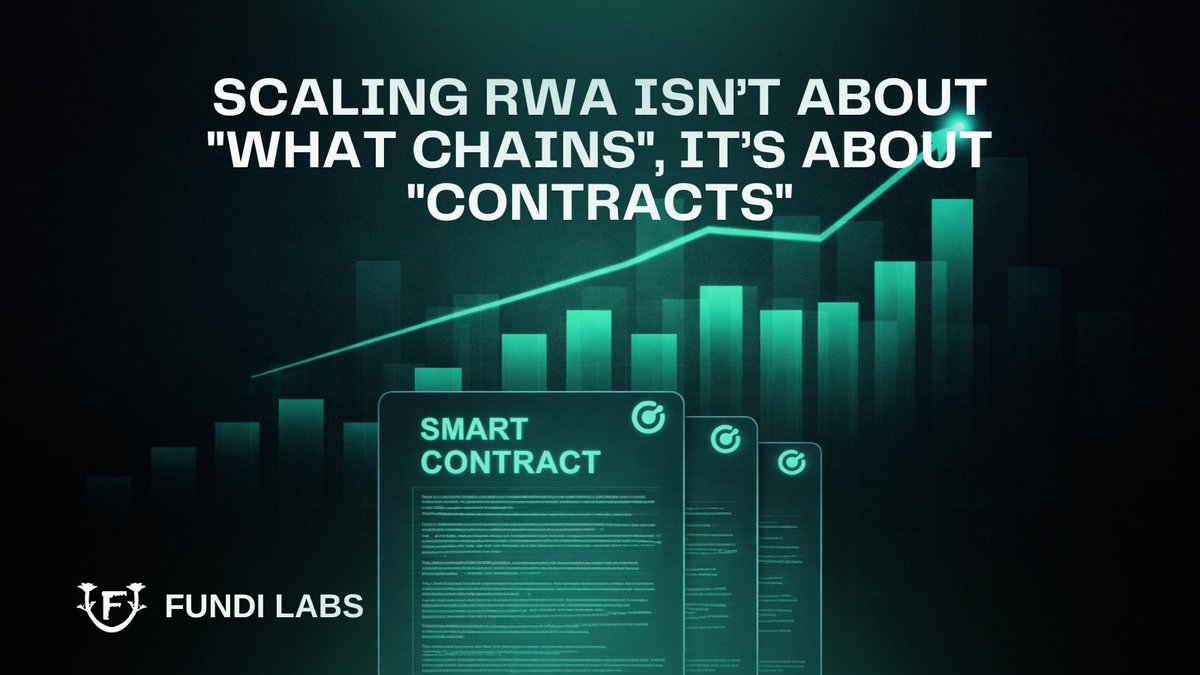
Scaling RWAs isn’t primarily a “which chain” problem. It’s a contract design problem. A lot of energy in the tokenization space goes into debating infrastructure. @ethereum or @solana? @base or another L2? Which chain is cheaper, faster, or has better liquidity? Those questions matter. The underlying chain affects transaction costs, accessibility, and ecosystem reach. Ignoring that would be a mistake. But once real assets and real capital are involved, the conversation shifts quickly. The real challenge becomes how the asset itself is structured. Tokenization can record ownership and automate transfers. What it doesn’t automatically solve are the deeper questions investors and institutions care about: • What legal rights does the token actually represent? • Who controls the underlying asset? • How are payouts calculated and distributed? • What happens if obligations aren’t met? • How are disputes resolved or terms updated? These are contract architecture questions, not blockchain questions. You can move a token across chains instantly. But if the agreement behind that token relies on manual processes, unclear enforcement, or poorly defined rights, the structure will struggle to scale. This is why sophisticated participants don’t evaluate tokenized assets based solely on the chain they’re built on. They examine whether the contracts, governance rules, and operational workflows are designed to handle real-world conditions. In practice, the most resilient RWA platforms treat tokenization as part of a broader system, one where legal structure, contract logic, and operational processes are designed to work together. Infrastructure matters. But infrastructure alone doesn’t create reliability. The projects that will scale real-world assets successfully are the ones that design contracts that hold up when capital moves, incentives change, and markets tighten. Because blockchains move tokens. Contracts move capital.
Fundi Labs tweet media
English
9
5
21
638
RJ 리트윗함
Fundi Labs
Fundi Labs@FundiProtocol·
Tokenization isn’t just slapping an asset onchain. The real question: Can you prove it works at scale? Legal, technical, operational, economic… diligence in tokenized assets covers it all. Read how pros do it ⬇️
Fundi Labs@FundiProtocol

What Diligence Really Looks Like in Tokenized Assets Today Tokenization promises efficiency, transparency, and liquidity. But anyone who’s raised capital or invested in tokenized assets knows this: not all tokens are created equal. Diligence in tokenized assets goes far beyond a simple legal review. It’s about understanding whether the asset, its contracts, and its ecosystem can reliably deliver what they promise, today and at scale. Here’s what professional due diligence looks like: 1. Legal & Compliance Verification - Is the token backed by a verifiable real-world asset? - Are ownership rights enforceable across jurisdictions? - Are contracts structured to protect all stakeholders, not just the issuer? 2. Technical & Smart Contract Audit - Are contracts secure, audited, and free from exploitable vulnerabilities? - Does the contract logic correctly handle payouts, governance, and ownership transfers? - Are there fail-safes or upgrade mechanisms if issues arise? 3. Transparency & Traceability - Can all token holders independently verify ownership and transaction history? - Is the asset’s lifecycle fully auditable and tamper-proof? 4. Economic & Risk Assessment - How is the token’s value derived and maintained? - Are liquidity and incentive structures robust under market stress? - Is the model resilient to downturns or rapid scaling? 5. Operational Due Diligence - Are reporting, distributions, and governance processes automated and reliable? - Are outcomes measurable, auditable, and aligned with stakeholders’ expectations? 6. Ecosystem & Stakeholder Alignment - Who are the participants, and are incentives aligned for long-term collaboration? - Is there a clear path for growth, adoption, and liquidity management? The takeaway from this is: tokenization alone doesn’t guarantee confidence or risk reduction. Proper diligence evaluates legal, technical, operational, and economic dimensions. Organizations that bake verifiability, enforceability, and transparency into their assets gain trust, reduce risk, and attract serious participation. At @FundiProtocol, we help organizations structure tokenized assets in ways that are auditable, enforceable, and investor-ready, so that value isn’t just promised, it’s provable. Follow for more

English
7
4
18
392
RJ 리트윗함
Fundi Labs
Fundi Labs@FundiProtocol·
What Diligence Really Looks Like in Tokenized Assets Today Tokenization promises efficiency, transparency, and liquidity. But anyone who’s raised capital or invested in tokenized assets knows this: not all tokens are created equal. Diligence in tokenized assets goes far beyond a simple legal review. It’s about understanding whether the asset, its contracts, and its ecosystem can reliably deliver what they promise, today and at scale. Here’s what professional due diligence looks like: 1. Legal & Compliance Verification - Is the token backed by a verifiable real-world asset? - Are ownership rights enforceable across jurisdictions? - Are contracts structured to protect all stakeholders, not just the issuer? 2. Technical & Smart Contract Audit - Are contracts secure, audited, and free from exploitable vulnerabilities? - Does the contract logic correctly handle payouts, governance, and ownership transfers? - Are there fail-safes or upgrade mechanisms if issues arise? 3. Transparency & Traceability - Can all token holders independently verify ownership and transaction history? - Is the asset’s lifecycle fully auditable and tamper-proof? 4. Economic & Risk Assessment - How is the token’s value derived and maintained? - Are liquidity and incentive structures robust under market stress? - Is the model resilient to downturns or rapid scaling? 5. Operational Due Diligence - Are reporting, distributions, and governance processes automated and reliable? - Are outcomes measurable, auditable, and aligned with stakeholders’ expectations? 6. Ecosystem & Stakeholder Alignment - Who are the participants, and are incentives aligned for long-term collaboration? - Is there a clear path for growth, adoption, and liquidity management? The takeaway from this is: tokenization alone doesn’t guarantee confidence or risk reduction. Proper diligence evaluates legal, technical, operational, and economic dimensions. Organizations that bake verifiability, enforceability, and transparency into their assets gain trust, reduce risk, and attract serious participation. At @FundiProtocol, we help organizations structure tokenized assets in ways that are auditable, enforceable, and investor-ready, so that value isn’t just promised, it’s provable. Follow for more
Fundi Labs tweet media
English
5
4
15
776
RJ 리트윗함
Fundi Labs
Fundi Labs@FundiProtocol·
A question we hear often: “If the asset exists in the real world, why do we need onchain records?” Here’s the truth: disputes don’t happen when everything goes smoothly. They happen when value changes. The moment money moves, ownership is transferred, or outcomes are measured, relying on memory, emails, PDFs, or trust alone becomes risky. Misunderstandings, lost documents, or human error can derail even the most well-intentioned agreements. That’s where onchain records matter. They provide: Immutable proof: Transactions and ownership can’t be altered or forgotten. Verifiable history: Every step is auditable by anyone with the right permissions. Confidence at scale: Stakeholders can trust that agreements are enforced automatically, even as complexity grows. In short, proof becomes more important than trust. And that’s exactly the layer we’re building at Fundi Labs - infrastructure that makes ownership, agreements, and impact verifiable, transparent, and enforceable. The real question isn’t whether the asset exists, it’s whether your proof does. If you’re ready to stop relying on memory and start relying on verification, let’s explore how onchain infrastructure can secure your organization’s operations. join our telegram channel - t.me/+zz9hAIl4TwhhO…
English
9
7
21
1.9K
RJ 리트윗함
Fundi Labs
Fundi Labs@FundiProtocol·
Some organizations adopt blockchain and operations get clearer. Others adopt it and chaos suddenly appears. The technology didn’t change, they fail because something else finally becomes visible. What it revealed did ↓
Fundi Labs@FundiProtocol

Onchain doesn’t automatically reduce risk, it just exposes what you never verified before. Over the last few years, many organizations moved toward blockchain for the same reason: certainty. Faster settlement. Clear ownership. Fewer intermediaries. Less room for disputes. And in many ways, they got exactly that. Transactions execute. Records don’t change. Automation works. But something unexpected started happening. Projects were technically correct, yet operationally fragile. Because most business risk was never in the database to begin with. It lives in the assumptions around it. A fund can exist onchain while the reporting process offchain is manual. A token can represent ownership while enforcement still depends on a lawyer and a spreadsheet. A nonprofit can show incoming donations while outcomes remain unverifiable. A company can automate payments while approvals still rely on internal trust. So the chain proves activity, but not reality. This is the moment many teams hit a wall. They didn’t adopt onchain infrastructure just to digitize the same uncertainty, they adopted it to operate differently. To coordinate capital, partners, and stakeholders without friction. But that only happens when systems verify the meaning of actions, not just the actions themselves. The shift organizations are actually searching for isn’t decentralization. It’s operational confidence at scale. Investors want to allocate without chasing reports. Partners want enforceable agreements instead of email confirmations. Donors want measurable outcomes, not summaries. Operators want processes that keep working under pressure. Onchain becomes powerful when it stops being a ledger and starts becoming operational infrastructure - where rights, conditions, and outcomes are part of execution, not interpretation. That’s the difference between putting a business onchain and running a business onchain. The next wave of adoption won’t come from more tokens or more dashboards. It will come from organizations realizing they no longer have to rely on coordination by memory, reputation, or manual oversight. They can rely on systems. And once an organization experiences that level of operational clarity, it doesn’t go back. So tell us, how your organization can leverage onchain infrastructure to reduce real-world risk and prove impact? Let’s connect and explore what’s possible. Join our community to stay ahead and connected - t.me/+zz9hAIl4TwhhO…

English
5
3
15
1.2K
RJ 리트윗함
Fundi Labs
Fundi Labs@FundiProtocol·
Onchain doesn’t automatically reduce risk, it just exposes what you never verified before. Over the last few years, many organizations moved toward blockchain for the same reason: certainty. Faster settlement. Clear ownership. Fewer intermediaries. Less room for disputes. And in many ways, they got exactly that. Transactions execute. Records don’t change. Automation works. But something unexpected started happening. Projects were technically correct, yet operationally fragile. Because most business risk was never in the database to begin with. It lives in the assumptions around it. A fund can exist onchain while the reporting process offchain is manual. A token can represent ownership while enforcement still depends on a lawyer and a spreadsheet. A nonprofit can show incoming donations while outcomes remain unverifiable. A company can automate payments while approvals still rely on internal trust. So the chain proves activity, but not reality. This is the moment many teams hit a wall. They didn’t adopt onchain infrastructure just to digitize the same uncertainty, they adopted it to operate differently. To coordinate capital, partners, and stakeholders without friction. But that only happens when systems verify the meaning of actions, not just the actions themselves. The shift organizations are actually searching for isn’t decentralization. It’s operational confidence at scale. Investors want to allocate without chasing reports. Partners want enforceable agreements instead of email confirmations. Donors want measurable outcomes, not summaries. Operators want processes that keep working under pressure. Onchain becomes powerful when it stops being a ledger and starts becoming operational infrastructure - where rights, conditions, and outcomes are part of execution, not interpretation. That’s the difference between putting a business onchain and running a business onchain. The next wave of adoption won’t come from more tokens or more dashboards. It will come from organizations realizing they no longer have to rely on coordination by memory, reputation, or manual oversight. They can rely on systems. And once an organization experiences that level of operational clarity, it doesn’t go back. So tell us, how your organization can leverage onchain infrastructure to reduce real-world risk and prove impact? Let’s connect and explore what’s possible. Join our community to stay ahead and connected - t.me/+zz9hAIl4TwhhO…
Fundi Labs tweet media
English
8
6
12
1.4K
RJ 리트윗함
Fundi Labs
Fundi Labs@FundiProtocol·
Most people hear tokenization and think it simply means putting an asset on a blockchain. But the real shift isn’t where the record lives, it’s how much trust the process demands. Today, ownership changes hands through emails, approvals, reconciliations, and documents passed between parties who all need to act correctly at the right time. Every step works… until one doesn’t. A delay, a mismatch, a missing record, and suddenly the transaction depends on interpretation instead of proof. Tokenization, done properly, reduces how often humans have to be trusted to manually confirm what already happened. At @FundiProtocol, the goal isn’t just digitizing assets. It’s structuring ownership so transfers, rights, and history remain verifiable regardless of who is involved. Ownership shouldn’t rely on someone remembering to send a PDF. It should persist as a system truth.
English
9
6
16
549
RJ 리트윗함
Fundi Labs
Fundi Labs@FundiProtocol·
Every donation tells a story. Every contribution creates impact. But how often do we actually see it? With Funds for Humanity, transparency isn’t an afterthought, it’s built into the system. Every donation, every milestone, every outcome is recorded onchain, creating a trail that anyone can verify. This isn’t just about giving money; it’s about ensuring your impact is real, measurable, and traceable. No black boxes. No “trust us” disclaimers. Just clear, verifiable proof of change. For organizations, foundations, and donors alike, accountability isn’t optional anymore, it’s the baseline expectation. If you want to support causes where your contribution truly matters, and can be verified, Funds for Humanity is leading the way. Transparency isn’t a feature. It’s the foundation of real impact.
English
7
5
14
440
RJ
RJ@c2bsolution·
@Nick_Prince12 How do builders categorize their token as an app coin?
English
0
0
0
37
RJ
RJ@c2bsolution·
@DCinvestor It’s because it’s no longer just politics anymore. This is about freedom and the collapse of the US Constitution
English
1
0
0
40
DCinvestor
DCinvestor@DCinvestor·
seeing a ton of people post about politics today who explicitly say they never, ever talk about politics publicly something broke today
English
42
10
301
11.1K
RJ 리트윗함
Fundi Labs
Fundi Labs@FundiProtocol·
DeFi didn’t stall because of lack of ideas. It stalled because trust was never systemized. We’ve been shipping faster, deploying more contracts, and moving more value onchain, but without shared standards for verification, ownership, or execution. We broke down where DeFi quietly breaks, and what it looks like when infrastructure actually catches up. Full post below 👇
Fundi Labs@FundiProtocol

DeFi has been hyped as the future of finance. And yes, it’s transforming how we think about money, lending, and investing. But let’s be honest, there’s a hidden problem slowing it down. Despite all the innovation, DeFi is missing a solid, verifiable infrastructure layer. Here’s what that looks like in the real world: i. Developers deploy contracts, but no standard exists for verifying their security, leaving users exposed to hacks and exploits. ii. Protocols can’t easily interoperate or be monetized, limiting innovation and adoption. iii. Complex contracts require trust in unknown parties, breaking the promise of decentralization. iv. Impact-driven projects, like public-good funding, often fail to scale because there’s no way to guarantee traceable, secure execution onchain. This isn’t a “theoretical risk.” It’s real money, real projects, real users at stake. But what's the solution? That’s where @FundiProtocol comes in: Fundi is the missing infrastructure layer for DeFi: - Verifiable Smart Contract Factories: Developers can mint contracts that are secure, auditable, and ownable. - Tokenized Validators & Protocols: The network incentivizes verification, making the system self-policing and trustworthy. - Transferable & Monetizable Assets: Developers and organizations can monetize entire portfolios of contracts and protocols safely. - Real-world Use Cases in Action: Funds for Humanity is already live, proving that automated, traceable, and impactful DeFi solutions are possible today. By building on Fundi, you’re not just creating DeFi applications, you’re building on a foundation that guarantees trust, transparency, and scalability. DeFi isn’t just about swapping tokens. It’s about creating a new financial system that works for everyone, but only if the infrastructure is solid. Fundi makes that possible. Explore Fundi: fundilabs.io How are you currently managing contract trust and scalability in your DeFi projects? Please comment below and let’s discuss how Fundi can assist you. Follow for more...

English
7
5
19
765