고정된 트윗

Sign the Edinburgh Proclomation here, the fight for the Liberation of Scotland starts with the pen.
🏴🏴🏴🏴🏴🏴
j6uvd9gbb.cc.rs6.net/tn.jsp?f=001ec…
English
🏴 JonnyBoy 🇮🇹
3.4K posts

@chiefjonken
Ducati, Crypto, FinTech and Watch loving maniac with a political twist and I was called a nationalist tadger today 🤣 (03/04/26)

Can't have an oil refinery. Can't have a chemical plant. Can't have a Chinese Wind Turbine Plant. Can't have zonal Electricity pricing. Can't hear a whisper from 37 Scots Labour MPs.

Indictment at the United Nations: A Report Submitted Directly to the UN Secretary-General Now Entered into the UN System Exposes Scotland as a Colony and Places the English Colonial State in the Dock Read the full report by Liberation Scotland and partners on the official UN website documents.un.org/doc/undoc/gen/… A document has now entered the official machinery of the United Nations. Circulated at the United Nations Human Rights Council (61st session), received by the Secretary-General, and registered under UN procedures, this report constitutes far more than an NGO submission. It is an intervention within the normative space of international law itself; and an indictment of the English colonial state. For Scotland as an English colony, it is nothing short of strategic. A Break in the Colonial Narrative For decades, the English colonial state has relied on a carefully constructed fiction. Scotland, the narrative insists, is part of a “voluntary union,” endowed with democratic representation, protected by devolution, fully exercising internal self-determination. It's a colonial lie. This report dismantles that fiction with clinical precision. It identifies Scotland not as a partner, not as a region, but as a territory under colonial sovereignty, explicitly placing it alongside cases such as New Caledonia and French Polynesia. This classification is not rhetorical but analytical, precise, legal, and comparative. It situates Scotland within the global structure of colonial domination. It strips away the British constitutional mythology and replaces it with a framework grounded in international law. Once that shift occurs, everything changes. Devolution Unmasked as Legal Assimilation At the core of the English colonial strategy lies devolution. Presented as a generous transfer of power, it has long been used to argue that Scotland already governs itself. The report exposes this mechanism for what it is. A colonial fraud. The Scotland Act 1998 is described as establishing administrative structures while preserving the overriding authority of the central, colonial English state, constituting a process of legal assimilation designed to negate Scotland’s status as a treaty partner. This is a devastating reframing. Devolution is no longer interpreted as autonomy. It is revealed as a technology of control, a system through which the English colonial centre maintains supremacy while projecting the illusion of self-government. Internal self-determination, in this light, is containment, certainly not liberation. The implication is profound. The English colonial state does not share sovereignty. It absorbs, restructures, subordinates, plunders. The Failure of Internal Self-Determination The report goes further. It demonstrates that systems of internal autonomy, wherever imposed under the authority of the dominant state, remain structurally incapable of delivering genuine self-determination. They operate within what the report identifies as a framework of hegemonic legal pluralism, where the colonised are permitted limited expression only within boundaries defined by the coloniser. Scotland’s constitutional reality is thus aligned with a broader global pattern. From New Caledonia to Okinawa, internal arrangements function not as solutions but as instruments of stabilisation for colonial rule. The conclusion follows with force. External Self-Determination & Decolonisation as the Only Solution The report states unequivocally that external self-determination is the only effective means of guaranteeing the rights of peoples subjected to such structures. This is not a suggestion but a doctrinal position grounded in international and UN law: -Article 1(2) of the UN Charter -The UN General Assembly Resolution 1514 (XV) -The UN General Assembly Resolution 1541 (XV) The implication is unmistakable. @UN @UNGeneva @UN_HRC @UNHumanRights @antonioguterres






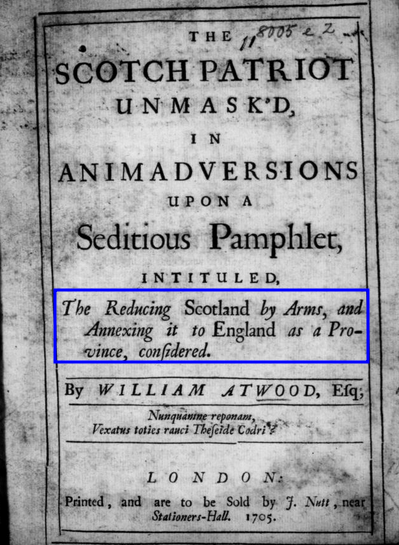
Atwood believed Scotland had no right to exist as an independent country. His book was sentenced to be publicly burned in Edinburgh.


Here is a shocker. The Scotland Act 1998 is an ordinary statute. It could be repealed as easily as the Dentists Act 1984. Yet the UK tells the United Nations that this flimsy, unentrenched arrangement gives Scotland genuine internal self-determination under Article 1 of the International Covenant on Civil and Political Rights (ICCPR). That claim is bogus. A parliament that Westminster can abolish tomorrow is not a foundation for self-determination but rather a concession, revocable at will. See this comparison with a few proper regional governments. History repeats itself, we might add. The doctrine of parliamentary sovereignty is the work of the 19th century English jurist A. V. Dicey. His claim was more grandiose still; yet this pre-1707 English parliamentary import is now the UK constitutional orthodoxy. Dicey compared the Treaty of Union - the very fount of the British constitution on which the "voluntary partner" thesis rests - to the Dentists Act of the day: one could be repealed by ordinary statute as easily as the other. This is the legal absurdity of the child (the British parliament) conducting a pre-conception assassination on the parent (the international treaty which is parliament's creator). Here is Dicey: "The principle of parliamentary sovereignty means neither more nor less than this, namely, that Parliament thus defined has, under the English constitution, the right to make or unmake any law whatever; and, further, that no person or body is recognised by the law of England as having a right to override or set aside the legislation of Parliament. The Act of Union with Scotland (1707) is, from a legal point of view, just as much an ordinary law as the Dentists Act (1878). It can be repealed by the same body and in the same manner as the Dentists Act."