Pieter Ibelings@ibelings
Been working on something I've wanted to build for years — a radio imaging array.
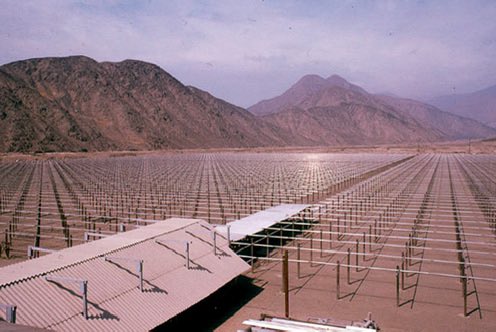
The concept: take an array of antennas, digitize every element with a phase-coherent SDR, then cross-correlate all baseline pairs to synthesize an aperture and image the radio sky. Same interferometric principle behind the LWA-TV system at the Long Wavelength Array in New Mexico (leo.phys.unm.edu/~lwa/lwatv.html), which runs 256 dual-polarization antennas doing real-time all-sky imaging below 88 MHz.
My version operates at 420-450 MHz. The antenna array is a 4x4 grid of circular cross-dipoles with ~0.6λ spacing. Each element feeds a home brew multi-channel FPGA SDR with 10GbE backhaul. All channels share a common 10 MHz reference and PPS, keeping the digitizers phase-locked across the array. The software aligns the incoming VITA 49 (VRT) streams by timestamp, computes the cross-power spectrum on every antenna pair, and builds a dirty map from the visibility matrix.
Beyond imaging, the same hardware opens up some other things I want to explore — angle of arrival estimation on HF, adaptive beamforming, and real-time interference cancellation by nulling specific spatial directions. An array that can see the full sky can also choose what not to see.
Only running 4 elements right now so the PSF is wide and the sidelobes are ugly, but the coherency holds through frequency changes, the correlation display updates live, and the sky map shows structure. Once the full 4x4 is wired up — 120 baselines, ~8° resolution at 435 MHz — it should start to get interesting. And there's nothing stopping it from scaling further. Drift scans can fill in the uv-plane over time and improve image quality from fewer antennas.
Images below:
4 coherent channels streaming live with sky correlation display
The 4x4 circular cross-dipole array for 435 MHz
For inspiration — the 256-element LWA array doing this at HF (LWA-TV live)