

Ethan Pollack

2.7K posts

Ethan Pollack banner
Ethan Pollack

Ethan Pollack

@ethanpollack

Higher ed finance, workforce development, labor markets, and econ policy. Senior Director at Jobs for the Future. Alum of Aspen, Pew, EPI, and OMB. Views mine.

Washington, DC 가입일 Mayıs 2008
1.6K 팔로잉1.2K 팔로워
Ethan Pollack 리트윗함
Michael B. Horn
Michael B. Horn@michaelbhorn·
Through income share agreements (ISA), students pay for their education as a percentage of their post-grad income rather than a flat up-front charge or a conventional loan where they are on the hook for a fixed monthly payment regardless of what they’re earning. I sat down with @KJMumford of @LifeAtPurdue and @ethanpollack of @jfftweets to learn more about what they’ve learned from studying Purdue’s “Back a Boiler” ISA program—and what those lessons might mean for making ISAs a bigger part of the way students pay for college.
English
1
2
0
208
Ethan Pollack
Ethan Pollack@ethanpollack·
@nickducoff I mean, I get why consumer protection folks like her had their worries. Their concerns were valid! But they approached the situation with a clenched fist rather than an open hand. Industry was willing to work with them, but they had no interest in collaboration.
English
0
0
1
17
Ethan Pollack
Ethan Pollack@ethanpollack·
🚨New Research🚨 Purdue's ambitious & controversial ISA program appears to have succeeded in providing an affordable, accessible, and nondiscriminatory alternative to Parent PLUS. Super relevant now that Parent PLUS is capped and Grad PLUS is gone!
English
1
0
1
109
Ethan Pollack
Ethan Pollack@ethanpollack·
Context: ➡OBBBA will blow a >10% hole in the student loan market. ➡ Students will face financing gaps: some will drop out, forgo education entirely, or rely on risky private loans w/ no low-wage protections. ➡Institutions will need to step up to address student financing gaps.
Preston Cooper@PrestonCooper93

"Roughly two-thirds (58% – 74%) of [Purdue's] Back a Boiler students have paid less in the ISA than they would have paid in a comparable Parent PLUS loan." @ethanpollack jff.org/blog/promising…

English
0
0
0
140
Ethan Pollack
Ethan Pollack@ethanpollack·
It's too early to definitively say if Purdue's ISA program was a success or not -- the vast majority of contracts are still in repayment. But this research should be encouraging to any institution looking to help its students address their financing gaps.
English
1
0
0
61
Preston Cooper
Preston Cooper@PrestonCooper93·
I regret to inform you that I am thoroughly enjoying myself in a jazz club in New Orleans and will not be able to comment on the Senate HELP package until tomorrow.
Preston Cooper tweet media
English
2
0
6
4.3K
Ethan Pollack
Ethan Pollack@ethanpollack·
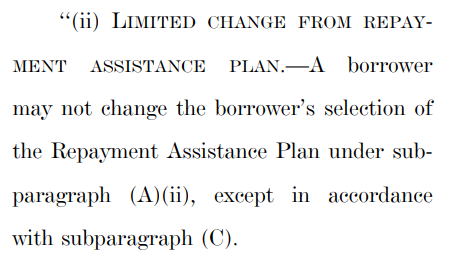
@hardtimesmaker @delislealleges I think the idea is that when borrowers have high income (i.e. when the IDR plan would require higher payments than the standard plan), they shouldn't be able to switch back to the standard plan to lower their monthly payments and thus push back the date of full repayment.
English
1
0
0
26
GoodTimesEnjoyer
GoodTimesEnjoyer@hardtimesmaker·
@ethanpollack @delislealleges But people in IDR can always pay back more (e.g., the amount they'd face in the standard plan) if they want to. Why would this make any difference?
English
1
0
0
46
Jason Delisle
Jason Delisle@delislealleges·
Under the House student loan reform bill (reconciliation bill), looks like if a borrower selects the income-driven repayment plan, they can not later leave it. Once in, always in. edworkforce.house.gov/uploadedfiles/…
Jason Delisle tweet media
English
1
3
6
1.4K
Ethan Pollack
Ethan Pollack@ethanpollack·
@clearSNR @PrestonCooper93 Yeah this is real. A more elegant approach would have been to just piggyback off of the tax system by adding a percentage point surcharge on existing marginal tax rates. But despite the cliff effects, I do like the progressive structure for distributional reasons.
English
0
0
0
40
SignalToNoiseRatio
SignalToNoiseRatio@clearSNR·
@PrestonCooper93 Biggest problem here is rhe benefits cliff. Tweek the math to be continuously graduated (like income tax). It's not cool for a $49,999 worker to pay $1999.96/yr but a *two dollar* pay raise to a $50,001 worker pays $2500.05/yr (+$500). Smooth out the discontinuities.
English
2
0
3
208
Preston Cooper
Preston Cooper@PrestonCooper93·
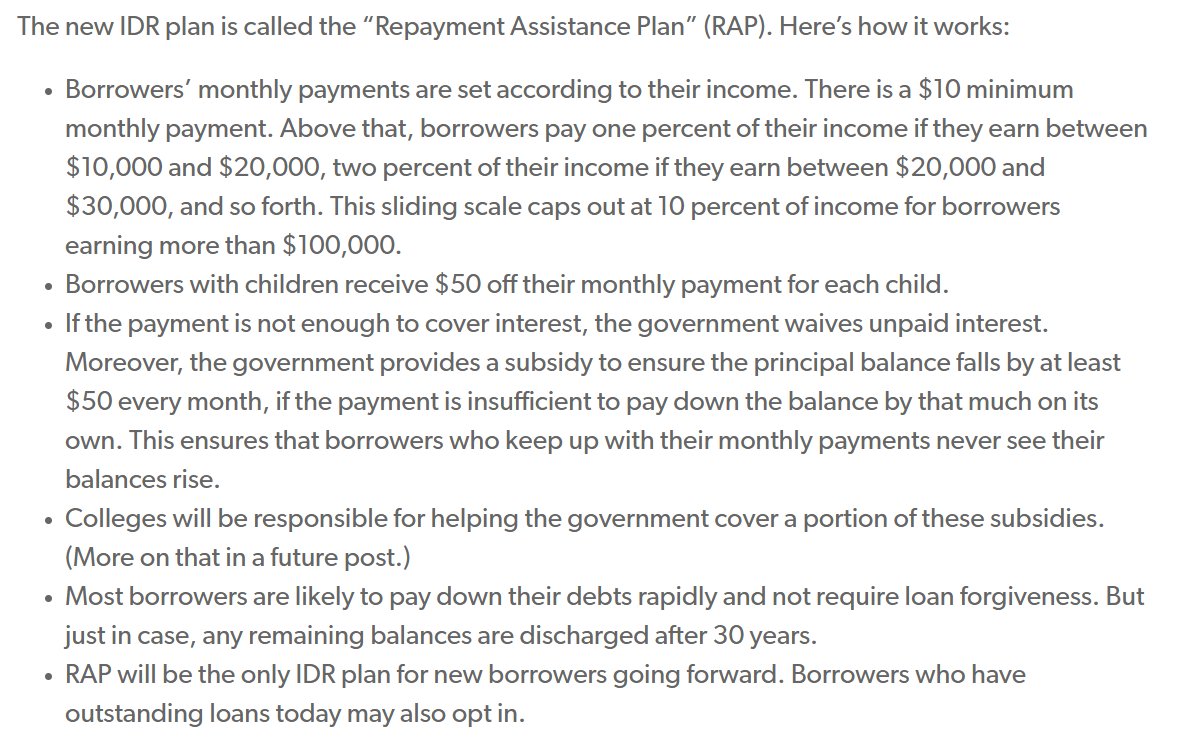
House Republicans have proposed a new student loan repayment plan that would - for borrowers who keep up with their payments - prevent balances from rising over time. Here's how it works:
Preston Cooper tweet media
English
6
12
53
17.3K
Ethan Pollack
Ethan Pollack@ethanpollack·
@PrestonCooper93 @ernietedeschi This has two impacts: 1. Low-income borrowers (i.e. those who would otherwise fall under the earnings thresholds) would have to make monthly payments. 2. Monthly payments are calculated as % of AGI rather than % of discretionary income (i.e. income above threshold).
English
0
0
0
22
Ernie Tedeschi
Ernie Tedeschi@ernietedeschi·
This is truly not a bad start. Something missing from the IDR conversation however is a limiting factor to help curb its influence on the growth of fees. In Australia’s IDR system, it’s a lifetime cap on loan size. One could also force IDR-eligible schools to cap tuition growth.
Preston Cooper@PrestonCooper93

House Republicans have proposed a new student loan repayment plan that would - for borrowers who keep up with their payments - prevent balances from rising over time. Here's how it works:

English
1
1
12
3.8K
Ethan Pollack
Ethan Pollack@ethanpollack·
The new House GOP student loan plan looks similar to the Australian model: payment % is graduated (1%-10% depending on income) and no forgiveness. Main differences: 1. No earnings threshold 2. No interest capitalization 3. Principal balances guaranteed to fall by at least $50/m
Preston Cooper@PrestonCooper93

House Republicans have proposed a new student loan repayment plan that would - for borrowers who keep up with their payments - prevent balances from rising over time. Here's how it works:

English
1
0
1
286
Ethan Pollack 리트윗함
Ethan Mollick
Ethan Mollick@emollick·
Large scale job displacements due to AI are likely to occur more slowly than a lot of people talking about AI and work might suspect. Translators were paid more and in more demand a year after GPT-4 than they were the year it launched.
Basil Halperin@BasilHalperin

The BLS just released new OEWS data, so we can actually update this (it's an annual survey every May -- so this is 18 months of data post-ChatGPT, instead of 6 months) From 2023 -> 2024: (1) Translator real wages +0.8% (2) Translator employment/employment share slightly up ⬆️

English
31
45
450
88.8K
Ethan Pollack
Ethan Pollack@ethanpollack·
Making government more efficient is tough. @TracyPalandjian proposes a common-sense (and bipartisan!) approach: what if government programs paid for outcomes rather than inputs? Taxpayer dollars get higher ROI, and states & private sector get freedom to innovate new approaches.
Social Finance@SocialFinanceUS

In @TIME, @TracyPalandjian outlines principles beyond cost-cutting to achieve true #government efficiency: evaluating programs for effectiveness, funding those that work, and using financial mechanisms to maximize #taxpayer dollars. Read the piece here: bit.ly/3CSbcuW

English
0
1
2
98
Ethan Pollack 리트윗함
Julia Pollak
Julia Pollak@juliaonjobs·
How can you get ahead without a degree? There are 73 “launchpad” jobs where workers tend to earn more over time and have more job security than the median college grad, according to great research by ⁦⁦@TheBGInstitutenytimes.com/2024/11/21/bus…
English
2
3
6
11.7K
Ethan Pollack 리트윗함
Stefanie Stantcheva
Stefanie Stantcheva@S_Stantcheva·
It’s hard to overstate how much people hate inflation—and the lasting scars this recent surge caused. People across the board, even Democrats, mainly blamed the government (see the figure👇). Check the summary 🧵for "Why do we dislike inflation?" here: x.com/S_Stantcheva/s…
Stefanie Stantcheva tweet media
Stefanie Stantcheva@S_Stantcheva

Why do we dislike inflation? 🚨New paper for @BrookingsInst revisits this long-standing question, already asked by @RobertJShiller in 1997, with current data and survey methods. Some key findings:🧵 1/10 socialeconomicslab.org/research/worki…

English
15
120
395
98.5K