

q(Alex Kiefer | everything else)
3.4K posts

q(Alex Kiefer | everything else)
@exilefaker
I'm nothing i̵f̵ ̵n̵o̵t̵ ̵a̵ ̵m̵i̵n̵i̵m̵a̵l̵i̵s̵t̵ • ML / philosophy research @ M3CS • 🎶 @ exileFaker • dad
New York City 가입일 Ocak 2009
1.1K 팔로잉1.3K 팔로워

q(Alex Kiefer | everything else) 리트윗함

pymdp 1.0.0 is here: batched, autodifferentiable, JIT-compiled active inference in JAX: github.com/infer-actively…
This release brings:
GPU/TPU-ready active inference
autodiff through inference, planning and learning
easy parallelization and batching with vmap()
English
One of the coolest papers I've read recently (from 2020), mapping propositional logic operators to algebra and using them to compose independent energy-based models. Thanks @a_tschantz for bringing it to my attention
arxiv.org/pdf/2004.06030
English
Yes. Super-human cognitive sophistication with zero intrinsic motivation. I'd argue this is possible because the cognitive/conative distinction (cf. osf.io/4n27k) cuts deep - arxiv.org/html/2508.2046…. Desires are autopoietic! (cc @DrJohnVervaeke)
François Chollet@fchollet
The bottleneck of current AI is simple: the techniques we use are still predicated on pattern memorization and retrieval, and thus they need *someone* to tell them which patterns to memorize (training data, RL envs...) That role cannot yet be played by AI in a truly open-ended and autonomous way. We can't yet remove the humans in the loop. In that sense, current AI is still purely a reflection of human cognition (both in terms of which tasks/goals it pursues and the patterns it uses to solve them). It isn't yet its own thing.
English
@realDonaldTrump Please. Sorry for my imperious tone previously. The headlines are upsetting.
English
I have nothing clever to say. @realDonaldTrump if you can, STOP THIS AGGRESSION.
English
Tip for quantum Bayesians: have your observations performed by optimistic friends!
English
OK, my kid just made me watch Kpop Demon Hunters and I cried. It was fucking fantastic.
This Evangelion dad may still have a thing or two to learn.
English
There's one logical fallacy that is in practice endemic to humans generally and is responsible for so much error, and it is: probably P, therefore P
Hume was right: certainty about mere matters of fact is always a mistake.
English
Relevant recent/forthcoming work:
Intrinsic Motivation as Constrained Entropy Maximization
mdpi.com/1099-4300/27/4…
A Predictive Architecture for the Attitudes - with @hohwy
osf.io/preprints/osf/…
On the possibility of deep alignment
arxiv.org/abs/2508.20465
English
Just gave a short presentation and had a follow-up conversation with @drmichaellevin about the role of entropy (maximization) in motivation and agency - grateful for the chance to discuss this + share!
youtube.com/watch?v=XFSPCL…

YouTube
English
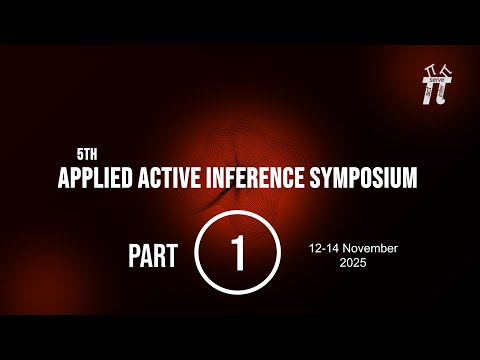
Hosting a panel discussion on the role of entropy (maximization) in motivation, today 2PM EST
livestream @ youtube.com/live/VTivWre-8…
as part of the @InferenceActive Applied Active Inference Symposium!
YouTube
English
@dioscuri Very much agree, I’d cast it in the past as the “problem of hacceity”
English

FWIW I think the hard problem of consciousness is real, but it's the problem of why reality has intrinsic qualities (rather than just structure and dynamics), rather than why intelligent self-aware beings exist.
Aidan McLaughlin@aidan_mclau
i knowww this take will be universally hated but i negatively update on the iq of anyone who believes in qualia or the hard problem of consciousness
English
I think this is a major step toward actually implementing, as opposed to simulating, large-scale agency -- cf. arxiv.org/abs/2508.20465
Alen Ribić@alenribic
Reading the paper, I now understand how their approach forms a thermodynamic computer of sort. It literally thermalizes towards low energy states via Gibbs dynamics! So the whole chip is effectively a massively parallel Gibbs sampler that continuously relaxes toward the equilibrium distribution of the energy function encoded by its weights!
English
Welp, I stand by the claim that the early arguments against LLM consciousness weren’t so great, but I have to say I’ve since come to agree more with @GaryMarcus about some limitations of the current tech
q(Alex Kiefer | everything else)@exilefaker
Ultra-short thread on LaMDA because I don't have time for anything else. 1. The problem of other minds (inferring consciousness/sentience from behavior) is one of the oldest in philosophy; it's astonishing that @Google, @CNN and @GaryMarcus have all managed to solve it easily
English
If I had to choose one AI/ML paper from 2025 to recommend to philosophers it'd be this one
arxiv.org/abs/2505.11581
English
@dioscuri Arguably, corporations as such (over and above simple voluntary contractual agreements) are a creature of government (limited liability, corporate personhood etc). So governments (at least in their usual forms) would be the problem across the board :)
English
It’s crazy to me that anyone could look at the 20th century and think “corporations are the problem, governments are the solution.”
English
As my daughter is walking around doing various things she's humming the Green Hill Zone theme. I've never been more proud 😭
English
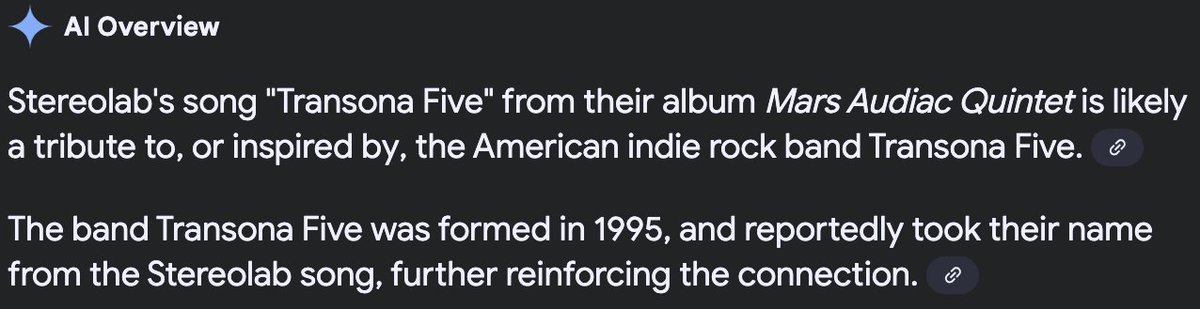
Well, I don't usually go in for this kind of thing, but in this instance, AI is an idiot
English