Active Inference Institute

2.8K posts

Active Inference Institute banner
Active Inference Institute

Active Inference Institute

@InferenceActive

Open-science Institute for learning, researching, and applying Active Inference.

Online Katılım Temmuz 2020
0 Takip Edilen5.2K Takipçiler
Sabitlenmiş Tweet
Active Inference Institute
Active Inference Institute@InferenceActive·
Welcome 👋: welcome.activeinference.institute Join Discord: 💬 discord.activeinference.institute Explore Projects: 🔍 projects.activeinference.institute Active Inference Ecosystem: 🌐 ecosystem.activeinference.institute Videos: 🎥 video.activeinference.institute Volunteer: 🌱 volunteer.activeinference.institute Intern: 🎓 intern.activeinference.institute Newsletter: 📰 newsletter.activeinference.institute Fellows Program: 📖 fellows.activeinference.institute Partnerships: 🤝 partnerships.activeinference.institute Support the Institute: 💖 support.activeinference.institute Join us in advancing the field of Active Inference and be part of our growing community!
Active Inference Institute tweet media
English
2
7
41
6.1K
Active Inference Institute
Active Inference Institute@InferenceActive·
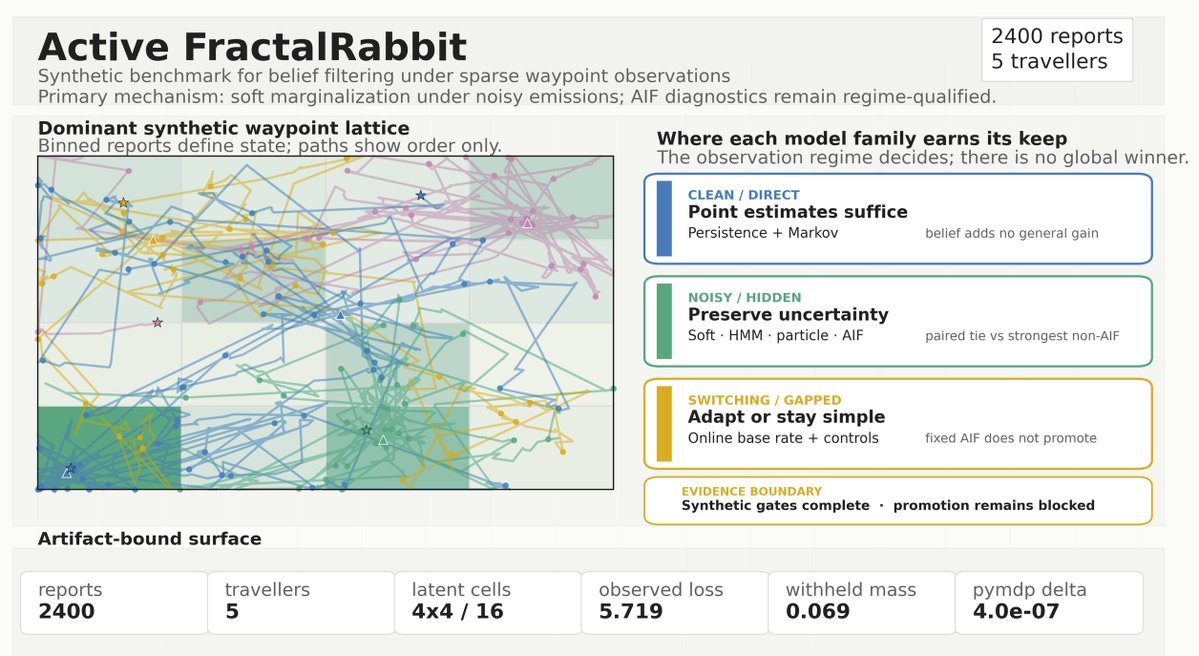
Active FractalRabbit: A Synthetic Benchmark for Belief Filtering Under Sparse Waypoint Observations Daniel Ari Friedman 🔗 Code: github.com/ActiveInferenc… 🔗 Paper: doi.org/10.5281/zenodo… Sparse waypoint analysis is privacy-sensitive: it must separate movement from irregular reporting, missingness, spatial coarsening, and corruption while preserving uncertainty about hidden location. Active FractalRabbit provides a controlled, artifact-bound benchmark whose headline lane uses a deterministic project-local synthetic FractalRabbit-format fixture; a separately retained lane exercises pinned open-source software from the National Security Agency as an independent simulator surface. The benchmark converts sporadic reports into categorical evidence, fits explicit hidden-state generative models, and compares transparent temporal, Markov, sequence, state-space, neural, latent-state, and active inference predictors under matched information sets. Under noisy partial-observability, Active Inference is the lowest-loss implemented predictor: it clearly leads point-estimate and raw-observation families and sits in a statistical tie with the strongest non-AIF belief-preserving comparator. The shared mechanism is soft Bayesian marginalization, which preserves probability across plausible cells instead of committing early to one state. Point estimates suffice for clean observations, an online base-rate predictor leads under regime switching, transparent temporal and disclosed kinematic controls anchor sparse reporting gaps, and withholding location sharply limits specific-cell recovery from metadata. The partially observable Markov decision process (POMDP) formulation also exposes variational and expected-free-energy diagnostics for belief, minimization, and integrity. These results establish a regime-specific synthetic model map and a reproducible evidence chain. The present contract covers synthetic software behavior; separate evidence protocols govern privacy and empirical evaluation
Active Inference Institute tweet media
English
0
0
1
376
Active Inference Institute
Active Inference Institute@InferenceActive·
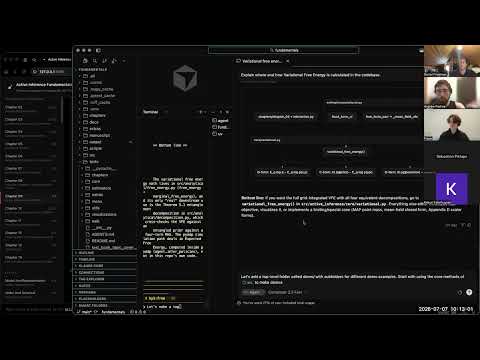
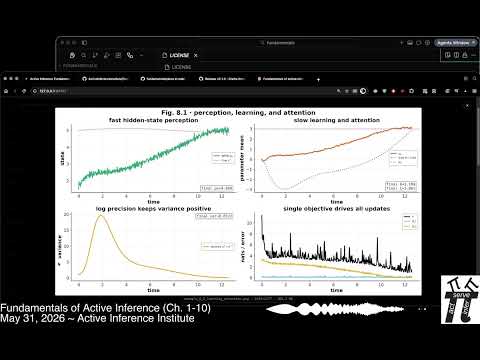
Fundamentals of Active Inference (Coding + Agents, Session 25) July 7, 2026 youtu.be/V46B4Xy1PeQ Code: github.com/ActiveInferenc… Using @NousResearch Hermes with free @OpenRouter LLM to Learn and Apply active inference.
YouTube video
YouTube
Active Inference Institute@InferenceActive

"Fundamentals of Active Inference" is now published! mitpress.mit.edu/9780262050951/… Textbook Group begins in April at the Institute, all levels of familiarity with Active Inference welcome to join: coda.io/form/Active-In…

English
0
0
1
529
Active Inference Institute
Active Inference Institute@InferenceActive·
YouTube video
YouTube
Active Inference Institute@InferenceActive

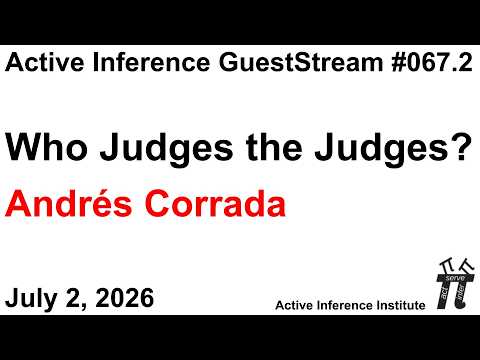
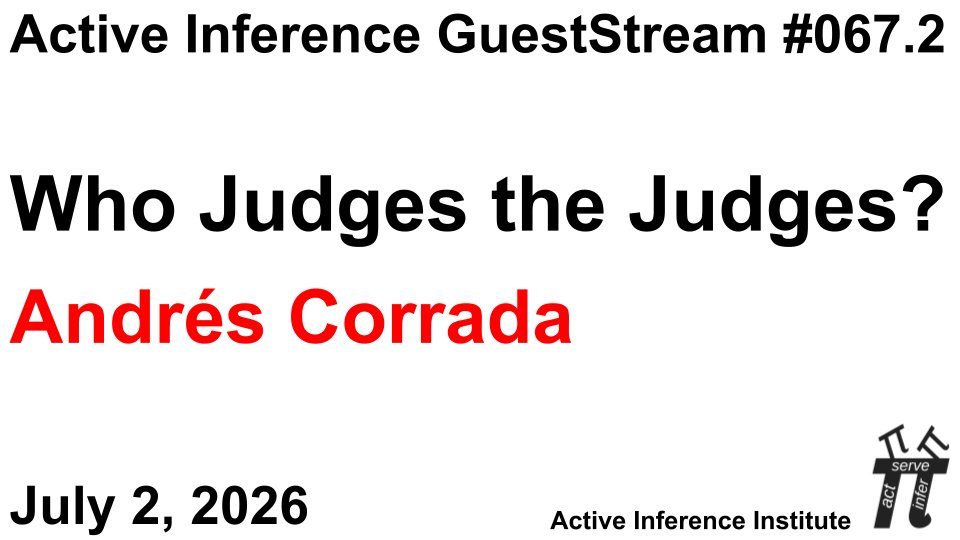
GuestStream #067.2 ~ 7/2/2026 at 12 UTC Andrés Corrada Who Judges the Judges? youtube.com/live/t2TgSuYH-… The problem of verifying experts that are smarter or more knowledgeable than us is ancient. Its modern incantation -- "When we use LLMs-as-Judges, who/what checks them?" -- should be amenable to all the strategies humanity has devised to ameliorate this curse of acquiring knowledge. We apply two of these strategies—ensembling experts and logical inconsistency—to evaluate classifiers when we lack the answer keys for their tests. Disagreeing experts allow us to logically exclude evaluations inconsistent with the counts of their differences. For example, if we all take a multiple-choice exam and disagree, we cannot all be 100% correct. This exclusionary logic for joint evaluations can be formalized as the integer solutions to a system of universally applicable Diophantine equations (axioms of classification). The newly released version of the Open Source NTQR Python package contains exact and random sampling generators for the logically consistent evaluation set given arbitrary number of questions, labels, or classifiers. We will demonstrate its simple use using Jupyter notebooks from the NTQR documentation. Considering the ubiquity of "who judges the judges?", this semantic-free counting logic should have wide applicability in helping ameliorate it. Some examples briefly discussed include: scalable oversight, correlated experts, self-evaluation, and no-knowledge alarms for misaligned classifiers. The talk concludes with the limitations of logic and its inability to answer scientific questions related to the safe monitoring of expert systems.

English
0
0
2
352
Active Inference Institute
Active Inference Institute@InferenceActive·
Realizing Emptiness: Operational Surrogates for No-Self-Evidence, QRF Opacification, and Bayesian Model Reduction Paper: zenodo.org/records/208348… Daniel Ari Friedman All manuscript and code source materials: github.com/docxology/real… This project operationalizes the 2026 preprint "There is no self-evidence: A physics of emptiness realisation" as a source-anchored software artifact. Its central claim is that a finite agent can use a boundary for prediction while never obtaining evidence that the boundary is ontologically real, and the software separates three local artifact roles: formal sanity checks for source equations, positive-control-style finite mechanism checks, and discriminating tests that reject stronger readings when a control is perturbed. The formal layer maps the paper's quantum free-energy principle (qFEP) and quantum reference frame (QRF) equations into finite operational surrogates, bridging each paper equation to a specific software artifact. The computed artifacts are a suite of finite quantum-information and contextuality audits — spanning two-qubit separability and entanglement entropy, Bell and contextuality witnesses, thermodynamic and open-system dynamics, seeded quantum-trajectory sampling checked against exact solutions, and frame-covariance checks for the quantum reference frame relabelings — with explicit positive controls, negative controls, or boundary checks recorded where the corresponding artifact contract requires them. The software represents QRF deployments as policies over boundary-channel sectorisations, using the same finite bitstream under self/environment/contextual relabelings so that QRF labels can organize prediction, action selection, and transformation covariance while failing to become evidence for an ontological self/world boundary. Bayesian model reduction is implemented as a sweep over prior precision and metacognitive access, extended with a sensitivity grid over observation noise. The separation prior is pruned only when removing it lowers the model's free energy, and kept when its remaining contribution to accuracy still offsets its complexity cost. The active-inference layer uses the inferactively-pymdp library (Heins et al. 2022) with profile-specific likelihood, transition, preference, and prior arrays for the separation-constrained, opacified, and post-dual quantum reference frame deployments, then records posterior beliefs, policy posteriors, selected actions, expected-free-energy summaries, seeded stochastic ensembles with null controls and replay seeds, and confidence intervals, without treating those simulations as empirical subject data. Practice protocols, compassion-policy scope, criticality-style indicators, quantum-boundary dynamics, empirical adapters, and artifact-release readiness are therefore written as bounded model interfaces, simulated indicators, local private release-readiness records, or blocked evidence classes. A physical realization of the quantum free-energy principle, public independent reproduction, and any human practice efficacy, neural measurement, or clinical outcome remain blocked future evidence classes.
Active Inference Institute tweet media
English
0
0
2
329
Active Inference Institute
Active Inference Institute@InferenceActive·
GuestStream #067.2 ~ 7/2/2026 at 12 UTC Andrés Corrada Who Judges the Judges? youtube.com/live/t2TgSuYH-… The problem of verifying experts that are smarter or more knowledgeable than us is ancient. Its modern incantation -- "When we use LLMs-as-Judges, who/what checks them?" -- should be amenable to all the strategies humanity has devised to ameliorate this curse of acquiring knowledge. We apply two of these strategies—ensembling experts and logical inconsistency—to evaluate classifiers when we lack the answer keys for their tests. Disagreeing experts allow us to logically exclude evaluations inconsistent with the counts of their differences. For example, if we all take a multiple-choice exam and disagree, we cannot all be 100% correct. This exclusionary logic for joint evaluations can be formalized as the integer solutions to a system of universally applicable Diophantine equations (axioms of classification). The newly released version of the Open Source NTQR Python package contains exact and random sampling generators for the logically consistent evaluation set given arbitrary number of questions, labels, or classifiers. We will demonstrate its simple use using Jupyter notebooks from the NTQR documentation. Considering the ubiquity of "who judges the judges?", this semantic-free counting logic should have wide applicability in helping ameliorate it. Some examples briefly discussed include: scalable oversight, correlated experts, self-evaluation, and no-knowledge alarms for misaligned classifiers. The talk concludes with the limitations of logic and its inability to answer scientific questions related to the safe monitoring of expert systems.

YouTube video
YouTube
Active Inference Institute tweet media
English
0
0
1
519
Active Inference Institute
Active Inference Institute@InferenceActive·
COGANT: Deterministic Codebase-to-GNN Translation Paper: zenodo.org/records/207053… Code: github.com/ActiveInferenc… COGANT (Codebase-to-GNN Translation) deterministically converts software repositories into structured Active Inference artifacts expressed in the Active Inference Institute's Generalized Notation Notation (GNN). It is an evidence compiler: it propagates reviewable program facts through a finite fixpoint rule pipeline and emits graph, matrix, provenance, visualization, and round-trip artifacts with confidence and provenance, rather than a single opaque embedding. A reverse synthesizer reconstructs a runnable Python package from an emitted GNN bundle, closing a forward-reverse-forward evaluation loop. This is the first public release (v0.6.0). Source: github.com/ActiveInferenc…
Active Inference Institute tweet media
English
1
0
5
413
Active Inference Institute
Active Inference Institute@InferenceActive·
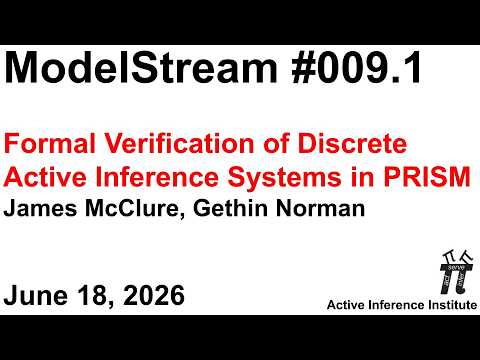
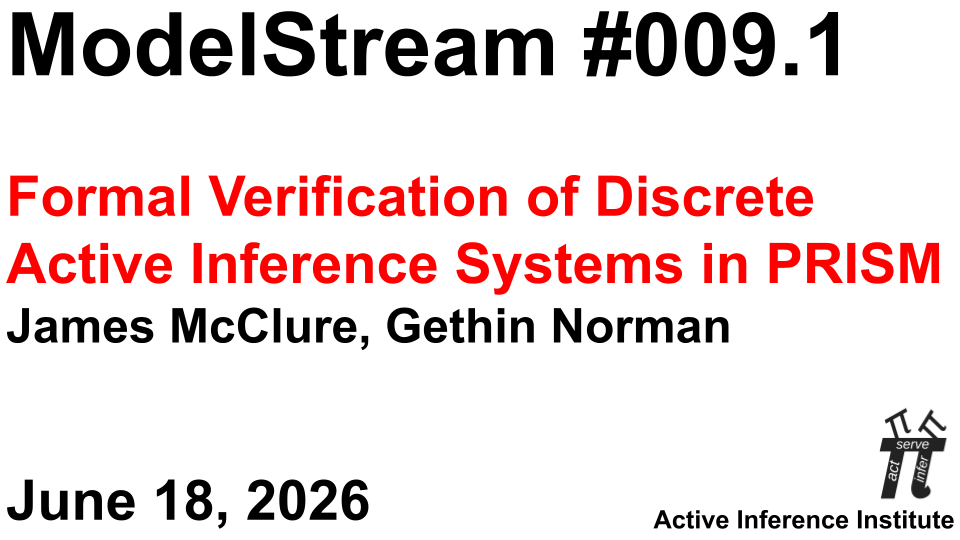
--- Call for Presenters at the 6th Applied Active Inference Symposium 2026! We are excited to invite researchers and practitioners to submit presentations for the upcoming 6th Applied Active Inference Symposium 2026, to be held on 12-13 November, 2026. Submit your application here. coda.io/form/2026-Appl… This online Symposium will focus on exploring the applications and frontiers of Active Inference. As with previous Symposia, the keynote address and panel will feature Karl Friston. All information: symposium.activeinference.institute --- Upcoming Livestreams: * ModelStream #009.1 ~ 6/18/2026 at 12 UTC James McClure, Gethin Norman Formal Verification of Discrete Active Inference Systems in PRISM youtube.com/live/-q8XqVxQq… --- “Fundamentals of Active Inference” textbook group The first cohort of the “Fundamentals of Active Inference: Principles, Algorithms, and Applications of the Free Energy Principle for Engineers” textbook group is ongoing! Register for the Textbook group here — …tbook-group.activeinference.institute --- Open Project Meetings this week: See activities.activeinference.institute for the location of all events listed here. * 6/16/2026, 17:00 UTC — “Fundamentals of Active Inference” ~ Textbook Group * 6/18/2026, 13:00 UTC — RxInfer.jl ~ Learning session * 6/19/2026, 13:00 UTC — “Fundamentals of Active Inference” ~ Textbook Group --- * Join the Discord: discord.activeinference.institute * Learn more about the Active Inference Ecosystem ecosystem.activeinference.institute * Make a Measurement to get your update included in the upcoming Newsletter: measure.activeinference.institute * We are a 501(c)(3) educational non-profit. Donate at: donate.activeinference.institute * Email blanket@activeinference.institute with any questions.
YouTube video
YouTube
Active Inference Institute tweet media
English
0
1
2
252
Active Inference Institute
Active Inference Institute@InferenceActive·
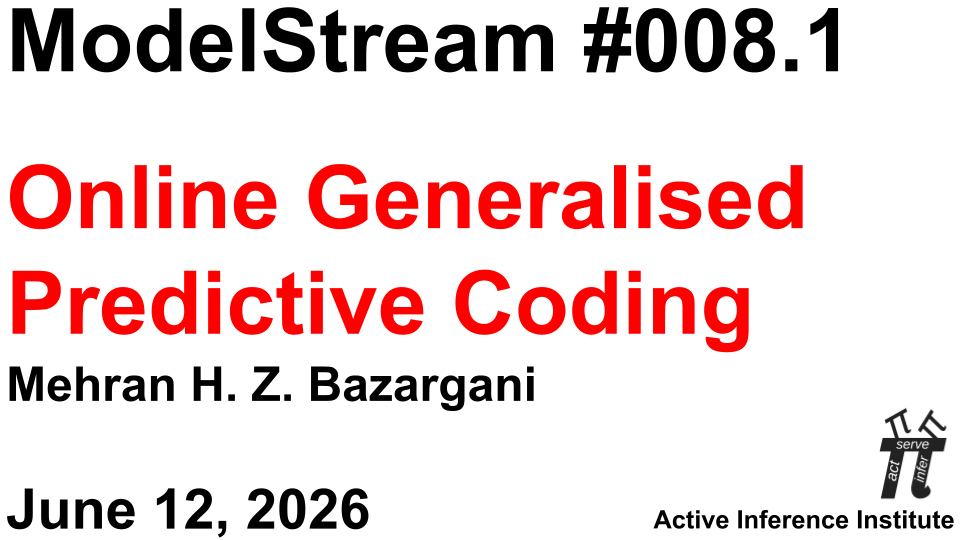
Announcements for week of June 8, 2026 weekly.activeinference.institute Upcoming Livestreams: ModelStream #008.1 ~ 6/12/2026 at 1 UTC Mehran Hossein Zadeh Bazargani Online Generalised Predictive Coding youtube.com/live/0pKxmZg5q… ModelStream #009.1 ~ 6/18/2026 at 12 UTC James McClure, Gethin Norman Formal Verification of Discrete Active Inference Systems in PRISM youtube.com/live/-q8XqVxQq… “Fundamentals of Active Inference” textbook group The first cohort of the “Fundamentals of Active Inference: Principles, Algorithms, and Applications of the Free Energy Principle for Engineers” textbook group is ongoing! Register for the Textbook group here — …tbook-group.activeinference.institute Open Project Meetings this week: See activities.activeinference.institute for the location of all events listed here. 6/9/2026, 17:00 UTC — “Fundamentals of Active Inference” ~ Textbook Group 6/10/2026, 17:00 UTC — CogNarr Ecosystem project 6/11/2026, 13:00 UTC — RxInfer.jl ~ Learning session 6/12/2026, 13:00 UTC — “Fundamentals of Active Inference” ~ Textbook Group Join the Discord: discord.activeinference.institute Learn more about the Active Inference Ecosystem ecosystem.activeinference.institute Make a Measurement to get your update included in the upcoming Newsletter: measure.activeinference.institute We are a 501(c)(3) educational non-profit. Donate at: donate.activeinference.institute Email blanket@activeinference.institute with any questions.
YouTube video
YouTube
YouTube video
YouTube
Active Inference Institute tweet media
English
0
1
3
218