Future

2.7K posts

Future banner
Future

Future

@futuree_88

Trust the process

가입일 Mayıs 2024
335 팔로잉252 팔로워
고정된 트윗
Future
Future@futuree_88·
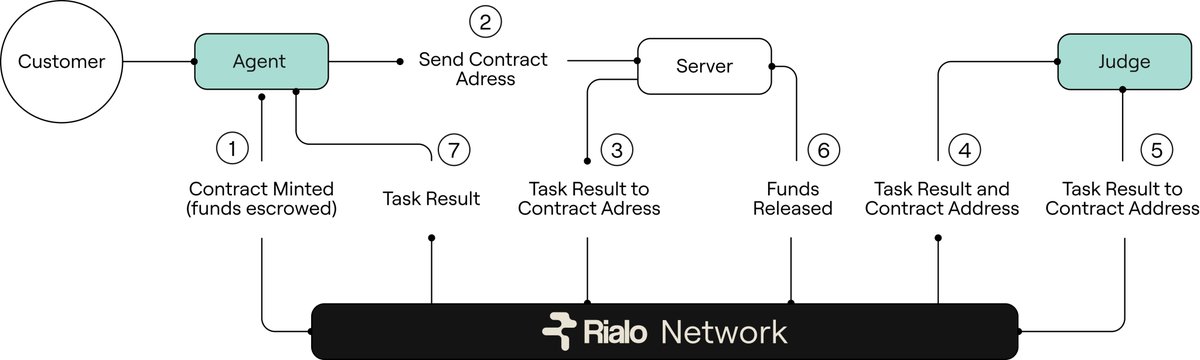
AI agents are starting to do real work for us. They book flights, run research, manage online services, and even move money while we sleep but as useful as that sounds, there’s a growing problem: automation without verification doesn’t scale. If you can’t verify the work being done, you can’t really trust the value being created. Right now, most agent systems operate in fragments. The task lives in one place, the payment happens somewhere else, and the proof of work is often missing or difficult to verify. When something goes wrong, users are left digging through logs or screenshots trying to figure out what happened. That’s not a system that can support real economic activity. This is the gap @RialoHQ is trying to solve with SCALE (Simple Contracts for Agent Labor Execution). SCALE creates a simple structure for coordinating work between humans and agents. The task is defined directly on-chain: you set the prompt, define the deadline, and choose the judge that will evaluate the result. At the same time, the payment for that task is locked into the contract the moment the job begins. This ensures that both the user and the agent know the terms before the work even starts. What makes this model powerful is how Rialo connects tasks, proof, and payment into a single system. Through native webcalls, the network can verify that the work actually happened in the real world. If the agent completes the task and the judge confirms it meets the criteria, the payment is released automatically. If the work fails to meet the requirements, the funds are returned to the user. This simple structure solves one of the biggest challenges in the emerging agent economy. Agents can now perform work with clear rules, verifiable results, and guaranteed payments, all enforced by the protocol itself. Users no longer need to rely on trust or manual oversight. As AI agents begin handling more responsibilities and more value online, these kinds of systems become essential. Automation alone isn’t enough. Verified automation is what allows it to scale. With SCALE, Rialo is building the infrastructure that allows AI agents to operate in a real economy where work is defined clearly, outcomes are provable, and value moves automatically when the job is done.
Future tweet media
English
8
0
22
202
𝙼𝚛.𝐆𝐡𝐨𝐬𝐭
Freedom in web3 is fast but trust is slow. With Rialink wallets become credible, users gain portable trust, and developers verify in one call. Built for @RialoHQ
𝙼𝚛.𝐆𝐡𝐨𝐬𝐭@Abd00lmalik

𝐈 𝐉𝐔𝐒𝐓 𝐒𝐇𝐈𝐏𝐏𝐄𝐃 𝐌𝐘 𝐏𝐑𝐎𝐃𝐔𝐂𝐓 𝐎𝐍 𝐑𝐈𝐀𝐋𝐎🏌‍♂️ In web3 people can create wallets in seconds, which is great for freedom and innovation, but it also creates a trust gap. People who want to collaborate or work together often share their GitHub links, Discord usernames, and other social information. However, when its time to move forward, there is no way to verify that the wallet address claiming these social profiles is actually legitimate. Also, a wallet shows ownership but not credibility, so projects struggle to know if a wallet is real or just a bot. Rialink solves these by linking one wallet to real social accounts. It helps a person show that a wallet address belongs to a user, and their github,Discord, or farcaster account also belongs to them. Rialink works this way: ➠ Go to rialink.vercel.app ➠ Connect SVM wallet ➠ Go to the verification page and connect your Github,Discord, or farcaster (Dw you can revoke access anytime) ➠ Rialink generates a proof hash (a reciept) that Verifies the link between your wallet and the accounts you claim to own. ➠ Users get a RialCard they can share showing linked accounts and a CardID for verification. ➠ Third parties can verify that the wallet address claiming these social profiles is actually legitimate in our verification page. ➠ Developers can integrate Rialink with one api call or a small sdk function Right now Rialink server checks social accounts and saves proof data in our database but this makes trust to still depend on out server. When @RialoHQ finallg goes live, Edge can do the social API checks,create proof hash and then save the proof hash record on chain through smart contracts so the result is more permanent and easier for everyone to edit. Rialink is live now and I am excited to collaborate with builders to make trust in web3 simple reliable and portable.

English
4
3
9
244
Future
Future@futuree_88·
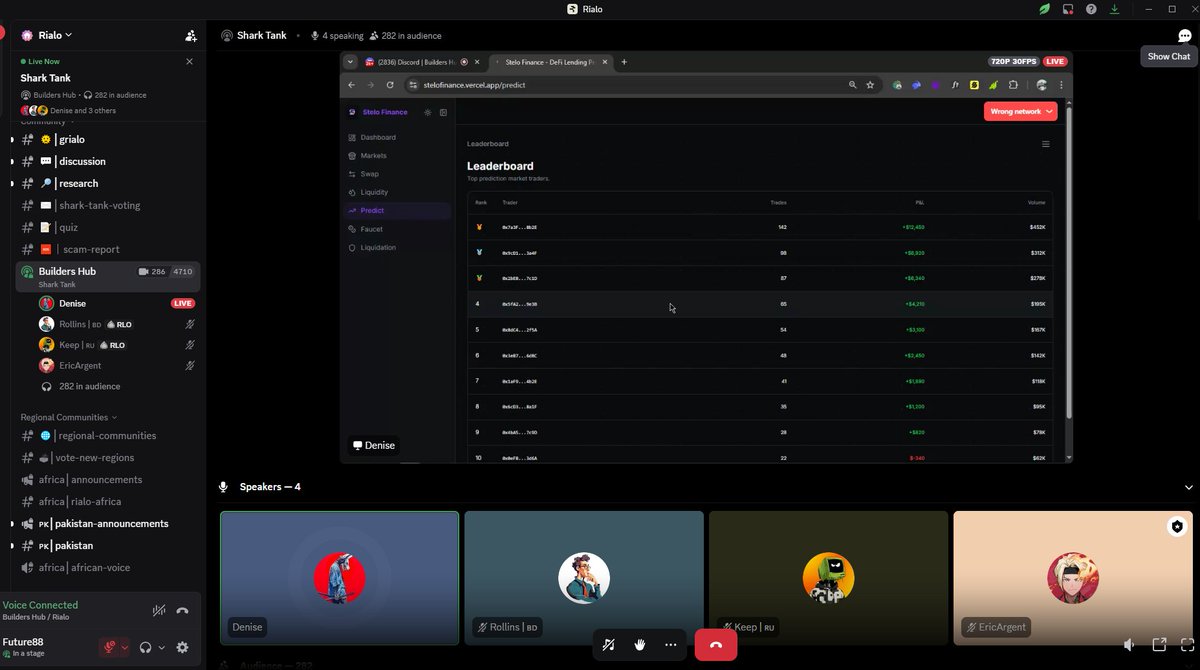
This week’s @RialoHQ Shark Tank recap Another solid session and this one had a really good mix of ideas across DeFi, discovery, and gaming. The projects presented were: ‣ Stelo Finance ‣ RialoBS (Rialo Builder Showcase) ‣ Rialo Royal Casino Denise kicked things off with Stelo Finance, a unified liquidity layer for the Rialo network. It’s basically an all-in-one DeFi platform. You’ve got lending and borrowing, LP provision across different pairs(not live yet), and a clean dashboard to track your portfolio. It also includes a swap feature for trading tokens and even a built-in prediction market. Next up was RialoBS, presented by Sukanto. This one is more like a discovery hub for the ecosystem. You can browse projects from the builder hub, check details, like what you find, and even view builder profiles with engagement stats. There’s also a Shark Tank section showing past winners, and YouTube integration so you can watch presentations directly. Finally, Rialo Royal Casino was presented by Oxszajoestar and Junior. A gaming platform currently running on testnet, where users connect and play using a native token called gUSDC. It features games like lucky dice and coin flip, with plans to add a leaderboard. Overall, a strong lineup this week. At the end of the event, @ericargent31113 shared an update to the voting system. From now on, only participants of the Shark Tank event can vote. They will be assigned a temp role that makes them eligible to vote. That's a wrap see you next week. @0x_alextine #RialoAfricaCreatorChallenge
Future tweet media
English
6
1
8
91
Future
Future@futuree_88·
What if generating a private key didn’t require trusting anyone at all? That’s the core idea behind Distributed Key Generation (DKG), and it represents a major shift from how most systems work today. In a typical setup, one entity generates a secret and distributes it. That creates an obvious risk. If that party is compromised or behaves maliciously, the entire system is exposed. DKG removes that risk by design. Instead of relying on a single dealer, every participant contributes to the creation of the secret. Each person generates their own hidden value and encodes it inside a polynomial, then shares parts of that polynomial with others. Through this process, a single group secret is formed, but no one ever sees the full secret. Each participant only holds a share of the final key. On its own, that share cannot do anything. But when a threshold number of participants come together, they can reconstruct the secret or produce valid cryptographic outputs like signatures. This is where the idea of a threshold system comes in. For example, in a 3 of 5 setup, any three participants can act together, while no single participant has full control. The mathematics behind this is surprisingly elegant. The secret is embedded in the constant term of a polynomial, and recovering it requires enough points on that curve. Each participant holds one of those points, and with a sufficient number of shares, the original secret can be reconstructed using Lagrange interpolation. In many cases, the system doesn’t even need to reconstruct the secret directly. Instead, participants combine their shares to produce a result that proves access to the secret without revealing it. From the outside, it behaves just like a normal cryptographic system. A signature produced this way verifies against a public key as if it came from a single private key, even though no one ever held that key in full. This is what makes DKG so powerful. It removes single points of failure and replaces trust in individuals with trust in the system itself. Control becomes distributed, and security becomes much harder to break. This approach fits directly into what Rialo is building. By using DKG for threshold signing and coordination, Rialo enables systems where no single actor has complete authority, yet the network can still operate securely and efficiently. It is a model designed for real-world conditions, where participants cannot always be fully trusted. Of course, DKG on its own assumes honest behavior. In practice, systems also need ways to detect and handle malicious participants. That is where verifiable secret sharing (VSS) comes in, adding a layer of accountability by allowing participants to prove that their shares are valid. DKG is the foundation, It shows that you can generate and use shared secrets without trusting any single party, and that is a fundamental step toward building truly secure and decentralized systems. Read more on Quoted Article. Get Real. Get Rialo gRialo friends @RialoHQ @rialo_africa #RialoAfricaCreatorChallenge
Rialo@RialoHQ

x.com/i/article/2040…

English
5
1
14
115
Adewale 🚦 👑
Adewale 🚦 👑@adewalearobieke·
It was another great Shark Tank event on @RialoHQ Discord yesterday quick one before I start. there's a change in the voting rules: only those who joined the event can vote now, which is fair to me 𝐃𝐞𝐧𝐢𝐬𝐞: 𝐒𝐭𝐞𝐥𝐨 𝐅𝐢𝐧𝐚𝐧𝐜𝐞 so the first builder, Denise came through with stelo finance, a full lending market on Rialo. at its core, it lets you: - lend and borrow against Rialo tokens (and others) - swap tokens directly through an integrated dex - provide liquidity and earn from transaction fees but it didn’t stop there. there’s also a leaderboard showing top traders, their total trades, PnLs and volume so it’s not just a lending app, there's more to it 𝐍𝐞𝐱𝐭 𝐰𝐚𝐬 𝐒𝐮𝐤𝐚𝐧𝐭𝐨'𝐬 𝐑𝐢𝐚𝐥𝐨𝐛𝐬 sukanto built one big home for all projects from builder hubs and shark tank. you can view all instantly (no login or wallet), see details like tech stack, builder's socials, github and live site for each project it even goes deeper to include youtube demos of presentations, project stats (views, likes and gitbub star rating for each builder) sukanto is an OG so it wasn't surprising this came from him 😉 𝐓𝐡𝐢𝐫𝐝: 𝐑𝐢𝐚𝐥 𝐑𝐨𝐲𝐚𝐥𝐞 𝐂𝐚𝐬𝐢𝐧𝐨 0xszajoestar and Junior built rial royal casino, an onchain gaming platform right now, it has dice, coin flip and slots the flow is simple: connect wallet, get test gusdt, play, withdraw if you win there’s also a utility layer where you can swap your winnings to another token it's still early and currently on testnet, but the idea is to put everything in one interface according to 0xszajoestar not usually a fan of games but this caught my attention still that's it for this week, see ya on the next one 👀 #RialoAfricaCreatorChallenge @0x_alextine
Adewale 🚦 👑 tweet media
Adewale 🚦 👑@adewalearobieke

𝐈 𝐝𝐞𝐩𝐨𝐬𝐢𝐭𝐞𝐝 $𝟏𝟓𝟎 𝐨𝐧𝐞 𝐭𝐢𝐦𝐞 𝐣𝐮𝐬𝐭 𝐭𝐨 𝐛𝐨𝐫𝐫𝐨𝐰 $𝟏𝟎𝟎 I know it sounds stupid but you are probably about to do the same 𝐡𝐞𝐫𝐞'𝐬 𝐰𝐡𝐚𝐭 𝐡𝐚𝐩𝐩𝐞𝐧𝐞𝐝. I needed $100 in USDT urgently, but I was holding $150 worth of ETH I didn't want to sell because it could pump went to aave, deposited $150 in eth as collateral and got a 100 usdt loan well that sounds normal until you don't have $150 to deposit as collateral my point is this, onchain credit doesn't make sense if you don't have more than you're currently borrowing and the reason is simple: these lenders don't see past your onchain history and assets so the only way they protect themselves is by locking more than they give you it's a different story when you're borrowing offchain because: - they see your FICO score computed based on your credit history - now, with Cash app and SoFi, even your education, employment history, cash flow and platform-specific behaviors now count what if onchain lenders could see what offchain lenders see? then it means: - more data and richer credit assessment - better loan servicing - loans can be tokenized - less collateral it's exactly what @RialoHQ is building a way for DeFi to price risk properly without locking up more capital than necessary the global unsecured credit market is worth around $4.7 trillion, onchain lending is around $56B, almost all overcollateralized there's still a lot of gap to cover, if you ask me thanks for reading 🙂‍↔️ #RialoAfricaCreatorChallenge

English
8
2
35
374
Future 리트윗함
Aethir
Aethir@AethirCloud·
ATH Security Notice We detected and contained a malicious attack on ATH bridge contracts connecting Ethereum to other chains. Key facts: • All compromised contracts have been disconnected. The exploit has been contained. • The main ATH supply on Ethereum is fully intact and unaffected. The ETH-ARB bridge on Squid is unaffected • User impact is limited to less than $90,000 USD • A full compensation plan will be released next week
English
12
14
122
12.2K
Future
Future@futuree_88·
@Steeze699 Onchain credits is powerful feature waiting for this feature and more to be live
English
0
0
1
3
Ohlamzz
Ohlamzz@Steeze699·
DeFi is kind of hitting a wall right now, yields are low because it’s mostly the same money moving around again and again and I don't think this can take things much further. If this space is going to grow, it has to connect to real-world value, not just keep recycling itself. Now this is where Rialo come in Instead of chasing quick returns, the focus is shifting to real credit and more stable income. @RialoHQ is building in that direction, linking stablecoins to actual economic activity. It just feels like a more solid path forward.
Ohlamzz tweet media
English
7
2
13
1.7K
Future
Future@futuree_88·
@Mosesndu081 @RialoHQ Nice recap brother. Yesterday Shark Tank was fun incredible pitches by our builders
English
1
0
1
14
ROSAAA
ROSAAA@rosabasir10·
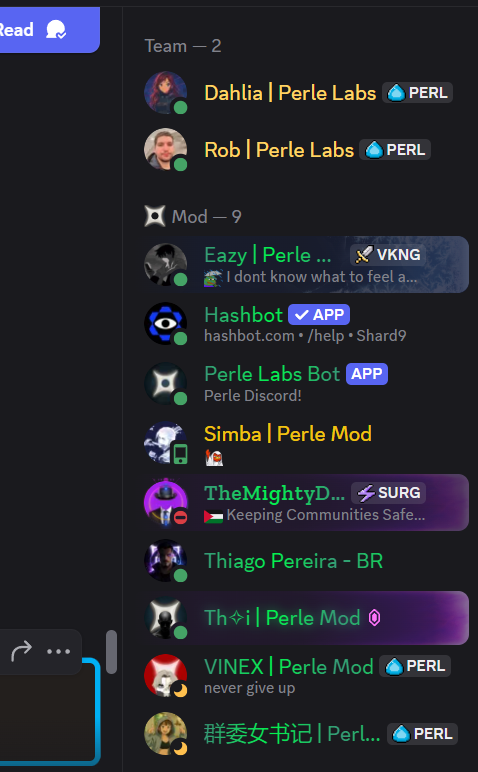
If you ever see these SHI** faces on discord LEAVE THAT SERVER ASAP! PERLE LABS BIGGEST SCAM OF 2026 SO FAR. @PerleLabs
ROSAAA tweet media
English
83
2
171
7K
iamcrimison (❖,❖)
iamcrimison (❖,❖)@iamcrimison·
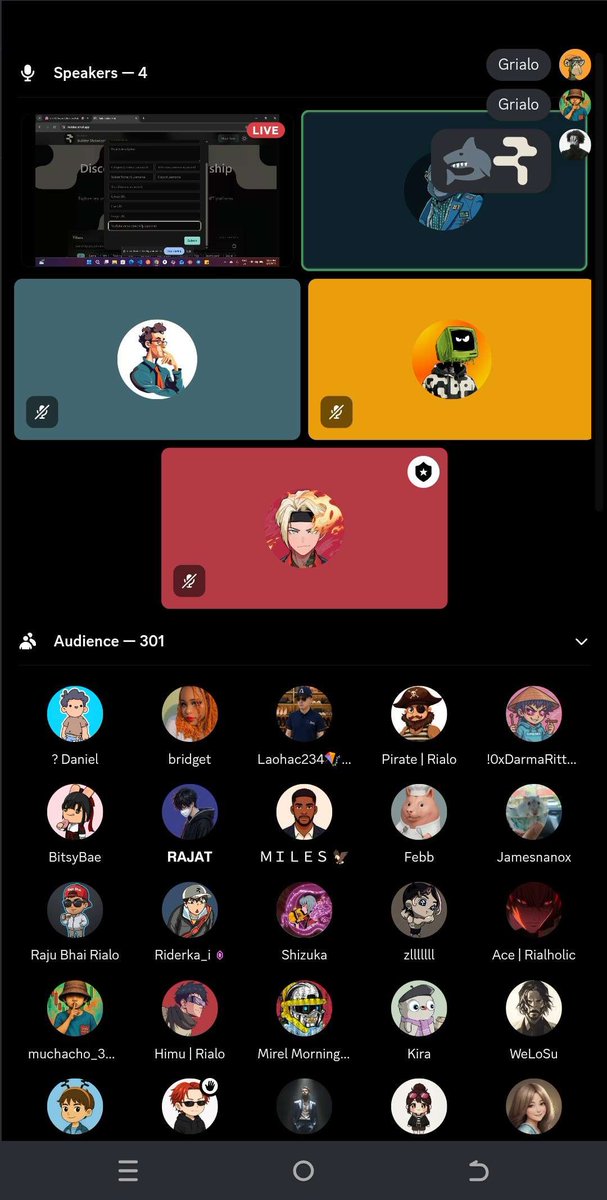
While most blockchain communities are buried in charts and speculative hype, the @RialoHQ Shark Tank sessions feel different. They aren’t just AMA sessions, they are high stakes, insightful deep dives into how we actually balance the space between Web3 complexity and Web2
iamcrimison (❖,❖) tweet media
English
8
0
9
80
onyedika
onyedika@0xOnyedika·
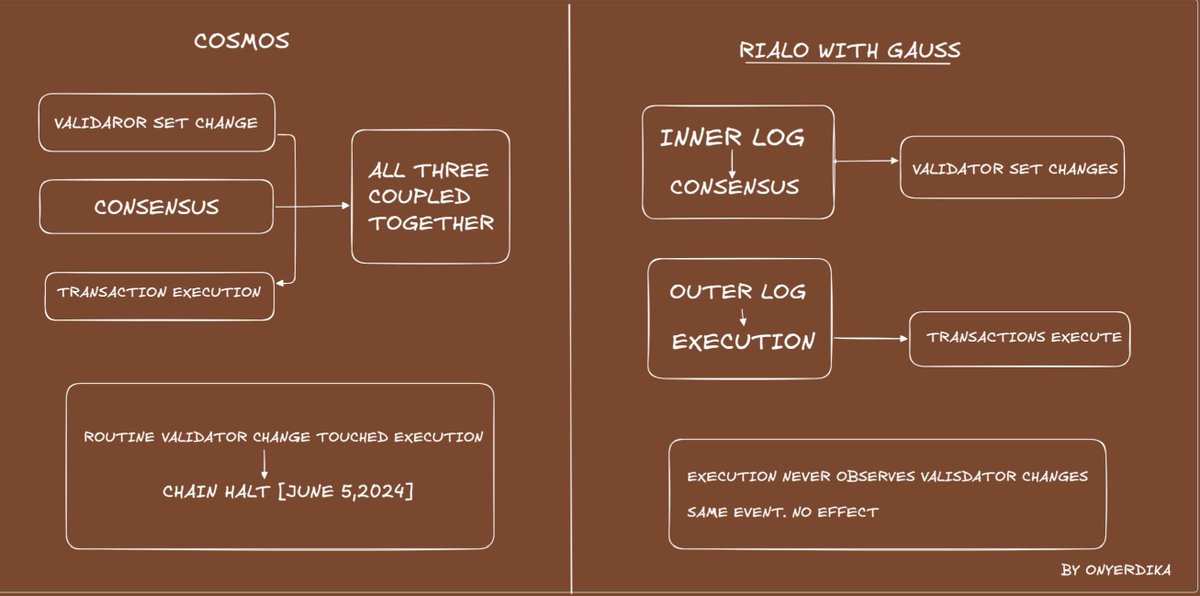
on june 5th, 2024, the cosmos chain halted and users couldn't make any transaction. this happened shortly after a scheduled software upgrade that lasted for 4hrs+ what really happened? there was a routine validator-set change, a normal onchain activity but this time it shook the network. something this small broke the system because changing validators, processing trx and consensus are all glued together. after this, cosmos had to manually coordinate validators, release a new sdk and patch the network while the chain was apparently ded at the time. but the real issue was architectural: validator set changes should happen only at the consensus layer rialo solves this with gauss, where validator changes happen inside the inner log (consensus layer), while transactions execute on the outer log. in this design, execution never observes validator change, only a stable system. gauss on rialo fixes the exact class of problem that took down a top chain for hours.
onyedika tweet media
English
11
2
46
452
Future
Future@futuree_88·
No One Holds the Key: How Rialo is Redefining Trust with DKG A lot of blockchain systems still rely on some level of trust, even if it’s not obvious. It might be a validator, a multisig group, or a backend service, but at the end of the day, control often sits in a few hands and that introduces risk. @RialoHQ is playing a different game, and DKG is a big part of that. With Distributed Key Generation (DKG), no single party ever creates or controls the full key. Instead, multiple participants contribute to generating it, and each one walks away with only a share. The full secret never exists in one place, yet the system can still operate as if it does. Control is no longer about who holds the key, but how many independent participants are required to act. In practice, this means actions like signing, validating, or executing workflows require coordination across multiple parties. This makes the network more resilient by design, so even if one participant fails or acts maliciously, the system still holds up. In Rialo, this becomes even more important as the focus shifts toward real-world use cases. Whether it’s automated workflows, financial interactions, or agents operating across systems where the cost of failure is much higher. You simply can’t afford weak points. DKG allows Rialo to build systems where trust is distributed by design. Sensitive operations can happen without exposing secrets, and decisions are enforced collectively rather than individually. The result is a system where trust is minimized, not assumed and that’s a key step forward. Because as blockchain moves closer to real-world adoption, the systems that succeed won’t just be decentralized in theory, they’ll be built so that no single point of control can break them. #RialoAfricaCreatorChallenge @rialo_africa
Future tweet media
English
13
3
17
199
Future 리트윗함
Adewale 🚦 👑
Adewale 🚦 👑@adewalearobieke·
𝐈 𝐝𝐞𝐩𝐨𝐬𝐢𝐭𝐞𝐝 $𝟏𝟓𝟎 𝐨𝐧𝐞 𝐭𝐢𝐦𝐞 𝐣𝐮𝐬𝐭 𝐭𝐨 𝐛𝐨𝐫𝐫𝐨𝐰 $𝟏𝟎𝟎 I know it sounds stupid but you are probably about to do the same 𝐡𝐞𝐫𝐞'𝐬 𝐰𝐡𝐚𝐭 𝐡𝐚𝐩𝐩𝐞𝐧𝐞𝐝. I needed $100 in USDT urgently, but I was holding $150 worth of ETH I didn't want to sell because it could pump went to aave, deposited $150 in eth as collateral and got a 100 usdt loan well that sounds normal until you don't have $150 to deposit as collateral my point is this, onchain credit doesn't make sense if you don't have more than you're currently borrowing and the reason is simple: these lenders don't see past your onchain history and assets so the only way they protect themselves is by locking more than they give you it's a different story when you're borrowing offchain because: - they see your FICO score computed based on your credit history - now, with Cash app and SoFi, even your education, employment history, cash flow and platform-specific behaviors now count what if onchain lenders could see what offchain lenders see? then it means: - more data and richer credit assessment - better loan servicing - loans can be tokenized - less collateral it's exactly what @RialoHQ is building a way for DeFi to price risk properly without locking up more capital than necessary the global unsecured credit market is worth around $4.7 trillion, onchain lending is around $56B, almost all overcollateralized there's still a lot of gap to cover, if you ask me thanks for reading 🙂‍↔️ #RialoAfricaCreatorChallenge
Adewale 🚦 👑 tweet media
English
26
3
48
997
Lizzie jane.IP (❖,❖)
Lizzie jane.IP (❖,❖)@Lizzie_jane7285·
Most systems trust ONE party to control a secret. That’s the weakest link. Distributed Key Generation (DKG) removes that risk entirely. Instead of a single owner, multiple participants jointly create a shared secret and no one ever sees the full key. How it works (simplified): • Each participant hides their secret inside a polynomial • Shares are distributed privately across the group • A threshold e.g. 3 of 5 is required to reconstruct or sign • The final key is formed collectively, not issued by anyone No trusted dealer. No single point of failure. Why this matters: • Stronger security against attacks & leaks • True decentralization (not just in theory) • Trust minimized coordination between participants • Critical for wallets, validators and on chain systems This guide breaks it all down: • Threshold cryptography fundamentals • Mathematical intuition behind DKG • Real-world use cases in blockchain • How systems stay secure even with malicious actors Built by @RialoHQ focused on bringing real, usable decentralized infrastructure to life. If you care about where blockchain security is going, this is worth your time Read the full article: rialo.xyz/learn/dkg-guide
Lizzie jane.IP (❖,❖) tweet media
Rialo@RialoHQ

x.com/i/article/2040…

English
11
0
21
155