
Sabitlenmiş Tweet
Minwon
11.3K posts


Minwon
@binhbethc
Builders at : @RialoHQ
24.838579, 55.404271 Katılım Mart 2021
2.6K Takip Edilen2K Takipçiler


gRialo !
@RialoHQ Addresses Web3's Privacy Problem:
Most blockchains today are public by default, unable to handle sensitive data or authenticate with Web2 services, which continues to hinder mainstream adoption. Technologies such as MPC, FHE, and TEEs each carry genuine potential, yet remain individually constrained when deployed in isolation.
Rialo addresses this through a privacy-preserving orchestration layer that unifies all three technologies into a single cohesive system known as REX (Rialo Extended Execution). Operating across a decentralized network, the system manages program verification, encrypted data routing, key policy enforcement, and execution attestation in a coordinated manner.
The result is that dApps can, for the first time, connect to Web2 services securely and privately, leveraging API keys and sensitive data inside a TEE without any of it ever being exposed.

English

AI agents now operate with a clear separation between heavy execution and lightweight verification. This ensures tasks are carried out efficiently while maintaining on chain trust and reliability.
Each action is transparent and verifiable, allowing agents to work autonomously yet within a secure and auditable framework. This design mirrors real world organizational principles while applying them to the blockchain ecosystem.
By managing execution authority through well-defined policies, Rialo enables automated processes without sacrificing control. Every transaction is accounted for, and all state updates are fully auditable.
This architecture empowers developers to scale complex applications confidently. @RialoHQ ensures that innovation, safety, and accountability go hand in hand, providing a robust foundation for next generation decentralized solutions.
English
English

These merch is the first one I made for myself to prepare for Arc's meet-ups in Vietnam later. And I'm sure I'll have a few more for those of you who meet me then.
Build on @arc
@samconnerone @bobbilee @silencexlm
English

Most blockchains today are trying to bolt on agent controls after the fact, build first, patch later.
Rialo is taking a different approach: the system is designed from the ground up with the assumption that agents will be a core part of it, not an afterthought.
A few things worth noting about how they're doing it:
Agents can connect directly to real-world data and the web without going through too many middleware layers.
Agent permissions are defined on-chain, making them easier to restrict and verify.
Every decision gets logged which makes auditing something that can actually happen, not just something that sounds good on paper.
@RialoHQ isn't just trying to make agents more useful. They're trying to make agents trustworthy enough that people would actually hand capital over to them.
ade | rialo.io@itachee_x
Agents need not own capital. They should receive temporary, policy-bound authority over capital. This mirrors how companies already work. Employees do not own the corporate treasury. They get scoped spending authority. Agents should work the same way.
English


500k ciphertexts committed on testnet and counting
CoFHE is now verifiable- anyone can inspect a computation request, recompute independently, and verify that the result matches what was committed onchain
scalable encrypted computation that you can actually hold accountable
(Tom Langer*)@0xtoml
CoFHE @fhenix is now verifiable! A couple of weeks ago, we introduced Ciphertext Commitments to CoFHE. Why does it matter? A bit of context first: CoFHE is an FHE Coprocessor, meaning that encrypted computations are executed externally, rather than directly by the blockchain’s nodes. This is what makes CoFHE scalable, practical and pluggable to any blockchain: the host chain does not need to perform FHE operations as part of its own consensus. But it also introduces a question: how can the host chain, developers, and users know that the Coprocessor is generating the correct encrypted results? That is exactly what Ciphertext Commitments are designed to address 👇 With Ciphertext Commitments, CoFHE publicly commits onchain to the result of an FHE computation. Each commitment binds a computation request to the ciphertext result that CoFHE produced. So essentially it maps: {operation, inputs} → result. The key point is that the host blockchain does not need to recompute the FHE operation itself. Instead, CoFHE posts an onchain commitment that makes the computation result transparent and auditable. Anyone can inspect the request, recompute the operation independently, and verify that the committed ciphertext result matches. In other words, CoFHE gets the scalability benefits of a coprocessor, while still giving a way to hold the coprocessor accountable. Since launching this feature CoFHE has already committed to >500k ciphertexts on testnet, and counting!
English

Agents need not own capital. They should receive temporary, policy-bound authority over capital.
This mirrors how companies already work.
Employees do not own the corporate treasury.
They get scoped spending authority.
Agents should work the same way.
English

blockchains may need computation rethink, or we'll keep hitting the same scaling wall.
most chains today still work the same way:
every validator re-executes every computation before accepting the result.
secure? yes.
efficient for AI systems, private apps, real-time finance and heavy computation?
not really.
that model worked well for simple transfers and smart contracts, but the more advanced applications become, the harder replicated execution starts to scale.
this is where proof-carrying computation gets interesting.
instead of:
everyone executing everything,
the flow becomes:
compute once → generate proof → verify everywhere.
the actual computation can happen offchain inside zkVMs, while the blockchain only verifies the cryptographic proof and settles the result onchain.
that changes the role of the blockchain completely.
the chain no longer has to repeatedly do all the heavy work itself just to trust the output.
This is what Rialo is building toward.
because Rialo is designed around RISC-V execution semantics, it aligns naturally with modern zkVM systems like SP1 and RISC Zero.
so instead of forcing every validator to replay expensive computation, Rialo can act as the verification and settlement layer for proof-based execution.
simple idea.
especially for:
AI coordination systems
private financial applications
real-time trading infrastructure
simulations
and large-scale onchain applications
execution scales offchain.
verification and settlement stay onchain.
@RialoHQ @0x_alextine

English
That kind of growth doesn’t come from marketing alone.
It comes from momentum.
@RialoHQ is slowly turning into one of the most organic builder communities in Web3 right now.
Early infrastructure.
Early builders.
Early conviction. 🚀
Get Real.
Get Rialo.
Rialo@RialoHQ
When we launched Builder's Hub in mid-January, 120 people showed up. No incentives. No giveaways. Just builders from the community. We thought that was a great start. Then it kept going. Jan → 120 | Feb → 250 | Mar → 300 | Apr → 360 | Today → 475 🔥 Every single month the community has broken the record. We also launched Shark Tank, a bimonthly event where community builders pitch, answer tough questions, and prove they belong. Started at 250 attendees. All-time high: 685. All organic. All community-driven. Get Real. Get Rialo.
English


@itachee_x A good system will automatically become incredibly valuable
English
Interesting observation internally on security:
You can easily tell the value of a crypto wallet key.
But API keys are hard to value and this fluctuates. A GitHub key worth nothing pre-launch is worth the whole company post-launch. Nobody ever re-prices.
Need a better system
English

Proof-Carrying Computation: Core Idea:
Execution (performing the calculation) and Verification (checking) are two different things.
Instead of everyone having to rerun the entire process, only a small, inexpensive, and fast cryptographic proof is needed. Two main models: On-chain: Execution directly on the chain + proof generation. The validator only verifies the proof (does not rerun).
Off-chain: Execution is entirely off-chain, only sending the result + proof to the chain. The validator verifies the proof and then accepts it.
Proof generator:
Executes the program → creates two things: Public result
Proof proving that “Running program P with input X produces output Y is correct.”
If using zero-knowledge, confidential data is never revealed. Benefits: Fast – Inexpensive – Private – Secure.
Blockchain only verifies proof instead of re-executing everything. In short: Cryptographic proof separates "doing" and "verifying," allowing blockchain to scale powerfully while remaining accurate and secure.
@RialoHQ

linhgia@BonBon380991
Traditional blockchains function like a “giant accounting team.” Every time a transaction occurs, all nodes in the network must recalculate and verify it from scratch to ensure no one is cheating. This makes the blockchain extremely secure and difficult to break, but it is slow, resource-intensive, and very expensive. This creates a major limitation: Computational tasks—such as AI, private data, complex games, or advanced financial applications—are almost impossible to run directly on the blockchain due to the high cost. Rialo solves this problem in a smarter way. Instead of forcing the entire network to “recalculate the problem,” Rialo only requires the performer to submit a cryptographic proof that the result was calculated correctly. Nodes in the network no longer need to rerun the entire process—they only need to verify that proof, which is much faster and cheaper. In short: Traditional blockchain: “Everyone has to recalculate the problem themselves.” Rialo: “Just check if the answer has valid proof.” As a result: Complex calculations can run efficiently on the chain. Sensitive data can still be protected. The system maintains high decentralization and security. Rialo acts as a “state verification and processing layer” for these proofs, helping the blockchain shift from a “recalculate everything” model to a “just verify the result” model. The result opens up the possibility of building many applications that were previously almost impossible to deploy on traditional blockchains. @RialoHQ
English

Private credit doesn’t have a smart contract problem.
It has a truth problem.
Everyone says putting private credit onchain will fix the system: automate loans, remove intermediaries, make everything transparent.
Sounds great.
But here’s the issue:
Smart contracts can enforce rules perfectly.
They cannot verify whether the data they receive is actually true.
Take a simple covenant:
“If a borrower’s interest coverage ratio falls below 2x → trigger default.”
Easy to code.
But where does that ratio come from?
Usually from:
• borrower financial reports
• servicers
• accounting systems
• third-party evaluations
And that’s where things break.
If the data is delayed, manipulated, or selectively reported:
The smart contract executes perfectly…
but produces the wrong result.
Traditional private credit already suffers from this:
→ misaligned incentives
→ delayed reporting
→ covenant adjustments
→ hidden risk
Moving it onchain doesn’t automatically remove these problems.
It can simply recreate the same system with a blockchain wrapper.
Tokenizing loans is easy.
Verifying reality is hard.
The next wave of onchain private credit probably won’t be won by tokenization platforms.
It’ll be won by whoever solves the verification layer between real-world data and smart contracts. @RialoHQ
English
@itachee_x everyone is a dev until the mainnet exploits hit, speed is nothing without security.
English
You sent the memo. Move fast. Use AI everywhere. Stay competitive.
Your engineers did exactly what you asked.
Bad code. Bad security practices. Everywhere.
The bill is coming due.
Especially for crypto companies.
Expect more bugs.
Expect more hacks.
English

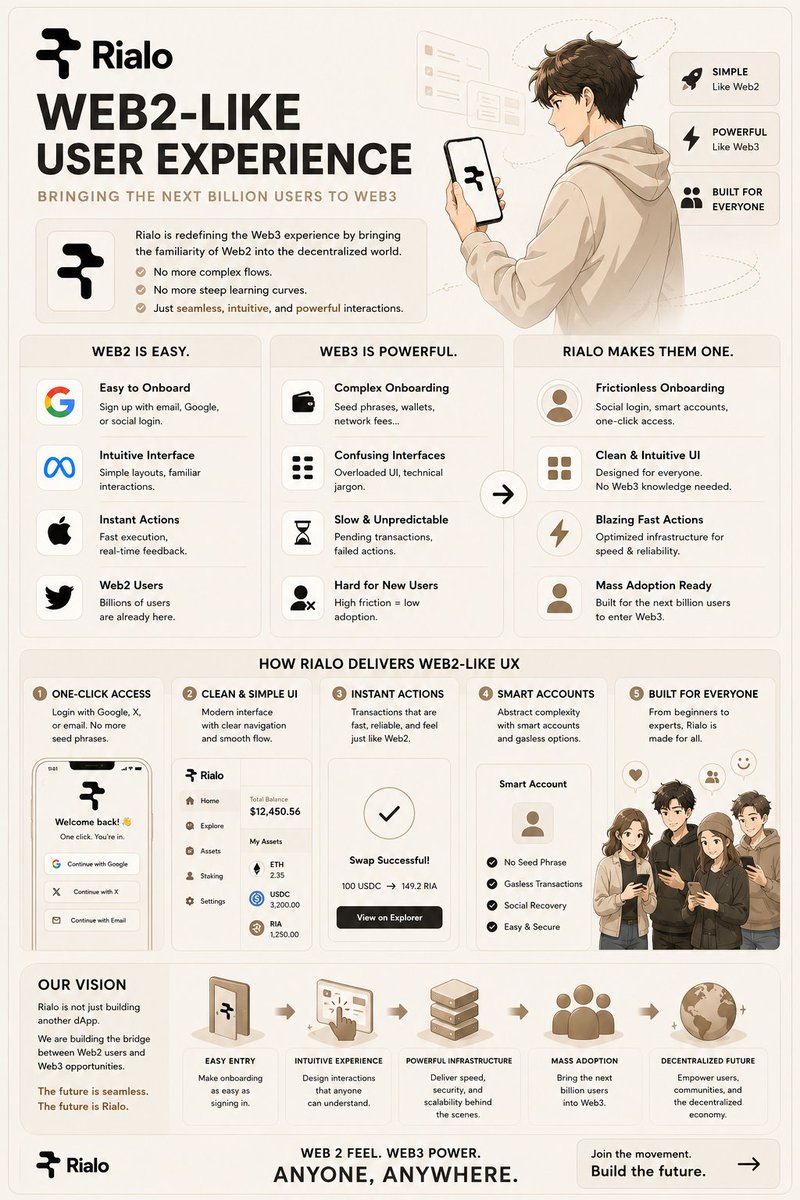
Most blockchains still feel like they are built for developers, not actual people. You’ve got wallets everywhere, bridges that break, gas fees popping up out of nowhere. It is exhausting.
That’s the gap @RialoHQ is going after. Rialo isn’t trying to launch just another fast L1.The goal is different: a chain that actually talks to the real world and doesn’t make you jump through hoops to use it.
Think apps that feel as smooth as Uber, WhatsApp, Instagram but running on Web3 underneath. You wouldn’t even need to know it’s crypto. What got me was how much they’re obsessed with usability:
• log in with email or social, no seed phrase dance
• SMS/email identity baked in
• scheduled transactions and automation that just work
• direct API connections to real-world data
And it’s all native to the chain. No ducttaping 5 external tools, bridges, and oracles together just to get something basic running.
The idea is simple to let developers build products, not babysit infrastructure.
Biggest takeaway for me is their stance on adoption. People won’t ditch Web2 comfort to go .So instead of forcing that switch, Rialo is bringing the chain to where people already are.
The vision makes sense that is make the blockchain invisible, make the apps actually usable, make Web3 feel normal. That’s how you get past the 100k crypto native users and into the real world.
Early, but I am bullish.
English
If execution no longer needs to be replayed by every validator, blockchain architecture changes completely.
that’s the direction @RialoHQ is building toward.
Instead of replicated execution:
• computation happens offchain
• the chain only verifies proofs
• then settles state
This unlocks:
• heavy computation
• private data
• real-time systems
while preserving trustlessness.
Most blockchains today are optimizing execution.
Rialo is optimizing verification.
read full article👇👇👇
Rialo@RialoHQ
English
I'm starting to use AI less and less for critical research.
It's been deluding me too much.
Days down a rabbit-hole of an idea I thought was bulletproof because Claude kept reinforcing it.
Only to find out with a simple google search it was illegal 😂
English