Jacopo Pasqualini

571 posts

Jacopo Pasqualini banner
Jacopo Pasqualini

Jacopo Pasqualini

@jcppsqln

Solvitur ambulando / Studying proteins at Schwede group @biozentrum, Basel (CH) / physics PhD @LIPh_Lab, Padova (IT) / Apprentice Philosopher

Basel, Switzerland 가입일 Kasım 2012
2.8K 팔로잉306 팔로워
고정된 트윗
Jacopo Pasqualini
Jacopo Pasqualini@jcppsqln·
📢📢📢 PAPER ALERT📢📢📢 I'm glad to share with y'all my first peer-reviewed paper! I, @SamirSuweis, and our collaborators tried to answer the question: what makes healthy and diseased gut microbiomes different? A thread on our stat.phys. answer 🧵1/n journals.plos.org/ploscompbiol/a…
English
2
4
18
1.6K
Jacopo Pasqualini 리트윗함
rcsb pdb 💉🧬💻🔬💊🌱🧠🦠
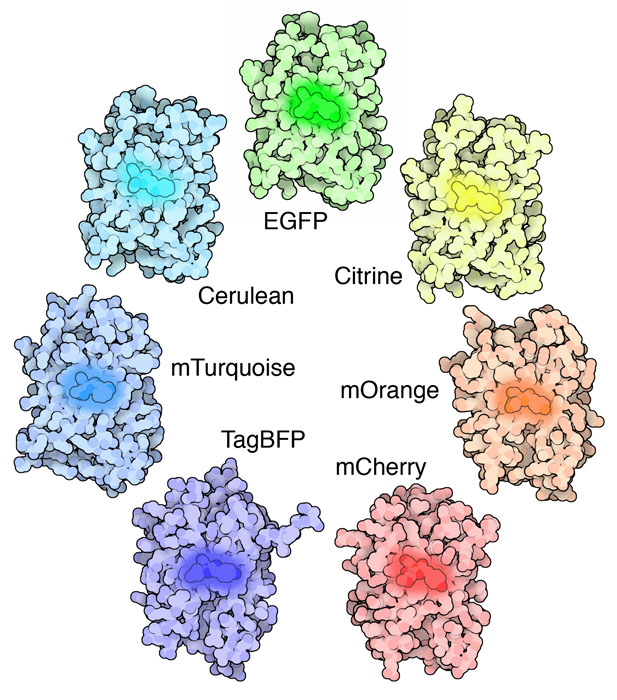
PDB-101 Focus: Biotechnology Learn how researchers are using biology in industry. Learn how GFP-like proteins found in nature or engineered in the laboratory now span every color of the rainbow pdb101.rcsb.org/motm/174
rcsb pdb 💉🧬💻🔬💊🌱🧠🦠 tweet media
English
0
48
198
8.5K
Malika 🧬
Malika 🧬@malikules·
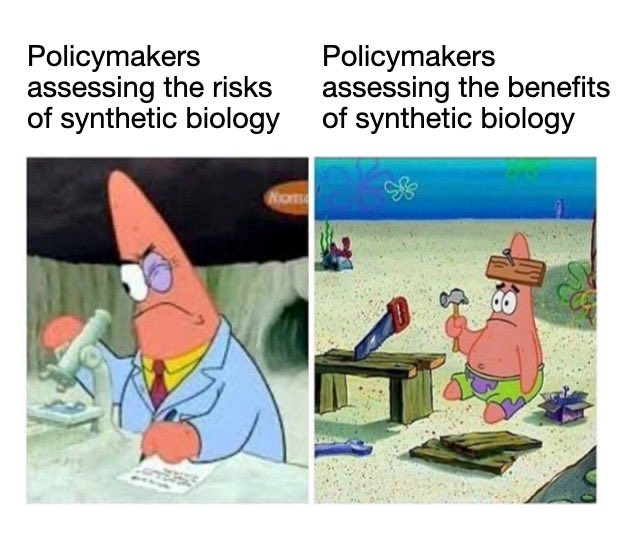
creating a groupchat for biotechies, humans-only, independent projects encouraged drop your fav bio-meme below to get added
English
110
7
248
14.2K
Jacopo Pasqualini 리트윗함
Niko McCarty.
Niko McCarty.@NikoMcCarty·
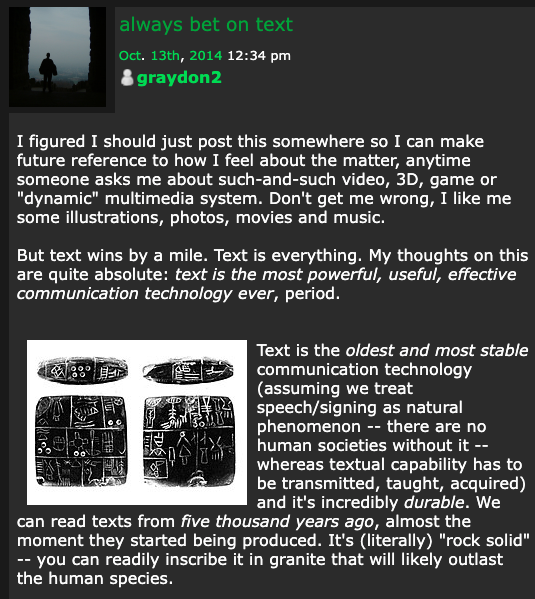
Some things I believe about writing: > It is the best, most efficient way to transmit ideas. (Brain-to-brain BCIs may surpass it someday.) Even the best YouTube videos or podcasts usually only convey a fraction of the ideas contained in an excellent essay. > It is faster to write than to make a video or record a podcast. Therefore, you should usually default to writing when exploring an idea. (And videos and podcasts usually involve a fair amount of writing anyway.) > Using AI to write for you (not research, or explaining a paper to you, but actually **writing**) will make you dumb. > Writing is a form of telepathy across space and time. Here's a passage from Stephen King that I love, about a table on which there is "a cage the size of a small fish aquarium. In the cage is a white rabbit with a pink nose and pink-rimmed eyes. In its front paws is a carrot-stub upon which it is contendedly munching. On its back, clearly marked in blue ink, is the numeral 8.... Do we see the same thing? We'd have to get together and compare notes to make absolutely sure, but I think we do." (King wrote this in 1999, and his thought of this rabbit, and what it looks like, shall remain firmly established for all time. Similarly, I can still read Pliny today and know exactly what he was thinking 2,000 years ago.) > It is the best way to make sure you, yourself, understand something. > If you can write something using simpler words, without distorting your meaning, then you should do so. > Adverbs are almost always your enemy; akin to a gentle lullaby that will strangle you into the passive tense. (And readers do not enjoy the passive tense.) This list will expand over time. Brief bibliography: - The Elements of Style by Strunk and White is the only book on writing worth reading. But Stephen King's "On Writing" is also nice. - "Always Bet on Text" by graydon2: graydon2.dreamwidth.org/193447.html
Niko McCarty. tweet media
English
3
13
93
17.8K
Jacopo Pasqualini 리트윗함
Biology+AI Daily
Biology+AI Daily@BiologyAIDaily·
Rewriting Protein Alphabets with Language Models 1. A groundbreaking study introduces TEA (The Embedded Alphabet), a novel 20-letter alphabet derived from protein language models, enabling highly efficient large-scale protein homology searches. This method achieves sensitivity comparable to structure-based approaches without requiring structural information, bridging the gap between deep learning representations and traditional sequence bioinformatics tools. 2. The core innovation lies in using contrastive learning to convert high-dimensional protein language model embeddings into a discrete alphabet. This allows for rapid sequence comparisons using optimized tools like MMseqs2, while retaining the ability to detect remote homologs with structural similarity, offering a powerful alternative to existing methods. 3. TEA demonstrates remarkable performance in benchmarks, achieving high sensitivity in detecting homologs within the SCOPe40 database and multi-domain proteins from the AlphaFold Database. It outperforms traditional sequence alignment methods and matches the accuracy of structure-based searches, all while maintaining low computational costs. 4. An intriguing aspect is the use of entropy as a confidence metric, providing a measure of prediction reliability. This allows researchers to filter results based on confidence levels, enhancing the accuracy of functional annotations and structural predictions, especially in challenging cases like disordered regions or poorly modeled structures. 5. The study highlights TEA’s potential to improve functional annotation by connecting structural singletons in the AlphaFold Database to cluster representatives. This approach identifies over 14 million new connections with high accuracy, suggesting TEA could revolutionize clustering efforts and reveal novel functional relationships. 6. Looking ahead, TEA offers a versatile framework for creating specialized alphabets tailored to specific biological goals, such as function prediction or interface description. This could extend its applications to RNA sequences and other areas, further integrating deep learning into bioinformatics workflows. 7. The TEA model and training scripts are available on GitHub, along with converted TEA sequences for popular databases like AFDB Clusters and UniRef50, making it accessible for researchers to integrate into their workflows. 📜Paper: biorxiv.org/content/10.110… #ProteinLanguageModels #Bioinformatics #ContrastiveLearning #HomologySearch #StructuralBiology #ComputationalBiology
Biology+AI Daily tweet media
English
2
24
100
6.4K
Hedinist
Hedinist@hedinist_·
Italian physicists bring an aesthetic sensibility to their figures that makes me vibrate with jealousy. I would not have come up with this light blue on yellow if stranded on the moon with one Jupyter notebook for ten thousand years
Hedinist tweet media
English
22
89
1.5K
50.8K
@levelsio
@levelsio@levelsio·
The Dutch took over in supremacy around 1620 from the Portuguese (and Spanish) and Amsterdam became the financial center of the world 🇵🇹 Portugal was 1 million people, the 🇳🇱 Dutch Republic was 2.5 million, so 2.5x the size, more people and more rich and dominated them at sea 🇬🇧 Then around 1700 the British who were literally a poor backwater island looked what the Dutch were doing it, copied it very well and scaled it, they had 5 million people (2x more than the Dutch) and 7x more land (and resources) 🇺🇸 Then in 1950, after World War 2, the Americans took over from the British. The US had 150 million people, while UK had just 50, so US was 3x more, and they had 40x more land (and resources) Do you see the pattern? The country who takes over next from the top empire usually copies them, and then has more people and more resources
Christoph Breuer@chribreuer

Be the Dutch in the 17th ce: -Dominate world trade -Art is seen as a golden age -Build a Northern Venice -Center of philosophy/science 17th c. ends: it's all over Van Gogh/a few physicists aside, there wasn't a single outstanding Dutch anymore. What did they mean by this?

English
152
79
1.5K
201.3K
Jacopo Pasqualini 리트윗함
Denys Shtilierman
Denys Shtilierman@DenShtilierman·
Серия спутниковых снимков демонстрирует, как с каждым годом разрастается Мариупольское кладбище. Масштабы захоронений — ужасающие. По оценкам разных источников, Россия убила более 100 тысяч русскоязычных жителей Мариуполя.
Русский
183
997
2.8K
418.8K
doopiidoo
doopiidoo@doopiidoop·
ZXX
85
766
5.8K
149.4K
Jacopo Pasqualini
Jacopo Pasqualini@jcppsqln·
@tessafyi You can check for spurious proteins with psauron (all reading frames + spurious detection), antifam search (agains spurious proteins), maybe different kmer distribution (k=3,4) for nucleotidic sequence. k=4 is usually used for metagenomic binning
English
1
0
1
27
Tessa Alexanian
Tessa Alexanian@tessafyi·
A bioinformatics puzzle: you have a piece of DNA with very little homology to natural sequences. How would you distinguish between abiological sequences (e.g. DNA origami or data storage) and AI protein designs?
English
36
23
197
18.1K
Jacopo Pasqualini
Jacopo Pasqualini@jcppsqln·
@anshulkundaje Reading the post, I had a similar impression. Also, the preprint there are few vibes but, rather, many nice checks. More, doing all these experiments could not be more distant from running something vibecoded. That post is hype-vibed
English
0
0
0
13
Jacopo Pasqualini
Jacopo Pasqualini@jcppsqln·
@BrianHie @samuelhking Seeing that generative genomics can fly in the lab is really encouraging for those working in this space. The future seems bright
English
0
0
1
28
Brian Hie
Brian Hie@BrianHie·
Welcome to the age of generative genome design! In 1977, Sanger et al. sequenced the first genome—of phage ΦX174. Today, led by @samuelhking, we report the first AI-generated genomes. Using ΦX174 as a template, we made novel, high-fitness phages with genome language models. 🧵
Brian Hie tweet media
English
36
208
1K
97.8K
Jacopo Pasqualini 리트윗함
Rayan Chikhi
Rayan Chikhi@RayanChikhi·
🌎👩‍🔬 For 15+ years biology has accumulated petabytes (million gigabytes) of🧬DNA sequencing data🧬 from the far reaches of our planet.🦠🍄🌵 Logan now democratizes efficient access to the world’s most comprehensive genetics dataset. Free and open. doi.org/10.1101/2024.0…
Rayan Chikhi tweet media
English
5
147
378
66.1K
Jacopo Pasqualini 리트윗함
arXiv.org
arXiv.org@arxiv·
#HBD to arXiv!🎈 On August 14, 1991, the very first paper was submitted to arXiv. That's 34 years of sharing research quickly, freely & openly! Some baby pictures to show how far we've come . . . when we were just a computer under desk . . . & in our 1994 punk phase . . . 👶💾
arXiv.org tweet media
English
15
172
761
32.7K
Francesco Venier
Francesco Venier@checovenier·
Capisco il dolore, venendo pure io da un’area interna. Ma rivitalizzare le aree interne è un obiettivo velleitario. I giovani se ne vanno da anni e ormai sono popolate solo da anziani. Qualcuna si potrà salvare con un po’ di agricoltura montana o di turismo lento, ma è una goccia, se non c’è reddito non ci può essere futuro.
Gilberto Trombetta@Gitro77

"C’è un passaggio, in un documento ministeriale pubblicato quasi in sordina all’inizio dell’estate, che dovrebbe far tremare le fondamenta della nostra Repubblica. È una frase contenuta a pagina 45 del nuovo Piano Strategico Nazionale delle Aree Interne 2021-2027 (PSNAI), approvato con grande ritardo e redatto tra le nebbie dei dipartimenti centrali. Si trova nell’“obiettivo 4: Accompagnamento in un percorso di spopolamento irreversibile”. E recita: “Queste aree non possono porsi alcun obiettivo di inversione di tendenza ma nemmeno essere abbandonate a se stesse. Hanno bisogno di un piano mirato che le accompagni in un percorso di cronicizzato declino e invecchiamento”. Non è una battuta, né un refuso. È la nuova linea di indirizzo strategico dello Stato verso centinaia di Comuni italiani, per lo più montani, collinari o rurali. Si tratta di un cambio di paradigma silenzioso ma devastante: si rinuncia ufficialmente all’idea di invertire la tendenza allo spopolamento. Si pianifica il declino. Lo si accompagna. Lo si normalizza. Per capire la portata della questione, bisogna risalire alla definizione di Aree Interne: sono quasi 4.000 Comuni italiani, sparsi in ogni regione, che si trovano lontani dai centri dove si concentrano servizi essenziali come sanità, istruzione e mobilità. Coinvolgono oltre 13 milioni di cittadini, il 23% della popolazione, distribuiti su quasi il 60% del territorio nazionale. In pratica, l’Italia profonda. Quella che custodisce boschi, pascoli, acque, borghi storici, comunità coese. E che oggi si vede diagnosticare una malattia terminale. Nel PSNAI, approvato nel marzo 2025 ma diffuso solo ora, lo Stato compie una distinzione netta tra territori rilanciabili e territori senza speranza. I secondi, si legge, hanno una struttura demografica compromessa, con popolazione in forte declino e basse prospettive di sviluppo. E quindi, si conclude, non possono avere obiettivi di rilancio. Ma cosa significa, in pratica? Significa che non si investirà più per trattenere giovani o attrarne di nuovi. Che non si costruiranno più servizi in quei luoghi. Che si pianificherà una dignitosa decadenza: un welfare del tramonto che fornisca badanti e medicine, ma non opportunità né speranza. Un gruppo di studiosi, amministratori e attivisti, riuniti il 12 giugno dal CERSTE, ha avuto il coraggio di dire le cose come stanno: questo documento è un verdetto, non una strategia. E viola in spirito l’articolo 3 della Costituzione, là dove parla dell’impegno della Repubblica a rimuovere gli ostacoli che limitano l’eguaglianza e la partecipazione di tutti i cittadini. Invece di rimuoverli, li si consacra. Si adottano criteri tecnici, tempi di percorrenza, densità, indicatori statistici che ignorano la realtà sociale e culturale dei luoghi. Si dimentica che molte fragilità sono state indotte da scelte politiche e tagli strutturali. Che non si può misurare la vitalità di un borgo solo coi numeri dell’anagrafe. Le implicazioni economiche sono enormi. Si accentua la polarizzazione tra città affollate e campagne abbandonate. Si crea un’Italia a doppia velocità dove le periferie non sono più nemmeno oggetto di recupero, ma di gestione passiva. Eppure, proprio in quei territori ci sarebbero opportunità strategiche: agricoltura sostenibile, turismo lento, energie rinnovabili, coesione sociale, difesa idro-geologica. Il paradosso è che nel resto d’Europa, dalla Francia ai Paesi nordici , le aree rurali sono oggetto di investimenti e valorizzazione. Hanno rappresentanza istituzionale, accesso a fondi dedicati, programmi a lungo termine. In Italia, invece, si preferisce accompagnare al tramonto. Non è solo un errore tecnico. È un messaggio devastante: Non contate più. È anche una questione di dignità: le comunità che resistono nelle Aree Interne non vogliono compassione. Vogliono giustizia, possibilità, strumenti. Questo è il punto che il PSNAI ignora. Le Aree Interne non sono solo problemi da contenere, come pare emergere dal documento. Sono risorse da liberare. E se l’Italia vuole davvero essere una nazione coesa, deve smettere di pensare in termini di resa amministrativa e tornare a fare politica, nel senso più alto: ascoltare, valorizzare, scegliere. Perché un Paese che dichiara la fine di sé stesso, un borgo alla volta, sta smettendo di essere una Repubblica".

Italiano
59
28
316
55.5K