

Mark Jansen
11.6K posts

Mark Jansen
@markjansen10
International and global policy comms at Stripe. Previously Google, and a few other places. When not working: 🚴♂️🏃♂️🎸📚🏕️ 🥾👨🍳.
The Netherlands, Brussels 가입일 Haziran 2009
3.1K 팔로잉3.1K 팔로워
Mark Jansen 리트윗함

Dear Parisians:
On Thursday, April 16, please join Works in Progress and Stripe for an evening of conversation about how France can capitalise on its existing successes – good infrastructure, abundant clean energy and some of the best people on Earth – to prosper economically once again.
The evening will include remarks on innovation and progress from @a_bergeaud, as well as a comparative look at the French and British economies from Works in Progress's @bswud, @SCP_Hughes and @pietergaricano.
We hope to see you there!
luma.com/kw9waijc?tk=T4…
English
Mark Jansen 리트윗함
Mark Jansen 리트윗함

We need a tax on self-driving cars.
Beneath eight states of the American Great Plains lies the Ogallala Aquifer, one of the largest bodies of groundwater on Earth. For centuries, extraction was constrained by the modest capacities of wind and hand power. At that rate, this 'fossil water' resource was effectively limitless. Farmers could draw as much as they wanted without ever running it down.
worksinprogress.co/issue/escaping…
But in 1949 Colorado Farmer Frank Zybach invented centre-pivot irrigation. Combined with electricity and the centrifugal pump, farmers could now draw thousands of gallons per well per minute, enough to irrigate 40 acres at a time. Since then, the aquifer has gone down 10%, losing a Lake Erie's worth of water. It is down 50% in the dry parts, where it recharges just 0.02 inches per year. Without intervention, modern pumps will bring about the total end of irrigated farming in the arid parts of the Great Plains in 20-30 years.
This is what I call the Ogallala Trap. Technological change can create a new tragedy of the commons. The telegraph enabled the destruction of the passenger pigeon; sonar, radar, and diesel enabled the industrial trawling that devastated the North Sea cod in a decade; chlorofluorocarbons came close to destroying the ozone layer.
Self-driving cars are about to do the same thing to roads. When you can sleep, work, or drink with friends in a moving vehicle, you will take many more journeys by car. Roads, which are free at the point of use almost everywhere, will grind to a halt. People who have to go to the office or the hospital will be stuck sharing the road with people having beers, working remotely, and taking naps.
There is a fix, but it depends on acting now, before autonomous vehicles go mainstream. Voters balk at being charged more for something they already depend on. The tax needs to come in as soon as possible. Waymos are already in dozens of cities and do millions of journeys per month. We have very little time left. If we want to save our roads from omnigridlock, we must introduce road pricing for autonomous vehicles.

English
Mark Jansen 리트윗함
Mark Jansen 리트윗함
Mark Jansen 리트윗함

A Danish scientist counted bugs on the same windshield, same road, same conditions, every year for 20 years. By year 20, 80% of the insects were gone.
In Germany, a group of volunteer bug scientists did something even bigger. They set traps in 63 nature reserves, not farms, protected land, and weighed everything they caught. Same traps, same method, 27 years straight. The total weight of flying bugs dropped 76%. In midsummer, when insects should be peaking, it was 82% gone. A follow-up in 2020 and 2021 checked again. No recovery.
In the UK, they literally ask drivers to count splats on their license plates after a trip. The 2024 count came back 63% lower than just 2021. Three years.
A 2020 study pulled together 166 surveys from 1,676 locations around the world. Land insects are disappearing at roughly 9% every ten years.
Here’s where it hits your plate. About 75% of the food crops we grow depend on insects to pollinate them, everything from apples to almonds to coffee. One 2025 study modeled what a full pollinator collapse would look like: food prices jump 30%, the global economy takes a $729 billion hit, and the world loses 8% of its Vitamin A supply.
Birds are already feeling it. North America has lost 2.9 billion birds since 1970. A study from just weeks ago found half of 261 bird species on the continent are now in serious decline, and the losses are speeding up in farming regions. The birds that eat insects lost 2.9 billion. The birds that don’t eat insects? They gained 26 million. That ratio tells the whole story.
One of the German researchers behind the 27-year study drives a Land Rover. He says it has the aerodynamics of a refrigerator. It stays clean now.
MAVERICK X@MAVERIC68078049
I am sure many of you have noticed this.
English
Mark Jansen 리트윗함

This so perfectly describes what it felt like to work at Stripe and, specifically, on the Comms team — which in many ways is an unsatisfactory way to describe such an interdisciplinary group of talented people. I highly encourage curious folks to apply.
Ollie Rickman@ollierickman
English
Mark Jansen 리트윗함

Many truly terrific people getting in touch about joining Stripe comms. If you've applied, we're working through applications as fast as we can! If you haven't yet, more info here: stripe-comms.lovable.app
English
Mark Jansen 리트윗함

Everyone’s talking about the K-shaped economy—the rich pulling away while everyone else stagnates.
In our inaugural Stripe Economics post, I take a look at @stripe + macro data, and I see the K on Wall Street, but not yet on Main Street:
• The most profitable third of US public companies now account for ~2/3 of total market cap—the highest on record.
• The S&P 500 rose 16.5% in 2025, and the top 1% own ~40% of all equities. So unsurprisingly the top 1% wealth share has risen (~2pp) since 2022.
• BUT, Stripe data suggest lower-income household spending has been growing faster than high-income households over the last few years.
• Wages tell a similar story: real earnings at the 10th percentile grew ~0.5pp slower than the 90th since 2022, but BOTH posted positive real wage growth.
• Why? 1) The wealthy hold lots of equities but only account for ~25% of consumer spending. 2) Real wages at the bottom have been supported by continued labor market tightness post-pandemic, though this may cool.
Read the full post below and subscribe!
stripeeconomics.substack.com/p/k-shaped-eco…
English
Mark Jansen 리트윗함

Stripe is the best place to do comms on the planet
And our team is growing
Ollie Rickman@ollierickman
English

Mark Jansen 리트윗함

Tomorrow on Cheeky Pint: @btaylor joins me to talk about the “fog of war” in software, building ahead of model capabilities, and why charging based on tokens is a mistake.
English
Mark Jansen 리트윗함
Mark Jansen 리트윗함
Mark Jansen 리트윗함

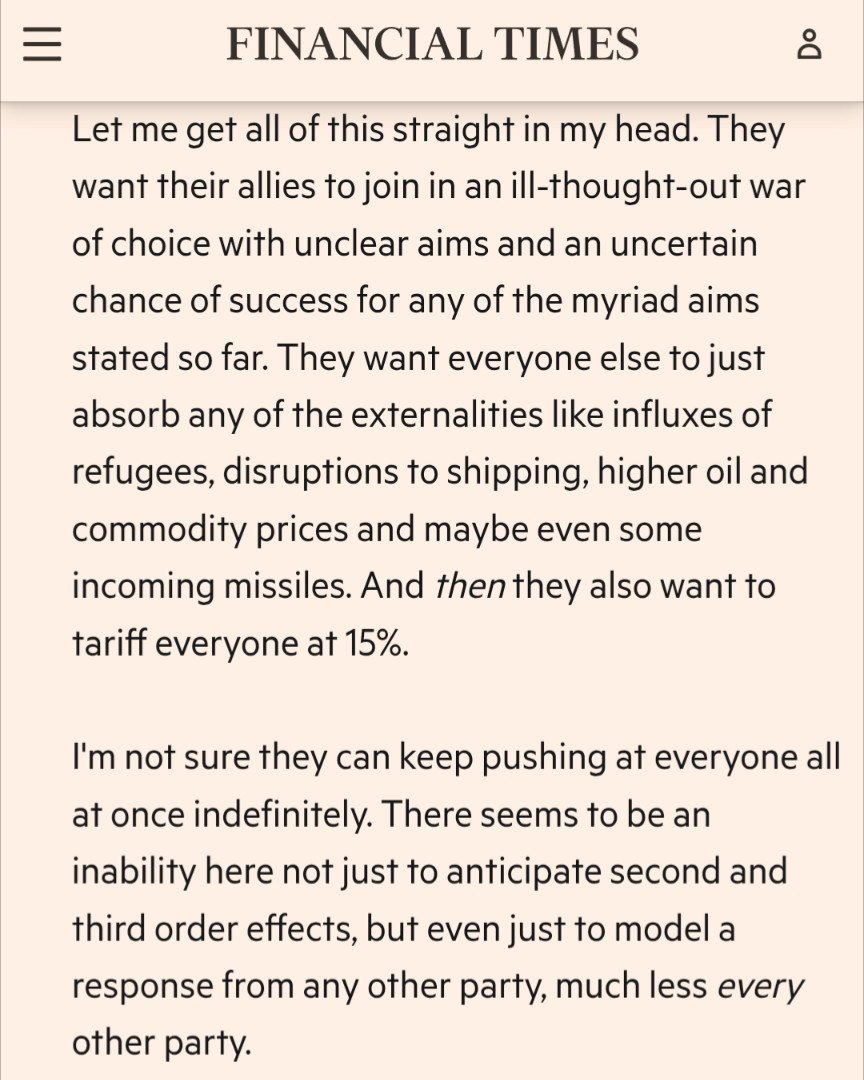
Fascinating to watch first 🇫🇷, then 🇬🇧, then 🇮🇹, now 🇩🇪 start to acknowledge what 🇪🇸's government recognised from the very start: the Trump-Netanyahu war on Iran is a reckless intervention conducted without regard for the rules of war and without a strategy for what comes next.
Bloomberg@business
German Chancellor Friedrich Merz warned the US and Israel against waging an “endless war” against Iran that could lead to the disintegration of the whole Middle Eastern state, a new migration crisis in Europe and lasting economic damage. bloomberg.com/news/articles/…
English
Mark Jansen 리트윗함
Mark Jansen 리트윗함

Stripe (@stripe) now supports 1.6% of global GDP.
The EMEA CRO joined us to discuss the Internet Economy, and why 80% of the NASDAQ 100 and 90% of the Dow Jones now rely on @stripe's infrastructure:
"The number grew 34% year-on-year... we've been heavily indexed toward the fastest-growing parts of the internet economy".
Conor highlights that Stripe isn't just for startups anymore: "From the fastest growing early-stage startups to large enterprises... there's real diversity in the customer base".
Stripe@stripe
The internet economy is speeding up. Last year, businesses running on Stripe generated $1.9 trillion in total volume, equivalent to roughly 1.6% of global GDP. The 2025 cohort of new companies joining Stripe was both the largest and the fastest we’ve ever seen.
English
Mark Jansen 리트윗함

Karoline Leavitt: "we had a very stupid and incompetent leader in this White House for four years who gave away many of our best weapons for nothing, for free, to another country very far away by the name of Ukraine."
Honestly, the sheer heartlessness, ruthlessness, and cruelty of saying that while we are still under attack, trying to survive. While entire families are being killed in russian bombings due to a lack of air defense missiles, and when we barely survived last winter’s humanitarian catastrophe caused by russian strikes on our infrastructure. I don’t know... I’m just stunned.
English
Mark Jansen 리트윗함

"Belgians are 6% richer than New Yorkers while working 24% fewer hours." (h/t @SethAckerman)
The idea that Europe should follow the US when it comes to productivity and competitiveness is not supported by the data. The Draghi Report is bad policy advice.
sethackerman.substack.com

English
Mark Jansen 리트윗함