the "wrong-rule" audit is a great way to test your education app. For example, in this question, if we're asking them to select all the vectors, a student could figure out this question by applying the "wrong-rule"
PhysicsGraph
279 posts


the "wrong-rule" audit is a great way to test your education app. For example, in this question, if we're asking them to select all the vectors, a student could figure out this question by applying the "wrong-rule"

PhysicsGraph is being upgraded with manim animations in many of the lessons to help reduce cognitive overload. There's a lot to making these actually achieve the desired aim. Take a look at the following video:

"What is a parabola?" is not a question you expect to hear from an 11th grader one week away from taking the ACT for college admissions. Yet this is exactly what happened this morning -- and this student is not the only one who has never been properly taught algebra or trigonometry even by the end of their junior year. Among my current roster of 20 students, approximately half were struggling from the same lack of prerequisite knowledge. The consistency in the deficiencies across states and school districts makes it obvious that this isn't a coincidence. We have a teaching, curriculum, and standards problem across the country, especially when it comes to reading and higher-level math. The confusing part is that this student knows how to factor quadratic equations, yet she doesn't know what they actually are, what their "roots" or "solutions" mean, what their standard form/vertex form are, or how to graph one. She does not recall the term "polynomial." There is no conceptual understanding whatsoever. This is concerning because quadratics and related concepts can easily make up 40% of the ACT Math portion. Thankfully, these concepts are also fairly easy to teach -- but that tells you even more about how schools are just not putting in any effort. It's just blatantly obvious that these schools do not care about college readiness whatsoever. They are not concerned with providing you the tools to succeed. As tutors, we are able to see these gaps clearly. The SAT and ACT test nothing more than basic algebra/trig. Nothing advanced at all. In the past, these standardized tests were significantly harder, and tutors might've actually been needed for help with logical thinking and advanced math techniques. But today? The reality is that my job only exists because our schools are utterly failing. I would happily give up my job if it meant students were actually equipped with the knowledge they needed to succeed in life. Yet, if we don't see this effort from the better, more funded schools or even private schools, then what can we even expect from everyday public schools? I guess my post is -- what the hell is going on?!

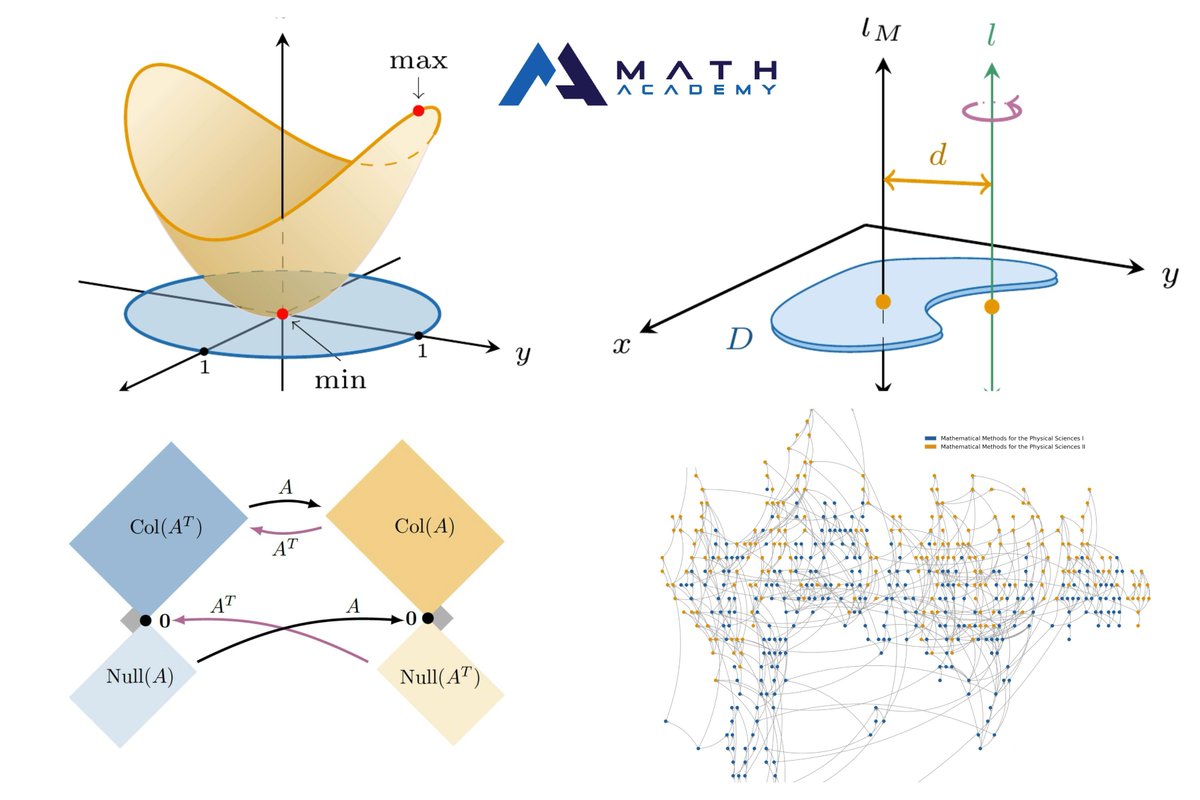
I'm delighted to announce that @_MathAcademy_ has released two courses in Mathematical Methods for the Physical Sciences. Designed for students who want the mathematical tools needed for undergraduate-level study in physics, engineering, and other STEM fields. Details below👇


A nice side effect of self studying physics is it's improved my confidence. A lot of the material came across quite intimidating to me before but you can learn it gradually with time, consistency, and motivation. It only gets harder but I'm excited to keep building on learnings

I just gave a closed-book, pen-and-paper midterm exam in my 300-level course at UBC with 100 students. All exams were graded by an experienced graduate-level TA according to a rubric. *** The average was 64/100.*** My class averages at UBC are usually 80-85. Context: • This was the first midterm, covering ONLY 4 weeks of material. • Students had a list of possible questions in advance: no surprise questions. • Questions included (a) 3 concept definitions, (b) 3 paragraph-long questions, and (c) a 1.5-page essay. • I have taught this class multiple times. Nothing in my teaching style changed this semester. • We read entire paragraphs of text in class, so students don't have to do something on their own that wasn't covered during the lecture. • Students take a 10-question multiple-choice quiz at the end of every class (30% of the final grade). • Attendance is 95-99% every class. Attention during lectures and participation in pair-work activities are very high → anticipating the end-of-class quiz. *** But unfortunately, I suspect many students are not reading the material on the syllabus. They are asking LLMs to summarize it instead.*** After the midterm, students reported: • They thought they knew concept definitions but couldn't produce them on paper. • They thought they understood the arguments but struggled to connect them or identify points of agreement and disagreement. My view: It might be “cool” or “innovative” to teach students to summarize readings with ChatGPT or write essays with Claude. But we may be doing them a disservice: reducing their ability to retain material, think creatively, and reason from what they know. If you only read what AI has summarized for you, you don’t truly "know" the material. Moving forward: We have a second midterm coming up. I don't know how to convey to students that the best way to do better on the exam is to rely on and improve their own reading skills.