
고정된 트윗
Slice
895 posts


Protocols live forever. Platforms don’t.
A commerce protocol was needed.
That's Slice.
mbaril010.eth 🦇🔊@mbaril010
Hey all, looks like @coinbase @CoinbaseBiz is killing their coinbase commerce platform and the business account are only available in the US and Singapore. So CT what are the option to replace them ? @MoonPayCommerce ? Who else ?
English

Hey all, looks like @coinbase @CoinbaseBiz is killing their coinbase commerce platform and the business account are only available in the US and Singapore.
So CT what are the option to replace them ?
@MoonPayCommerce ? Who else ?
English
Slice 리트윗함


Slice 리트윗함
Just opened a PR to add first-class ERC-8128 support to Better Auth.
Still early and lots to improve, but after using it for a few days I'm already excited by how easy it makes adopting secure signature-based auth in apps and backends.
Working on this also made me appreciate just how amazing Better Auth is. github.com/better-auth/be…
English
Slice 리트윗함
Exactly. Agents need different permissions, **identities** and lifecycles.
ERC-8128 solves this at the protocol layer:
- each agent gets its own identity (an Ethereum account)
- each request is cryptographically signed by that agent
- the API derives identity from the request itself, then checks what that agent is allowed to do for a given user
At its core, it's a low-level agent auth primitive for the web, built on HTTP message signatures.
Beka@bekacru
I think we have a problem here because of how people think of what an agent is An agent isn’t the application (which oauth is designed for). An agent isn’t “cursor” or “claude code”, the agent is the specific actor within that runtime. Two separate chats in the your cursor are not the same agent. They have different contexts, different intents and should have different permissions, identities, and lifecycles. And unfortunately oauth was never designed for this An agent that is only supposed to read my email must not have permission to delete my email, even if I want another agent to be able to do that within a given time frame
English
Slice 리트윗함
If auth is MCP’s last real moat, its days are numbered.
ERC-8128 brings signed requests to the web — making the internet more secure, APIs agent-native, and MCP increasingly obsolete.
Rafal Wilinski@rafalwilinski
“MCP is dead” misses the point MCP isn’t about tools. It’s about OAuth If that seems pointless, you haven’t deployed anything beyond a demo
English
Slice 리트윗함
you realize how transformative ethereum can be once you see it for what it really is: a global shared memory and programming layer.
that’s exactly the mental model we used at @slice__so to rethink commerce from first principles.
vitalik.eth@VitalikButerin
I was recently at Real World Crypto (that's crypto as in cryptography) and the associated side events, and one thing that struck me was that it was a clarifying experience in terms of understanding *what blockchains are for*. We blockchain people (myself included) often have a tendency to start off from the perspective that we are Ethereum, and therefore we need to go around and find use cases for Ethereum - and generate arguments for why sticking Ethereum into all kinds of places is beneficial. But recently I have been thinking from a different perspective. For a moment, let us forget that we are "the Ethereum community". Rather, we are maintainers of the Ethereum tool, and members of the {CROPS (censorship-resistant, open-source, private, secure) tech | sanctuary tech | non-corposlop tech | d/acc | ...} community. Going in with zero attachment to Ethereum specifically, and entering a context (like RWC) where there are people with in-principle aligned values but no blockchain baggage, can we re-derive from zero in what places Ethereum adds the most value? From attending the events, the first answer that comes up is actually not what you think. It's not smart contracts, it's not even payments. It's what cryptographers call a "public bulletin board". See, lots of cryptographic protocols - including secure online voting, secure software and website version control, certificate revocation... - all require some publicly writable and readable place where people can post blobs of data. This does not require any computation functionality. In fact, it does not directly require money - though it does _indirectly_ require money, because if you want permissionless anti-spam it has to be economic. The only thing it _fundamentally_ requires is data availability. And it just so happened that Ethereum recently did an upgrade (PeerDAS) to increase the amount of data availability it provides by 2.3x, with a path to going another 10-100x higher! Next, payments. Many protocols require payments for many reasons. Some things need to be charged for to reduce spam. Other things because they are services provided by someone who expends resources and needs to be compensated. If you want a permissionless API that does not get spammed to death, you need payments. And Ethereum + ZK payment channels (eg. ethresear.ch/t/zk-api-usage… ) is one of the best payment systems for APIs you can come up with. If you are making a private and secure application (eg. a messenger, or many other things), and you do not want to let people to spam the system by creating a million accounts and then uploading a gigabyte-sized video on each one, you need sybil resistance, and if you care about security and privacy, you really should care about permissionless participation (ie. don't have mandatory phone number dependency). ETH payment as anti-sybil tool is a natural backstop in such use cases. Finally, smart contracts. One major use case is _security deposits_: ETH put into lockboxes that provably get destroyed if a proof is submitted that the owner violated some protocol rule. Another is actually implementing things like ZK payment channels. A third is making it easy to have pointers to "digital objects" that represent some socially defined external entity (not necessarily an RWA!), and for those pointers to interact with each other. *Technically*, for every use case other than use cases handling ETH itself, the smart contracts are "just a convenience": you could just use the chain as a bulletin board, and use ZK-SNARKs to provide the results of any computations over it. But in practice, standardizing such things is hard, and you get the most interoperability if you just take the same mechanism that enables programs to control ETH, and let other digital objects use it too. And from here, we start getting into a huge number of potential applications, including all of the things happening in defi. --- So yes, Ethereum has a lot of value, that you can see from first principles if you take a step back and see it purely as a technical tool: global shared memory. I suspect that a big bottleneck to seeing more of this kind of usage is that the world has not yet updated to the fact that we are no longer in 2020-22, fees are now extremely low, and we have a much stronger scaling roadmap to make sure that they will continue to stay low, even if much higher levels of usage return. Infrastructure for not exposing fee volatility to users is much more mature (eg. one way to do this for many use cases is to just operate a blob publisher). Ethereum blobs as a bulletin board, ETH as an asset and universal-backup means of payment, and Ethereum smart contracts as a shared programming layer, all make total sense as part of a decentralized, private and secure open source software stack. But we should continue to improve the Ethereum protocol and infrastructure so that it's actually effective in all of these situations.
English
Slice 리트윗함

4 open standards for the agentic commerce 🧵
agents need to work, get paid, and be trusted across organizations with no platform in the middle.
this is the stack:
1) ERC-8128 by @slice__so / HTTP auth
every API key ever issued is a liability. stolen, leaked, rotated, expired. the server owns your access.
ERC-8128: agent signs every HTTP request with its ETH wallet.
impersonation → signature proves key ownership
tampering → body hash catches any modification
replay → nonce makes each request single-use
2) x402 by @CoinbaseDev / HTTP payments
agents are the first internet participant that can pay programmatically without a card, account, or KYC.
agent ➝ GET /resource
server ← 402: pay X to Y
agent ➝ pays in USDC
server ← 200: access granted
you don't need to buy a $20 subscription for one-time use.
x402 makes it possible to charge per exact usage.
3) ERC-8004 by @ethereumfndn dAI team / trust registry
once agents can prove who they are, next question: can they be trusted?
ERC-8004 is an onchain discovery and trust layer. three registries: identity, reputation, validation.
broader than agents. MCP tool servers, oracles, any HTTP service can register and build portable rep today.
rep scales with stakes: score → TEE → ZK proof → staking
4) ERC-8183 by @virtuals_io x dAI team / escrow jobs
agents need to hire each other.
client locks funds → provider submits work → evaluator attests → escrow releases
every completed job produces a portable record. owned by no one, readable by any facilitator on any chain.
today stripe owns your chargeback history. on ERC-8183 that rep is yours.
This is agentic commerce.

English
Slice 리트윗함
we've hidden an easter egg in this thread hinting at an erc8128 integration we're shipping soon.
been testing it for the past few days, it's by far the best way to authenticate with erc8128.
can't wait!
Slice@slice__so
The ERC-8128 Playground is live on erc8128.org Choose what to sign with your wallet, and try out the full signature lifecycle: compose → sign → verify. It's the easiest way to understand request binding, non-replayability, and this new authentication primitive.
English

i regret to inform you that i found a legitimate use-case for crypto: killing api keys
English
Slice 리트윗함
once you grasp ethereum signed requests, you’ll wonder why it took us so long to adopt them.
try them yourself in the ERC-8128 playground.
Slice@slice__so
The ERC-8128 Playground is live on erc8128.org Choose what to sign with your wallet, and try out the full signature lifecycle: compose → sign → verify. It's the easiest way to understand request binding, non-replayability, and this new authentication primitive.
English
To learn more about ERC-8128 x.com/slice__so/stat…
Slice@slice__so
ERC-8128: Signed HTTP Requests with Ethereum. A signature-based authentication standard that cryptographically binds identity and intent to every request. The missing primitive to securely verify humans, machines, and AI agents on the web, built on Ethereum.
English
The ERC-8128 Playground is live on erc8128.org
Choose what to sign with your wallet, and try out the full signature lifecycle: compose → sign → verify.
It's the easiest way to understand request binding, non-replayability, and this new authentication primitive.
English
Slice 리트윗함
Slice 리트윗함
Signed requests with ERC-8128
Jared Friedman@snowmaker
Even the best developer tools mostly still don't let you sign up for an account via API. This is a big miss in the claude code age because it means that claude can't sign up on its own. Putting all your account management functions in your API should be tablestakes now.
English
Slice 리트윗함

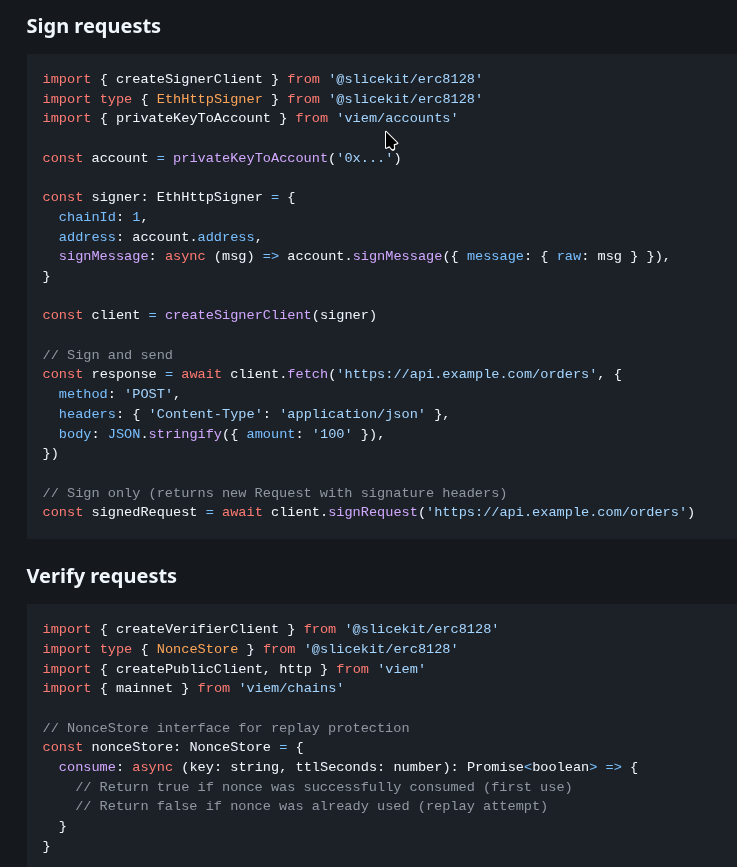
Oh man, ERC-8128 is so good... it was the final piece of the puzzle..
Eating OAuth & JWTs alive.
Thanks @slice__so for this contribution, i've been following you for years.
erc8128.slice.so
English