Soumyadeep Paul 리트윗함
Soumyadeep Paul
2.1K posts

Soumyadeep Paul
@spaultweet
Amateur investor, technology architect by profession, also interested in sports and science. occasional writer @ https://t.co/djjxih59lK
Bengaluru, India 가입일 Mart 2013
138 팔로잉179 팔로워
Soumyadeep Paul 리트윗함

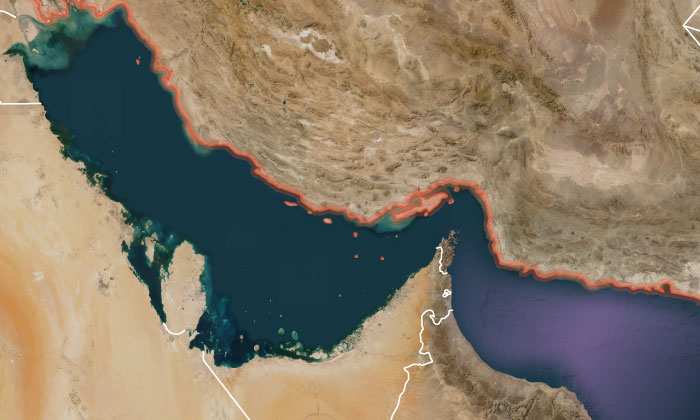
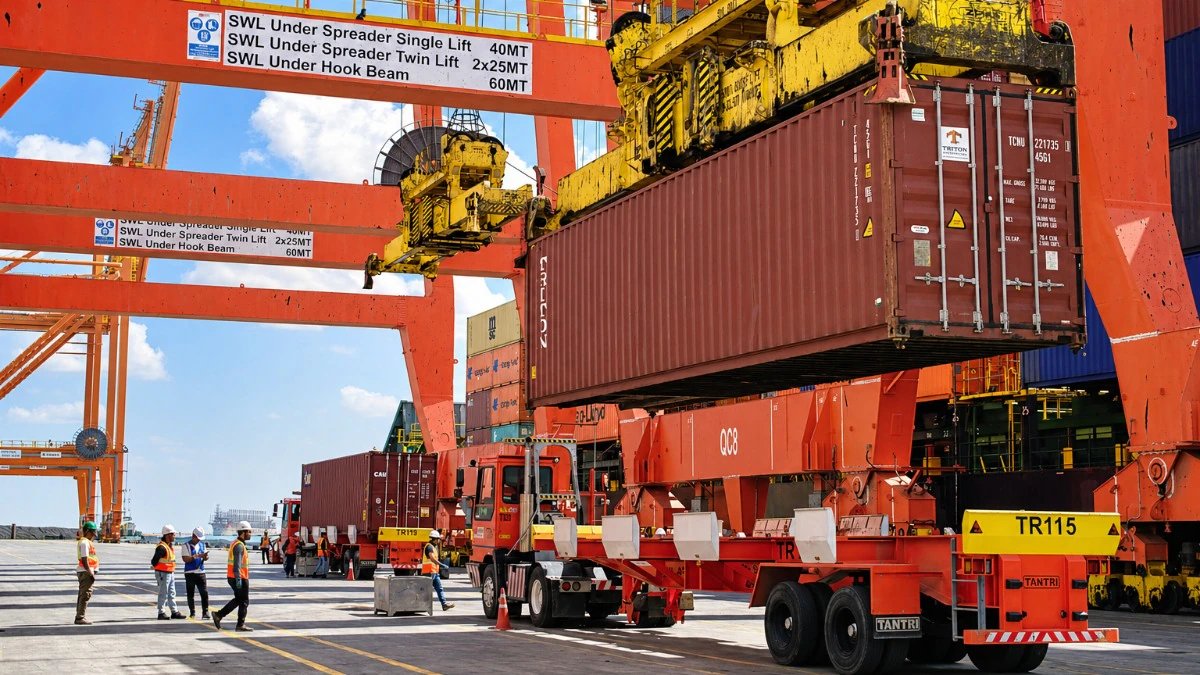
🇵🇰🇮🇷 Pakistan just opened 6 land corridors with Iran to route around the U.S. naval blockade.
3,000+ containers already in transit. Via Iran's own state media, so take the numbers with some salt, but the move itself tracks.
This is significant. The U.S. blockade only works if Iran is actually isolated. Pakistan sharing a 900km border and actively running cargo through it punches a hole in that logic.
China is watching. India is watching. Every country that trades with Iran and doesn't want to pick a side is watching.
How does Washington respond to an ally quietly dismantling its blockade?
Source: Fars News Agency


Mario Nawfal@MarioNawfal
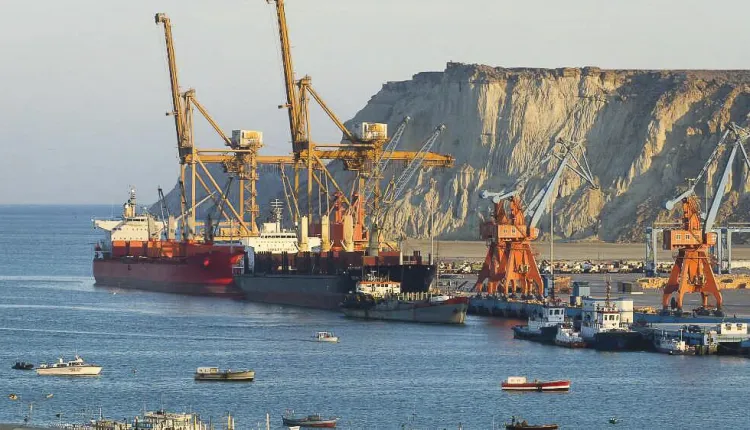
🇺🇸🇮🇷 CENTCOM confirms: 20 vessels are stranded in Iran's Chabahar port because of the U.S. blockade on Iranian shipping. $110 oil is the price the rest of the world pays while they wait for someone to flinch. How long can both economies sustain this simultaneously?

English
Soumyadeep Paul 리트윗함

Man goes to America.
Does PhD. Stays back. Gets job. Starts family. Starts business. Builds fortune. In that order.
Years pass. All well. All perfect. Until not anymore.
Problems in marriage. On the verge. Desperate to separate. Only one hurdle.
California is a “community property” state. Which means that wealth generated during a marriage is generally split 50-50 in a divorce. Whatever man owns of his business, wife gets half of it. Can’t let that happen. Solution?
Transfers almost all he owns to siblings in India. Shares, IPR, the works. Keeps only 5% to himself. And then?
Back to India. Two oceans away from California laws.
Away from American jurisdiction, under banners of “rural empowerment,” “austerity,” and “nation-building,” a new phase of life about to start. Unencumbered with the ghosts from the troubled marriage. But wait...man still married, right?
WhatsApp to the rescue.
Talaq...talaq...talaq.
Sorry, he no Muslim, so no talaq. Just a polite WhatsApp text saying, me want divorce.
Finally free. Unencumbered from the woman’s presence, breath of fresh air. New life. New narratives.
“The recluse” who owns just 5% of his business!
Except, sister safekeeps 47% and brother 35%. Nationalism, austerity, and build-in-India. Potent mix. Man becomes patron saint of Bharatmata’s arrival. But wife unwilling to give up.
Stranded with a specially abled son, woman moves court. In California. Court passes verdict. Man guilty of abandonment. Asked to post a billion-dollar bond. Man appeals. Loses.
Man tries restructuring business. Court says no.
Man must distance himself from the corporate helm at his business to safeguard interests. Steps down as CEO. Steps up as “chief whatever.” Convenient. Effective? Time will tell. But for now...
Quite the rockstar in home country. Writing open letters asking Indians to “come back for Bharatmata.” Basking in hero-worship. Might enter politics, the last refuge, you know.
Unsolicited advice:
Don’t listen to him.
He had to, you don’t. There’s a reason you left home. And that reason isn’t just money. It’s a quality of life your folks back home cannot begin to comprehend.
English
Soumyadeep Paul 리트윗함

Confessions and realities
42M, 55LPA
I am a 42-year-old man with a senior job in IT. I have a house in Chennai, a supportive wife, and two children. On paper, everything about my life looks perfect. I have achieved all the things society says a man should achieve.
In my twenties, life felt different. I had friends to spend time with. We would hang out at Marina Beach and Besant Nagar beach, watch movies at Rohini, Udayam, and Kasi theatres, and ride around Mount Road on my RX100.
In my thirties, I had colleagues to talk with over tea breaks. We would discuss apartments, onsite trips, and share random stories about life and work.
But now, in my forties, life has turned into a quiet routine. My phone rarely rings for anything personal. Most calls are about office work, bank alerts, or someone from home asking me to pick up milk on the way back.
The loneliness of a man in his forties is unusual. I am not physically alone, but I often feel like a machine.
When I enter my home, I am simply “Appa.” I am the person who pays school fees, fixes the Wi-Fi, and handles repairs. My wife is busy with her work and the kids. My children are teenagers now, living in their own worlds and their own rooms. They love me, but they mostly see me as the person who provides comfort and stability. They no longer see me as an individual.
At the office, I am the senior person. I am expected to have all the answers. I cannot tell my team that I feel tired. I cannot tell my boss that I sometimes struggle to keep up with new technologies. I must appear confident and strong, even when I quietly worry about the future.
Sometimes I drive home slowly from work just to spend a few extra minutes in the car. I listen to songs from my college days.
For those fifteen minutes, I am not a manager or a father. I am simply myself again.
I realize that I have not had a real conversation about my feelings with anyone in years.
My old friends now exist mostly as names on WhatsApp. We send “Happy Birthday” or “Congratulations” messages, but rarely talk. When we meet at weddings, our conversations revolve around our children’s grades or the cars we drive. We never talk about what we actually feel.
The hardest part is that I cannot even complain. If I tell my family that I feel lonely, they look confused and say, “But we are all here with you.”
They do not understand that a person can be surrounded by people and still feel like they are on a desert island.
Society teaches men that if they provide money and security, they have succeeded in life.
But no one teaches us how to deal with the silence that comes with it.
I have built a beautiful life for everyone around me, but sometimes it feels like there is no space left for me inside it.
And maybe… this is what life in your forties feels like.
English

@tarunoneworld @NKapoor2020 @TheClubJunto @AjuGeorge7 Of course people will ask questions because it is easier to question corporations than politicians.
Let’s talk about R&D budget of government. What about Indian military? Why did the govt reduce tax incentives for R&D.
What the govt doing to keep scholars in the country?
English

@NKapoor2020 @TheClubJunto @AjuGeorge7 Every shareholder is a stakeholder. So is every employee. The IT Sector is a key to India's progress. People will ask questions. Why do you have a problem?
English

Bernstein: India’s Ambitions are Hollow Without R&D Investments
1. No nation in history became a developed economy with R&D @ 0.65% of GDP
2. Labor Arbitrage Economy: Demand broken as wages stagnate for 10 yrs. You raise wages, you can’t compete. AI dents it further.
INSIGHTS:
R&D Intensity (% of GDP)
2000s
Korea: 3.12%
Taiwan: 2.7%
China: 1.32%
India: 0.82%
2010s
Korea: 4.29%
Taiwan: 3.3%
China: 2.11%
India: 0.75%
2020-25
Korea: 5.21%
Taiwan: 4.0%
China: 2.8%
India: 0.65%
Widening Innovation Gap: China’s GDP is 5X of India. Its R&D budget is 4X in % of GDP. So, in dollar terms, China is 5x4 = 20X of India’s R&D every year.
Labourers vs. Innovators
a. India’s Top 10 Companies: Combined R&D Expense 2025 (Thinking in Quarters): Below $1B
b. China Companies R&D Expense 2025 (Thinking in Decades): BYD $8B; Huawei $14B; Xiaomi $5B
c. Korea: In 1970s, private to government R&D share was 20:80. In 1990s, the ratio became 80:20. Korean government forced private sector to invest in R&D, reject short-termism, and massively incentivized firms with export credits and R&D tax credits.
d. Taiwan: In 1980s, the government funded research labs for semiconductors. The “seed” was sown by the government; the “scale” was led by private sector. Today a single company TSMC controls 70% world market share in semiconductor pure-play, driven by AI demand.
e. China: In 1980s, India and China had similar R&D investments. China realized that technology was their only guarantee of national survival. The government and private sector formed a combined “war machine” to become the “IP owner” and not just the “world’s factory” for tech goods.
India’s Scarcity Mindset
a. While Korean and Chinese companies operate in a culture that rewards global innovation, Indian companies operate in a culture that rewards bowing down before bureaucrats and ministers.
b. To grow in India, you don’t need to build world-beating products. You just need to operate in those areas of the domestic economy where government policy favours Indians over foreign businesses.
c. Think of a student whose father owns the school, and no other students are allowed to sit in the exam. What will be his capability? While other countries demand global dominance as a point of national pride, Tata, Reliance, and Adani cannot even make a candy that sells in the world market.
d. Curse of Cheap Labor: Indian IT companies realized that when you can make 20% margin by selling cheap labor, why build a semiconductor factory that requires $20 billion CapEx? They kept distributing lakhs of crores in dividends (mainly to promoters) while the world invested in AI and chips.
e. The GCC Paradox: India now has over 50% of the world's Global Capability Centers (GCCs). From Google to Walmart to Mercedes, the world’s best tech innovation and research is happening in India, but the Intellectual Property (IP) belongs to other countries. So, we remain only “cheap labour” for others.
Low Wages; Broken Consumption
a. Labour arbitrage economies enjoy GDP growth till wages keep rising. But wage growth stalls when other poor economies like Bangladesh or Philippines catch up with lower wages. That’s when their dream of becoming a “developed economy” gets a reality check.
b. From 2015 to 2025, real wages in India have stagnated. Rural wages have seen a negligible CAGR of 0.1%, and entry-level IT salaries have famously remained stuck at ₹3.5 LPA. China’s real wages (inflation-adjusted wages) have grown at 8 to 9% CAGR during the same period.
c. Indian companies continue to operate in low-complexity, me-too product/service segments where low wages are a competitive advantage. But now AI is the new emerging threat to IT sector and GCCs.
Endpiece
In absence of an urgency to shift from Labour Arbitrage to Innovation Premium, India risks falling into the Middle Income Trap. India’s demographic dividend is ending by 2040. Without investing patient capital in R&D, India will squander its opportunity to achieve a developed nation status by 2047.
@arabicatrader
English

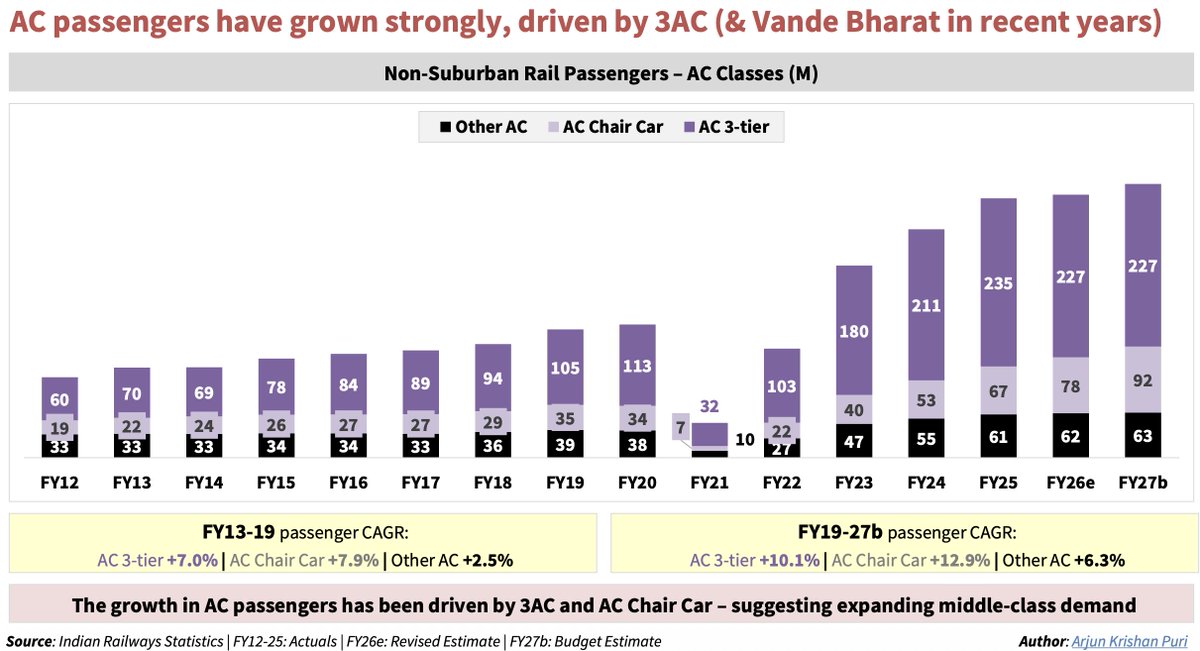
@sajithpai @arjunkpuri Also the fact that AC tickets never available doesn’t help. Every one can’t plan 60 days advance. A dynamic pricing, not for revenue maximisation like airlines, but a true demand supply based one would help.
English

@sajithpai @arjunkpuri For upto 500 km distance, car has become a major competition for train. For a family of 4, cost and time is comparable.
Probably explains why the AC passengers plateauing.
English

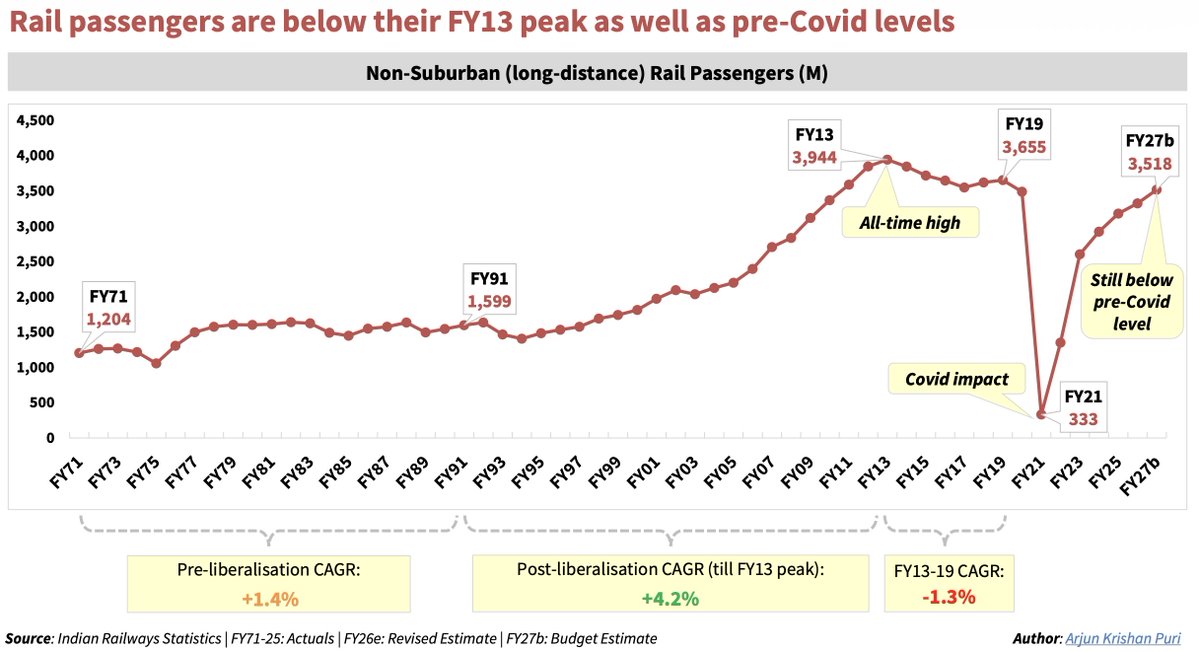
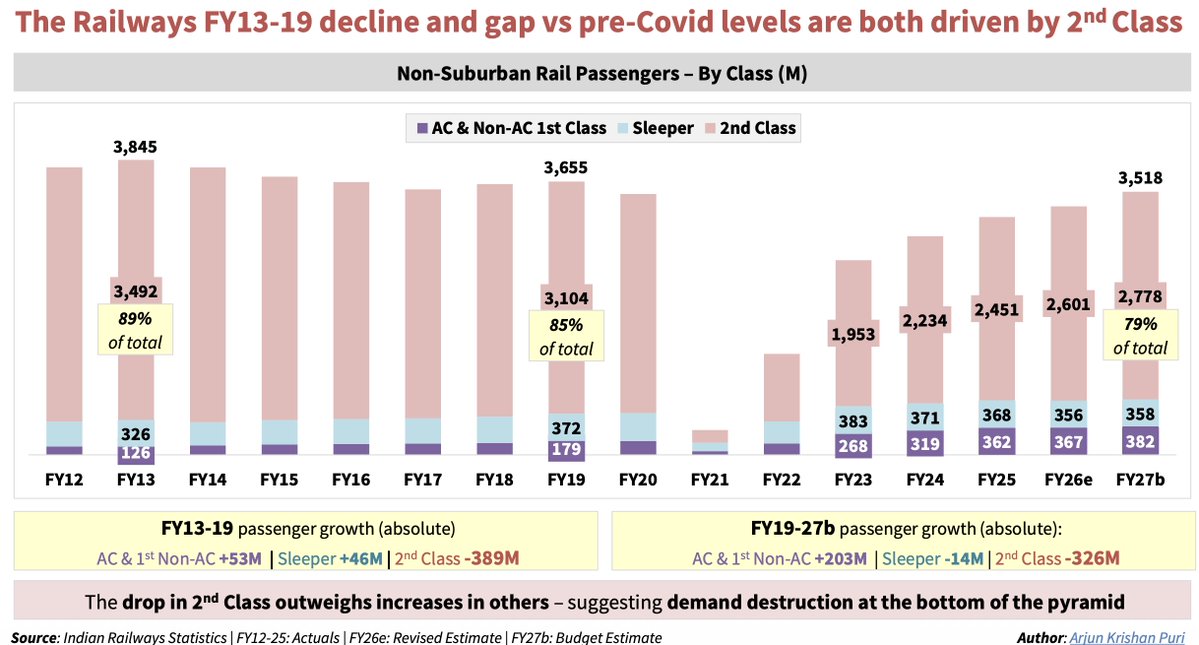
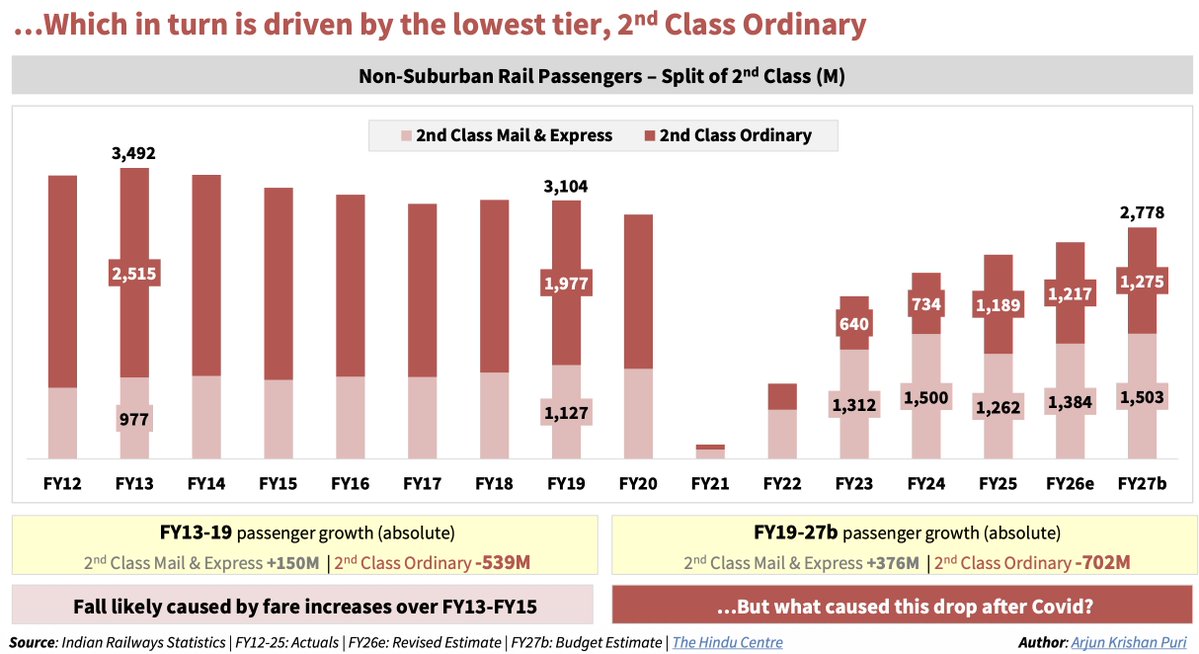
A story in 4 charts of how rail travel in India isn't growing with the decline led by 2nd class seats.
Sharp analysis by @arjunkpuri, one of my favourite thinkers + analysts - he does a lot more of his writing + thinking on linkedin though.


English
Soumyadeep Paul 리트윗함

Expressway has come as a real blessing for the people of Dehradun.
Earlier, it took 6–8 hours for NCR "laadles" to reach Dehradun, so they mostly came on weekends. With the expressway now functional and travel time reduced to 3–4 hours, Dehradun will have the privilege of witnessing these prime species daily.
Guess roads bring far more glorious dividends than just development.
English

@SanaSecurities I doubt it will happen again. RBI is now more closely linked with finance ministry now. And politicians want a weaker currency - hence higher inflation, so that it is easier to manage deficit financed freebies.
English

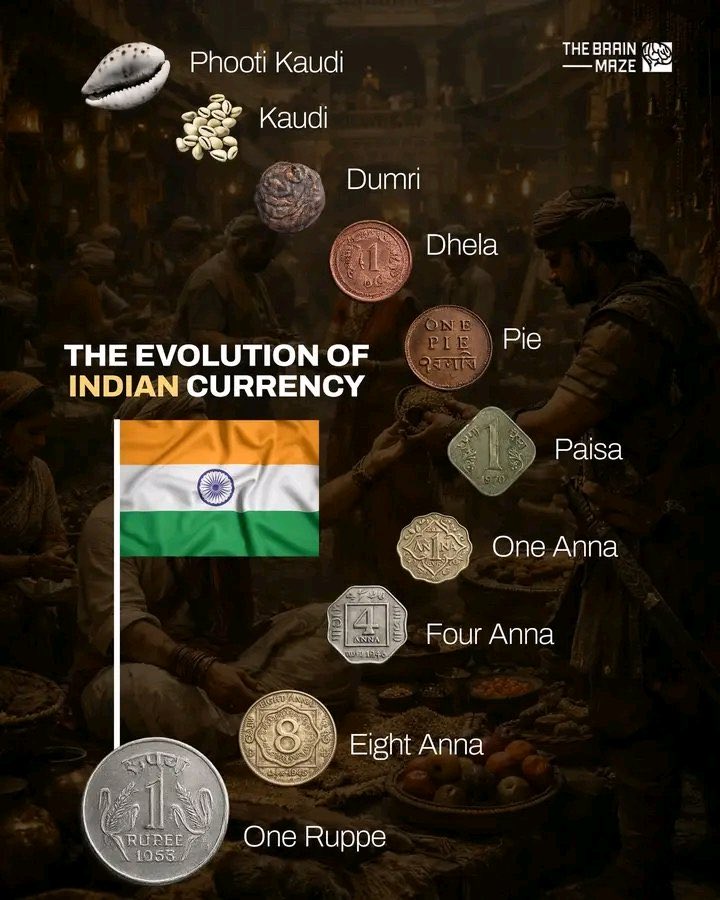
@unjoeyy @GabbbarSingh It is there in the Motu patlu song
मोटू और पतलू की जोड़ी
ना ढेला ना दमड़ी ना कौड़ी

Notice as the denomination increased the lines started getting more positive:
“Mai apni जायदाद se tumhe Ek phooti Kaudi nahi dunga”
“Do kaudi ki shakal hai teri”
“Dhele bhar ki aukaad nahi hai teri”
“Zamindar saab, Mai aapki Pie Pie chuka dunga”
“Paisa hi Paisa hoga”
“Char chavanni ghode pe” (char aana)
“Solah aana sach baat”

Eesti
Soumyadeep Paul 리트윗함

Her name is Rohini Sindhuri.
She is a 2009 batch IAS officer posted in Karnataka.
In 2018, she was the District Collector of Hassan. She discovered illegal sand mining happening every night from the rivers in her district. She stopped it.
Local politicians were furious. They went to the Chief Minister.
Within days, she was transferred out of Hassan.
She fought it in the Karnataka High Court. The court ruled her transfer was illegal and ordered the government to reinstate her.
The government reinstated her.
Then transferred her again.
She went back to court. She kept going back to court every single time the system tried to silence her.
Between 2018 and 2023, she was transferred seven times. Each transfer came within weeks of her exposing something.
She never stopped working. She never stopped filing cases. She never stopped showing up.
India has a system where honesty is punished with transfers. Rohini Sindhuri refused to accept that as her final answer.
She is still in service today.
Follow for real stories about people who refused to quit.

English
Soumyadeep Paul 리트윗함

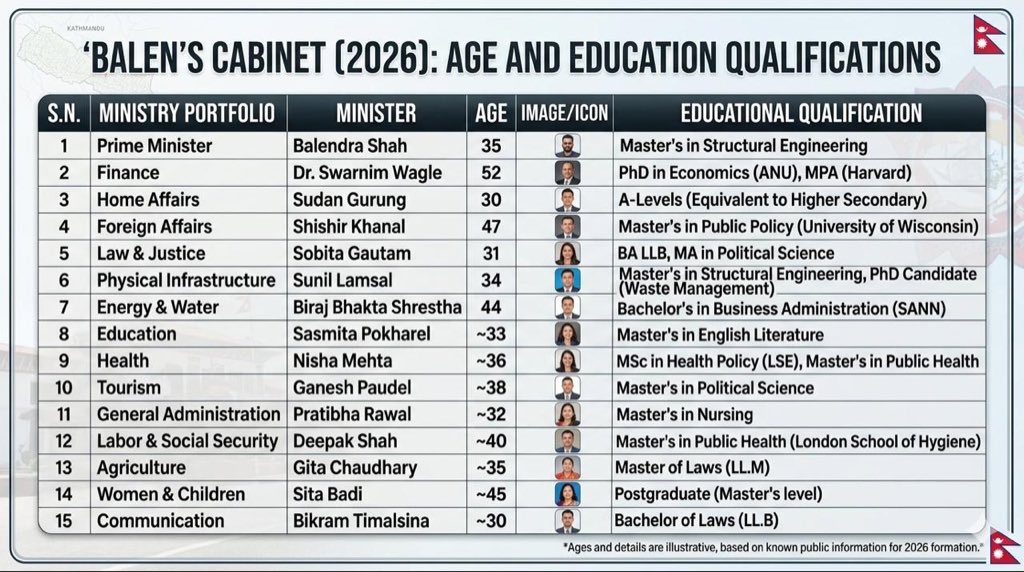
#Nepal rubbing salts on the wounds by appointing educated and qualified professionals backed with professional degrees to do the ministerial job.
Best wishes to Nepal for this experiment.

English
Soumyadeep Paul 리트윗함

Unbelievable! Justice Yashwant Varma resigns on the VERY DAY he was to defend against impeachment process in "cash-at-home" case.
He gets a dignified exit! Faces no action unless CJI orders FIR. So far no FIR (bcos of impeachment!).
No, no excuses. ndtv.com/india-news/cas…
English
Soumyadeep Paul 리트윗함

Justice Yashwant Varma has resigned.
And that is the end of the corruption proceedings against him. No High Court or Supreme Court judge in India has ever been punished for corruption since independence.
If a judge faces allegations of corruption, the Supreme Court itself examines them and may then recommend impeachment by Parliament. If the judge resigns before impeachment, the matter is closed. Though technically an FIR can still be filed after resignation, governments do not do so. They never have.
So technically, Justice Varma walks free with pension, benefits, and title intact. Wishing honorable Justice Varma a pleasant and joyful post retirement life.
English
Soumyadeep Paul 리트윗함

Tax payer in India pays taxes on income earned . He has to take loan for house and car and arrange for EMI . He pays all taxes on salary and capital gains on investments. Has to take care of medical and education for his family. Government takes every penny of tax possible.
But what happens when he lose his job? No hand holding by anyone. The same authorities who collected tax to fund laadli Behena to win elections, look away. So it is like take care of cow till milking, and then leave on road.
Sad state of affairs
English