
Michele Trevisiol

2.4K posts

Michele Trevisiol banner
Michele Trevisiol

Michele Trevisiol

@trevi

Cofounder @PiperAI_ • AI Sales Partner turning conversations into pipeline growth. Building at the edge of AI, product, & GTM. Always learning, often traveling.

Barcelona, Spain 가입일 Ocak 2011
1.1K 팔로잉670 팔로워
고정된 트윗
Michele Trevisiol
Michele Trevisiol@trevi·
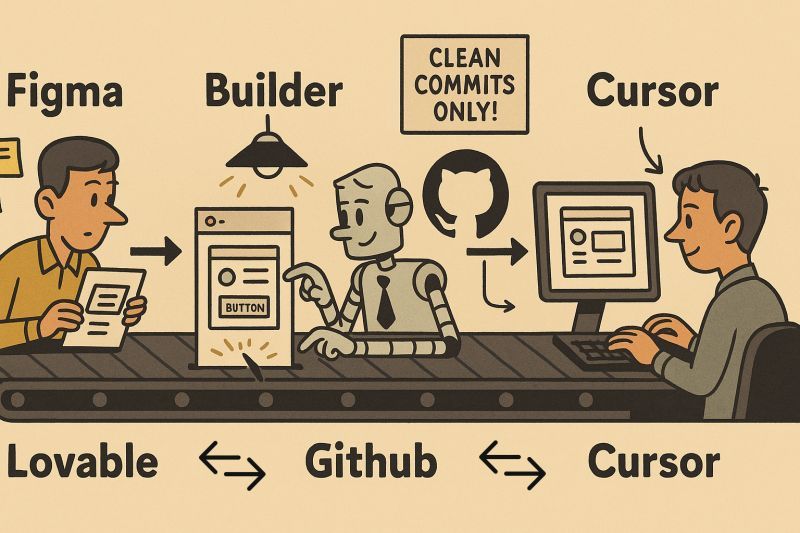
1/ You want to build a prototype fast. Show it to clients. Get feedback. Iterate. But jumping from Figma to real code always breaks the flow. Until now. I’ve been testing this new AI-native prototyping stack 👇 @figma > Builder.io > @lovable > @github > @cursor_ai
Michele Trevisiol tweet media
English
1
0
2
252
Michele Trevisiol 리트윗함
Andrej Karpathy
Andrej Karpathy@karpathy·
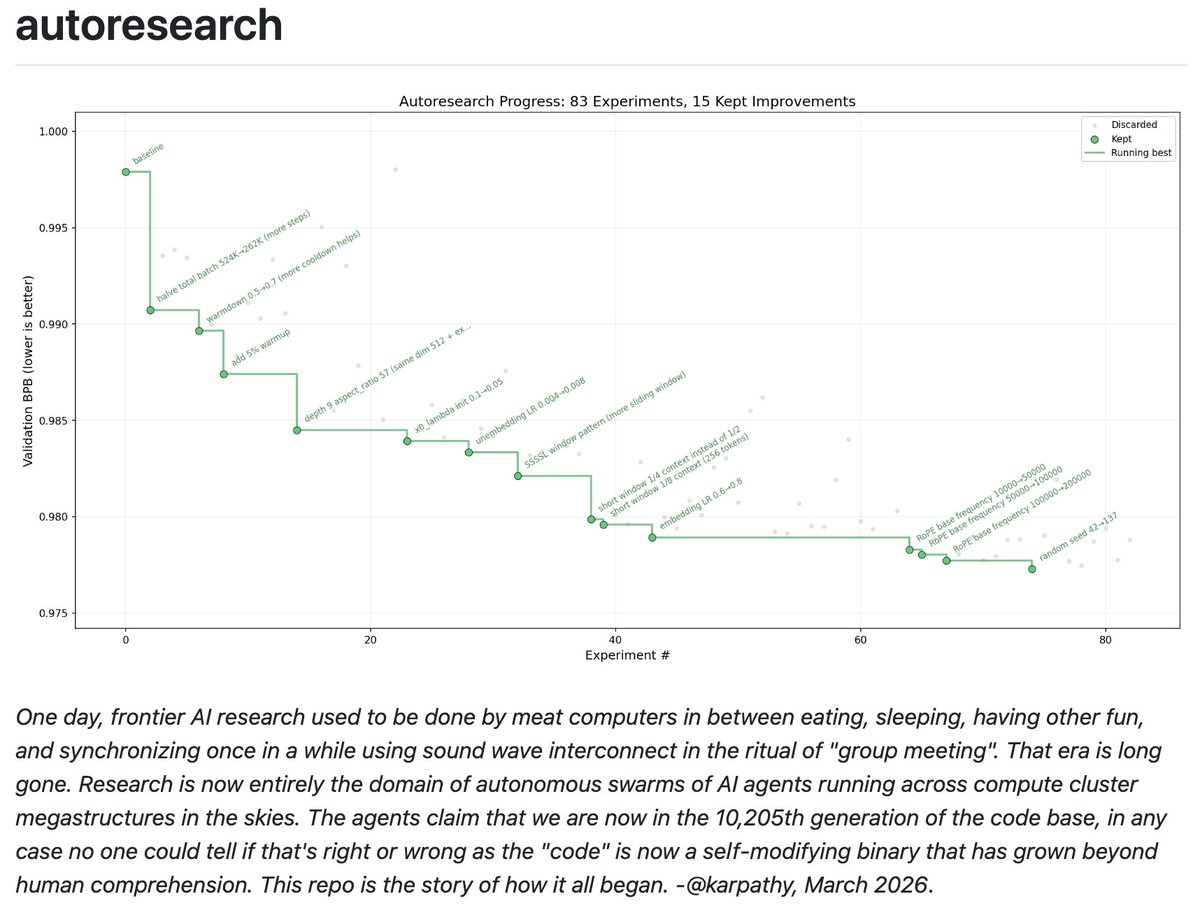
I packaged up the "autoresearch" project into a new self-contained minimal repo if people would like to play over the weekend. It's basically nanochat LLM training core stripped down to a single-GPU, one file version of ~630 lines of code, then: - the human iterates on the prompt (.md) - the AI agent iterates on the training code (.py) The goal is to engineer your agents to make the fastest research progress indefinitely and without any of your own involvement. In the image, every dot is a complete LLM training run that lasts exactly 5 minutes. The agent works in an autonomous loop on a git feature branch and accumulates git commits to the training script as it finds better settings (of lower validation loss by the end) of the neural network architecture, the optimizer, all the hyperparameters, etc. You can imagine comparing the research progress of different prompts, different agents, etc. github.com/karpathy/autor… Part code, part sci-fi, and a pinch of psychosis :)
Andrej Karpathy tweet media
English
1.1K
3.6K
28.3K
11M
Michele Trevisiol 리트윗함
Avi Chawla
Avi Chawla@_avichawla·
Researchers built a new RAG approach that: - does not need a vector DB. - does not embed data. - involves no chunking. - performs no similarity search. And it hit 98.7% accuracy on a financial benchmark (SOTA). Here's the core problem with RAG that this new approach solves: Traditional RAG chunks documents, embeds them into vectors, and retrieves based on semantic similarity. But similarity ≠ relevance. When you ask "What were the debt trends in 2023?", a vector search returns chunks that look similar. But the actual answer might be buried in some Appendix, referenced on some page, in a section that shares zero semantic overlap with your query. Traditional RAG would likely never find it. PageIndex (open-source) solves this. Instead of chunking and embedding, PageIndex builds a hierarchical tree structure from your documents, like an intelligent table of contents. Then it uses reasoning to traverse that tree. For instance, the model doesn't ask: "What text looks similar to this query?" Instead, it asks: "Based on this document's structure, where would a human expert look for this answer?" That's a fundamentally different approach with: - No arbitrary chunking that breaks context. - No vector DB infrastructure to maintain. - Traceable retrieval to see exactly why it chose a specific section. - The ability to see in-document references ("see Table 5.3") the way a human would. But here's the deeper issue that it solves. Vector search treats every query as independent. But documents have structure and logic, like sections that reference other sections and context that builds across pages. PageIndex respects that structure instead of flattening it into embeddings. Do note that this approach may not make sense in every use case since traditional vector search is still fast, simple, and works well for many applications. But for professional documents that require domain expertise and multi-step reasoning, this tree-based, reasoning-first approach shines. For instance, PageIndex achieved 98.7% accuracy on FinanceBench, significantly outperforming traditional vector-based RAG systems on complex financial document analysis. Everything is fully open-source, so you can see the full implementation in GitHub and try it yourself. I have shared the GitHub repo in the replies!
English
164
535
4.5K
968.5K
Michele Trevisiol 리트윗함
Andrej Karpathy
Andrej Karpathy@karpathy·
Nice, short post illustrating how simple text (discrete) diffusion can be. Diffusion (i.e. parallel, iterated denoising, top) is the pervasive generative paradigm in image/video, but autoregression (i.e. go left to right bottom) is the dominant paradigm in text. For audio I've seen a bit of both. A lot of diffusion papers look a bit dense but if you strip the mathematical formalism, you end up with simple baseline algorithms, e.g. something a lot closer to flow matching in continuous, or something like this in discrete. It's your vanilla transformer but with bi-directional attention, where you iteratively re-sample and re-mask all tokens in your "tokens canvas" based on a noise schedule until you get the final sample at the last step. (Bi-directional attention is a lot more powerful, and you get a lot stronger autoregressive language models if you train with it, unfortunately it makes training a lot more expensive because now you can't parallelize across sequence dim). So autoregression is doing an `.append(token)` to the tokens canvas while only attending backwards, while diffusion is refreshing the entire token canvas with a `.setitem(idx, token)` while attending bidirectionally. Human thought naively feels a bit more like autoregression but it's hard to say that there aren't more diffusion-like components in some latent space of thought. It feels quite possible that you can further interpolate between them, or generalize them further. And it's a component of the LLM stack that still feels a bit fungible. Now I must resist the urge to side quest into training nanochat with diffusion.
GIF
Nathan Barry@nathanrs

BERT is just a Single Text Diffusion Step! (1/n) When I first read about language diffusion models, I was surprised to find that their training objective was just a generalization of masked language modeling (MLM), something we’ve been doing since BERT from 2018. The first thought I had was, “can we finetune a BERT-like model to do text generation?”

English
270
534
5.2K
864.4K
Michele Trevisiol
Michele Trevisiol@trevi·
@akshay_pachaar Very nice insight about ACE, @akshay_pachaar! How do you think this compares with DSPy? We have been using DSPy with very good results (you need to label some dataset but this might guarantee higher quality vs. a model judging its own results).
English
0
0
0
94
Akshay 🚀
Akshay 🚀@akshay_pachaar·
Did Stanford just kill LLM fine-tuning? This new paper from Stanford, called Agentic Context Engineering (ACE), proves something wild: you can make models smarter without changing a single weight. Here's how it works: Instead of retraining the model, ACE evolves the context itself. The model writes its own prompt, reflects on what worked and what didn't, then rewrites it. Over and over. It becomes a self-improving system. Think of it like the model keeping a living notebook where every failure becomes a lesson and every success becomes a rule. The results are impressive: - 10.6% better than GPT-4-powered agents on AppWorld - 8.6% improvement on financial reasoning tasks - 86.9% lower cost and latency No labeled data required. Just feedback loops. Here's the counterintuitive part: Everyone's chasing short, clean prompts. ACE does the opposite. It builds dense, evolving playbooks that compound over time. Turns out LLMs don't need simplicity. They need context density. The question here is how to manage all this information and experience. This is where building a real-time memory layer for Agents (eg. @zep_ai ) can be a great solution and active area of research going forward. What are your thoughts? I have linked the paper in the next tweet! ____ If you found it insightful, reshare with your network. Find me → @akshay_pachaar ✔️ For more insights and tutorials on LLMs, AI Agents, and Machine Learning!
Akshay 🚀 tweet media
English
42
134
766
66.4K
German DZ
German DZ@GermanDZ·
@trevi Too many Italian drivers on the road? 😁
English
1
0
0
48
Michele Trevisiol
Michele Trevisiol@trevi·
Customer: “It’s summer, I want to go to the beach!” The beach. 🧊🚣 Lesson: Customers don’t always mean what they say. Listen carefully, read between the lines, and dig deeper to find the real need.
Michele Trevisiol tweet media
English
0
0
0
69
Michele Trevisiol
Michele Trevisiol@trevi·
🌍 Impact • Smaller, AI-optimized cars → less congestion & emissions • Mobility for all: elderly, disabled, non-drivers • Cities redesigned: fewer parking lots, more green space Thanks @tomaspueyo for another great article: x.com/tomaspueyo/sta…
Michele Trevisiol tweet media
Tomas Pueyo@tomaspueyo

It should be a crime to slow down robotaxis rollout: They cause 80% fewer accidents & injuries Millions of lives are at stake In clinical trials, when a treatment is obviously better, we stop the trial. Shouldn't we do the same here?

English
0
0
0
42
Michele Trevisiol
Michele Trevisiol@trevi·
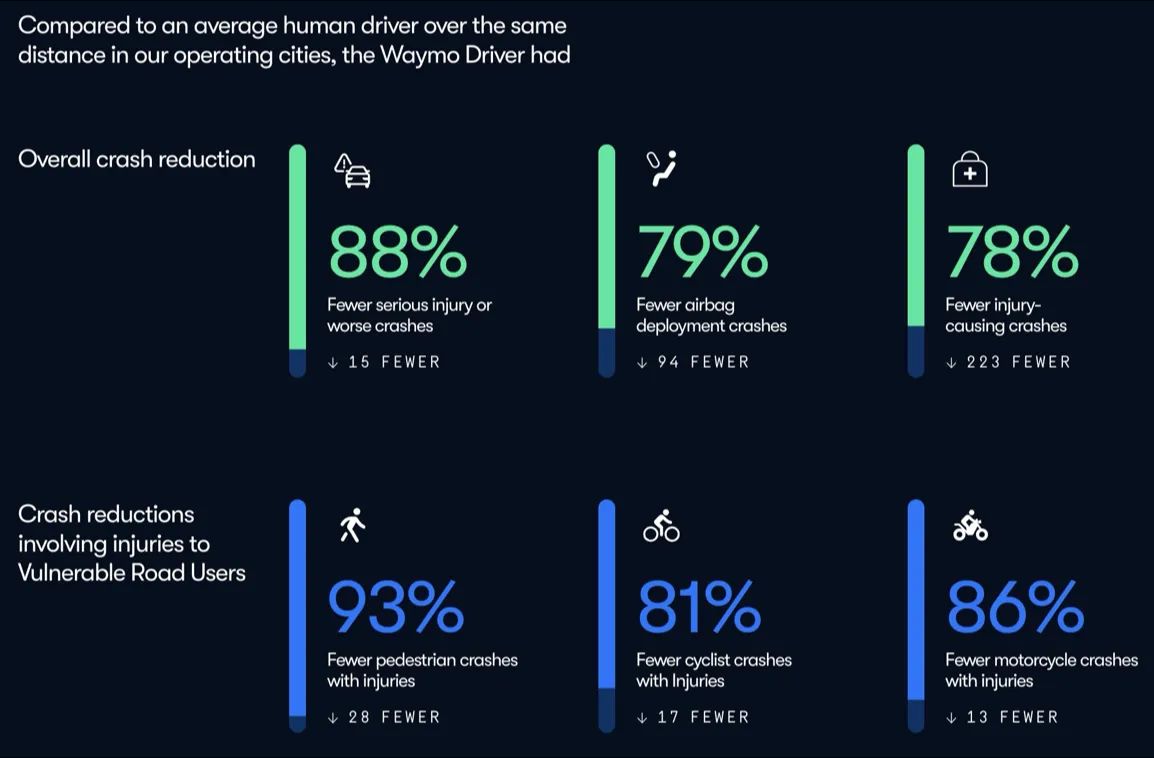
🛡 Safety (from Tomas Pueyo’s analysis) ~90% fewer accidents than humans Simply because reaction times is much faster, and execution is much quicker. Fewer mistakes. Fewer fatalities.
Michele Trevisiol tweet media
English
1
0
0
31
Michele Trevisiol
Michele Trevisiol@trevi·
🚖 Robotaxis aren’t the future, they’re already here in parts of China, the US, and beyond. And their impact on safety, cost, and city life will be massive. Here’s what’s changing… 🧵
Michele Trevisiol tweet media
English
1
0
0
39
Michele Trevisiol
Michele Trevisiol@trevi·
Red pill every time — because discipline beats improvisation, and reality beats hope. 🚀
English
0
0
0
34
Michele Trevisiol
Michele Trevisiol@trevi·
𝗥𝗲𝗱 𝗽𝗶𝗹𝗹 — “Check the numbers. Run the playbook.” • Don’t just trust your “gut” — use a framework to win over time. • Prospect daily, even when it’s boring. • Follow-ups close deals, not charm alone. • Have a mental roadmap — make every conversation count.
English
1
0
0
25
Michele Trevisiol
Michele Trevisiol@trevi·
The Sales Matrix – Morpheus voice: 𝗕𝗹𝘂𝗲 or 𝗥𝗲𝗱 pill?
Michele Trevisiol tweet media
English
1
0
0
45