UDIT AGARWAL

28.6K posts

UDIT AGARWAL banner
UDIT AGARWAL

UDIT AGARWAL

@uditmo2006

bowing to the hand of destiny

가입일 Temmuz 2009
4.9K 팔로잉745 팔로워
UDIT AGARWAL 리트윗함
Swarajya
Swarajya@SwarajyaMag·
⚓ India and Singapore advance plans for a digital and green shipping corridor. 📍 A roadmap is being prepared for an MoU covering infrastructure, investment and green fuel systems. 🌱 The initiative supports decarbonisation and sustainable maritime development.swarajyamag.com/news-brief/ind…
English
0
35
117
5.9K
UDIT AGARWAL 리트윗함
Normal Guy
Normal Guy@Normal_2610·
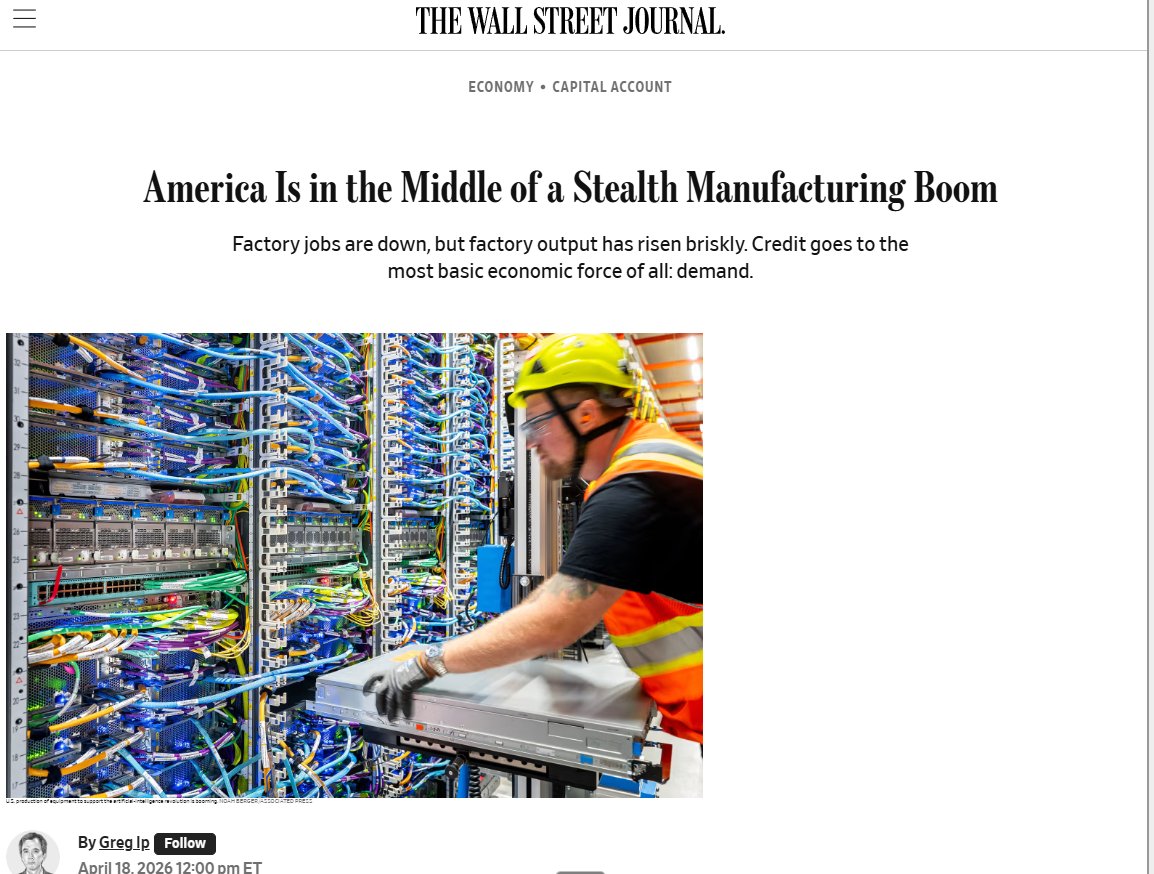
US manufacturing lost 100,000 jobs since January 2025 but output went up 2.3% in the same period The sectors doing well are AI hardware and aerospace, both mostly exempt from tariffs. Computer and electronics production rose 7.7% but imports in the same sector rose 40.5%. Both growing together, not one replacing the other. Where tariffs were applied hard - autos, furniture both imports and domestic production fell. Demand built this recovery. Tariffs had nothing to do with it. The US makes more with fewer people because the factories that are growing don't need assembly line workers. They need cooling system engineers, semiconductor technicians, and robotics operators. Output per hour is up 2.4%, the strongest gain since 2011. Elon is going to be Right perhaps in the future :) Manufacturing jobs aren't coming back in the old form. The new jobs pay more and need more skill. The politicians promising factory jobs to voters are selling a version of manufacturing that doesn't exist anymore. but long story short, this is positive for that Nation :) wsj.com/economy/americ…
Normal Guy tweet media
English
2
5
28
2.4K
UDIT AGARWAL 리트윗함
Normal Guy
Normal Guy@Normal_2610·
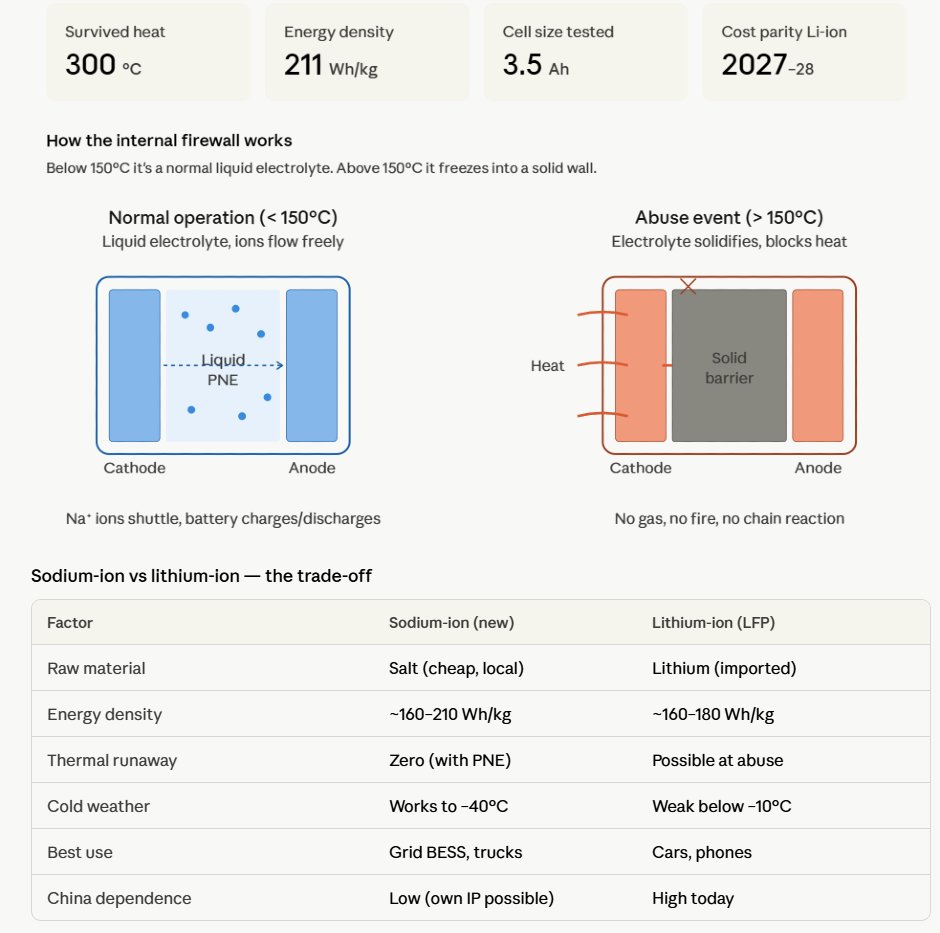
Team of Chinese scientists built a sodium-ion battery that simply refuses to catch fire, even when you torture it at 300°C, stab it with a nail, or overcharge it. The paper landed in Nature Energy on 6 April 2026, and the tech is already tied to a real factory (HiNa Battery) Yup for commercial production, When yu study battery Ecosystem always focus on China what they are doing, they heavily investing in Sodium tech Why? Raw material supply chain, they are just doing balance of storage energy diversification And for stationary storage, two things matter more than energy density - cost per kWh, and not catching fire. Sodium wins both. Cost - sodium is literally salt. India has coastline, lakes, and salt flats. Lithium we import, mostly from Chile and Australia, and the supply chain goes through China for refining. Reliance Hithium tech-sharing episode in January 2026 was a taste of what that dependence look like with China Fire risk - picture a 500 MWh BESS sitting in 45°C Rajasthan heat during a May peak. If one cell goes into thermal runaway in a lithium pack, insurance and regulatory costs explode. Sodium with this PNE trick makes that worry go away. Cold tolerance - works from –40°C to 60°C. Ladakh winters, Thar summers, Chennai monsoon humidity - all fine. Regular lithium dies below –10°C. Reliance bought Faradion in late 2024 for roughly $170 million. What most misses even me is what Reliance actually owns - 29 patent families covering sodium-ion cell chemistry, cathode materials (Faradion pioneered the oxide route), architecture, and crucially, safety systems. That last bit just became ten times more valuable this week.
Normal Guy tweet media
English
2
29
143
6.3K
UDIT AGARWAL 리트윗함
Luke Gromen
Luke Gromen@LukeGromen·
For nearly 10 yrs I've said "The US can maintain post-1971 structure of USD reserve status (whereby USTs are global primary reserve asset), or the US can have a flourishing defense industrial base, but it cannot do both." In this paper, @ctindale proves this. Kudos Craig!
🇦🇺Craig Tindale@ctindale

x.com/i/article/2041…

English
23
85
691
78.1K
UDIT AGARWAL 리트윗함
Normal Guy
Normal Guy@Normal_2610·
From cyberweapons to cybersecurity, now there will be real urgency to develop new protocols. A lot of powerful models are available open-source today, and what if someone, over the long term, trains one at an extended level on something like a Mac Mini cluster or consumer GPU chips and breaks into systems with it? I don't know exactly how it will play out, but one has to "zip" the resources too, lock them down, control access otherwise a truly intelligent system can do anything if it really tries The shift is already visible. Earlier the fear was nation-states building cyberweapons in secret labs. Now the fear is different - a single smart person sitting in a room, with open-source weights, cheap hardware, and patience, can slowly fine-tune a model for offensive use. The barrier to entry is collapsing. What used to need a government budget may soon need only electricity and time. That is why new protocols will have to be born. Today cybersecurity stack was built for a world of human hackers and script kiddies. It was not built for an agent that never sleeps, reads every CVE ever published, and can probe a network for months without getting tired. The old firewalls, signature-based antivirus, even current zero-trust models, they will start to feel like wooden doors against a machine that can pick any lock. intelligence, once it is out in the open, cannot be put back in the box. Open-source is a gift and a risk at the same time. The same model that helps a student learn can help a bad actor break a bank. So the future is not about stopping AI, it is about containing misuse while keeping the benefits flowing. and, if an intelligent system genuinely tries, and nobody has zipped the resources around it, it can do almost anything. That is the quiet warning sitting under this whole revolution.
Ethan Mollick@emollick

In different hands, Mythos would be an unprecedented cyberweapon I am not sure how we deal with this, except to note a narrow window where we know only 3 companies could be at this level of capability. But it may be Chinese models (maybe open weights ones?) get there in 9 months

English
0
4
18
4.5K
UDIT AGARWAL 리트윗함
🇦🇺Craig Tindale
🇦🇺Craig Tindale@ctindale·
Pre-war Japan is a historical rhyme worth keeping in mind. Pearl Harbour came at the end of a tightening sanctions regime imposed by the West. Oil. Scrap iron. Strategic inputs. Each restriction narrowed Japan’s room to manoeuvre. Once a state concludes that the foundations of its economy and war machine are being closed off, the urgency of decisions change. Stability stops being the governing aim. The question becomes whether action now offers better odds than passivity under encirclement. If you want to understand the motivation, start there: fear of encirclement. That sits near the center of the moral question people are wrestling with now. Chinese control over critical minerals and industrial supply chains carries the same structure. If Beijing can place at risk the inputs required for American military production, grid expansion, AI systems, and industrial continuity, then the issue sits well beyond ordinary trade friction. It becomes leverage over the material basis of power itself. In that setting, dependency acquires a strategic meaning. A supply chain is no longer a market arrangement. It is a potential instrument of compulsion. It begins to register as a survival question. American conduct follows from that insight. Washington appears to believe that a future vulnerability must be arrested before it hardens into a permanent strategic fact. The issue is not mood or rhetoric. It is anticipation of future disablement. States act with force when they judge that delay will deepen exposure and narrow their remaining options. Israel’s view of Iran belongs to the same family of reasoning. A threat interpreted as maturing, entrenching, and approaching irreversibility produces a distinct political psychology. Restraint loses prestige. Preemption gains coherence. It starts to appear rational. History offers rhymes. Japan in 1941. Israel in 1967. Germany in 1914. Sparta facing Athens. A state perceives an adverse shift in the conditions of survival. Time ceases to appear neutral. Decisive action starts to present itself as necessary. The future is imagined as a worse bargaining position, a worse military position, a worse chance of endurance. Under those conditions, radical action begins to present itself as reasonable . Which is the deeper point. States become dangerous when threat attaches itself to material dependence, shrinking time horizons, and the real expectation of future weakness. At that moment, power makes a clean break in linear diplomatic terms. It thinks in windows, chokepoints, bottlenecks, and irreversible loss. Its perceived menu of options is radicalised by the structure of the threat itself. Those who read the United States as soft, irresolute, or indefinitely patient may be misreading the situation completely. A state that believes its future industrial base, military capacity, and strategic freedom are at risk won’t behave like a complacent hegemon. It behaves like a power trying to prevent encirclement before it becomes permanent. That is why the present moment has to be read through matter. This is where The Return of Matter comes back into view. The real contest is no longer about slogans, values, or even finance in the narrow sense. It is about control over the physical substrates of power: energy, metals, refining, grids, shipping, compute, and the industrial systems that make military and economic life possible. Once matter returns to the center, states stop speaking the language of frictionless markets and start acting in the older ancient language of survival. What we are watching now is that transition made visible: the progression of action under perceived material threat, the re-entry of physical constraint into strategy, and the collapse of the fantasy that interdependence had abolished coercion. With that realisation comes a grief for the passing of the old world. .
🇦🇺Craig Tindale@ctindale

x.com/i/article/1997…

English
18
59
248
36.1K
UDIT AGARWAL 리트윗함
Ritesh Jain
Ritesh Jain@riteshmjn·
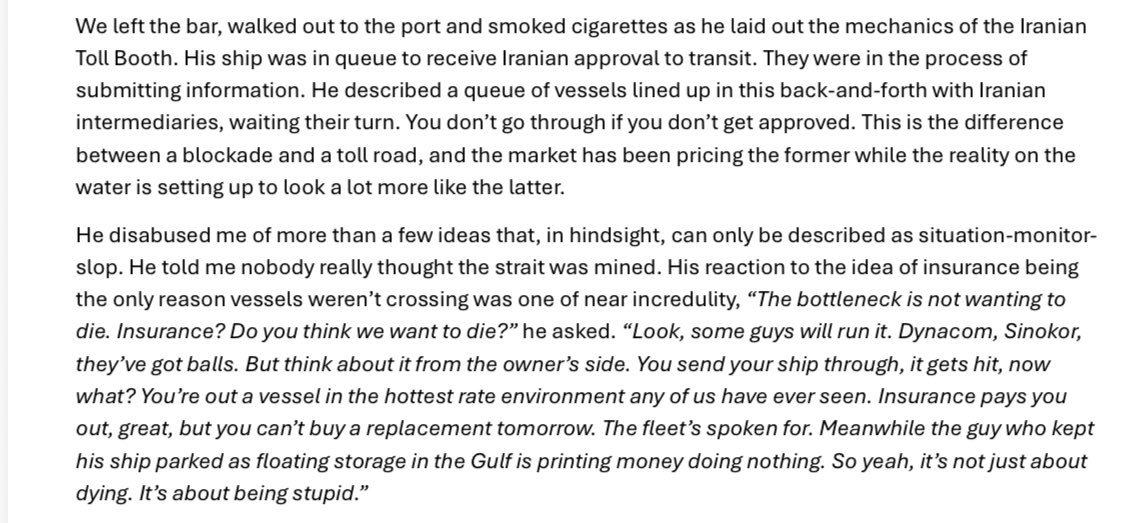
Nobody absolutely nobody except the Citrini research will explain you this simple arithmetic. Excerpt from a piece titled strait of Hormuz: A Citrini Field trip. Humint beats technology hands down.
Ritesh Jain tweet media
English
27
240
2.8K
167K
UDIT AGARWAL 리트윗함
Normal Guy
Normal Guy@Normal_2610·
Idealist is now Published :) Indian auto-component companies executed over 120 inorganic moves between April 2020 and March 2026, the most intense capability-building cycle in the sector's history. buymeacoffee.com/normal_2610/id…
Normal Guy tweet media
English
1
5
46
2.6K