John B ᯅ

266 posts

John B ᯅ banner
John B ᯅ

John B ᯅ

@utxoshit

Rational Bitcoiner | Software Engineer | $BTC - $TSLA | Barbecue | Retired USAF C2 / Air Defense / Battle Management / Tactical Data Links / JICO

Earth 가입일 Aralık 2020
1.3K 팔로잉637 팔로워
John B ᯅ
John B ᯅ@utxoshit·
An AES-256 encrypted file on my hard drive costs 0 cents to defend. Even if we charitably pretend the entire current Bitcoin network, roughly 1 zettahash per second, could be redirected into AES-256 key testing, an average brute-force search would take about 1,800,000,000,000,000,000,000,000,000,000,000,000,000,000,000,000 years. Bitcoin proof-of-work is deliberately calibrated so someone finds a valid nonce about every 10 minutes. How much would that cost?
English
0
0
0
6
John B ᯅ
John B ᯅ@utxoshit·
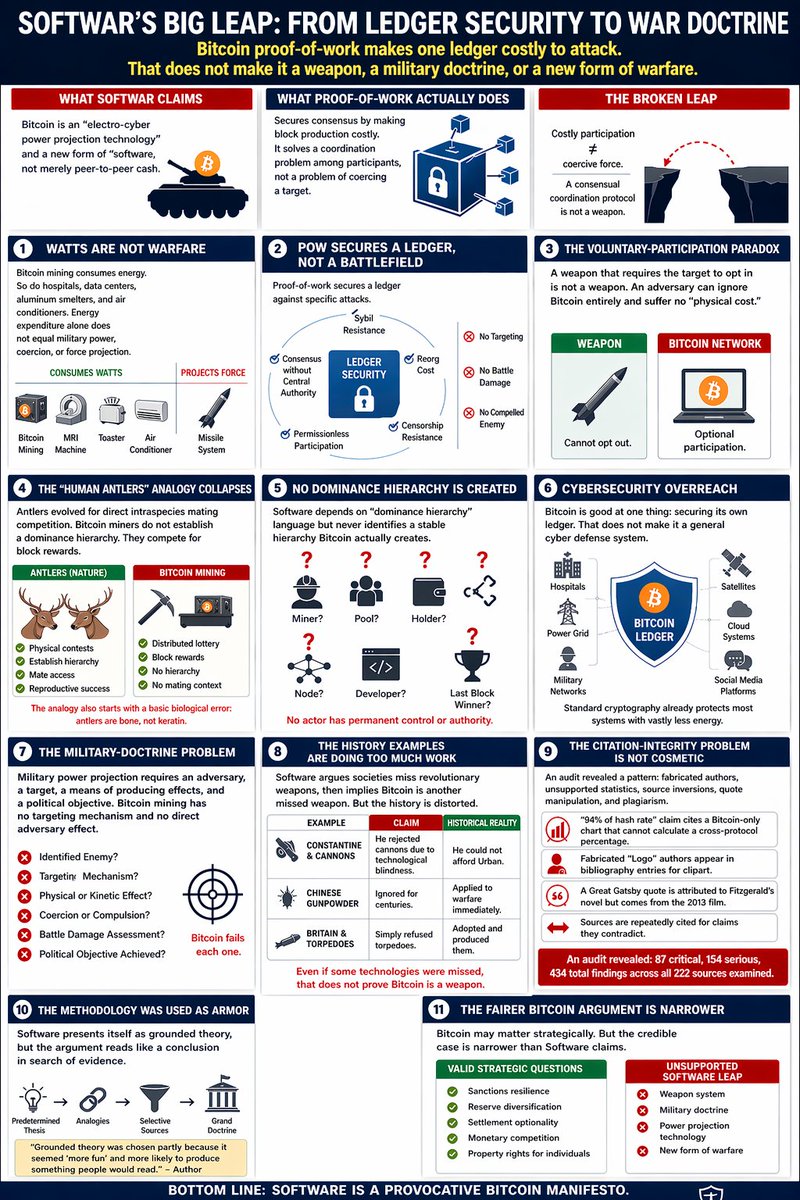
I think this makes the same leap Softwar makes. It starts with a real property of Bitcoin proof-of-work, then jumps to a national-defense claim the mechanism does not support. Bitcoin proof-of-work makes it expensive to rewrite Bitcoin's ledger history. That matters. But it matters for Bitcoin. Lowery presents this as if Bitcoin can secure cyberspace, or arbitrary digital assets in general. He never gives the technical mechanism that would make that happen. Without a mechanism, Softwar is not proving a defense theory. It is just assigning Bitcoin a capability the protocol does not have. Bitcoin doesn't secure hospitals, routers, satellites, military networks, cloud systems, identity providers, software repositories, industrial control systems, private keys, exchanges, wallets, or communications infrastructure. It secures valid Bitcoin block history. The ledger. That is a much narrower application. The "physical cost" framing also misses something basic. *All computing has physical cost.* Brute forcing encryption has physical cost. Scanning networks has physical cost. Running malware has physical cost. Operating botnets has physical cost. The question is not whether physics is involved. It is whether the cost mechanism protects the target. This is why Softwar fails. Bitcoin proof-of-work is designed to be solved. The difficulty adjusts so miners find valid blocks at a target rate, roughly every 10 minutes. That's useful for Bitcoin consensus because it is friction. It's not security. Defense is not "let someone through every 10 minutes." COMSEC is the opposite. You don't want unauthorized decryption to become feasible on a schedule. You want it to remain infeasible. And you don't want to slow down legitimate users to every 10 minutes if they make a mistake. Command and Control Systems require lightning fast decision making. You don't want someone locked out for 10 minutes for a mistake. You don't want an authenticated kill chain decision to wait 10 minutes while the target drives off. That is why actual military communications security doesn't look like Bitcoin mining. The U.S. defense and intelligence world uses Type 1 inline network encryptors, HAIPE devices, key management, encrypted enclaves, access controls, segmentation, and layered architectures. For example: TACLANE devices are NSA-certified Type 1 encryptors used to protect information up to Top Secret/SCI. Public NSA guidance for CNSA 2.0 calls for AES with 256-bit keys for all classification levels, along with post-quantum algorithms for key establishment and signatures. A 256-bit keyspace is not remotely comparable to finding a Bitcoin nonce every 10 minutes. Even if we charitably pretend the entire current Bitcoin network, roughly 1 zettahash per second, could be redirected into AES-256 key testing, an average brute-force search would take about 1,800,000,000,000,000,000,000,000,000,000,000,000,000,000,000,000 years. Bitcoin proof-of-work is deliberately calibrated so someone finds a valid nonce about every 10 minutes. AES-256 is designed so unauthorized key recovery isn't a practical attack path at all. Bitcoin is controlled friction. AES-256 is denial. So the claim that cyberattacks are easy because they cost almost no physical energy is wrong. A brute-force attack against properly implemented modern encryption would require absurd physical resources. Cosmically more. e.g. more power than the sun contains till it's death. Most hacks don't happen because the attacker failed to pay a proof-of-work toll. They happen because of vulnerabilities, stolen credentials, phishing, misconfiguration, supply-chain compromise, endpoint compromise, custody failures, or bad key management. Even inside Bitcoin, "attack the network" does not always mean "generate more electricity than the rest of the network." Eclipse attacks target the peer-to-peer layer by isolating a victim node from honest peers. That does not require a 51% attack. Bitcoin itself still depends on conventional networking assumptions and conventional security engineering. That is the thesis category error at the center of this argument. Bitcoin proof-of-work is a consensus mechanism. It's not a general cyber-defense system. It makes one kind of attack against Bitcoin expensive. It doesn't create an "electro-cyber dome" over national infrastructure. A Hash Force would mostly do one thing: mine Bitcoin. It wouldn't automatically protect classified networks, military communications, power grids, hospitals, satellites, citizen identity systems, or software supply chains. Proof-of-work has real security uses: Anti-spam, Sybil resistance, timestamping, and Bitcoin settlement. "Bitcoin is the future of national cyber defense" makes zero sense without a mechanism to do so. Softwar doesn't prove its claims. It just assumes the things it needs to demonstrate.
John B ᯅ tweet media
English
0
0
0
15
John B ᯅ
John B ᯅ@utxoshit·
@SovereignL1f3 The only vibes I get from Softwar are factual inaccuracies: "The unnecessarily large structure of antlers looks like a waste of keratin. Why burn so many calories carrying around the weight of that much extra keratin, and waste more energy clanging them together?"
English
0
0
0
5
John B ᯅ
John B ᯅ@utxoshit·
@StLBraveheart @chrisisFTW @WayofLono @HodlMagoo @gladstein Why is it that people that says someone else doesn't understand softwar, can't explain softwar? Can you explain Softwar? How does it project power? How does it coerce an unwilling participant to do anything they don't want to do?
English
0
0
0
5
Magoo PhD
Magoo PhD@HodlMagoo·
Trump has not done a single thing for Bitcoin. Enabled himself to grift on shitcoins, nothing more.
English
139
106
1.7K
55.9K
John B ᯅ
John B ᯅ@utxoshit·
@Stuart_crwon @Bilalbinsaqib The Softwar thesis provides no mechanism to protect networks. Bitcoin PoW is designed to be overcome every 10 minutes. That combined with node consensus rules prevent "bad" changes to the ledger. This doesn't translate to general cybersecurity in any way.
English
0
0
0
18
Stuart
Stuart@Stuart_crwon·
@Bilalbinsaqib Totally agree. Ignoring this Softwar concept could leave countries weak online.
English
1
0
0
32
Fiat Archive
Fiat Archive@fiatarchive·
ADMIRAL SAMUEL PAPARO: "We have a node on the Bitcoin network right now. We're doing a number of operational tests to secure and protect networks using the Bitcoin protocol." ⚡️
English
2
0
8
769
John B ᯅ
John B ᯅ@utxoshit·
@DailyStackHQ Please talk to an opposing viewpoint on this. The Softwar thesis isn't technically grounded. DoW is about to waste a lot of taxpayer money if they buy into the Softwar thesis. Wake up @INDOPACOM
John B ᯅ tweet media
English
0
0
0
8
Dennis Porter
Dennis Porter@Dennis_Porter_·
WE MUST HAVE DE MINIMIS, SOFTWAR, SBR, & MINED IN AMERICA! SEE YOU IN VEGAS! 🇺🇸
Dennis Porter tweet media
English
7
8
76
6K
Brian Brookshire
Brian Brookshire@btc_overflow·
Imagine telling someone just a few years ago that in 2026 we'd hear a four-star admiral publicly talking about the US military's interest in bitcoin and its bitcoin node. We've come a long way.
Bitcoin Magazine@BitcoinMagazine

JUST IN: 🇺🇸 Four-star military officer Admiral Samuel Paparo confirms the USA is running a Bitcoin node. "We have a node on the Bitcoin network right now. We're doing a number of operational tests to secure and protect networks using the Bitcoin protocol."

English
5
7
121
8.1K
John B ᯅ
John B ᯅ@utxoshit·
@Roubini18 @btc_overflow Okay. I'll leave you be. You just dodge every point anyway. Maybe hit me up when you learn what reusable proof of work is.
English
1
0
0
11
John B ᯅ
John B ᯅ@utxoshit·
Nostr isn't bitcoin and nostr isn't Softwar. You still haven't described anything about an implementation of Softwar. The admiral has a credibility issue in that he said Bitcoin is a "reusable proof of work" protocol that protects peoples intellectual property. Can you tell me how that is right? And I'm the one with the credibility problem?
English
1
0
0
25
John B ᯅ
John B ᯅ@utxoshit·
@Roubini18 @btc_overflow The thread speaks for itself. Anyone reading can see which side answered the question and which side switched to insults. It is strange to defend an idea this hard and then insult someone for asking you to explain it. Take care.
English
1
0
0
16
John B ᯅ
John B ᯅ@utxoshit·
@Roubini18 @btc_overflow Four questions on the table. You answered none of them, then switched to mocking me. That is the whole Softwar playbook in one thread. Not a single Softwar proponent can defend it or describe it. Take care
English
1
0
0
22
John B ᯅ
John B ᯅ@utxoshit·
When I talk to grok about it, it says the same things I'm saying. Softwar is nonsense. The thesis presents no valid mechanism. “If the theories are valid” appears repeatedly before huge conclusions. That's why I'm asking you. You said if bitcoiners, "don’t understand SoftWar, time to read the book! This is total vindication that Lowery was right." Why can't you tell us what he is right about? as opposed to saying, "chat with grok."
English
2
0
0
22
John B ᯅ
John B ᯅ@utxoshit·
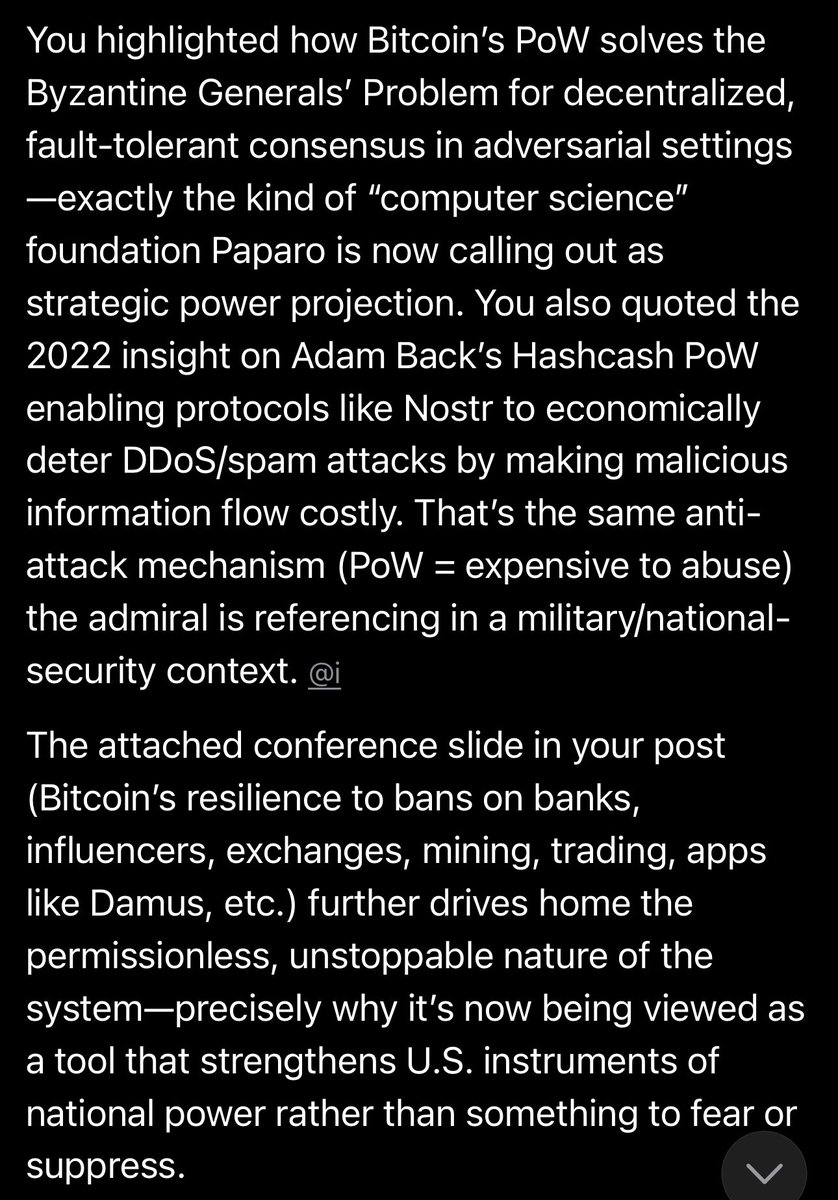
please stop pasting LLM output. You dodged the RPOW point completely. The admiral got the protocol wrong, you told me to watch him to learn, and now you are moving on. Nostr's PoW is Adam Back's Hashcash doing its original 1997 job: anti-spam. Nobody called Hashcash power projection when it was deterring email spam. Adding "national security context" to the that mechanism does not change what it does. It makes abuse expensive on a relay. That is not coercion of an adversary. Your own quoted text says "PoW = expensive to abuse." That is anti-spam. not coercion. not force projection You are describing a cost function and calling it a weapon. "Permissionless and unstoppable" describes the network's censorship resistance. It doesn't identify a target, a coerced behavior, or a theory of victory. Bitcoin being hard to ban IS NOT the U.S. projecting power. It is Bitcoin resisting the U.S. when the U.S. tries to ban it. Those are opposite directions. Four questions still open: target, coercion, adversary response, theory of victory.
English
1
0
0
32