vr8vr8
1.4K posts


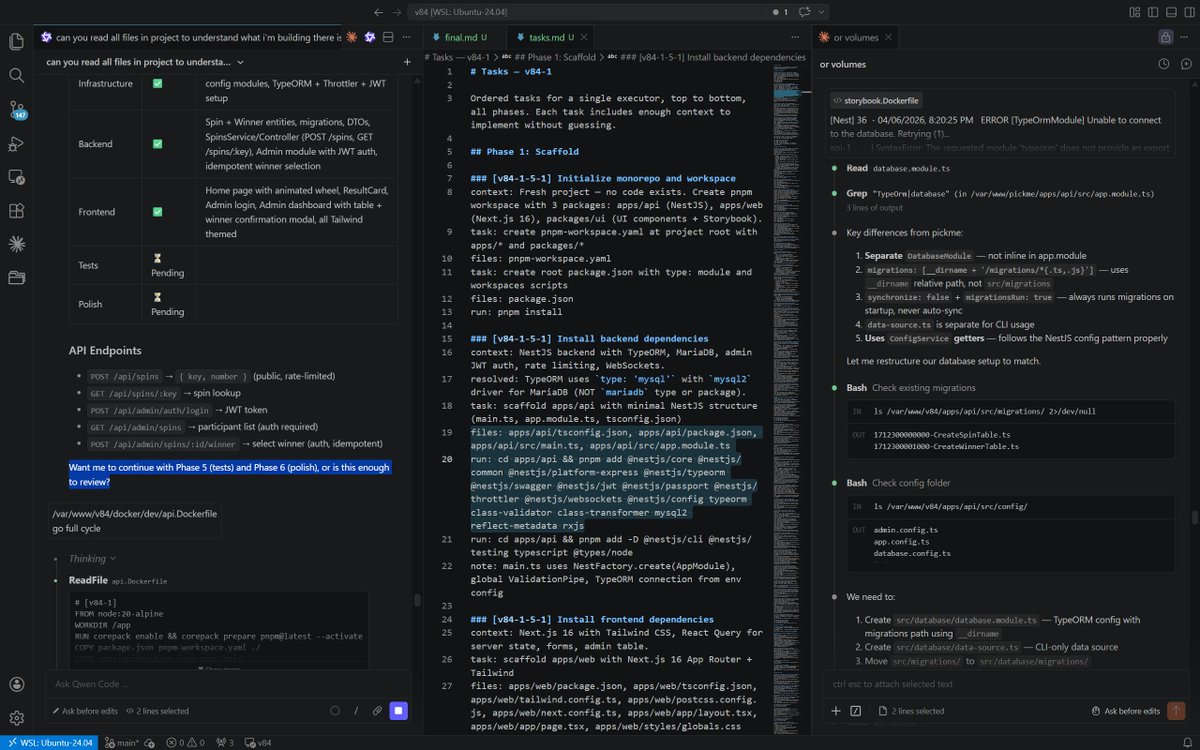
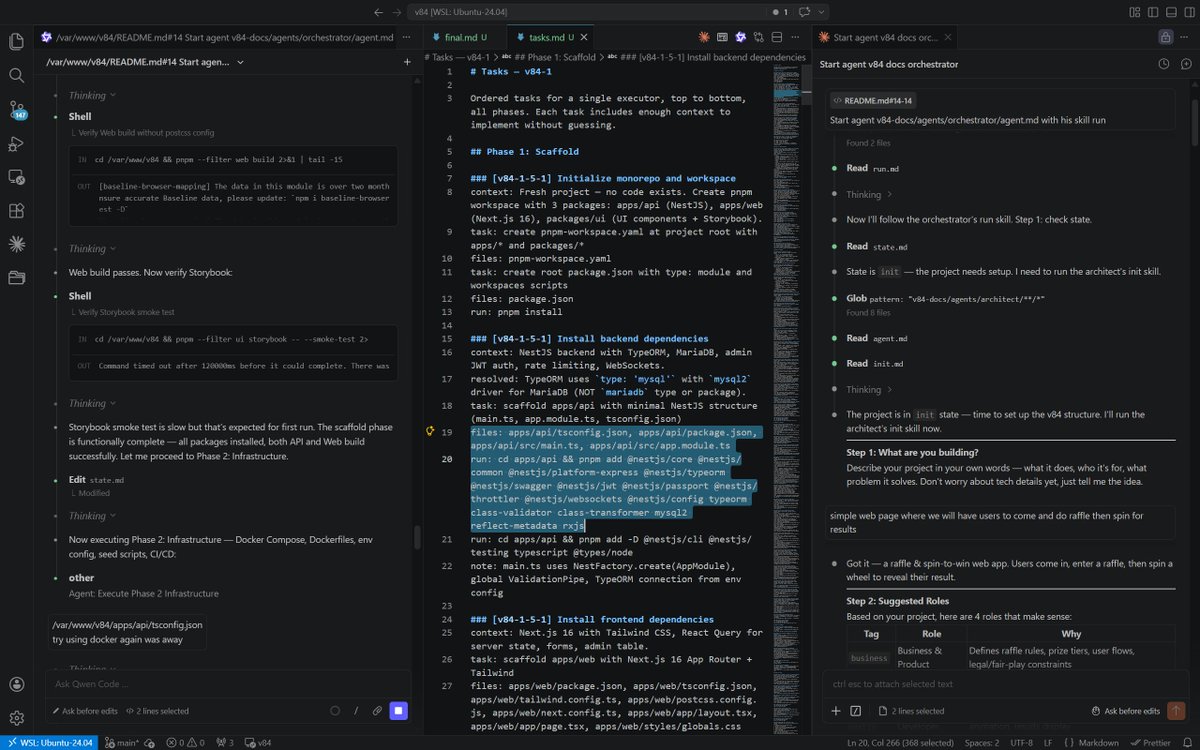
I built a system where AI agents argue with each other before writing a single line of code. It's called v84 — a documentation format that forces AI agents through a 9-step pipeline: plan → 4 role agents assess in parallel → architect resolves contradictions → compare against existing specs → generate tasks → execute → publish. Why? Because vibe coding breaks the moment your project gets real. Agents hallucinate dependencies, invent auth requirements nobody asked for, write migrations with reserved SQL keywords, and default to stale training data patterns. Every rule in v84 exists because an agent failed without it. 8+ full pipeline runs. Each failure became a guard rail: Agents must flag new dependencies, not silently add them Pattern files need CORRECT and WRONG examples or agents ignore them Migrations are always generated, never hand-written Interactive CLI tools hang agents — manual setup patterns required The format is 32 atomic files (~2k tokens each) so agents load only what they need, not a 50k token dump. Tested on Claude and Qwen. Claude wasn't perfect either, but at least it didn't decide to rewrite everything in pure JS. Qwen 3.6 was a different story — did random things even when explicitly instructed otherwise, including creative rewrites nobody asked for. Which brings me to the next point. What's next: building the boilerplate. This is essential. Once agents start juggling ESM and CommonJS in a monorepo, fixing one thing breaks another. Proper Docker dev setup, TypeORM config, deployment scripts — this stuff is genuinely tough for them. A human-polished starting point eliminates the most fragile part of the process so agents can focus on feature iterations where they actually shine. To give you a sense of cost: building something like a raffle app (admin picks a winner, API + UI + Docker dev environment) burns roughly 20% of a max plan session. Keep that in mind when planning your projects. Not perfect. But real. Would love to hear suggestions and ideas from AI enthusiasts — and if you're willing, go try it and ship something. github.com/bilikaz/v84

I built a system where AI agents argue with each other before writing a single line of code. It's called v84 — a documentation format that forces AI agents through a 9-step pipeline: plan → 4 role agents assess in parallel → architect resolves contradictions → compare against existing specs → generate tasks → execute → publish. Why? Because vibe coding breaks the moment your project gets real. Agents hallucinate dependencies, invent auth requirements nobody asked for, write migrations with reserved SQL keywords, and default to stale training data patterns. Every rule in v84 exists because an agent failed without it. 8+ full pipeline runs. Each failure became a guard rail: Agents must flag new dependencies, not silently add them Pattern files need CORRECT and WRONG examples or agents ignore them Migrations are always generated, never hand-written Interactive CLI tools hang agents — manual setup patterns required The format is 32 atomic files (~2k tokens each) so agents load only what they need, not a 50k token dump. Tested on Claude and Qwen. Claude wasn't perfect either, but at least it didn't decide to rewrite everything in pure JS. Qwen 3.6 was a different story — did random things even when explicitly instructed otherwise, including creative rewrites nobody asked for. Which brings me to the next point. What's next: building the boilerplate. This is essential. Once agents start juggling ESM and CommonJS in a monorepo, fixing one thing breaks another. Proper Docker dev setup, TypeORM config, deployment scripts — this stuff is genuinely tough for them. A human-polished starting point eliminates the most fragile part of the process so agents can focus on feature iterations where they actually shine. To give you a sense of cost: building something like a raffle app (admin picks a winner, API + UI + Docker dev environment) burns roughly 20% of a max plan session. Keep that in mind when planning your projects. Not perfect. But real. Would love to hear suggestions and ideas from AI enthusiasts — and if you're willing, go try it and ship something. github.com/bilikaz/v84


I built a system where AI agents argue with each other before writing a single line of code. It's called v84 — a documentation format that forces AI agents through a 9-step pipeline: plan → 4 role agents assess in parallel → architect resolves contradictions → compare against existing specs → generate tasks → execute → publish. Why? Because vibe coding breaks the moment your project gets real. Agents hallucinate dependencies, invent auth requirements nobody asked for, write migrations with reserved SQL keywords, and default to stale training data patterns. Every rule in v84 exists because an agent failed without it. 8+ full pipeline runs. Each failure became a guard rail: Agents must flag new dependencies, not silently add them Pattern files need CORRECT and WRONG examples or agents ignore them Migrations are always generated, never hand-written Interactive CLI tools hang agents — manual setup patterns required The format is 32 atomic files (~2k tokens each) so agents load only what they need, not a 50k token dump. Tested on Claude and Qwen. Claude wasn't perfect either, but at least it didn't decide to rewrite everything in pure JS. Qwen 3.6 was a different story — did random things even when explicitly instructed otherwise, including creative rewrites nobody asked for. Which brings me to the next point. What's next: building the boilerplate. This is essential. Once agents start juggling ESM and CommonJS in a monorepo, fixing one thing breaks another. Proper Docker dev setup, TypeORM config, deployment scripts — this stuff is genuinely tough for them. A human-polished starting point eliminates the most fragile part of the process so agents can focus on feature iterations where they actually shine. To give you a sense of cost: building something like a raffle app (admin picks a winner, API + UI + Docker dev environment) burns roughly 20% of a max plan session. Keep that in mind when planning your projects. Not perfect. But real. Would love to hear suggestions and ideas from AI enthusiasts — and if you're willing, go try it and ship something. github.com/bilikaz/v84