

0ffshoreagain
56 posts

0ffshoreagain retweetledi

Alright mfs, if you haven't realised it yet
Your B2B offer has about 6 months before AI makes it worth $0
We put together a 23-page doc with 25+ AI-proof offers that will keep generating 7-figures/yr
(even if you have zero experience or sell something AI can already automate)
Our student closed a $20K deal last week using this exact list
RT + follow & comment "DOC" and I'll send it

English
0ffshoreagain retweetledi
We've consulted 35+ businesses over the last 12 months across very different environments
From agency owners doing $30K-$100K per month to consulting firms operating at $300K+ monthly
As well as hedge funds managing billions in AUM, private jet companies, international law firms, corporate events firms, luxury real estate developers, and family offices
Out of all of that we documented everything:
- What actually closed
- What didn’t
- Which positioning made deals move
- Which words killed them instantly
- The scripts that booked calls
- The SOWs that got signed
- Pricing structures that stretched LTV
- Delivery frameworks that kept clients paying
And we packaged everything
Not some mental masturbation on "how to think about offers"
Actual deployable assets
15+ complete offers you can steal and run this week
Each one comes with:
- The market research behind it
- The positioning (exact words to use and exact words to never say)
- Cold email and DM scripts that are booking calls right now
- The full sales script from open to close
- SOW and contract templates
- Live sales call recordings
- Walkthrough videos of me breaking down why each offer works
- Delivery frameworks
- 10+ AI prompts that compress research, SOW generation, and call review by 10x
(Works regardless of what you deliver. Lead gen, SEO, ads, web design, AI, sales consulting, whatever)
You also get access to more than 25 hours of highly practical video content focused on positioning, sales, offer structuring, and delivery
Every video is based on real situations, with us walking through actual engagements
In addition to the content, there is a private community with weekly live calls hosted by me and my partner, as well as daily support from our team
You can submit your offers, outreach, and sales calls, and we’ll give you direct feedback on what needs to be fixed so you can iterate quickly
If you're starting out, this skips 3-4 years of iterating in the dark, burning cash on testing, sending cold emails that get ignored and begging for case studies
You start with the proof
You’re using scripts that have already closed real deals and positioning that has already worked in competitive environments from day one
If you're already printing this is a different kind of multiplier
You already have the infrastructure, the business acumen, and the execution speed
You just need new markets where your same skill is worth 3-5x more
And you need them mapped with the scripts and positioning ready to go
RT + DM "library" if you want access
(Spots are limited)

English
0ffshoreagain retweetledi
If you carry expertise and deep knowledge, you’re already sitting on a multi-million engine
Here’s how to switch it on:
Before we get into the model, we need to put an end to one of the dumbest narratives circulating online
The self-righteous idiots who love to virtue-signal about how “selling a course is gay”
Every time someone says that, they think they’re displaying moral purity or intellectual superiority, when in reality they’re publicly admitting they’re retarded
Refusing to productize your expertise isn’t noble
You’re just burning a fuck ton of money
Over the last few months, we’ve been building a model for an international lawyer in our network
He’s operating across multiple jurisdictions with clients moving assets, restructuring companies, buying residencies, and fixing up their global tax exposure
The system we’ve built essentially takes the lawyer’s expertise and distributes it across multiple white-label front-end brands operating under completely different narratives
Each of these brands sells a small, targeted info asset, migration guidance, structuring strategies, residency intel, regulatory positioning, whatever angle resonates with the persona they’re built for
People look at these small front-end products and assume we’re doing education, but the real function is completely different
Every sale puts cash in the system while also telling us exactly who the buyer is, what they need, and how urgent their situation is
The product becomes the entry point that funds itself, pulls the market toward you, and sends the most serious and pre-qualified profiles straight to the main brand
What makes the model so powerful is that none of these front-end brands are tied to the lawyer’s name
That gives us total creative freedom to be aggressive, polarizing, and hyper-specific without diluting the authority or positioning of his primary firm
Each brand attacks a different demographic cluster, and within each cluster we break the audience down further, like Russian dolls, into three or four sub-personas that respond to different pain points
One brand is built for entrepreneurs shifting assets abroad
Another is shaped for agency owners and ecom founders who start doing volume and realise their domestic setup has become a liability
A third speaks to traditional business owners preparing for relocation, succession, or inheritance restructuring
And inside each of those, we split again: crypto guys, high-income consultants, small fund operators, traders, corporate nomads, and so on
The front-end products get buyers through the door, but the real purpose is to identify psychological profiles, segment intent, and qualify prospects through their purchasing behavior
And because these products are paid, the acquisition engine is effectively self-liquidating
While normal firms burn money to capture leads, our system gets paid to do it
We acquire thousands of leads per week across multiple brands, each with a distinct tone, narrative, and funnel architecture, all converging quietly toward the same backend
This is where the model becomes a capital machine
No matter which white-label brand the customer enters through, all roads eventually lead to the lawyer’s main firm
The high-trust backend offer where the real revenue happens: legal structuring, international tax strategy, residency planning, entity architecture, inheritance strategy, banking optimization, cross-border compliance, and all the complex engagements the front-end ecosystems were designed to feed
The result is a dual-stream revenue engine that prints money on both ends
The front end generates cash every day while simultaneously filling the pipeline with qualified prospects
The backend collects the high-ticket work and long-term engagements
Together, the system now produces between $8,000 and $15,000 per day in revenue, depending on demand spikes
And since the recent escalation involving Iran, the numbers have leaned closer to fifteen
A lot of people are reconsidering their residency, their structures, their asset protection strategies, and their overall exposure
The lawyer isn’t “selling courses”
He’s weaponizing knowledge into distribution nodes that expand reach, influence, and deal flow without ever touching his core brand
He’s converting intellectual skill into leverage, infrastructure, and compounding engines that work 24/7
This is the difference between being an expert and owning a capital system
One sells time
The other owns pipelines that will keep producing long after the expert stops working
And the part that turns this entire system into a printing press is that the white-label brands don’t just feed the lawyer’s backend
They also generate a second layer of revenue because every lead entering these funnels becomes an asset we can cross-monetize with other offers inside our network
Among the flow of people entering the ecosystem each day, the lawyer sends us the profiles that have the right level of income, urgency, and complexity
Those are perfect candidates for a strategic “marketing audit” that consistently converts into consulting engagements priced between $30K and $60K
The funnel warms them, the product qualifies them, the lawyer filters them, and by the time they reach us they already trust the ecosystem and know exactly why they’re here
We get high-intent leads without running a single campaign of our own, and everyone in the chain gets paid again
The same logic applies when we bridge these leads into other verticals
If someone enters the system with a plan to move abroad and restructure their assets, there’s a high chance they’re also thinking about real estate
So we route those profiles to a real estate development partner who handles new-build projects in the exact jurisdictions they’re relocating to
A relocation client becomes a structuring client
A structuring client becomes an investor client
An investor client becomes a real estate buyer
Every step is natural because the ecosystem anticipates their next move before they do
And this doesn’t stop there
Once the leads enter the system, we also route a portion of them into sectors that have nothing to do with legal structuring but make perfect sense for people who move capital internationally
Some profiles are sitting on liquidity and actively looking for diversification into alternative assets, so they’re redirected to a partner who packages buy-ins into cash-flowing digital assets like media properties, audience portfolios, or newsletter aggregators
Others are founders preparing for rapid international expansion and need operational firepower, which makes them ideal candidates for a partner who builds offshore recruiting pipelines and installs full remote teams in under thirty days
We also see operators with complex payment flows who need multi-currency merchant setups or specialised PSPs, so they’re matched with a partner who secures high-risk or high-volume processing accounts globally
Each of these pathways corresponds to a specific behavioural signal, so the redirection feels obvious to the client
The partner receives a buyer who already trusts the ecosystem
The client gets exactly what fits their next move
And the ecosystem earns an additional layer of revenue from a lead that already covered its acquisition cost long before it reached the backend
This is the advantage of owning distribution instead of renting attention
One single entry point turns into five monetizable pathways
One funnel feeds three businesses
One buyer pays multiple times across multiple brands without ever feeling sold to
If you’re a founder, tax advisor, lawyer, accountant, crypto operator, wealth manager, ecom mf, private banker, or anyone sitting on deep expertise, you need to understand something:
You don’t need to turn into a content monkey or play the infoproduct circus
The goal is to convert your competence into a replicable architecture that multiplies your distribution, diversifies your acquisition, segments your market at scale, and feeds your backend with a constant, paid stream of high-quality clients
Expertise doesn’t become leverage until it leaves your head and enters an autonomous system that earns while you sleep
If you want to build a system like this around your expertise, a multi-brand engine that monetizes, segments, and feeds your backend 24/7
DM “SYSTEM” and we’ll architect it with you
(Experts only)

English
0ffshoreagain retweetledi
Mfs paying $26K for a rotating car platform to avoid doing a three-point turn in their driveway
26 thousand dollars to skip a 20-second maneuver
Pretty sure nobody in this industry is doing outbound
The guy manufacturing this thing is probably selling it through word of mouth and a shitty website
There is zero structured acquisition between him and the owners of $10M+ villas whose driveways are too narrow for their Brabus
That's what an untapped niche looks like
A market where there's capital, demand, and ZERO digital or commercial sophistication
The ultra-premium home automation installer doing $100K+ systems in luxury villas
The custom wine cellar builder doing $80-150K installations with climate control, lighting, humidity management, custom racking
The guy building private golf simulators for residences at $50-250K a pop
Safe room manufacturers doing $150-500K installations in UHNW residences with ballistic doors, satellite comms, autonomous ventilation, secure storage
High-end landscapers building $500K-2M gardens for private estates, reshaping entire plots of land with natural pools, century-old trees transplanted at $50K each, invisible irrigation systems
Nobody is doing structured origination for any of them
The pattern is always the same
A product or service with a massive ticket size
A UHNW or HNW client base
And very low commercial sophistication
Most people will scroll past this video on TikTok and think "wtf rich people are insane"
But the mf who's thinking about printing cash sees this video and thinks "who makes this, how do they sell it, and how do I plug into their pipeline"
Every video of rich people spending money on insane shit is free market research
An infinity pool at $400K
A home cinema at $300K
A private car elevator at $150K
Each of these products has manufacturers behind it
Each manufacturer in these niches is running a business with zero structured acquisition
Which means each business is a potential mandate
While you're fighting to sell cold email to SaaS companies at $50/month with 45 competitors on every deal, there's a guy in a workshop in Lombardy building custom furniture at $200K per order who has NEVER received a single prospecting email in his life
English
0ffshoreagain retweetledi

0ffshoreagain retweetledi
Been quiet for a bit cause I was taking 8-10 calls a day with private bankers and wealth managers across Switzerland and Luxembourg
Structuring how they access new HNWI and UHNWI relationships without depending on their network, referrals, or warm intros
Also, closed a 6 figure consulting engagement with a luxury corporate events firm
Few other things I'll talk about when they're ready
Now I have a fuck ton of new stuff to share
Breakdowns and mechanics of how these deals get structured, how the conversations actually go, what the offers look like, how the math works
Coming back with the best and most useful content I've ever made
Starting this week, long format drops on YouTube

English
0ffshoreagain retweetledi
As gay as this sounds, we're currently building a killer engagement group on LinkedIn
We're sitting on an offer that's already printing hard
So I wanna nuke the platform
If we all push each other's content it means more cash collected for everyone
It’s going to be very simple
You post and everyone in the group drives traction within the first 10 minutes
I ran a slightly different strategy a few years ago in the EU market
And the result was everyone in the group printed HARD
At one point the entire timeline was covered with just our content
So we’re going to run it back and go even harder on LinkedIn with this group
We've already got a few guys in the group booking 25-30 calls/month
If you're already running a B2B offer and want to 10x your traction
RT, follow & DM me your LinkedIn profile and I’ll add you to the GC
English
0ffshoreagain retweetledi
While people on the TL are jerking off openclaw, mfs working with us are stacking $10K/month retainers as a hygiene standard
All done without being a content monkey or having a personal brand
Funny thing is this isn’t even the offer we were pushing together
We were structuring a real estate offer for the Middle East
He had to pause it because of the current situation there
And even with the core offer on hold, he still walked out and collected $28.5K on another offer
Now aiming for a $30K-$40K month
Because once you spend time with us, you don’t just copy an offer
You absorb the way we think
Offer architecture, angle selection, distribution logic, diagnostic process
And you can plug it into any offer you want to run
That’s the entire point of working 1:1 with us
You’re not locked into one vertical or one play
We give you the operating system behind $10K-$30K+ deals so you can print in any vertical, at any time, with whatever offer you decide to run
DM “SOVEREIGN” if you want to work 1:1 with us on your offer

English
0ffshoreagain retweetledi
Alright mfs, just crafted a new banger
How we took a European consulting firm from €650K to €1.1M MRR in 9 months
Covers:
- the hidden structural choke points killing their growth
- the intelligence layer that doubled margins
- the exact moves you can steal and play to scale your offer past its current ceiling
Same methodology we use to serve clients like Lacoste, Mashreq Bank, HSBC
RT + follow & comment “Firm” and I’ll send it
English
0ffshoreagain retweetledi
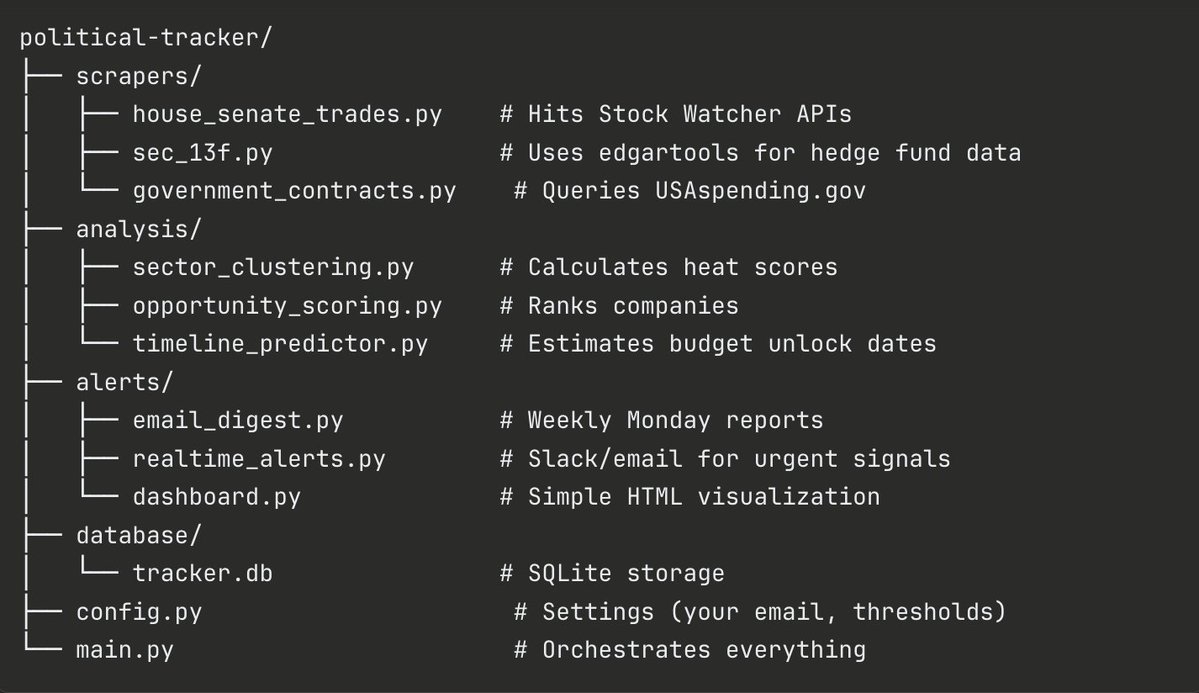
If you're over 80 IQ and you can sell, get Claude to build you a monitoring system that tracks where political money flows before anyone else knows
When politicians and institutional investors cluster their investments in specific sectors, they're signaling where government money, regulatory changes, and policy support are headed
That political investment data gives you a 4-8 month head start on the billions in collective vendor spending that flows when those companies receive contracts and funding
You can position your B2B offer or consultancy ahead of vendor budget unlocks by identifying which sectors and companies are about to receive massive capital influxes, before they even know they'll need your services
The cascade usually works this way:
Month 0-2: Politicians start buying stocks in a specific sector (defense, clean energy, healthcare, infrastructure). These mfs know what legislation is coming, what budgets are being approved, what contracts will be awarded
Month 2-4: Hedge funds and institutional investors follow with their own positions. Both political and institutional money aligns which means the signal strengthens
Month 4-6: Gov contracts get awarded, regulations pass and funding programs launch
Companies in that sector suddenly have:
- Multi-million dollar government contracts
- Grant money that needs deploying
- Regulatory requirements demanding immediate compliance
- Growth mandates from investors
Month 6-8: Those companies now need to:
- Hire aggressively
- Rebrand and market themselves
- Build new capabilities
- Navigate compliance
- Scale operations
Your vendor budgets are now unlocked
If you know how to identify pain points and craft a killer offer, this is a money printer
Tell Claude to build a daily monitoring system that:
- Tracks politician stock trades (House/Senate disclosure sites)
- Monitors hedge fund positions (SEC 13F filings)
- Identifies government contracts awarded USASpending.gov
- Flags hiring surges at target companies (I don't think Claude can track LinkedIn data so find another way or do it manually)
When 10+ politicians and multiple hedge funds buy the same sector within weeks, that's your signal
Cross-reference against government contract databases to see which specific companies just got funded
Track VC rounds and hiring patterns
Have Claude send you a weekly email with 5-10 companies ranked by opportunity score, showing exactly which businesses just got funded and will need consultants/agencies in 2-4 months
Build sector specific case studies 2-3 months before budget unlock
Target middle managers (Program Managers, Procurement Managers, Operations Managers) who directly control vendor budgets and are actively executing the newly funded projects
You're contacting them BEFORE they publish RFPs, before competitors even know there's opportunity
When the money hits their accounts, you're already the trusted expert they've been talking to for months
You bypass the entire RFP process while every other agency is in a race to the bottom on price
English
0ffshoreagain retweetledi
Based on convos we’ve had lately with operators doing anywhere from 50K to 300K+/mo
A lot of you still think an ecosystem means stacking deliverables
But an ecosystem is about stacking leverage, and eventually graduating into capital infrastructure
Once you control operations, capital becomes the natural extension
That’s exactly what we’re doing on our end
We just brought in a new partner on the investment side
The guy used to only work exclusively with $50M+ clients, but recently launched a separate asset platform for people in the $1M-$50M range
This opens an untapped arbitrage window for us
The $1M-$50M bracket is the most structurally underserved capital segment in the market
They’re too big for retail, too small for private banks to prioritize, and completely fragmented
No ecosystem exists to aggregate their deal flow, educate them, or route their capital
Which means:
Whoever controls origination + education + distribution for that segment becomes the default gateway to capital
Our strategy is to become part of the operators structuring this segment
This partnership gives us instant access to both sides of the wealth ladder:
- the big players ($50M+)
- the emerging wealthy ($1M-$50M)
By partnering with someone who already has footprint in both tiers ($1M-$50M and $50M+), we don’t have to “build trust” from scratch, we step into an existing capital migration pipeline
So we can originate deals, distribute capital, structure consulting offers and monetize via success fees, retainers, or advisory
This type of infrastructure lets us:
- Aggregate mid-tier capital
- Channel it into vetted opportunities
- Offer consulting + capital desks to founders
- Build a private deal flow ecosystem nobody else has
- Control the full cycle: origination, allocation, and backend monetization
All of this becomes relevant the moment your own model starts to hit structural limits
If you’re already doing 50k+ per month and you feel the limits of a linear model, the bandwidth cap, the operational drag and the low-value client cycles
The next stage is graduating into an ecosystem that produces leverage, not deliverables
And if you’re good enough, it eventually opens the door to capital infrastructure
If you want to see what that transition looks like for your business specifically
DM “INFRA” and I’ll walk you through the model

Mitch@benjaminprinter
How to transition from a linear offer to an ecosystem Linear offers start as simple transactions: one service, one deliverable, one exchange of money for work Most people get stuck here because the model scales only by adding more clients or working more hours Ecosystems work differently They don’t scale by adding more clients They scale by adding more surfaces where capital can attach itself The shift toward an ecosystem begins the moment the offer stops addressing an isolated task and starts addressing the conditions that surround the task When a provider shifts from fixing symptoms to shaping infrastructure, the offer naturally expands: - instead of running ads, they reshape acquisition - instead of building a funnel, they influence the entire revenue architecture - instead of integrating software, they reorganize workflows The offer expands not by adding features, but by addressing the broader system that creates the client’s problems in the first place As soon as the scope touches strategy, implementation, optimization, and continuity, the relationship is no longer linear It becomes layered, each layer creating a new entry point for value and, therefore, revenue The second stage happens when the provider gains enough operational visibility inside the client’s business to understand dependencies Once you see how decisions are made, where bottlenecks originate, how budgets move, which teams rely on which processes, all of that becomes leverage The work stops being a deliverable and starts becoming part of the company’s internal structure Insights drive opportunities Opportunities lead to expansion Expansion creates durability The vendor who once delivered a task now influences multiple surfaces of the business: - planning - execution - reporting - enablement - optimization - risk reduction From there, the economics shift naturally Instead of selling “more work,” the provider monetizes continuity, stability, and strategic influence Recurring retainers, expansion projects, performance based upside, licensing, and backend participation stop being add-ons and become the natural byproducts of the relationship The offer no longer says, “Here is what we do,” but rather, “Here is the operational environment we install inside your business” Over time, the client’s reliance deepens Removing the provider would create friction, destabilize processes, slow growth, or break continuity, so the switching cost rises automatically Because the ecosystem has embedded itself into their workflow, their planning cycle, and their internal logic Fees become easier to justify The provider stops being one option among many and becomes the default operating partner A linear offer sells a deliverable At this stage, growth no longer comes from acquiring more clients It comes from adding more layers to the same client, more functions, more integrations, more surfaces where the ecosystem can lock into the company’s existing structure A previously linear business now captures value vertically instead of horizontally And the same client who once paid for a single deliverable now represents a stack of interlocking revenue streams
English
0ffshoreagain retweetledi
I know it’s not really the trend on here to talk about your failures, but this is a conversation I had with @jordan_ross_8F back in 2022
At that time, I was sitting at $250K/month with my agency
3 clients, 90% profit margin, one partner, one VA
And the whole tech stack was basically Telegram + iPhone Notes
No SOPs and no processes
When I joined Jordan’s program, I remember how he and his now co-founder Spencer were shocked by our ability to produce money ex nihilo, especially with such a chaotic setup
They were so shocked that we ended up collaborating with them directly on a specific offer
Unfortunately, I had major personal issues that forced me to completely stop working, and I burned everything down like a retard
I’ve been back on track since then
After scaling multiple offers past 6 figures/month again, it simply made sense to help agencies and consultants, because I know exactly how to take something that works and make it scale FAST
You can hit stupid numbers with nothing but a phone and a killer offer
What’s actually hard is making money reliably, at scale, without the entire machine collapsing the second you stop pushing
So if you’re already in that stage where you can produce $15K, $30K, or even $50K+ months, and you want to scale aggressively with:
- acquisition that brings calls every day
- a front end offer that closes predictably
- a backend that creates recurring revenue and longer-term contracts (so you’re not starting from zero every month)
DM me “SOVEREIGN” if you want me to personally help you refine your offer and scale it 1:1

English
0ffshoreagain retweetledi
We booked 70+ calls for our finance offer in 30 days all through LinkedIn cold DMs
$15-30K ticket, AI profile pic, each account under 500 followers with zero content
Just recorded a 10-minute video leaking our entire outbound process from start to finish
(and how you can implement the same to book 20-40 calls for your offer in March)
RT + Follow & Comment “Linkedin” and I’ll send it
English
0ffshoreagain retweetledi
I’ve always said flexing is gay
Because 99% of the time you’re just seeking validation from other men
But like everything in life, there are exceptions, and last December I ran one of the funniest, highest ROAS experiments of my life
For context, before business, I almost went pro in football
I’ve played with and against guys who now play in the Premier League, La Liga, Ligue 1, Switzerland, etc
These guys make crazy money but 90% of them are financially clueless
Horrible structuring
Bad advisors
No long term planning
No idea how fast the tap can stop flowing
I have extremely strong partners in tax advisory, wealth structuring, and investments, so I already knew there was a golden bridge between my network and the services we offer
The problem is ballers are almost impossible to convince
Low financial literacy, high ego, predatory entourages, and short attention spans
If you come in like a consultant, try to “educate” them, and posture as the smart guy, you’re dead
So I used the only strategy that works with this demographic:
Become one of them, or at least look like it
And what are the two things footballers love above everything?
Hoes and spending a fuck ton of money on stupid shit
So in December, I flew to Dubai to spend a few days with two of my friends who play in Europe
And for one week straight, I made sure their experience was exactly what they’re wired to respond to
Best tables in Dubai
Bitches exactly in their taste
Luxury shopping on command
I even rented a Rolls-Royce Cullinan with a chauffeur, so they could move around in absolute comfort
(Funny thing is, in real life I don’t even own a car)
The key psychological point here is ballers don’t respect people who make money
They respect people who spend more than them, more easily than them, right in front of them
Their entire social hierarchy is built on visible spending power
If you spend less, you're below
If you spend the same, you're equal
If you spend more and you look like you don’t even care, they instantly assume you know something they don’t
So I outspent them in every category, on purpose, visibly, and effortlessly, to trigger the psychological shift they ALL have:
“If he spends more than me while I make $100K-$300K/month, what the fuck is he doing that I don’t understand?”
98% of my time was spent making sure they had the time of their lives
2% of my time was spent calmly breaking down:
- why their current financial structure is a disaster
- why their investments are scams
- why their entourage is draining them
- why the tap doesn’t flow forever
- and how to actually protect and grow their capital
I didn’t “pitch”
I let the environment do the selling, and positioned myself as the only guy who genuinely cares about their long term survival
Now, I’ve got them
They ask me for advice on everything
Changing agents, club decisions, life choices, and obviously how to structure their capital
The ROAS on that Dubai trip is around 30
The LTV is ridiculous
Footballers are sheep
Inside a locker room, if one guy does something good, everyone copies
Outside their club, every player has 10 friends in other clubs, who each have 10 friends, who each have 10 friends
The referral loop is infinite
My end goal is to build a vehicle that looks like a fund, behaves like a fund, but grows in a way traditional funds can’t compete with
Because athletes LOVE attaching their name to things that make them look smart or “on the inside”
If one guy puts in $350K, the next guy puts in $350K, and suddenly you’re sitting on $3M to $10M AUM without ever opening the fund to the public
What I’m building rn is a pre fund infrastructure
Wealth structuring + education + perception dominance + trust installation
Rn I’m controlling their advisors, the inflows, the outflows, the narrative, the social proof, and the dependencies
The moment you control a player’s capital behavior, you naturally become the allocator
You become the risk filter, the gatekeeper, and the opportunity decider
Which is literally what a fund manager is
But the fund I’m building won’t compete with traditional funds on the same axis
Traditional funds fight over track record, returns, analytics, and sector thesis, and obviously that part will be solid
But the real competitive advantage will be cultural capture
The psychology
The locker room dynamics
The fact that players don’t follow data, they follow whoever they believe sits above them in the social hierarchy
I already have a draft of the evolution path
Phase one is advisory and structuring, which I’m already doing by default
Managing their money behavior before ever touching their money
Phase two is a co-investment syndicate where I bring players into deals, not into a fund, and take carry
Phase three is running athlete SPVs, one investment at a time, with full GP economics
Phase four is turning that pipeline into a formal vehicle
And phase five is the Athlete Circle Fund, a fund built by athletes, for athletes, but actually run by people who understand money
Which brings me to the real point
Yes, I still think flexing is usually pathetic
But when used intentionally, in the right environment, for the right target, and tied to a high ticket backend
Flexing becomes a paid acquisition channel
My Dubai trip was LP warming
The entire week was a proto fundraising flywheel
Mfs thought they were partying, but I was onboarding them

Jeremy Moser@jeremynickmoser
Unless your goal is to impress 16-18 year olds & shill them a $997 course, flexing cars & watches is a straightline way to poverty
English
0ffshoreagain retweetledi
Alright mfs, just crafted a 21-page doc on how we rebuilt a consultant's stagnant B2B offer from the ground up
Within 15 days of starting with us, he closed a $15K upfront + $10K/mo retainer
I just packaged the entire play into a doc with screenshots of the exact step-by-step instructions we laid out for him
RT + Follow & Comment "B2B" to get the doc
GIF
English
0ffshoreagain retweetledi
How to mathematically prove that your "hard work" & “grinding” is most probably worth $15/hour
(and how to fix it before you waste 2026)
There's a specific type of delusion I see in almost every agency owner/consultant I talk to
The "grinding" mfs flexing 12 hour days
Then you run the math and realize they're making $15/hour
Not because they're not working hard
But because they never stopped to calculate what their time is actually worth
Spoke to a 19-year-old kid recently running a revenue recovery offer for roofing companies
Framing is solid
But the buyer and pricing are completely fucked
Guy was charging $3K upfront
He was cold calling 6-7 hours a day
Every single day
Now don’t get me wrong, it’s good that the kid is working harder than most middle aged guys
But he spent 35 hours a week dialling
And when I asked how many sales calls he'd booked in the last week
He said two
One of them ghosted
One of them closed
Now when you run the math :
140 hours of cold calling per month
8 sales calls generated
40% show-up rate
3 actual opportunities
1 closes at $3K
140 hours of work = $3,000 in revenue
$3,000 / 140 hours = $21.42/hour
And that's before he even delivers the service
Once you factor in the 50-70 hours per month he spends actually fulfilling the work
His effective hourly rate drops to around $15/hour
Literally minimum wage in most states
And he had no idea
Because he never ran the math
He convinced himself that being busy meant he was working
Cold calling feels productive
But productive toward what?
If 35 hours of effort only generates $3K in revenue
Might as well go work a minimum wage job
And the worst part is he would've kept doing it
For months
Maybe years
"I just need to crack the code"
"I just need to get better at cold calling"
"I just need more volume"
None of that was true
The problem wasn't his cold calling skills
The problem was the math didn't work from day one
Remember, the numbers always expose everything
Your offer is mispriced if you need 140 hours to generate one $3K deal
Your market is wrong if the buyers you're targeting can't afford what your time is worth
Your acquisition is broken if your conversion rate from outreach to close is under 5%
Your positioning is trash if you're spending 35 hours a week convincing people to take a call
Numbers don’t lie
The worst part was
He decided to cold call without ever understanding his KPIs
Because that's what he saw other agency owners doing
So he copied the tactic without understanding the math behind it
For this kid, the fix is simple :
Stop selling $3K revenue recovery to residential roofers
Start selling $20-40K commercial pipeline infrastructure to industrial contractors, manufacturing firms and facility management companies
Same service & same delivery
The acquisition math he math immediately makes sense:
20 sales calls per month
15% close rate
3 deals closed
At $20K average
$60K collected
English