0xChen | e.z@0xChenez
Just aped here at 470k
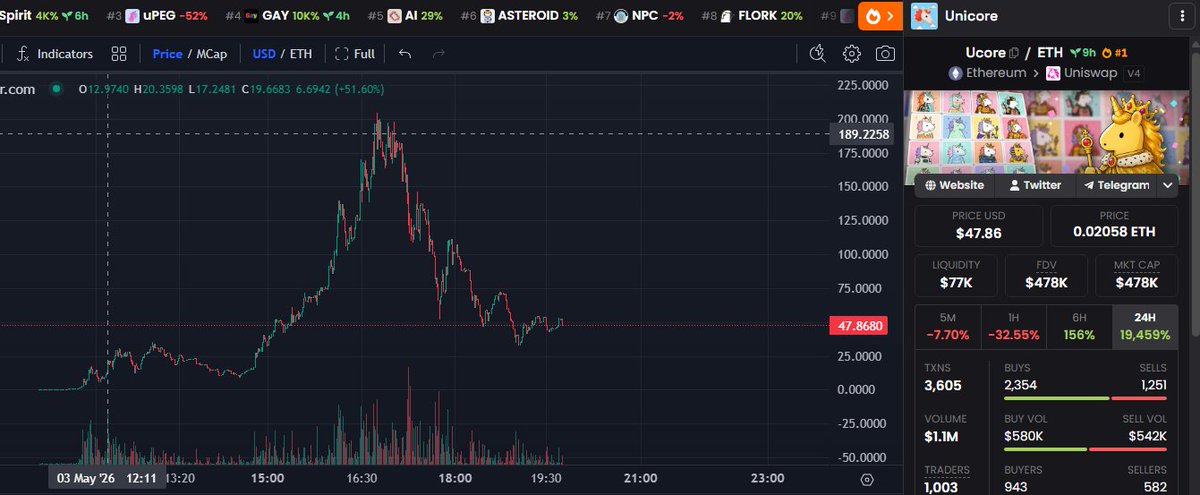
$Ucore
0xd4e43C86334940A246Daae8908c9b3cfb97c6817
Use ur brain and read
*--**-*-*--**-*-*--*-**-*-*-*-*-*-*--*-*-**-*-*-
$UPEG opened the market’s eyes to what Uniswap v4 hooks can do.
$UCORE looks like the cleaner next step.
The difference is simple:
$UPEG was mostly about the on-chain object / visual meta.
$UCORE adds an actual reward layer on top of it.
Every whole $UCORE you hold activates an on-chain Unicore object. That object has its own rarity tier, and that rarity decides how much weight you get from the protocol rewards.
The reward stream comes from a flat 3% tax on every Uniswap v4 swap. That pool gets shared back to holders based on the rarity weight of their objects.
So you’re not just holding a token.
You’re holding a token + an on-chain object + a reward slot.
That’s why I think $UCORE is more interesting than $UPEG.
$UPEG proved people care about v4 hook objects.
$UCORE takes that same idea and makes it more DeFi-native: fixed supply, rarity-weighted ETH/WETH rewards, object survival, and deflation mechanics built around whole-token selling.
Every time someone sells a whole token, 1 UNICORE object gets destroyed.
Fewer objects means the remaining objects have a bigger share of the reward system.
That’s the part people are probably underpricing right now.
It’s not just “unicorn art.”
It’s a reward-weighted object economy built around Uniswap v4 hooks.
The branding is clean too. Unicorns, rarity cards, on-chain objects, reward slots, and a simple mechanic that normal CT can understand in 30 seconds.
$UPEG had the first-mover narrative.
$UCORE has the better holder incentive design.
That’s usually where the second wave gets interesting.