Essam Hassan

10.6K posts

Essam Hassan banner
Essam Hassan

Essam Hassan

@0xEssam

Builder // Angel. prev R&D @Lightshift_xyz Core @Chainlink, OS/Search @Google

🇨🇭 Katılım Nisan 2011
2.2K Takip Edilen10.7K Takipçiler
Sabitlenmiş Tweet
Essam Hassan
Essam Hassan@0xEssam·
The brick walls are there for a reason. The brick walls are not there to keep us out. The brick walls are there to give us a chance to show how badly we want something. (1/2)
English
3
7
39
0
Essam Hassan
Essam Hassan@0xEssam·
Love how go is making a come back in high perf development
English
0
0
0
216
Kye Gomez (swarms)
Kye Gomez (swarms)@KyeGomezB·
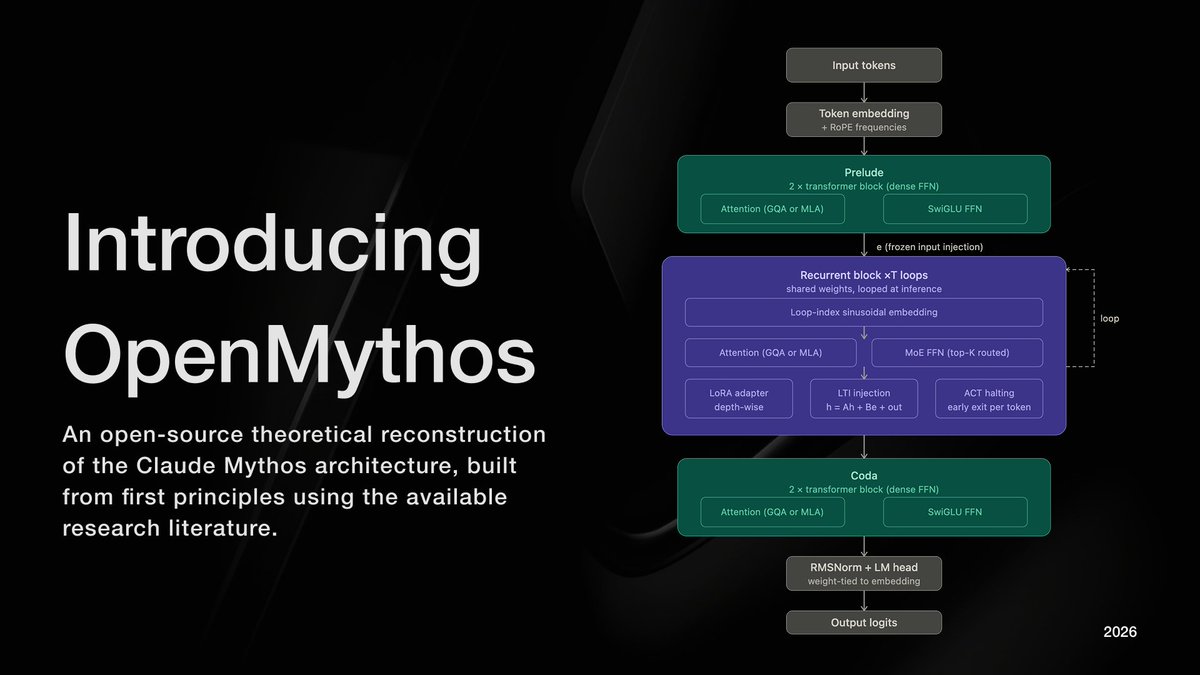
Introducing OpenMythos An open-source, first-principles theoretical reconstruction of Claude Mythos, implemented in PyTorch. The architecture instantiates a looped transformer with a Mixture-of-Experts (MoE) routing mechanism, enabling iterative depth via weight sharing and conditional computation across experts. My implementation explores the hypothesis that recursive application of a fixed parameterized block, coupled with sparse expert activation, can yield improved efficiency–performance tradeoffs and emergent multi-step reasoning. Learn more ⬇️🧵
Kye Gomez (swarms) tweet media
English
235
1.2K
8.2K
1.6M
Zach Lloyd
Zach Lloyd@zachlloydtweets·
We launched Oz (oz.dev) in February, and enterprise demand has accelerated quickly since. Warp’s enterprise ARR is now up 500%+ since Q4 as more companies look to move coding agents to the cloud, without giving up flexibility, governance, or control over their data.
Zach Lloyd tweet media
English
5
9
124
16.1K
Essam Hassan retweetledi
Dan Romero
Dan Romero@dwr·
kinda odd that despite the widespread availability of superhuman ai coding agents, the pundit class that’s claimed “i could have built that” for years has not, in fact, built that.
English
15
15
212
15.4K
Essam Hassan
Essam Hassan@0xEssam·
@johnennis wrong social network. this kind of content would kill on Linkedin
English
1
0
1
258
John Ennis
John Ennis@johnennis·
I think one of the biggest challenges when it comes to going hard into using AI is loneliness I am learning all these awesome things and becoming super capable But the set of people that I can really talk to about it is very small Is anyone else having this experience?
English
1.1K
173
3.8K
163.3K
Essam Hassan
Essam Hassan@0xEssam·
@yacineMTB If your program is realllly well designed it will use on statics and registers. You should not do round trips for memory whatsoever. If you do, then it isn’t a good program.
English
0
0
4
673
kache
kache@yacineMTB·
Dynamic allocation / heap allocation is enemy number one. If your computer program is well designed, you should know how much resources it is going to take up before you run it. If you don't, then it isn't a good program Allocate everything on the stack
English
118
11
465
323.7K
Essam Hassan
Essam Hassan@0xEssam·
مش بلوكشين بس فيه حلول كتيره من ال cryptography خصوصا zero knowledge systems المشكله في تبني الحلول دي كلها انها بتقف موظف الحكومه مش هينفع ياخد بكلامك ان ال math is sound و انك t-verify a cryptographic witness ده كافي التكنولوجيا موجوده من ٦-٧ سنين المشكله في التطبيق هي ثقافيه بحته و شفناها مع حكومات كتيره بعد ما القله المثقفين في الحكومات دي بتطرح المشاريع دي للنقاش بتقف عشان وزير التموين ولا الانتاج الحربي بتاعهم مش بيفك الخط و بيستعمل وورد بالعافيه فتيجي تقوله group theory و elliptic curves مش هينفع هو كويس انه فاهم يعني ايه kyc اصلا Look up: zk-id selective disclosures/Proof Of Personhood
العربية
0
0
2
51
Fede’s intern 🥊
Fede’s intern 🥊@fede_intern·
LLMs now make critical decisions in hospitals, defense, banks, and governments. Yet nobody can verify which model actually ran, or whether the output was tampered with. A provider or middleman can swap weights, silently requantize the model, alter decoding, inject hidden prompts, do supply chain attacks, or change the deployment surface without the user knowing. This problem is already serious. It will become critical. We think this needs a practical solution, not just a theoretically clean one. CommitLLM is designed to be deployable on existing serving stacks now: the provider keeps the normal GPU serving path, does not need a proving circuit, does not need a kernel rewrite, and does not generate a heavy proof for every response. In practice, two families of approaches dominated the conversation before this work: fingerprinting, which can be gamed, and proof-based systems, which are theoretically strong but too expensive for production inference. We built CommitLLM to target the middle ground. The core idea is to keep the verification discipline of proof systems, but specialize it to open weight LLM inference. The cryptographic core is simple: Freivalds style randomized checks for the large linear layers, plus Merkle commitments for the traced execution. Then a lot of engineering work is needed to make that line up with real GPU inference. The key trick is this. A provider claims `z = W × x` for a massive weight matrix. Normally you would verify that by redoing the multiply. Instead, the verifier samples a secret random vector `r`, precomputes `v = rᵀ × W`, and later checks whether `v · x = rᵀ · z`. Two dot products instead of a full matrix multiply. In the current implementation, a wrong result passes with probability at most `1 / (2^32 - 5)` per check. A full matrix multiply, audited with two dot products. Most of the transformer can then be checked exactly or canonically from committed openings. Nonlinear operations such as activations and layer norms are canonically re executed by the CPU verifier. The one honest caveat is attention: native FP16/BF16 attention is not bit reproducible across hardware. CommitLLM verifies the shell around attention exactly, then independently replays attention and checks that the committed post attention output stays within a measured INT8 corridor. So attention is bounded and audited, not proved exactly. That means the protocol already gives very strong exact guarantees on the parts that matter operationally most. If an audited response used the wrong model, the wrong quantization/configuration, or a tampered input/deployment surface, the audit catches that exactly. That includes things like model swaps, silent requantization, and provider side prompt or system prompt injection. Today the implementation and measurements are strongest on Qwen and Llama. But the protocol itself is not meant to be Qwen or Llama specific: we expect it to generalize across open weight decoder only families. What still has to be done is the engineering work to integrate and validate more families explicitly, and we are already working on that. On the measured path, online generation overhead is about 12 to 14% with the provider staying on the normal GPU serving path. The heavier receipt finalization cost is separate and can be deferred off the user facing path. The main systems costs are RAM and bandwidth, not proof generation. The full response is always committed, but only a random fraction of responses are opened for audit. Individual audits are much larger, roughly 4 MB to 100 MB depending on audit depth. The important number is the amortized one: under a reasonable audit policy, the added bandwidth averages to roughly 300 KB per response. After too many weeks without sleep, I’m proud to show what I built with @diego_aligned: CommitLLM. Thanks Diego for your patience. I've been calling you at random hours. The code and paper still need some cleaning and formalization. We’re already in talks with multiple providers and teams that have cryptography related ideas on how to improve it even more. We’re really excited about this and we will continue doubling down on building products in AI, cryptography and security with my company @class_lambda. If governments, hospitals, defense and financial systems are going to run on LLMs, verifiable inference is not optional. It is infrastructure. I will be explaining this in more details in the days to come and I will show how to test it and run it.
Fede’s intern 🥊 tweet media
English
31
53
345
95.1K
Essam Hassan retweetledi
sudox
sudox@kmcnam1·
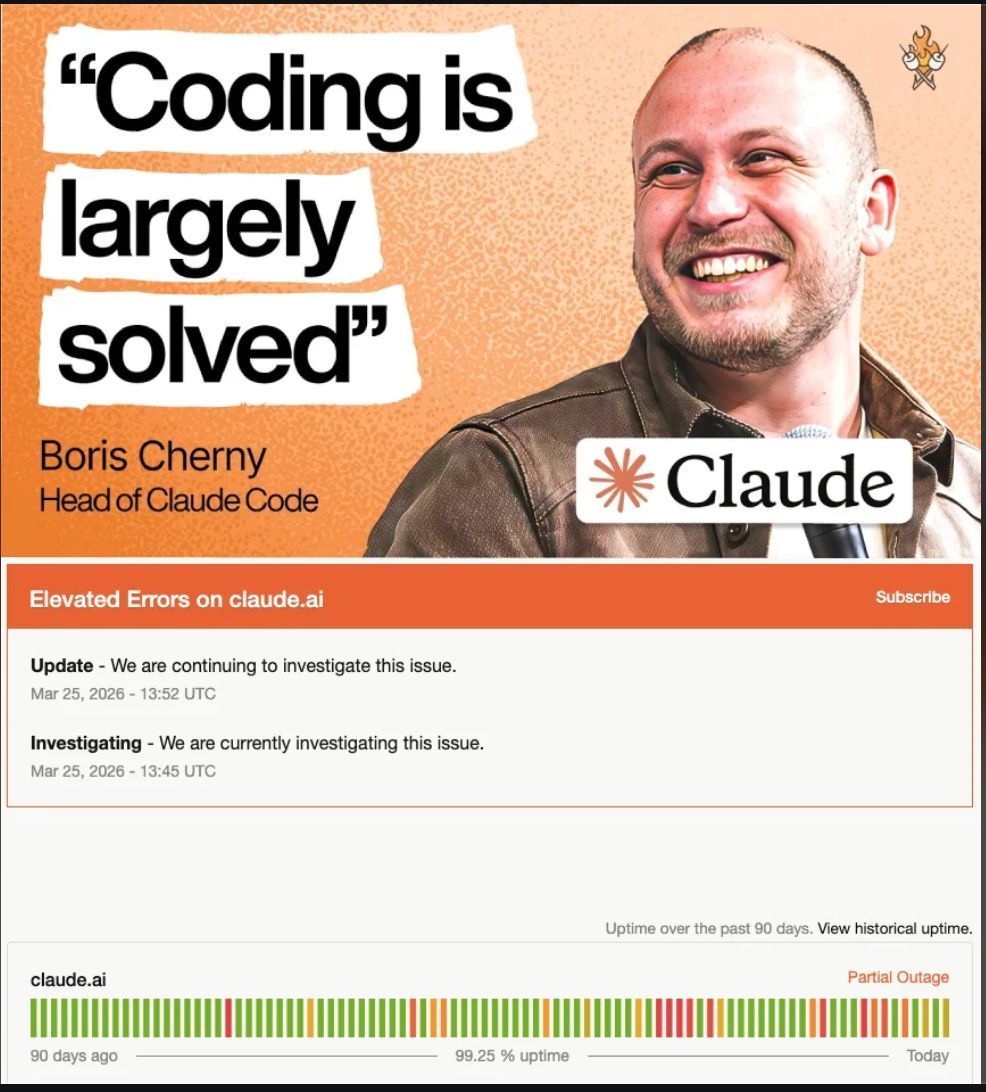
LoL
sudox tweet media
26
64
1.2K
33.1K
Essam Hassan
Essam Hassan@0xEssam·
bonus: Apple will win big by sitting out the silicon war and stockpiling cash.
English
0
0
1
228
Essam Hassan
Essam Hassan@0xEssam·
Highly specialized OSS models that can run in browser sandbox/handheld compute is the end game but because it goes against today’s value supply chain, we will only ‘discover’ this a couple years from now.
Igor Carron@IgorCarron

x.com/i/article/2037…

English
1
0
4
705