Rialo@RialoHQ
The $1.7T+ US unsecured consumer credit market is starting to move beyond credit scores alone.
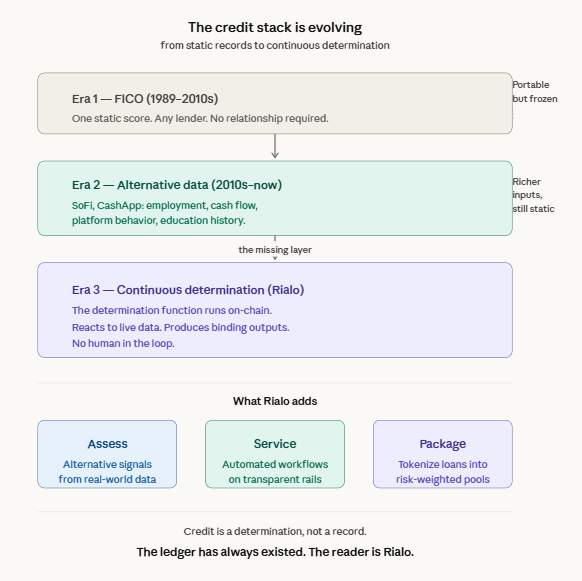
For decades, lenders mostly relied on systems like FICO to decide who should get a loan, how much they should get, and at what rate. That is changing: newer lending systems, including those used by @SoFi and @CashApp, use signals ranging from education and employment history to cash flow and platform-specific behavior to make those decisions.
The next step is to upgrade the lending stack and move key components onchain.
Rialo makes this possible by connecting onchain credit systems to real-world data, providing infrastructure to automate servicing workflows onchain, and enabling seamless tokenization of real-world assets, including private credit and consumer loans.
That opens up three opportunities:
- Richer credit assessment: Lenders can use alternative signals to determine creditworthiness by tapping into real-world data through Rialo.
- Efficient servicing: Lenders can run loan management and repayment workflows on Rialo’s transparent, programmable blockchain rails, reducing overhead and improving transparency.
- Loan packaging: Lenders can tokenize loans and bundle them into risk-weighted vintages, or loan pools organized by risk profile, with clearer visibility into risk and performance.
The opportunity for lenders is not just to make better loans. It is to use infrastructure that enables them to assess, service, and package loans in a single integrated system.
Get Real about credit. Get Rialo.