

blkMamba
8.5K posts


blkMamba retweetledi

SAMSUNG AND SK GROUP ARE ABOUT TO ANNOUNCE $1.3 TRILLION IN INVESTMENTS
The announcement comes Monday at South Korea's presidential office at 2pm local time.
Samsung Electronics Executive Chairman Jay Y. Lee and SK Group Chairman Chey Tae-won will both present their investment plans directly to President Lee Jae Myung.
What is reportedly included:
- Samsung: 4 to 5 new semiconductor fabs in the Gwangju area plus chip packaging plants in South Chungcheong province.
- SK Hynix: 4 to 5 new semiconductor fabs in Gwangju plus NAND plant expansion in North Chungcheong province.
(Source Bloomberg)

English



blkMamba retweetledi

Just woke up to a flood of bullish signals again. Even though it’s a holiday weekend in both the US and Hong Kong, I don’t believe in taking the foot off the gas.
While most people are relaxing with family, I genuinely enjoy working and sharing alpha with my community. Sorry that I will bombard with so many bullish posts this weekend — but the opportunities right now are simply too good to stay quiet.
I’ve also asked Cat @cantonmeow to drop more exclusive videos covering our core holdings and trending stocks that you should NEVER miss this cycle! More content is coming. Stay tuned, and as a thank you to the entire X community, we shall drop one bonus video completely free!
English
blkMamba retweetledi

Just a reminder: 99% of X was bearish on memory 3 months ago...
Since then:
$MU $380 -> $1122 (+195.26%)
$SNDK $565 -> $2155 (+281.42%)
$EWY $132 -> $219 (+65.91%)
SK Hynix 849K -> 2.685M KRW (+215.5%)
Samsung 172K -> 362K KRW (+110.7%)
If you see a bunch of projections on memory names like Samsung becoming the most profitable company in the world in 2028.
Might be a good idea to think independently outside of the narratives at the time like "Oil, LNG, Helium, Iran, etc."
Probably same thing now with optical names and their projections into 2027, 2028.
I do think photonics and memory are the 2 top themes though, with optics being very early into the supercycle.

Serenity@aleabitoreddit
Thoughts on the $EWY / KOSPI crash and whether it's a buying opportunity for Samsung/Sk Hynix: This looks like a clear buying opportunity. Especially as investors misunderstand that 2026 is not 2022 (Ukraine-Russia) conflicts. AI has fundamentally changed the demand for memory, compared to the 2022 downturn in consumer electronics, where Samsung/Sk Hynix also footed opex costs. The main catalyst for one of the largest single-day drops in Korean history was Iran drone striking QatarEnergy's Ras Laffan complex. Qatar is roughly ~20% of the global LNG supply. Results: -> Dutch TTF (Euro Natural Gas): +46% -> Asian Spot LNG: + 39% -> U.S. Natural Gas: +4.16% (fine) The LNG spike was the catalyst for the drop as South Korea is materially exposed as it relies on imported LNG. Fearing this inflationary energy shock, investors aggressively dumped South Korean tech equities, combined with deleveraging of 10x Samsung/Sk Hynix. Sending -> Samsung Electronics down by 9.79%. -> SK Hynix shares sank by 11.12%. and the $EWY (KR futures) down 14.49% today. Everyone is fearing the 2022 incident with Russia-Ukraine war increasing LNG prices, causing industrial electricity tariffs in South Korea climbed by roughly 70% after KEPCO stopped abosring losses. In 2022 alone, Samsung's domestic facilities consumed approximately 28,000 GWh of electricity. The tariff hikes added an estimated KRW 2 trillion (over $1.4 billion USD) to Samsung's annual operating expenses and over KRW 1 trillion for SK Hynix. This unprecedented spike in operational expenses (OPEX) hit at the exact worst possible time. In late 2022, the semiconductor industry entered a brutal cyclical downturn. Post-pandemic demand for PCs and smartphones plummeted, leading to a massive oversupply of DRAM and NAND flash. However, 2026 is completely different: Compared to 2022 that faced increasing energy costs during a downturn: AI demand for memory is completely unprecedented. On the 27th, there were reports of DRAM hikes again from Samsung/Sk Hynix. Demand for NAND prices from $SNDK have been so high for capacity allocation that they've been taking 3 year pre-orders in advance. There is no end to demand in sight, and no relief way until 2028. Comparing this to 2022, where consumer segments for laptops and smartphones were already facing a downturn, memory makers could not pass on the costs (and tanked opex bill). That caused a major correction last time. Because the global AI chip shortage is so acute in 2026, they will seamlessly pass their inflated utility bills down the supply chain. Because supply is severely constrained, Samsung and SK Hynix dictate the market terms. Big Tech hyperscalers (Microsoft, Meta, Google, Amazon) are locked in an AI arms race. They are highly price-insensitive right now and prioritize securing volume over haggling. As a result, this looks like a clear buying opportunity, especially as projections range from: Morgan Stanley | Macquarie on Samsung 2026: ~$182.0B USD vs. ~$210.8B USD 2027: ~$235.1B USD vs. ~$333.7B USD Morgan Stanley | Macquarie on SK Hynix: 2026: ~$132.9B USD vs. ~$190.5B USD 2027: ~$167.0B USD vs. ~$312.8B USD The selloff looks like an immediate de-risking from fears over 2022 Ukraine-Russia-conflicts, combined with extreme leverage from 10x instruments. But unlike 2022, where laptops and consumer demand were already facing a downturn and LNG spikes caused Samsung/SK Hynix to foot the bill: This time it's passed onto hyperscaler costs because demand is too high. People always compare KOSPI to silver, but the difference is one has whopping operational income, where in a bull-case scenario, 2 years of income alone would exceed their market cap of companies like SK Hynix. The drop on Samsung/Sk Hynix looks like a clear buying opportunity as their operational income will likely blow past any short term volatility.
English
blkMamba retweetledi
非常感谢中文社区对我最看好股票的投资思路进行的深度剖析!
总的来说,像 $AAOI 和 $SIVE 这样的激光公司是我个人的最爱,因为它们在拓展营收方面有着极大的想象空间。它们可以不仅仅局限于销售激光器,还能制造完整的光模块 以及各种光引擎或 ELS (外部光源) 组件。
又或者像 $COHR 那样,甚至可以向上游延伸进军衬底制造领域,从而实现垂直整合,并不断提升自身的毛利率和总潜在市场规模 TAM
这其中很大一部分的关键在于要率先精准踩中投资主线,毕竟去年很多人甚至都不觉得“光子学(photonics)”能成为一个真正的热门概念。
而且我认为最会让大多数人感到惊讶的是,我们目前仍处于极其早期的阶段。绝大多数的营收放量(爬坡)要到明年,也就是 2027 年的上半年乃至下半年才会真正开始!
不过,能看到中文社区大家持续不断的支持,真的让我感觉非常棒。我会尽我所能,不辜负大家给我起的 “白毛股神” 这个称号。
梭哈.AI@SUOHA_AI
中文
blkMamba retweetledi

$MRVL $JBL $SIVE
Jabil Q3 26 FY outlined how strong $SIVE will participate in the upcoming years ahead 👀

English
blkMamba retweetledi
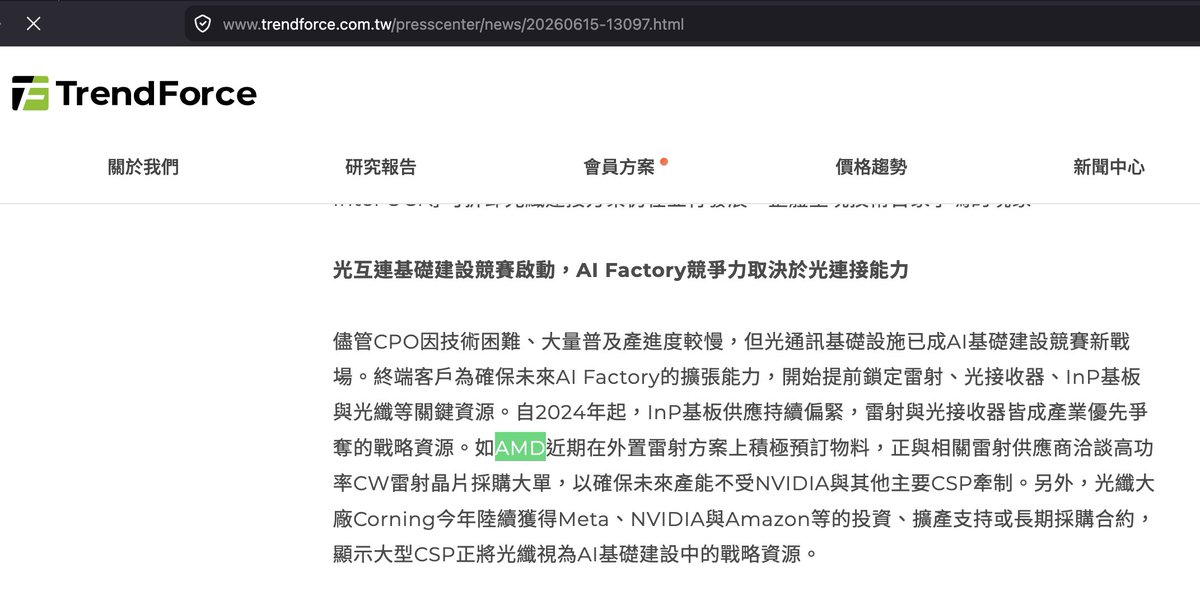
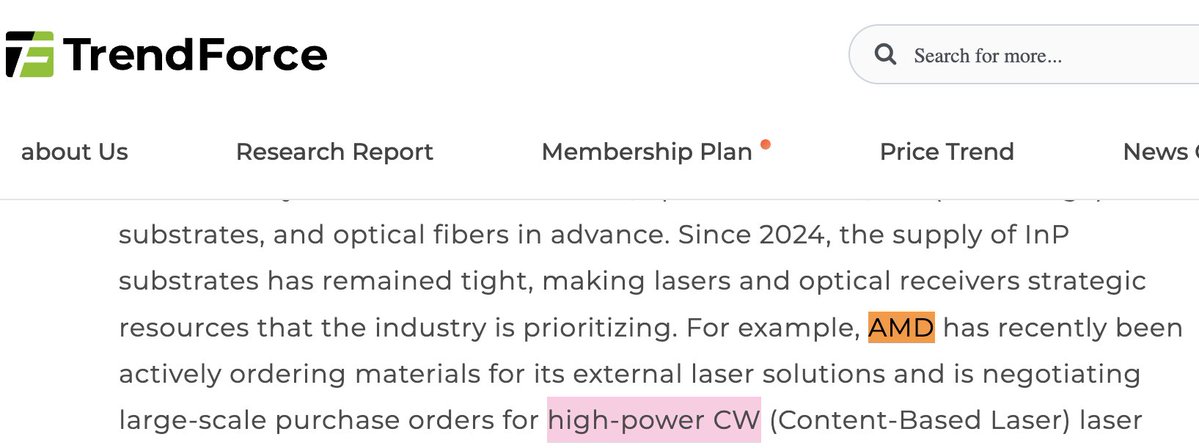
Trendforce reports that $AMD is actively trying to secure CW laser supply with multiple major procurement orders...
Is probably just the start of the bottleneck?
There's not much independent capacity in Western supply chains left other than $SIVE or $AAOI and maybe Macom.
Especially after Lumentum/Coherent got locked up with multi-year agreements with Nvidia. (disclosure, own Sive and aaoi)
Lumentum is already CW laser constrained and is likely buying off Japanese companies like Sumitomo/Furukawa if I had to guess per ER, and those are probably running at max capacity.
From the Trendforce report, this is:
"to ensure that its future capacity will not be constrained by NVIDIA and other major Cloud Service Providers (CSPs)."
I wouldn't be surprised if other hyperscalers like Amazon, Microsoft, and others saw Nvidia / AMD signing LTAs, and are trying to secure capacity next.
A lot of it is game theory on not getting choked out by competitors, and looks like AMD is tipping the first domino after Nvidia.
But my opinion is that this just goes and show how invaluable this CW laser chokepoint is and the companies are inside it.
English
blkMamba retweetledi
I’m not sure why many folks are super bearish on my high conviction $AAOI long…
Ever since $30, then on the way up to $170. (Yes I do think every bear is wrong, we’ll see who’s right).
They have scarce laser capacity that $AMD and other hyperscalers are looking for.
While the entire industry is bottlenecked by $NVDA.
Along with a US transceiver supply chain for mass production of 800g/1.6T (management - largest in America).
While demand far exceeds supply and while assembly gets outsourced to Asia.
Then they’re quoting $471M monthly revenue in H1 entering H2 of 2027. Which is $5.6B ARR, off a $13.5B MC…
While a lot of major inflection volume hits even later in 2028.
As for fluctuations, there might be active $600M ATMs that get tapped into at random times.
And random bear posts + macro from time to time that cause more volatility (eg. Analyst notes saying bear on $LITE due to false CPO delay rumors, then that brings down others in the sector).
Also we’re a year out so timelines are still a little early.
I haven’t seen such fast revenue ramp since $NBIS.
Formless@Amiteshkumar840
@aleabitoreddit AAOI又高跳下落,对此你怎么看
English
blkMamba retweetledi

blkMamba retweetledi
Mizuho Research: No delays on CPO or 800v dc.
Revised up optical engine projections from $NVDA demand ramp.
- Next phase in CPO for long term, believes InP DFB lasers remains the focus (hello $SIVE). VSCEL and microLED remain "unproven" in short distance in rack + chip to chip for 1.6T+
- HVDC deployment on track, 800VDC incremental volume 2027, with higher penetration in 2028.
What a stupid CPO related selloff recently.

Serenity@aleabitoreddit
$NVDA Networking Senior Vice President refuting recent analyst reports on delays: - “ the most exciting stuff is co-packaged optics.” - There is no delay in H2 CPO product delivery schedule. - CPO switch will enter mass production and begin ramping up customer deliveries as planned in the second half of 2026 This was a media article, original interview source credit should have been credited to Tae Kim / Computex. Something fun to note too was this quote “Gilad was VERY enthusiastic about the CPO ramp from Nvidia.” Both near term and long term. Yeah… I’m extremely bullish on CPO alongside Nvidia.
English
blkMamba retweetledi
$MRVL $JBL $SIVE 👀 how many time you can ignore before it is to late? $SIVE

Marvell Technology@MarvellTech
Deploying next-generation optical connectivity at the pace AI infrastructure demands requires more than advanced technology. It requires standards that reduce integration complexity and give data center operators flexibility at the time of deployment. The Open CPX MSA, which includes Marvell among its members, is building that foundation. A single CPX array can be configured to support co-packaged copper for intra-rack connections, co-packaged optics for rack-to-rack communication, and ZR/ZR+ modules for long-distance interconnects, with port configurations determined at deployment rather than at design time. With near- and co-packaged port shipments projected to grow from under one million in 2025 to more than 100 million per year by 2030, that kind of flexibility matters. George Hervey explains what Open CPX makes possible: mrvl.co/4emX2Ro
English
blkMamba retweetledi
New reports that $AMD is scrambling for CW laser supply.
And is negotiating large-scale purchase orders for CW Lasers to ensure its production capacity is not constrained by $NVDA (Trendforce)
Obvious CW laser beneficiaries:
- $SIVE (AMD went to GFS for CPO, Sivers reference laser level)
- $AAOI (Rosenblatt analyst checks)
Lumentum/Coherent are kinda booked out way into 2028 as well.
Lumentum is especially constrained for CW capacity already from existing EML contracts (so they probably are buying from Sumitomo/Furukawa and co).
Maybe Macom and Japanese giants still have spare capacity. (disclosure, own aaoi/sivers).
I predicted this last year and said hyperscalers should go more upstream to secure capacity... at laser levels, epiwafer levels, or even inp substrate levels.
To not get bottlenecked by Nvidia.

English
blkMamba retweetledi

Imagine if the whole Iran-US bull rally extends into November.
Cantonese Cat 🐱🐈@cantonmeow
Gap up = Ceasefire Gap close = Ceasefire is fragile Sustained rally for a few months going into midterm elections in November = Some type of peace deal Maybe? 🐱🐈🐈
English
blkMamba retweetledi
Today, there's a new report that China eased InP substrate exports.
Which is expected to relieve mass production bottlenecks in the photonics market (source: Digitimes)
My optical positions are very happy to hear this:
From $AXTI (substrates), $IQE (epiwafers) to $AAOI (lasers) / $LITE / $SIVE, and others.
Taiwanese optical players like VPEC, Landmark, and others should go brrr as well.
Just to recap: the photonics market, especially for laser companies is moreso "how much can you make" rather than how much demand is there.
InP substrates was one of the main bottlenecks affecting upstream capacity.
So if you're able to make more = more revenue.


English
blkMamba retweetledi
It’s been officially 3 months since I posted my $SIVE long thesis back at 4 SEK.
This idea is now up ~1900%…
With many US institutions from JPM to Fidelity only recently entering positions.
Probably my 2nd greatest thesis of all time after $AXTI.
Did you listen anon?

English
blkMamba retweetledi

blkMamba retweetledi
Adding more lanes of copper is no longer a sustainable scaling strategy for data centers: signal integrity, EMI and cabling complexity are exploding.
Optical I/O replaces thick cable bundles with high‑density fiber, simplifying architecture and enabling the next generation of hyperscale designs.
#OpticalIO
English
blkMamba retweetledi