
hardik retweetledi
hardik
4.2K posts

hardik
@0xhardik
Founder and CEO @cryptotimes_io
Dubai, United Arab Emirates Katılım Mart 2011
2.1K Takip Edilen1.3K Takipçiler
hardik retweetledi

hardik retweetledi

🌸 Celebrating Women in Crypto
On this #InternationalWomensDay2026, we celebrate the incredible women whose leadership and innovation continue to shape the global crypto and blockchain ecosystem.
From policy and investment to technology and education — their contributions are driving the future of digital assets.
A thread highlighting some inspiring leaders. 🧵👇

English
hardik retweetledi

🔥EXCLUSIVE: Bitcoin failed its war test. Gold didn’t.
As U.S.–Israel strikes on Iran escalate:
• Oil +8–9% on supply fears
• Gold extends record rally above $5.3K
• $128B wiped from crypto
• $515M liquidations in 24h
$BTC breaks lower while tokenized gold surges. Asia braces for oil shock.
Read this full breakdown by our Founder and CEO @0xhardik 👇
The Crypto Times@CryptoTimes_io
English
hardik retweetledi
hardik retweetledi
hardik retweetledi

🎙️🇭🇰 WATCH: @harbour_ind_cap, Head Ambassador of @Polkadot, joins @0xhardik, CEO & Founder of The Crypto Times to discuss on Polkadot's 97% Drawdown & DOT Halving at @consensus_hk.
Key Insights👇
• How a Polkadot-focused VC fund navigates a 97% drawdown
• Why they remain committed to the Polkadot ecosystem
• DOT halving and inflation reduction impact
• JAM and the decentralized supercomputer thesis
• Polkadot Hub and smart contract strategy
• Governance concerns and Web3 Foundation influence
• Developer activity vs low TVL disconnect
• Harbor Industrial Capital’s $100M fund target
Timestamps👇
00:18 Introduction – Harbor Industrial Capital & Polkadot Focus
00:52 Polkadot Down 97% – Managing LP Expectations
02:17 Why Stay Committed to Polkadot?
03:59 Is Polkadot’s Layer Zero Model Irrelevant?
05:48 Attracting Capital in a Bear Market
07:55 Polkadot Treasury Overspending on Marketing
08:52 Parachain Auctions to Agile Coretime Transition
10:53 DOT Halving Explained
13:24 Will Halving Improve Scarcity?
14:10 Risk of Unstaking & Selling Pressure
16:55 Smart Contracts on Polkadot Hub
18:43 Gavin Wood’s Strategic Pivot
21:09 What Is JAM (Decentralized Supercomputer)?
24:14 JAM vs Ethereum vs Bitcoin Analogy
26:07 Largest Blockchain Migration Explained
29:09 Developer Activity vs Low TVL
30:54 Is Gavin Wood Responsible for Marketing Gap?
32:58 2026 Milestones for Recovery
33:35 Proof of Personhood (POP) Explained
36:15 Harbor Fund Strategy & Web3 Foundation Backing
37:46 Governance & Insider Concerns
41:43 Portfolio Allocation Strategy
43:54 Polkadot App & Retail Adoption
47:29 Final Outlook on DOT
#ConsensusHK #ConsensusHK2026 #HongKong
English
hardik retweetledi

🇭🇰 WATCH: @MarcinRedStone Co-Founder of @redstone_defi, sits down with @0xhardik, CEO & Founder of The Crypto Times to break down the future of tokenized RWAs & oracle risk in on-chain finance.
Key Topics Covered👇
• Why tokenized RWAs haven’t scaled as expected
• Private credit vs tokenized treasuries
• Oracle risk in real-world assets
• Preventing liquidation cascades
• AI vs AI in oracle security
• Institutional due diligence (BlackRock, Apollo)
• Oracle legal liability & SLAs
• Prediction market vulnerabilities
• Why infrastructure is underappreciated in crypto
• RedStone vs Chainlink – modular vs monolithic design
Timestamps👇
00:19 Introduction – Marcin Kaźmierczak & RedStone Overview
00:53 What RedStone Oracle Does & $8B Secured
02:18 Which RWA Category Is Scaling?
03:16 Private Credit vs Tokenized Treasuries
06:32 When Do RWAs Become Real Market Infrastructure?
08:12 Why Oracles Are Critical for Tokenization
09:15 Oracle Risk & Liquidation Cascades
09:31 AI vs AI in Oracle Security
11:14 Microsecond Latency & Arbitrage Protection
12:07 MegaETH Integration & 10ms Block Updates
13:42 Working With BlackRock & Apollo
16:26 Preventing “Fat Finger” Errors (Paxos Case)
18:22 Biggest Misconceptions About Oracle Risk
19:42 Red Token, Staking & Slashing Model
22:23 Governance & Token Security Concerns
24:12 What Would an Oracle Failure Look Like?
25:49 APAC vs US Institutional Behavior
27:41 Western Builders’ Mistakes in Asia
29:14 Prediction Market Vulnerabilities (Polymarket vs Kalshi)
32:44 Compliance DeFi Must Accept (KYC & Transparency)
34:22 Legal Liability for Oracles
36:55 What Will DeFi Look Like in 5 Years?
39:02 RedStone vs Chainlink – Modular vs Monolithic
40:28 Cost Comparison vs Chainlink & Centralized Providers
41:36 Advice for Crypto Investors
44:05 Closing Remarks
#ConsensusHK #ConsensusHK2026
English
hardik retweetledi

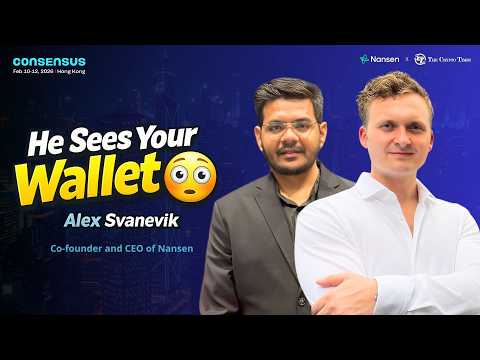
🇭🇰 WATCH: @nansen_ai CEO @ASvanevik sits down with @0xhardik CEO & Founder of The Crypto Times to discss AI, On-Chain Markets & the Future of Crypto at @consensus_hk.
Key Insights👇
• Why “most crypto founders slow rug”
• Why Cardano is a “ghost chain”
• Why ETFs are only temporary intermediaries
• Why AI will change how we trade crypto by 2030
• Why crypto is inevitable due to $100T wealth transfer
• The real incentive problem in crypto
• Why autonomous AI trading is dangerous
• Nansen’s profitability & funding status
• On-chain vs centralized risk after FTX
Timestamps👇
00:00 Introduction
00:19 Why Nansen Is Betting on AI Trading
01:20 Are You Competing With Your Own Customers?
02:11 How Nansen AI Actually Executes Trades
03:12 Why Nansen AI Beats GPT Models
06:06 Joint Venture Protocols (JVP) Explained
07:56 What Is NX8 Index Product?
09:33 Does Nansen Promote Its Own Products?
10:13 Narrative Trading vs Fundamentals
12:24 Every Asset Will Be Tokenized
14:54 Has Crypto Fixed Its Trust Problem?
16:29 ETFs Are “Temporary Intermediaries”
18:05 AI Risks in DeFi & Autonomous Trading
20:28 What Crypto Founders Get Wrong About AI
22:50 Crypto Is Inevitable ($100T Wealth Transfer)
24:02 Arkham vs Nansen – Quality vs Free Data
25:33 Biggest Misreads in On-Chain Data
27:12 Nansen Layoffs & Profitability
29:07 Surviving a 2-Year Bear Market
30:14 Why Nansen Is Free on Solana
33:39 “Cardano Is a Ghost Chain”
36:31 Quantum Risk & Bitcoin
37:13 The Most Uncomfortable Truth in Crypto
38:57 Why Nansen Won’t Launch a “Shitcoin”
40:21 Closing Remarks
Watch it exclusively on: youtu.be/3opmYyWY6uM?si…
Or read the full coverage: cryptotimes.io/2026/02/12/exc…

YouTube
English
hardik retweetledi

🇮🇳 Crypto in India: Taxed, Regulated, or Misunderstood?
🎙️ Vikas Gupta, India Head at @Bybit_Official, sits down with @gksolanky, Research analyst at the crypto times to discuss:
• India’s 30% crypto tax & 1% TDS
• Travel Rule & FIU compliance
• Bybit’s exit and re-entry in India
• Institutional adoption trends
• The October 10 liquidation event
• Bear market outlook
Timestamps:
00:00 Introduction
00:27 Budget 2026 & India’s Crypto Tax Update
01:12 Government’s Compliance Push & Travel Rule
02:09 Is Bybit the Most Compliant Offshore Exchange?
03:05 Travel Rule Implementation Challenges
06:05 Institutional Crypto Adoption in India
08:21 Bybit’s Exit & Re-entry in India
11:08 FIU Registration & Compliance Process
12:42 Competition in India’s Crypto Market
16:22 Suggestions to Indian Government
20:01 Evolution of Crypto Exchanges (Growth vs Compliance)
23:34 Indian User Behavior: Tier 1 vs Tier 2 Cities
25:06 Derivatives vs Spot Trading in India
29:20 Exchange Responsibility & Hack Transparency
34:27 Are We in a Bear Market?
37:56 October 10 Liquidation Event
40:48 Binance Bug Allegations
42:26 Advice for Beginners & Advanced Traders
45:21 Why Believe in Crypto? Blockchain & AI Future
53:14 Closing Remarks
English
hardik retweetledi

Two leaders. One vision.
Shaping the future of crypto.
Our CEO @0xhardik meets @binance Co-CEO @_RichardTeng at #ConsensusHK2026 🇭🇰.

English
hardik retweetledi

Day 1 | #ConsensusHK2026 🇭🇰
The market might be in the red, but Hong Kong is buzzing.
We’re officially on the ground at @consensus_hk 2026!
Interestingly, even with $BTC under $70k and the charts looking shaky, the turnout here in Asia's biggest crypto gathering is massive.
Our mission here? Filter the signal from the noise.
In an industry where "money grabs" often mask true innovation, we are here to highlight the projects and trends that offer real consumer utility and long-term value.
Not everything in crypto deserves your attention, but this coverage does.
Stay tuned for the latest scoop!
let’s connect: @0xhardik, @JahnuJ76219
English
hardik retweetledi

Meet our team at @consensus_hk | Feb 10–12 🤝
The Crypto Times will be on the ground delivering live coverage, sharp insights, and in-depth reporting from key talks and panels across the event.
Our team on-site:
• @0xhardik — Founder & CEO,The Crypto Times
• @JahnuJ76219 — Research Analyst & Crypto Journalist, focused on deep research, market narratives, and on-ground reporting
Looking forward to sessions featuring Richard Teng, Charles Hoskinson, Joseph Lubin, and other industry leaders.

English
hardik retweetledi
hardik retweetledi

There have recently been some discussions on the ongoing role of L2s in the Ethereum ecosystem, especially in the face of two facts:
* L2s' progress to stage 2 (and, secondarily, on interop) has been far slower and more difficult than originally expected
* L1 itself is scaling, fees are very low, and gaslimits are projected to increase greatly in 2026
Both of these facts, for their own separate reasons, mean that the original vision of L2s and their role in Ethereum no longer makes sense, and we need a new path.
First, let us recap the original vision. Ethereum needs to scale. The definition of "Ethereum scaling" is the existence of large quantities of block space that is backed by the full faith and credit of Ethereum - that is, block space where, if you do things (including with ETH) inside that block space, your activities are guaranteed to be valid, uncensored, unreverted, untouched, as long as Ethereum itself functions. If you create a 10000 TPS EVM where its connection to L1 is mediated by a multisig bridge, then you are not scaling Ethereum.
This vision no longer makes sense. L1 does not need L2s to be "branded shards", because L1 is itself scaling. And L2s are not able or willing to satisfy the properties that a true "branded shard" would require. I've even seen at least one explicitly saying that they may never want to go beyond stage 1, not just for technical reasons around ZK-EVM safety, but also because their customers' regulatory needs require them to have ultimate control. This may be doing the right thing for your customers. But it should be obvious that if you are doing this, then you are not "scaling Ethereum" in the sense meant by the rollup-centric roadmap. But that's fine! it's fine because Ethereum itself is now scaling directly on L1, with large planned increases to its gas limit this year and the years ahead.
We should stop thinking about L2s as literally being "branded shards" of Ethereum, with the social status and responsibilities that this entails. Instead, we can think of L2s as being a full spectrum, which includes both chains backed by the full faith and credit of Ethereum with various unique properties (eg. not just EVM), as well as a whole array of options at different levels of connection to Ethereum, that each person (or bot) is free to care about or not care about depending on their needs.
What would I do today if I were an L2?
* Identify a value add other than "scaling". Examples: (i) non-EVM specialized features/VMs around privacy, (ii) efficiency specialized around a particular application, (iii) truly extreme levels of scaling that even a greatly expanded L1 will not do, (iv) a totally different design for non-financial applications, eg. social, identity, AI, (v) ultra-low-latency and other sequencing properties, (vi) maybe built-in oracles or decentralized dispute resolution or other "non-computationally-verifiable" features
* Be stage 1 at the minimum (otherwise you really are just a separate L1 with a bridge, and you should just call yourself that) if you're doing things with ETH or other ethereum-issued assets
* Support maximum interoperability with Ethereum, though this will differ for each one (eg. what if you're not EVM, or even not financial?)
From Ethereum's side, over the past few months I've become more convinced of the value of the native rollup precompile, particuarly once we have enshrined ZK-EVM proofs that we need anyway to scale L1. This is a precompile that verifies a ZK-EVM proof, and it's "part of Ethereum", so (i) it auto-upgrades along with Ethereum, and (ii) if the precompile has a bug, Ethereum will hard-fork to fix the bug.
The native rollup precompile would make full, security-council-free, EVM verification accessible. We should spend much more time working out how to design it in such a way that if your L2 is "EVM plus other stuff", then the native rollup precompile would verify the EVM, and you only have to bring your own prover for the "other stuff" (eg. Stylus). This might involve a canonical way of exposing a lookup table between contract call inputs and outputs, and letting you provide your own values to the lookup table (that you would prove separately).
This would make it easy to have safe, strong, trustless interoperability with Ethereum. It also enables synchronous composability (see: ethresear.ch/t/combining-pr… and ethresear.ch/t/synchronous-… ). And from there, it's each L2's choice exactly what they want to build. Don't just "extend L1", figure out something new to add.
This of course means that some will add things that are trust-dependent, or backdoored, or otherwise insecure; this is unavoidable in a permissionless ecosystem where developers have freedom. Our job should make to make it clear to users what guarantees they have, and to build up the strongest Ethereum that we can.
English
hardik retweetledi

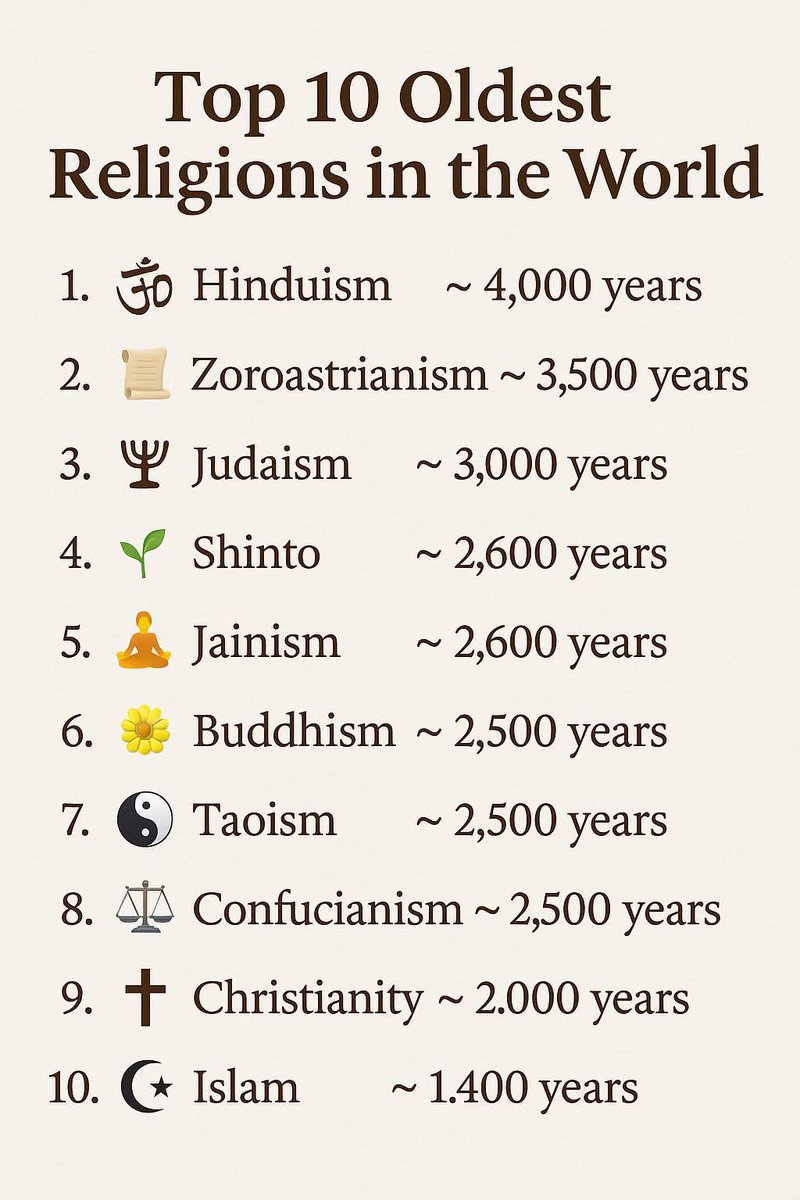
Top 10 Oldest Religions in the World
1. 🕉️ Hinduism ~ 4,000 years
2. 📜 Zoroastrianism ~ 3,500 years
3. 🕎 Judaism ~ 3,000 years
4. 🌿 Shinto ~ 2,600 years
5. 🧘 Jainism ~ 2,600 years
6. 🌼 Buddhism ~ 2,500 years
7. ☯️ Taoism ~ 2,500 years
8. ⚖️ Confucianism ~ 2,500 years
9. ✝️ Christianity ~ 2,000 years
10. ☪️ Islam ~ 1,400 years

English
hardik retweetledi