Fanous🇮🇶 retweetledi
Fanous🇮🇶
3.5K posts

Fanous🇮🇶
@108z2
Interested in Iraqi and regional politics
Baghdad Katılım Ağustos 2024
412 Takip Edilen97 Takipçiler

@rec_tuber انا اردني و قبل ما ادخل تويتر كانت نظرتي ايجابية للخليج بشكل عام
لكن اكتشفت انه عقلياتهم متخلفة اغبياء ما عندهم غير كلمة مجوس و ذيول فرس و اخونجي
بحزن لما اشوف فارسي لابس كوفية و يدعم فلسطين و لما اشوف سعودي امارتي كاتب فلسطين ليست كضيتي
حتى في كثير اردنيين متأثرين بخطابهم
العربية

بن گفير يحتفل باصدار قرار اعدام اهل السنة في سجون اسرائيل
ولا اسمع اي اعتراض من الاخوة السعوديين
لا ارى رعايا تنظيم الدولة السورية يتباكون في التعليقات.
اينكم يا احرار العرب !
The Cradle@TheCradleMedia
VIDEO | Israeli National Security Minister Ben Gvir, outside the Knesset chamber, celebrates the passing of the death penalty law for Palestinian detainees, describing it as historic and saying, “Soon we will count them one by one.”
العربية
Fanous🇮🇶 retweetledi

@Hydikm الشهيد علي رضا قائد القوات البحرية في الحرس الثوري
هكذا وصف الشعب العراقي
الشعب العراقي شعب حي وغيور🇮🇶
الغيرة العراقية مشهودة لها وهيَ الرقم الصعب حالياً وحتى في المستقبل القريب
العربية

@Turkiye_O1 @ahmadslmanx يجب على الاتراك مساندة ايران والقضاء على الكرد في هذه الاراضي والى سيدمرون المنطقة لأنهم سرطان في قلب دولنا
العربية

@ahmadslmanx لا ينبغي لإيران أن تنخدع بحيل الدولة الإرهابية الأمريكية
ورغم الإيحاء بأنها ستحتل الجزر، إلا أنها قد تتسلل عبر شمال العراق.
يمكنهم التسلل مع الأوغاد الذين يطلق عليهم حزب العمال الكردستاني.
لا ينبغي لإيران أن تظهر الرحمة وتهاجم العدو دون خوف
العربية
Fanous🇮🇶 retweetledi

ترحيب واسع تشهده المدن الإيرانية بوصول المواكب الحسينية وقوافل الإغاثة العراقية حيث اصطف المواطنون على جانبي الطرق لاستقبالها الى جانب التعبير عن امتنانهم لهذه المبادرة الإنسانية
وفي المقابل تعيش أوساط المعارضة الإيرانية في الخارج والتي تدعم الحرب حالة من الغضب معتبرة أن هذه المشاهد خيانة لايران وفق زعمهم، كان هذا الموضوع هو الابرز اليوم في التايم المعارض الايراني
العربية
Fanous🇮🇶 retweetledi

@Fatooshyyy @irakirak11344 @Hydikm شنو اختلاط عرقي هم الفارسين اشكالهم تشك شك من اجمل وانقى سلالات البشر
العربية
Fanous🇮🇶 retweetledi

Wow, those are some very interesting images. The highest quality I have seen to date, with some valuable information. Thank you for sharing.
If you are asking what I see, well, first understand a couple things. I am not a military person, or familiar with bomb damage assessment. Nor am I a political person, or economist. I just build and operate the hardware. So I’ll tell you what this looks like from a hardware perspective, and label things that are objectively facts vs. things I am guessing at or if I put any opinions in.
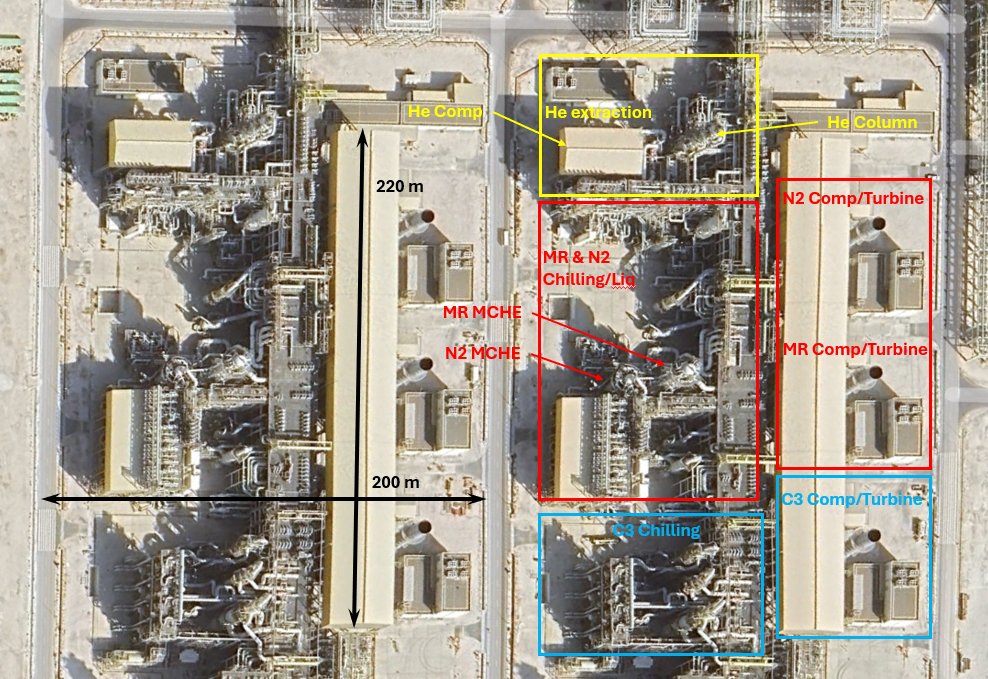
With those caveats, here are some facts and my analysis of the Train 6 strike. I’ve attached two pictures. The first is the undamaged facility from happier days. I’ve labelled the north end of the train with some color coded boxes, and a couple dimensions on Train 7 to give a sense of scale.
Train 6 used an Air Products (now Honeywell) AP-X process, which has three refrigeration loops in series, each driven by a Frame 9 mechanical drive turbine – a propane (C3) loop, a mixed refrigerant (MR) loop, and a nitrogen expansion (N2) loop. Propane precools the feed gas and the refrigerant, the MR liquefies it, and the N2 subcools it all the way to -160 C.
At the southern most portion of the photo, in blue, there is the propane refrigerant system. Process equipment is to the west of the main spine rack, and the driver is to the east. Drivers include both the turbine and the compressors on a single shaft for each loop, and they are located under the 220 m long turbine building with the tan roof. Exhaust stack is immediately to the east turbine building, with the VFD components just south of the stack.
The red boxes in the middle are the primary liquefaction section, with two machines on the east in the turbine building, and the main cryogenic heat exchangers (MCHEs) on the west side of the rack. I’ve labelled the MCHE’s. The larger is the MR MCHE, which is about 50 m tall, and has a two inch thick aluminum shell. The N2 MCHE for gas subcooling is a little further to the west. It is shorter and has a stronger stainless steel shell; it is a substantially stouter piece of equipment. These two MCHEs combined are in the range of $50-100MM capital cost with a two year lead time.
The yellow box at the top is the helium extraction unit. The machinery is electrically driven compander, inside the small building, and the primary separation column is just to the east of the building.
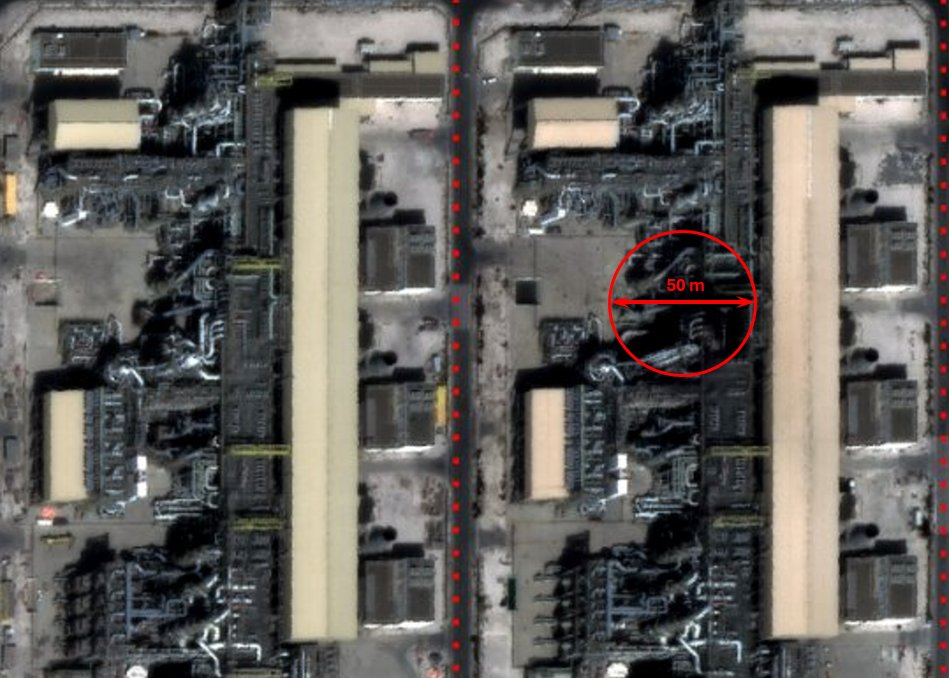
With the basics out of the way, take a look at the second picture. I’ve marked where the missile impacted, and the visible area of damage; the shadows disguise some of the blast and make it a bit harder to see. But from my view, it is quite bad, having hit immediately north of the MR MCHE, doing a fine job of messing up the equipment in the liquefaction section. Compare to Train 7 next door. I’ve marked the approximate circle of visible damage, which indicates an immediate blast radius on order of 50 meters. While I’m not military, it is pretty easy to calculate the energies involved, which indicates to me that we are talking about something on order of ~100 kg HE warhead. Sizable enough to do some real damage, but not a catastrophic hit from 500 kg or more. I am a bit surprised I could not see more damage from the subsequent fires. Qatari emergency crews responded to the fires, and it appears to me they did quite well at extinguishing them quickly before significant escalation.
Note the precision of the hit. If I were responsible for targeting this facility, … well, I couldn’t do it, because I love these facilities and the machines in them too much. But if a hypothetical person who knew about the facilities and wanted to harm them was planning it, this is just about where they would place a strike to cause maximum damage. Possibly a little further to the southeast to strike right on top of the MR turbine, but certainly within about 50 meters of the actual strike point. That will give a feel for the CEP of these missiles. It is quite good, which I understand is not at all a given for nations building missiles. Remember the notorious inaccuracy of the Iraqi Scuds during the 1991 Gulf War. The Iranians don’t suffer from the same problem – they can hit what they aim at with considerable precision despite American and Gulf nation efforts at interception at one of the most heavily defended areas in the Gulf. In fact, in Qatar, this site is probably the most heavily defended site, only excepting Al Udeid air base and Doha itself.
What was damaged? The resolution is not adequate to fully identify everything – you’d really need a walk through to be sure. But it is clear the MR MCHE is destroyed, along with some of the smaller pieces of equipment around there. The N2 MCHE is still standing, but there is some visible damage. I’d guess that, even with the shell standing, a missile strike this close would complete destroy soft items – insulation, instruments, cabling, platforms – and likely perforate the shell with fragments such that it would be unusable as a pressure vessel. My best guess is the N2 MCHE will require replacement.
To the east, the turbine housing roof appears undamaged, but I think this is deceptive. The roof is about 40 meters high, and the missile blast wave will initiate below it and propagate sideways under the pipe rack and through the building. Both the N2 and MR machines are close to the blast point and likely received a significant overpressure, along with heat from the subsequent fire. I have no doubt they are damaged. Frame 9's are robust and reliable industrial machines, but they are not designed for missiles. Whether they can be repaired or will need to be replaced is an open question.
North of the impact point, I suspect the helium machine was protected from significant damage by the intervening piperack. However, the column protrudes above the piperack and probably caught an overpressure and significant fragmentation. My guess here is the helium column was likely perforated and will require major repair or replacement.
To the south, the MCHE’s and piperack absorbed most of the damage and my best guess is the propane system is likely undamaged, or only suffered minor damage.
Qatar has said the train will require 3 – 5 years to be back in operation. In my mind that seems a little conservative. If they can get to work immediately, and expedite procurement, I would guess about three years is a reasonable timeline. Five years I think is longer than will be required, absent another attack causing further damage.
Analysis? This is speculation on my part, and anyone might well disagree. But it appears to me that Iran was sending a message more than simply just trying to destroy. They used a precise missile, but with a somewhat smaller warhead, one that is large enough to cause heavy damage, but not so large as to cause catastrophic irreparable damage to the entire train or even to multiple trains. They also targeted two trains that are jointly owned with the Qataris by ExxonMobil. (Puzzle question – why did the second missile strike Train 4 instead of the larger Qatar-XOM Train 7? Or maybe they did try to hit Train 7, but that missile was intercepted? Don’t know…). But they conspicuously avoided hitting the trains that are co-owned by Japanese or Korean partners, trying to keep them onside or neutral in the war. To me, this strike seems to say, “Look Qatar and XOM – we can hurt you. But we didn’t hurt you as much as we could, and we want you to use your influence to get the US to stop and restore the status quo ante.” Whether that will work is for the political people to say. I do know the Qataris are royally ticked off at this attack.
Anyway, that is my read on it. It is definitely a very bad attack, one that caused substantial damage and will impact Qatari production for years. I am not trying to play down the impact in any way. But it is simultaneously true that it *could* have been worse.
I’ll look at the Train 4 strike when I can. Looks like the miss was a bit more there – it struck southwest of the turbine house, looks like it affected the propane equipment. These reviews take a bit of time, and I am chronically short of that commodity. But thank you again for sharing these photos.


English