

Seranity/Precise market analysis
63 posts

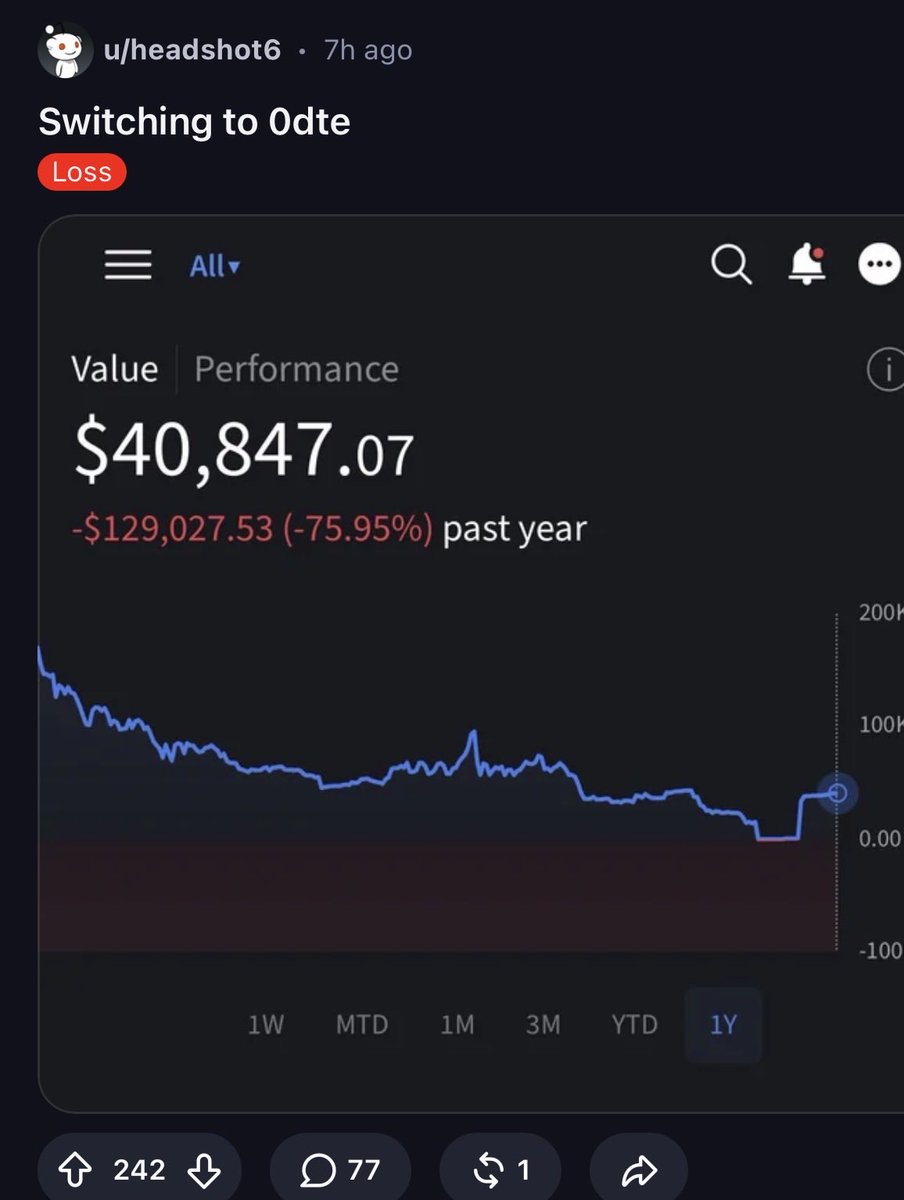
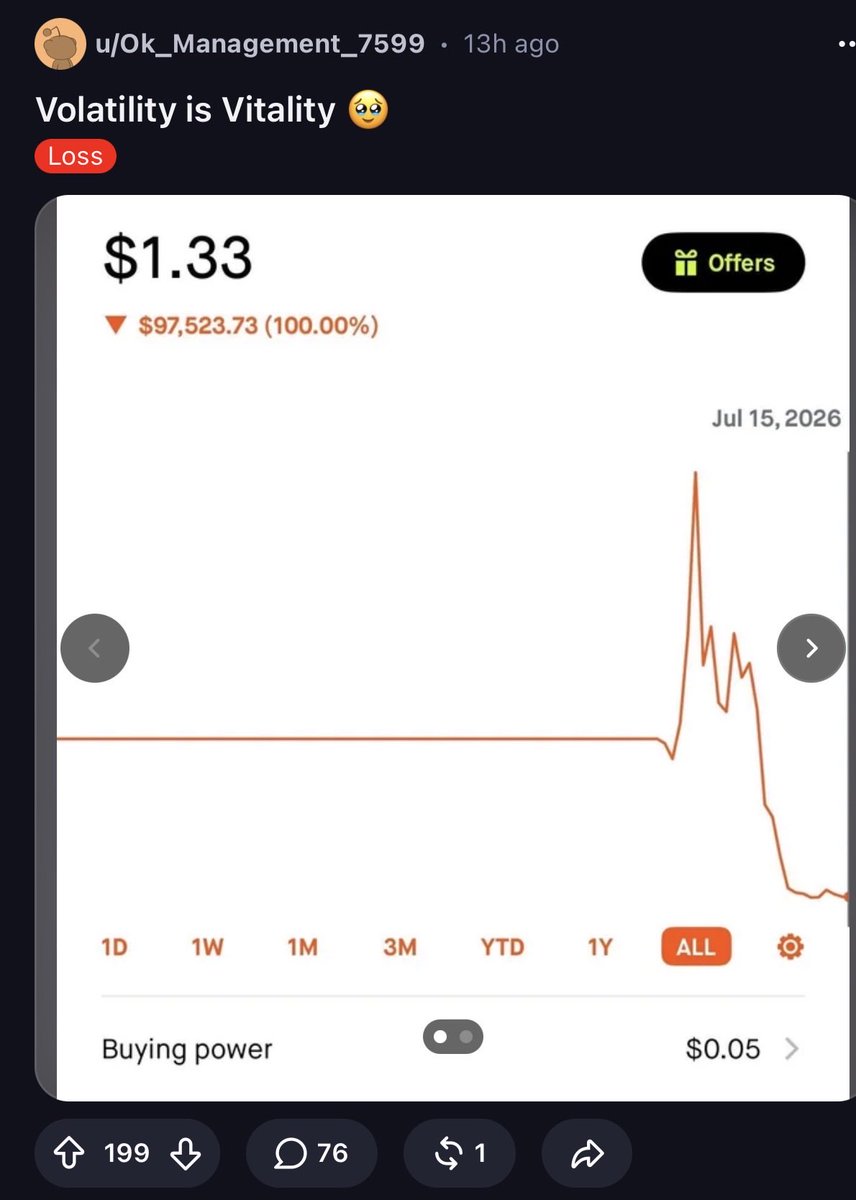
Feels bad, -49.4% drawdown this month after the recent crash.
My portfolio is mainly AI chokepoints and bottlenecks.
In the memory, photonics, robotics, and upstream semis, (on margin) which all tend to be higher beta than others. But reduced leverage recently from the crash.
I see a lot of people making fun of the drop or AI names, saying it’s obvious that:
- “AI is a bubble”
- “memory/kospi is a bubble”
- “photonics is a bubble”
- “humanoids won’t get anywhere”
- “neoclouds will get replaced by hyperscalers like Meta”
And a bunch of retail + bots saying “sell everything, it’s never going to recover”.
But I have conviction that all these themes are backed by structural revenue growth or technological shifts.
And I’ve had similar drawdowns back when there admin threatened global tariffs, before markets pulled off a recovery.
I personally have a longer horizon + higher tolerance for volatility than others, to see how this plays out.
Especially considering a lot of retail view things on a week to week basis: no, my thesis isn’t wrong yet if I project revenue inflection in H2 2027 and it’s 2026 now.
Anyway, feels bad short term just wanted to share anyway for transparency.

Serenity@aleabitoreddit
Agreed! It’s nice to remember your thesis during a market crash. From my own personal thesis, if $AAOI hits $1.4B quarterly revenue start of Q3 2027. Which is annualized $5.6B off a $8B MC. Is it “over” for the company if that revenue ramp hasn’t even shown up in the quarterly earnings… when it’s 2026? Same applies to my CPO sector exposure like $SIVE, an architecture shift led by $NVDA. If scale out volume ramps from H2 2026 into 2027, and scale up heavily volume ramps into 2028. Is it “over” that $0 -> $91B TAM expansion (per GS) hasn’t even hit yet? With robotics like Agility, is it over in 2026 if the listing hasn’t even happened yet and humanoids haven’t ramped? I personally think current market conditions are a reflection of liquidity and leverage, not individual fundamentals. It’s brutal for everyone to see KOSPI, TW, Nikkei, and AI, space, robotics sector stocks crash recently. Especially when there’s a lot of irrational behavior stemming from those leverage. In the end, we can’t tell you what stocks to buy, what timeframe you should sell, how to size your positions, or what you should do. Only share personal thoughts or research and track if they get validated over time. So it’s extremely important to build your own thesis, since everyone has unique risk tolerance or investing timeframes. And that usually leads to having higher conviction during crashes.
English
Kim Sunwoo of Meritz Securities: "This Is Not the Time to Sell Samsung Electronics and $SKHY"
They claim markets are excessively misunderstanding the situation with semis. And that DRAM shortage will intensify in the second half of this year.
- H2 2026: "suppliers can fulfill only 75%–80% of DRAM demand".
- 2027: "fulfillment is expected to fall into the 60% range."
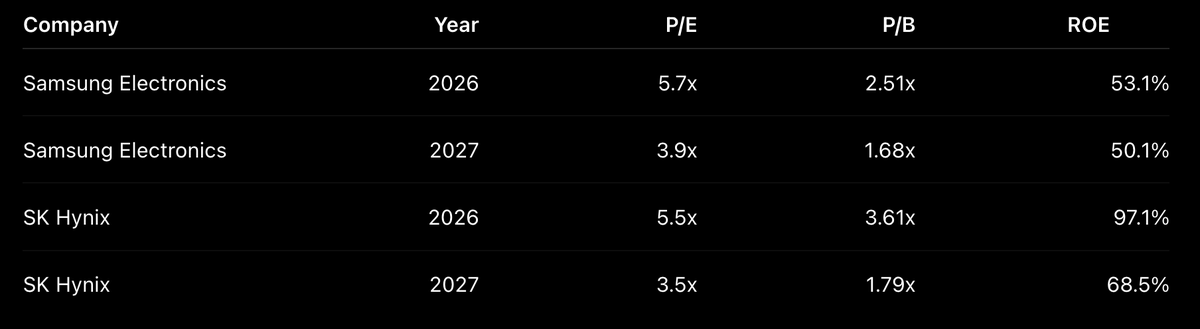
In the article, they attached market forecasts that show SK Hynix with a 2027 3.5x P/E and Samsung a 3.9x P/E.
Think the $INTC CEO said it best around timeframes with his quote "no relief in memory supply or pricing until at least 2028".
Especially after $MU 16 LTAs with favorable take or pay volume contracts... memory demand seems structural.

English


Lot of people were curious about $SIVE capacity volume ramp modeling through fab-light (Win Semi + others):
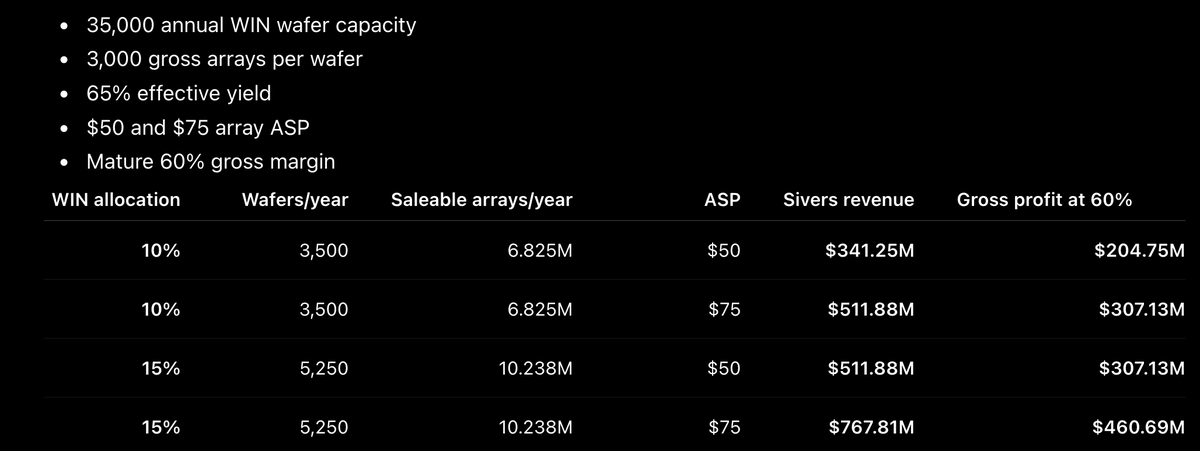
Using 10% of Win's wafer capacity as a low-end allocation (65% yield assumption, $50-$75 ASP):
Sivers would support $341-$512M worth of annual array revenue. Given upper end of managements 50-60%+ gross margin target, would be roughly:
$205–307M of annual gross profit.
Against Sivers current ~$1.1B MC, would be ~:
3.6–5.4× MC/gross profit if this capacity scenario plays out in 2028.
And at 15% would be $307–461M in gross profit (2.4–3.6× MC/gross profit)
Sivers CEO also replied that they're working with more fabs for capacity. And from an older deck, there looks to be more qualifications since 2024.
So capacity targets might be larger than what's stated here as CPO takes off.
I also expect to see revenue pipeline projections hiked in future quarters, as more qualification suppliers to into HVM.
_
As for demand side, CW also happens to be very bottlenecked.
Lumentum are buying CW off the open market due to EML obligations from their ER transcript.
And $AMD are signing LTAs to secure CW capacity (from Trendforce). So when Sivers is ramping with $GFS, $JBL, Ayar, $POET, O-NET and others...
Given the current constraints, it's highly likely any independent qualified capacity that comes online would be absorbed.
And as a cherry on top, Morgan Stanley named $SIVE (~$1.1B) as one of the three leading CPO laser players .
Alongside $55B+ players Coherent and Lumentum in their recent note for a reason...
_
TLDR: Sivers only needs a low end allocation from Win to make substantial gross income relative to current valuations.
I think the largest revenue upside that isn't modeled in if they TAM expansion with M&A after US NASDAQ listing.
By copying the Lumentum playbook with Cloud Light to build out entire transceiver modules or with optical engines.

Anders Storm@StormDirac
Your assumptions are wrong. Win Semiconductors has a InP capacity of 35.000 wafers per year. Assume even a low number 10% of that is 3500 wafers. There are approximately 3000 CW arrays on a wafer, price per Array >$50. At only 10% of this capacity Sivers could sell for more than $500m just for arrays..then you have pluggables, wireless...at 20% capacity...even more. Production qual has been ongoing for sometime, as WIN mgmt confirmed, hence should not be too far away.
English
$AAPL looks to acquire AI chip companies for running AI (Source: The Information)
Right now, $MSFT, $META, Amazon, Google are carrying AI capex spend.
But what if Apple joined the others after M&A?
A possible scenario is that they revise capex largely upward for their own AI buildout.
Since they probably witnessed Google cutting off Meta from compute constraints... or what happens when you partner with OpenAI for LLMs.
Then learned how important it is to have your own infrastructure.
This scenario would be quite bullish thematically from optical networking to foundries and something markets would not expect? We'll see what happens.

English

$NVDA CEO, Jensen Huang in Tokyo today said:
"The reports are not true. Vera Rubin is already in production. Giant amounts of production incoming"
As a flat denial to the accusation that their AI servers would be delayed.
Jensen appears to be using the Umbrella term for Rubin Ultra/Kyber, then pointed to current gen ramp.
Regardless, lot of damage has been done already to Nvidia supply chains stock prices, after the multiple delay reports. Even if Nvidia refuted them by clarifying Kyber change was an architecture optimization, not impacting timelines.
It's a very dangerous and growing trend for folks to post overreaching broader claims from technical nuances to grow viewcount... Especially if they get Jensen has to respond.
In the end, I'm trusting $NVDA on timelines since they probably have the greatest visibility into their own supply chain.

English
Just wrapped the most hype anime convention weekend! Met my favorite seiyuu, scored limited-edition merch, and my cosplay group’s photo shoot hit different. Worth every second of line-waiting and sore feet!

English
Seranity/Precise market analysis retweetledi

Sharing my newly tried matcha white chocolate cookies with my bestie Life’s too short for boring snacks—treat yourself and share the joy!

English
Tried that ultra-light wireless earbuds for sports today—zero tangles, crystal-clear audio even during sprints, and a 8-hour battery that lasted my whole workout plus commutes. Game-changer for my daily fitness routine! ♀,

English
Seranity/Precise market analysis retweetledi

A late-night acoustic set with cozy coffee shop vibes makes today’s mood perfect—soft guitar strums + warm vocals = pure comfort.

English