Nikhil.||@nikhil303475
What Is @fermah_xyz Kernel? Why Does Proof-System-Agnostic Infrastructure Matter? What Major Problem Does It Solve for the Future of Proving Systems?
The blockchain industry is rapidly moving toward a future powered by Zero-Knowledge (ZK) proofs. From rollups and privacy applications to AI verification and decentralized infrastructure, ZK technology is becoming one of the most important foundations of modern crypto.
But despite all this innovation, one major limitation still exists: most blockchain protocols are not truly autonomous.
Today’s systems still rely heavily on humans, keeper bots, multisigs, centralized servers, or external operators to function. Smart contracts can execute instructions, but they cannot independently observe events, make decisions, and complete workflows on their own.
This is the exact problem Fermah is trying to solve.
{▪︎}What Is Fermah Kernel?
Fermah Kernel is a composable and autonomous workflow engine designed to give protocols real “agency.”
Instead of acting like passive smart contracts that only react when triggered, protocols powered by Fermah Kernel can:
▪︎ Observe on-chain events
▪︎ Execute conditional logic
▪︎ Trigger computations
▪︎ Generate proofs
▪︎ Publish verified outputs back on-chain
Most importantly, all of this happens without manual execution or centralized coordination.
Kernel runs workflows inside trustless sandboxed environments, allowing blockchain applications to behave more like autonomous systems rather than static software.
In simple terms, Fermah Kernel transforms blockchain infrastructure from reactive software into self-operating infrastructure.
{▪︎} Why Proof-System-Agnostic Infrastructure Matters
One of the biggest challenges in today’s ZK ecosystem is fragmentation.
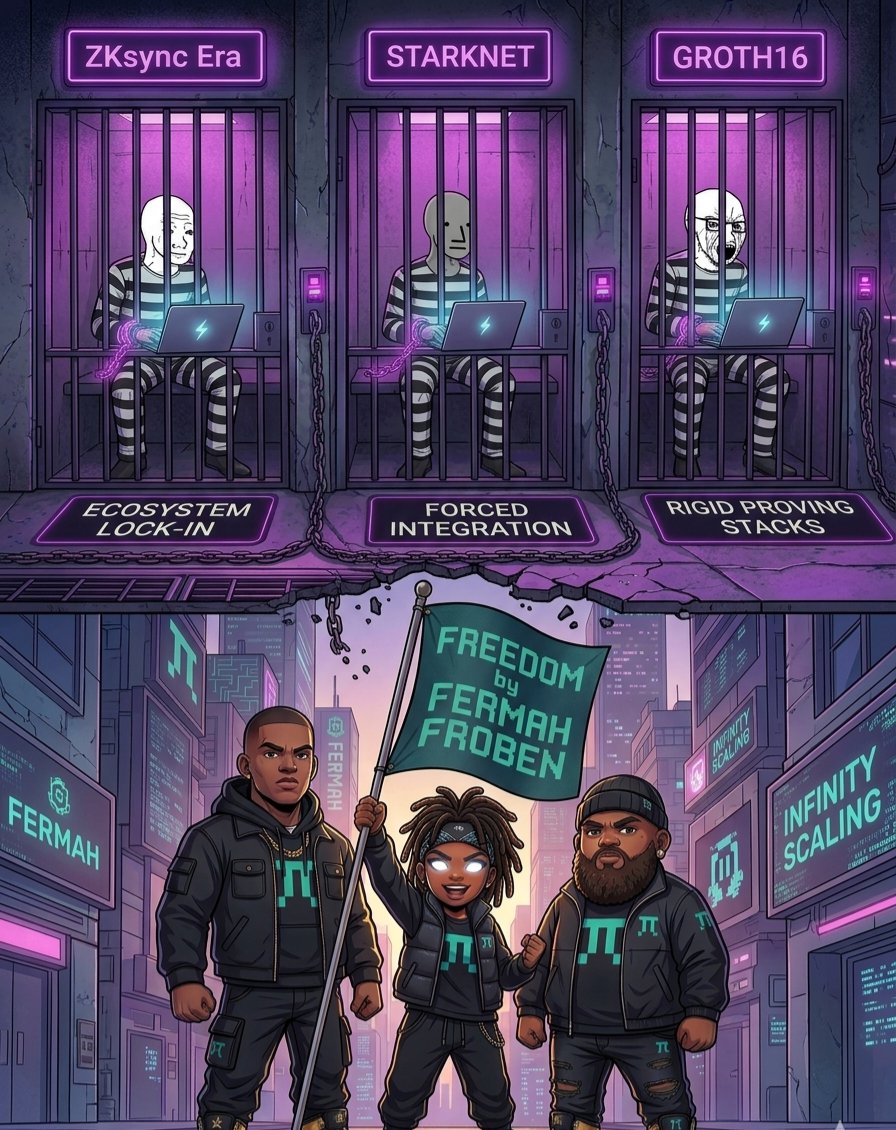
Different projects rely on different proving systems such as Halo2, SP1, Groth16, STARKs, and zkVMs.
The problem is that most infrastructure is tightly connected to a single proving stack. This creates vendor lock-in. If developers want to switch to a newer or more efficient proving system, they often need to rebuild large parts of their infrastructure.
Fermah Kernel solves this issue by being proof-system-agnostic.
This means developers are not locked into one proving technology. They can move between proving systems without rebuilding their entire stack.
That flexibility matters because ZK technology is evolving rapidly. The best proving system today may not remain the best tomorrow.
{▪︎}What Major Problem Does Fermah Solve?
The future of ZK proving systems faces two major challenges: massive proving workloads and human dependency.
Generating ZK proofs requires enormous computational power. Centralized proving systems are expensive, difficult to scale, and vulnerable to single points of failure.
Fermah Kernel acts as the orchestration layer that automates these workflows. Instead of humans coordinating every step, the system manages proving tasks autonomously and verifiably.
At the same time, Kernel removes dependency on centralized operators and keeper bots. Protocols no longer need constant human involvement to remain operational.
This creates a future where blockchain applications become continuously active, self-operating, and truly decentralized.
{■}Final Thoughts
Fermah is not simply building a faster proving network. It is building infrastructure for a future where protocols can operate autonomously, proving systems remain modular, and developers stay free from vendor lock-in.
By solving fragmentation, inefficient orchestration, and human dependency, Fermah Kernel could become one of the foundational infrastructure layers for the next generation of ZK-powered applications.
@0xTribal
@7wealthh