
Sabitlenmiş Tweet
1c
382 posts


1c
@1creformed
Aspiring African Warlord. San • Western Hunter-Gatherer • Tasmanian 🇿🇦🇬🇧🇦🇺
Katılım Mayıs 2026
36 Takip Edilen36 Takipçiler

“How about we support black women in pop”
And you’re posting Tyla and Zara 2 non black women lmaoo
acervo ✷ tyla@tylacerve
que tal apoiar mulheres negras de verdade no pop?
English
1c retweetledi

The Hoteps are calling him North African All Father 🕊️🕊️they don’t know about Sir Basal Eurasian

Typical African@Joe__Bassey
Facial reconstruction of a 315,000-year-old man from Morocco's Jebel Irhoud site.
English
1c retweetledi


1c retweetledi


1c retweetledi
Even Asake fans are trying to troll lmao
You guys have forgotten that Ayra Starr tried introducing the local champion to global audience and he ruined it with his foolish verse🤦🏿
AYOXX🪖🇨🇦🇦🇺@Ayomichaelxx
Ayra Starr drop song but Na fola outro for the song nin dey trend😂😂 What does that tell you ??😂😂
English
1c retweetledi


1c retweetledi

1c retweetledi

Arabs got the best PR team in human history. They’ve been disgusting, r**pist, anti black s**mbags for thousands of years, but we perceive them to be an oppressed group because of Palestine.
رايــد@Q1iinf
الاعب البرازيلي. حبيبته
English
1c retweetledi

What is the latinas of Africa? Get these Nigerians off this app
Cleverly 💐@Cleverlydey4u
Cape Verde women are ready for the World Cup match today against Spain… the Latinas of Africa 😅❤️
English
i went to cape verde myself (amazing country) and most cape verdeans do not look like this, they are probably supporters.
Cleverly 💐@Cleverlydey4u
Cape Verde women are ready for the World Cup match today against Spain… the Latinas of Africa 😅❤️
English
@jimmyadam120 @Vixthaone @Sulkalmakh “proto sapien”
are we fucking retarded? sapiens are literally anatomically modern human, we are the only human species called sapiens 😭
English

@Vixthaone @Sulkalmakh I’m not white, this guy is a proto sapien nobody today looks him like because he is an archaic human
English
1c retweetledi
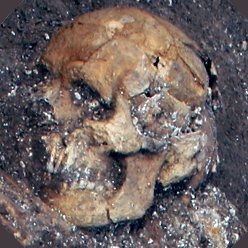
Facial reconstruction of a 315,000-year-old man from Morocco
The first discovery at the Jebel Irhoud site was made in 1961, when a remarkably complete skull of an archaic human was unearthed. Subsequent excavations revealed another cranial vault, the mandible of a child, and several additional bone fragments.
The site has been dated multiple times, with estimates ranging from 30,000 to 190,000 years ago. By 2007, the accepted age was approximately 160,000 years. However, new analyses conducted by the same research team demonstrated that the Jebel Irhoud deposits are significantly older, dating between 240,000 ± 35,000 and 378,000 ± 30,000 years ago, with an average age of approximately 315,000 ± 34,000 years.
The Jebel Irhoud individuals occupy an intermediate position between modern humans (including Upper Paleolithic Cro-Magnons) and more archaic groups such as Heidelberg humans, Neanderthals, and African Middle Pleistocene populations. This pattern is evident across nearly all studied anatomical features, including the skull, mandible, brain, and dentition.
The occipital and temporal bones of Irhoud 1 retain several archaic characteristics, whereas the frontal bone exhibits more derived traits. The face of Jebel Irhoud 1 is essentially indistinguishable from that of modern humans and, in some respects, appears even more modern than that of certain Upper Paleolithic Homo sapiens specimens.
The mandible displays a receding chin, although a very weak indication of chin prominence may be present. Considered in isolation, the jaw appears relatively archaic; however, in combination with the facial morphology, it does not seem particularly primitive. Viewed from a three-quarter angle, Irhoud 1 appears remarkably modern, while its archaic features become most apparent in profile.
The cranial vault bones of Jebel Irhoud 1 are thick, and the vault itself is low and elongated. The forehead is low and receding, although less sloping than that of European Neanderthals. The brow ridge is massive, postorbital constriction is pronounced, and the occipital region exhibits a chignon-like morphology.
The mandibular fossa of the temporal bone is moderately deep and spacious. The articular eminence is well developed, and the postglenoid process is large.
The face is extremely high and broad. The upper face is relatively flattened, while alveolar prognathism is strongly expressed. The orbits are tall and square-shaped, and the nose is very broad. A canine fossa is absent, and the alveolar process is high.
The teeth are large.
The brain morphology resembles that of the Kabwe (Broken Hill) specimen. Cranial capacity has been estimated at 1,305–1,480 cm³. (Hublin et al. (2017), Richter et al. (2017), Antropogenez, S. Drobyshevski (2017)).


English
@Sulkalmakh Wouldn’t his hair be straight? I believe kinky hair is a recent evolution
English

@Sahelianist Niggers are unemployed. They have nothing better to do than fuck
English

How do you fund programs to “whiten” the country and still end up majority black?
ADONIS@adonispara
Rio before the great niggerification
English


Blasians bout to take over sports
damn I want Blasians kids fasho
ESPN Africa@ESPNAfrica
Japan goalkeeper Zion Suzuki: 🇺🇸 Born in the USA 🇯🇵 Mother is Japanese 🇬🇭 Father is from Ghana 😮
English
1c retweetledi

