debbie yoon retweetledi

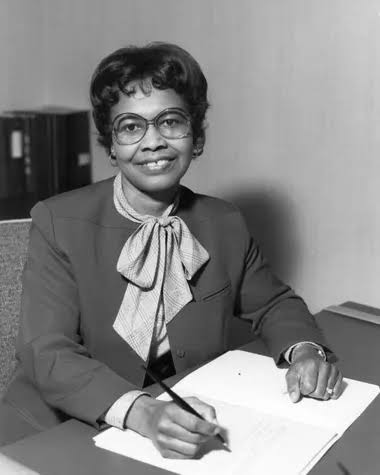
In 1930, rural Virginia, a Black girl born into sharecropping poverty wasn't supposed to leave the tobacco fields.
But Gladys Mae Brown had other plans....
Her hands picked crops. Her mind solved equations no one asked her to solve. Her parents, despite barely scraping by, made a choice that defied every expectation placed on them. They kept her in school.
She became valedictorian at a segregated high school with torn textbooks and broken windows. She earned a scholarship to Virginia State College in an era when being Black, female, and intellectually brilliant meant the world tried to crush you three different ways.
In 1956, she walked through the doors of the Naval Proving Ground in Dahlgren as the second Black woman they'd ever hired. Four Black employees. Hundreds of white men. Most didn't think she'd survive the week.
They were catastrophically wrong.
Gladys calculated weapons trajectories by hand. Complex differential equations that consumed hours of meticulous work. Her accuracy became legendary. When computers arrived, she didn't resist the future. She learned Fortran. She mastered programming languages. She transformed weeks of calculations into hours.
Then came Seasat in the 1970s. The first satellite studying Earth's oceans from orbit. She became project manager. But her true contribution remained hidden in the mathematics.
For GPS to function, you need Earth's exact shape. Not close. Exact. Earth isn't a smooth sphere. It's an asymmetrical, gravity-distorted, irregular mass of mountains and ocean trenches.
Gladys spent years constructing mathematical models describing every deviation, every curve, every gravitational anomaly of our planet's true form. She analyzed satellite data. She built geoid models. Tedious, invisible, revolutionary work.
That mathematics became the foundation of GPS.
Every navigation app. Every emergency rescue. Every autonomous vehicle. Every precision farming system. Her equations make it possible.
Forty-two years at Dahlgren. Retirement in 1998. GPS fully operational worldwide. Billions of users. Almost nobody knew her name.
She raised three children. Earned her PhD at seventy after surviving a stroke. Lived quietly.
Until 2018, when someone at a sorority event read her biography aloud. The room went silent. The story exploded.
At eighty-eight, Gladys West was inducted into the Air Force Space and Missile Pioneers Hall of Fame. The world finally learned her name.
She mapped the entire planet. Then everyone forgot. Until they remembered.
Gladys West worked alongside her husband Ira West, who was also a mathematician at the Naval Proving Ground. They met at Dahlgren and built both a family and parallel careers in an environment that actively discriminated against them. After retirement, she didn't stop. She earned her PhD from Virginia Tech at age 70, proving that intellectual curiosity doesn't have an expiration date.
The GPS system relies on something called the geoid, a mathematical model of Earth's shape that accounts for gravitational variations. Gladys West's calculations helped create these models by analyzing millions of data points from satellite altimetry. Without accurate geoid models, GPS coordinates would be off by hundreds of meters, making the technology essentially useless.
Her story remained hidden partly because classified military work doesn't generate headlines. Many pioneers of satellite and navigation technology worked in obscurity for national security reasons. The sorority member who recognized her contribution was reading through Alpha Kappa Alpha biographies when she noticed the GPS connection and brought it to public attention.
© Women Stories
#drthehistories
English