

MSP
18.1K posts


MSP retweetledi

MSP retweetledi

MSP retweetledi
RCB has nullified chasing advantage by scoring huge on this first inning.
Rajat Patidar’s over cover six vs Rabada is the shot of the match for me so far.
English
MSP retweetledi
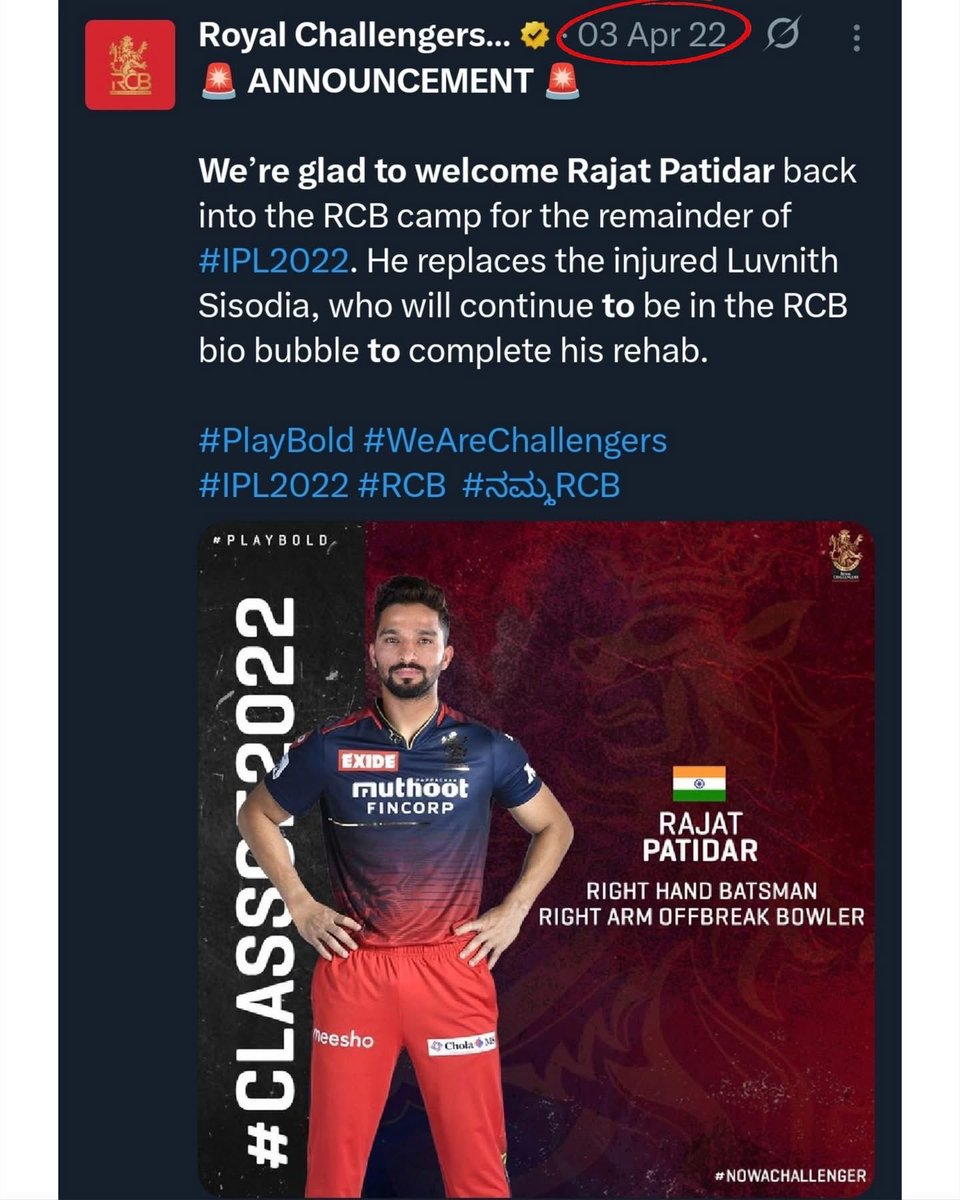
Probably the greatest moment in RCB’s history, a moment that changed the fortune of the franchise.
English
MSP retweetledi
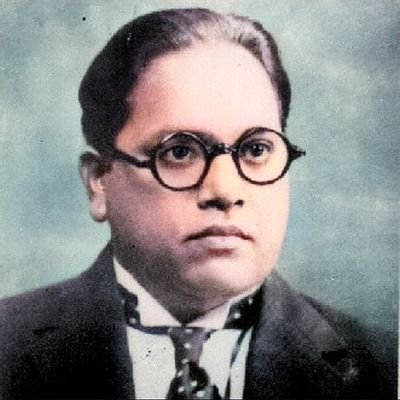
IMO, the Vedas are everything in one. Chanting them after necessary refinements to the mind, and with intent, one can get revelations about science, as much as about spirituality or surgery.
In the age of AI, I will request you to think of the Vedas as quantized, compressed version of a lot of revealed knowledge distilled into the most efficient, lossless sounds called mantras.
Most people may, at most, appreciate their rhythms while they see religious intent mostly with bits of philosophy and spiritual instructions here and there.
It's like someone appreciating an AI model's training weights and the output they see using a low level computer without having the powerful hardware or knowhow to extract the best knowledge.
A truly determined seeker will improve this hardware (or his brain and mind) to be able to extract much knowledge out of the quantized and distilled model (or the Vedas).
To the credit of the Vedas, they even provide the necessary steps to build and improve the hardware (body and mind) to extract the knowledge. Many seekers from Patanjali to Sankara have developed complete systems on how to do this.
But even if all these systems are lost, and only the sounds of Vedas remain in human consciousness, it will still enable more Patanjalis and Sankaras to emerge and develop systems to realize the Universe complete with all its knowledge. This is the beauty of the Vedas.
This is why the Vedas were never just "religion". They are a complete epistemic system engineered for precision, revelation, and infinite expansion of knowledge in our simulation.
They enable us to see the entire source code of the simulation (past, present, and future) or access just parts of it to in-vivo improve our experience (by creating science & tech with the revealed knowledge).
@bubbleboi is in the process of realizing this, do read👇
bubble boi@bubbleboi
I’ve been reading the Vedas a lot recently, and what’s stood out is how it doubles as an encyclopedia as well as a religious text. Astronomy, medicine, mathematics, metallurgy, linguistics, are all woven through hymns and rituals as one body of knowledge. Simply calling it “religious” forces it into a Western category that didn’t have the apparatus to recognize what it actually was. It’s closer to a tradition of formalized epistemology in which metaphysics, observation, and language form one continuous inquiry, which as a result led Indian civilization to develop along a fundamentally different path because of it. You can see the effect most clearly in the sciences. Around 600 BCE, the Vedic record describes a surgical procedure that matches modern rhinoplasty and is still foundational to reconstructive surgery today. Centuries before Western Europe stopped treating eclipses as supernatural, Indian scholars had calculated the circumference of the earth within 0.2% and explained eclipses as shadows. Centuries before Plato and Aristotle rejected atomism, the Vedic tradition already held that matter is composed of indivisible particles combining into binary and triatomic compounds, transformable by heat. The first formal rules for zero and negative arithmetic appear in the Vedas, along with infinite-series derivations of π, sine, and cosine centuries before Newton and Leibniz. The interesting question is how did they get so much right, so early? My best guess is language. The Vedic tradition is unique compared to other oral traditions as it demanded letter-perfect oral transmission across generations. Around 500 BCE, scholars composed a generative grammar of Sanskrit called Panini so rigorous it anticipates Backus-Naur form, the notation that defines programming languages today, by 2,500 years. Sanskrit is recursive, rule-based, and built to minimize ambiguity. It reads more like mathematics than English. When you think in a language built like that, the precision of the language becomes the precision of your reasoning. The West didn’t formalize this until much later. Kant argued our categories of understanding shape what we can know, Wittgenstein wrote that the limits of language are the limits of one’s world, and Kripke showed that naming doesn’t just describe things, it constitutes what they mean and how we can reason about them. All three touch the same insight which is that thought is downstream of language. The Vedic tradition operated on that insight thousands of years earlier. To the point that they built a whole language first and used it to think clearly about everything else after. I find that all really fascinating.
English
MSP retweetledi

MSP retweetledi

That one guy who travels from South Africa to India every year for every important RCB match to support his biscotti😭♥️
#RCBvsGT
English
MSP retweetledi

devdutt padikkal when he's asked to bat even one over without kohli
English
MSP retweetledi

🚨 Google DeepMind CEO Sir Demis Hassabis:
“Today’s systems, are nowhere near [AGI]. Doesn’t matter how many Erdős problems you solve… I think it’s far, far from what a true invention or someone like a Ramanujan would have been able to do”
it’s over for the Erdős hype
English
MSP retweetledi

I’ve been reading the Vedas a lot recently, and what’s stood out is how it doubles as an encyclopedia as well as a religious text. Astronomy, medicine, mathematics, metallurgy, linguistics, are all woven through hymns and rituals as one body of knowledge. Simply calling it “religious” forces it into a Western category that didn’t have the apparatus to recognize what it actually was. It’s closer to a tradition of formalized epistemology in which metaphysics, observation, and language form one continuous inquiry, which as a result led Indian civilization to develop along a fundamentally different path because of it.
You can see the effect most clearly in the sciences. Around 600 BCE, the Vedic record describes a surgical procedure that matches modern rhinoplasty and is still foundational to reconstructive surgery today. Centuries before Western Europe stopped treating eclipses as supernatural, Indian scholars had calculated the circumference of the earth within 0.2% and explained eclipses as shadows. Centuries before Plato and Aristotle rejected atomism, the Vedic tradition already held that matter is composed of indivisible particles combining into binary and triatomic compounds, transformable by heat. The first formal rules for zero and negative arithmetic appear in the Vedas, along with infinite-series derivations of π, sine, and cosine centuries before Newton and Leibniz.
The interesting question is how did they get so much right, so early? My best guess is language.
The Vedic tradition is unique compared to other oral traditions as it demanded letter-perfect oral transmission across generations. Around 500 BCE, scholars composed a generative grammar of Sanskrit called Panini so rigorous it anticipates Backus-Naur form, the notation that defines programming languages today, by 2,500 years. Sanskrit is recursive, rule-based, and built to minimize ambiguity. It reads more like mathematics than English.
When you think in a language built like that, the precision of the language becomes the precision of your reasoning. The West didn’t formalize this until much later. Kant argued our categories of understanding shape what we can know, Wittgenstein wrote that the limits of language are the limits of one’s world, and Kripke showed that naming doesn’t just describe things, it constitutes what they mean and how we can reason about them. All three touch the same insight which is that thought is downstream of language.
The Vedic tradition operated on that insight thousands of years earlier. To the point that they built a whole language first and used it to think clearly about everything else after. I find that all really fascinating.
English
MSP retweetledi

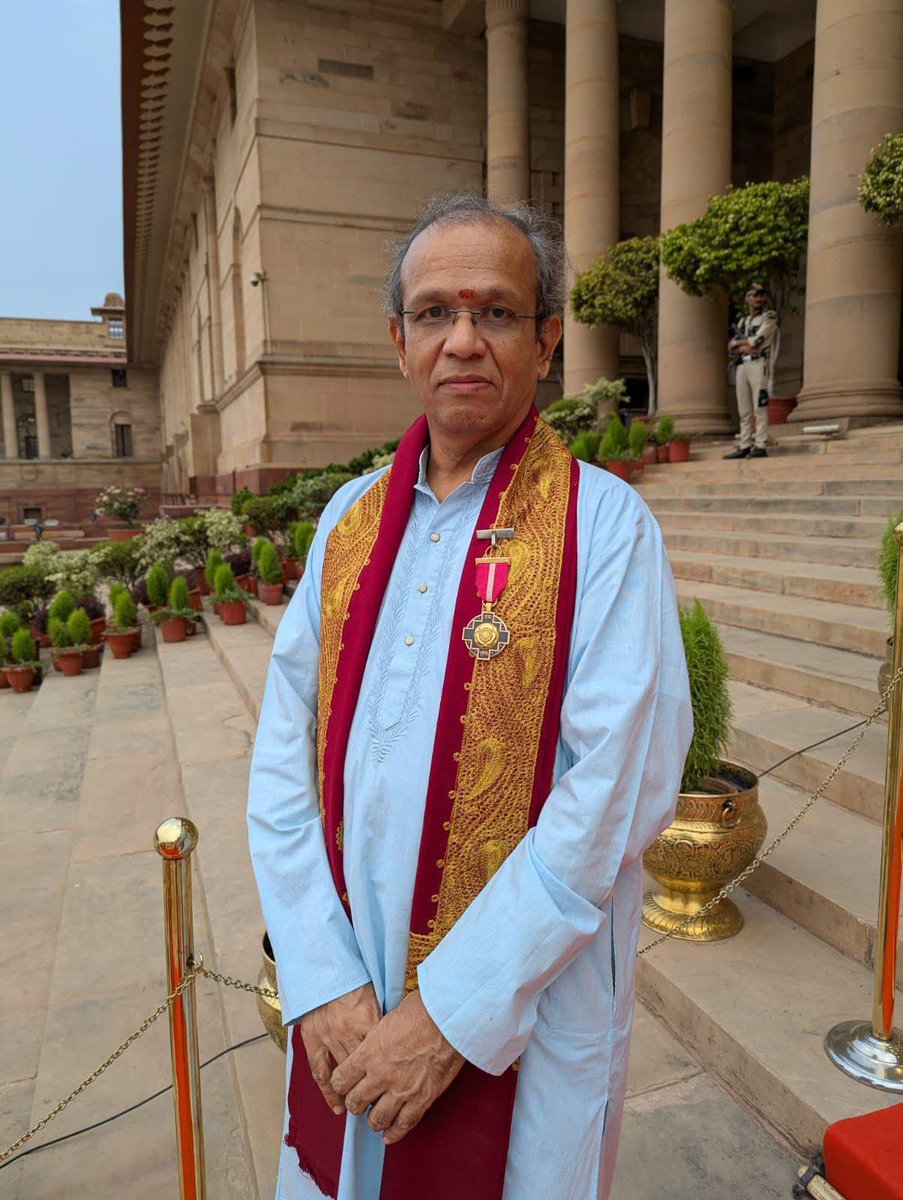
Seeing Shatavadhani Dr. R. Ganesh on the steps of Rashtrapati Bhavan is a moment of immense pride. This isn't just a photograph; it is a profound tribute to India’s intellectual heritage and our rich polymathic culture. A truly well-deserved honor for a titan of knowledge.
A sight that warms the heart!
🇮🇳✨ #ShatavadhaniGanesh #IndianCulture #RashtrapatiBhavan
English


MSP retweetledi

MSP retweetledi

#PadmaAwards | Shatavadhani Dr. R. Ganesh, Karnataka’s renowned scholar and recipient of the Padma Bhushan 2026, has dedicated his life to reviving the ancient Indian art form of Avadhana — a rare literary tradition that combines poetry, memory, multitasking, and intellectual brilliance.
Born in Kolar in 1962, Dr. Ganesh has mastered 18 languages, authored over 70 books, and emerged as a leading scholar of Indian literature and performing arts.
Through decades of performances and cultural outreach, he has played a significant role in preserving and promoting India’s rich literary and artistic heritage for future generations.
#PeoplesPadma #PadmaAwards2026
@HMOIndia @PadmaAwards @PIB_India @PIBBengaluru
English
MSP retweetledi



MSP retweetledi

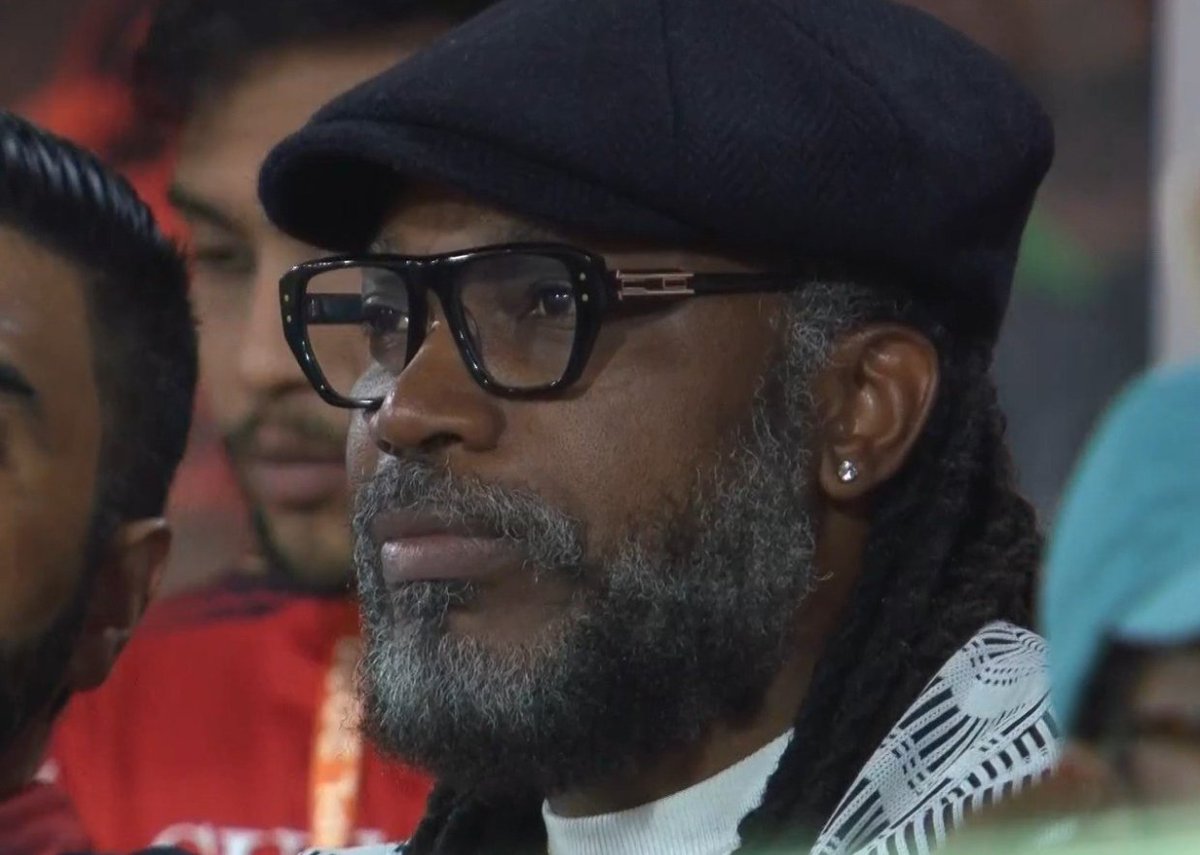


This is 19 yrs old Virat talking about the mindset in that #U19WC final of 2008..Nah man I have not seen any young IND cricketer with this elite mindset right from the start..This man was born to rule world cricket..They dont make players like him anymore
English