Challenging arrogance, dismantling illusions, and imagining the next new world order. I don’t tweet for likes. I tweet to shake the foundations you stand on.
@2025_eye@GPX_Press becoming rich doesn't mean you are out of the reach of biased laws...your suggestion is like running away from the real issue...bro,i know many rich and powerful people destroyed by these laws...
BOOK RECOMMENDATION
Getting a good grip on the basics of geopolitics is important, to deeply understand what's happening around us, and to us. Here are my recommended readings.
Buy and read!
#BookRecommendation#Geopolitics#Geoeconomics
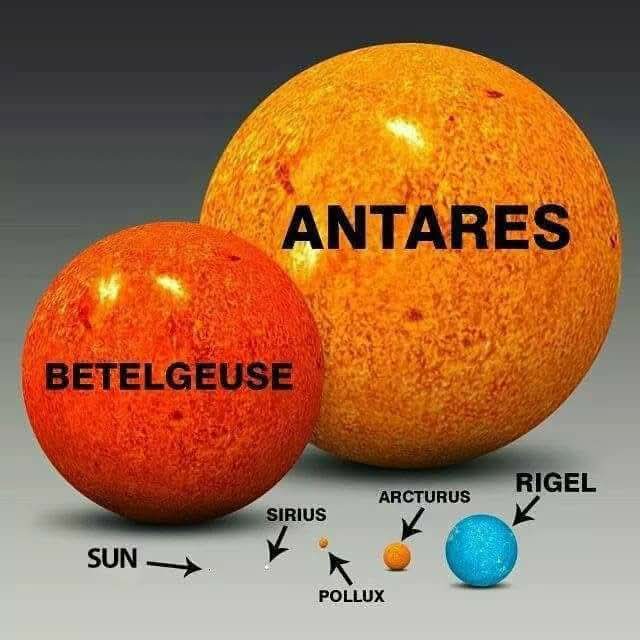
✨️ How Big Are Stars? Let’s Put It in Perspective!
When you gaze up at the night sky, it's easy to think of our Sun as the biggest star around. After all, it dominates our sky and sustains all life on Earth. But in the cosmic scale of things, our Sun is actually quite small. Here's a look at how it measures up.
☀️ The Sun
Diameter: ~1.39 million km
Volume: Can fit about 1.3 million Earths inside it
Classification: G-type main-sequence star (G2V)
Despite its might in our solar system, the Sun is considered a dwarf star compared to others in the galaxy.
Source: Sun Overview, NASA Solar System Exploration
✨ Sirius
Diameter: ~2 times that of the Sun
Mass: ~2.1 solar masses
Notability: The brightest star in Earth's night sky
Sirius A is a binary system's main component and shines so brightly because it’s both intrinsically luminous and relatively close to Earth at just 8.6 light-years away.
Source: Gaia Mission, European Space Agency (ESA)
🟠 Pollux
Diameter: ~9 times the Sun
Classification: Orange giant (K0III)
Pollux is the brightest star in the Gemini constellation and is a prime example of a star that has exhausted its core hydrogen and expanded into a giant.
Source: Pollux, SolStation
🔴 Arcturus
Diameter: ~25 times the Sun
Brightness: ~170 times as luminous as the Sun
Classification: Red giant (K1.5III)
At about 37 light-years away, Arcturus is the brightest star in the Northern Hemisphere and provides a glimpse into the Sun’s future, billions of years from now.
Source: Arcturus, NASA ADS (Astrophysics Data System)
🔵 Rigel
Diameter: ~79 times the Sun
Classification: Blue supergiant (B8Ia)
Rigel is one of the most luminous stars known, shining tens of thousands of times brighter than the Sun. Its short life is the price for such brilliance—it will end in a supernova.
Source: Rigel Star Facts, Universe Today
🔴 Betelgeuse
Diameter: ~700 times the Sun
Classification: Red supergiant (M1-2Ia-ab)
Located in Orion, Betelgeuse is so large that if it replaced our Sun, its surface would extend past the orbit of Jupiter. And yes, it's the star that might go supernova "soon"—astronomically speaking.
Source: Betelgeuse, American Association of Variable Star Observers (AAVSO)
🔥 Antares
Diameter: ~883 times the Sun
Classification: Red supergiant (M1.5Iab-Ib)
The brightest star in Scorpius, Antares rivals Betelgeuse in size and is often called the “heart of the scorpion.” If it sat at the center of our solar system, it too would engulf the orbits of the inner planets and reach beyond Mars or Jupiter.
Source: Antares Imagery, European Southern Observatory (ESO)
🌌 Stephenson 2-18 – The Largest Known Star
Diameter: ~2,150 times the Sun
Classification: Red hypergiant
Discovered in the Stephenson 2 star cluster, this behemoth is currently considered the largest star by radius known to science. It is so massive that light would take over 8 hours to travel around its surface, compared to just 14.5 seconds for the Sun.
@EscapeDmatrics@pankaj689700@GPX_Press Yes, correct! Money can buy anything in the world - and women understand the language of Money better than anyone else! For a rich man , women and laws will be in his pocket!