
21metrics

254 posts

21metrics banner
21metrics

21metrics

@21metrics

A signal in the sea of noise. 21metrics is an on-chain podcast, covering Bitcoin, digital assets, and macro.

Timechain Katılım Eylül 2019
76 Takip Edilen64 Takipçiler
21metrics retweetledi
oinonen_t
oinonen_t@oinonen_t·
Investors Accumulating NEXO, Taker Buys Dominant [A Macro Turning Point Ahead] After a negatively skewed first quarter, the crypto market is approaching an inflection point, accompanied by selling pressure exhaustion. The leading cryptocurrency Bitcoin recently recaptured $75K, while many higher beta tokens have ascended by 20%. Although the sentiment remains cautious, ETF inflows, potential easing or Fed pivot, institutional adoption, and tokenization could spark a new upside. [Taker Buys Dominant, Indicating New Demand] CryptoQuant’s native on-chain data shows NEXO-related taker buy volume surging again (green), after a long epoch of taker sell dominance (red). This shift reflects an inflection point, suggesting increasing buyer activity, including whales, institutions, HNWIs, and retail. In general, taker buy volume measures the amount of market buy orders, meaning takers hitting the ask side aggressively. This indicates buyers are more eager and willing to pay the current (or slightly worse) price to enter positions quickly, rather than waiting with limit orders. While a sustained increasing taker buy volume has historically preceded or coincided with upward price moves, it also shows stronger investor conviction. From a wider vantage point, the pattern indicates confidence in the NEXO token, and the @Nexo ecosystem. [Nexo as the Tax-Efficient Platform to Access Liquidity] Why is Nexo so popular among crypto investors? The platform provides an instant credit line, allowing investors to borrow fiat currency or stablecoins without selling their assets. Nexo’s users keep exposure to potential price appreciation, without selling their portfolio, and gain a tax-efficient access to liquidity. cryptoquant.com/quicktake/69e0…
oinonen_t tweet media
English
4
5
20
171
21metrics retweetledi
oinonen_t
oinonen_t@oinonen_t·
📈 @21metrics Podcast: Why Infrastructure Is Quietly Winning? Shift bitcoin, crypto, infrastructure tokens, and RWAs with SideShift.ai.
English
1
4
10
437
21metrics retweetledi
oinonen_t
oinonen_t@oinonen_t·
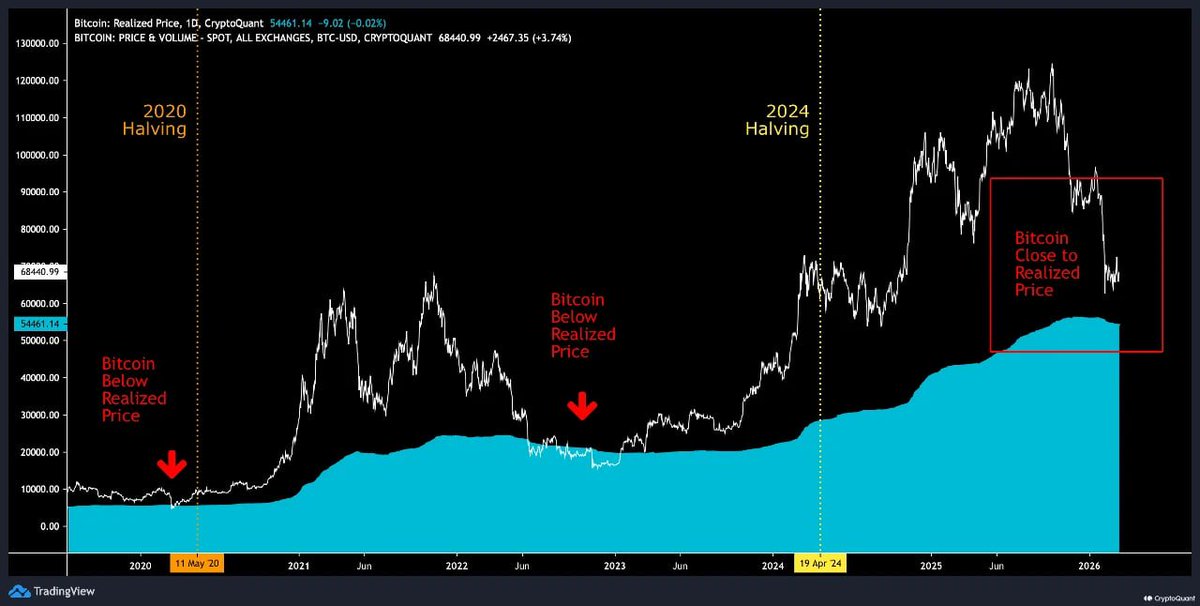
Bitcoin Dips into Accumulation Zone [Volatility Hits Macro] Geopolitical shocks from the Middle East sent oil surging and CBOE Volatility Index above 31 on Monday, mirroring escalating uncertainty. At the same time, Bitcoin dipped to $65K, as part of a larger risk-off sentiment. From a broader vantage point, Bitcoin is not a risk-off asset like gold. Instead, it's a risk-on investment that succeeds during calm macro and favorable credit cycles. [A Capitulation Ahead?] Although we’re pretty deep in a bear cycle, there hasn’t been a true capitulation event, yet. What’s missing is a classic final flush: The kind of panic-driven, high-volume capitulation where weak hands are completely washed out, leveraged traders get liquidated, and on-chain realized losses spike dramatically. [Bitcoin Dips into Accumulation Zone] As Bitcoin’s spot price falls lower, it’s reaching toward the realized price that has historically been an indicator for undervaluation. During early 2020 and late 2022, Bitcoin’s spot price plunged under the realized price, mirroring a buying opportunity. It’s easy to see the pattern repeating in 2026: While quant models indicate Bitcoin’s consolidation, a true bottom indicator would be spot dipping deep into the realized price territory, again. Like in the bear cycle of 2022, Bitcoin is again in the accumulation zone, representing historically undervalued spot prices. The smart money accumulates here. [Coinbase Premium Negative, Binance Whales Selling] The Coinbase Premium Index has once again returned to negative territory, reflecting the weakening appetite of institutional investors. As CQ stated in the recent DAT report, there is no broad institutional demand right now. Whales are increasingly active on the Binance platform, depositing large Bitcoin batches that will potentially be sold. At the same time, Binance’s Exchange Whale Ratio is rising. cryptoquant.com/quicktake/69ca…
oinonen_t tweet media
English
1
3
5
195
21metrics retweetledi
oinonen_t
oinonen_t@oinonen_t·
🎙️ @21metrics Podcast: Are RWAs Eating Altcoins? Shift crypto and RWAs with SideShift.ai.
English
2
4
10
444
21metrics retweetledi
oinonen_t
oinonen_t@oinonen_t·
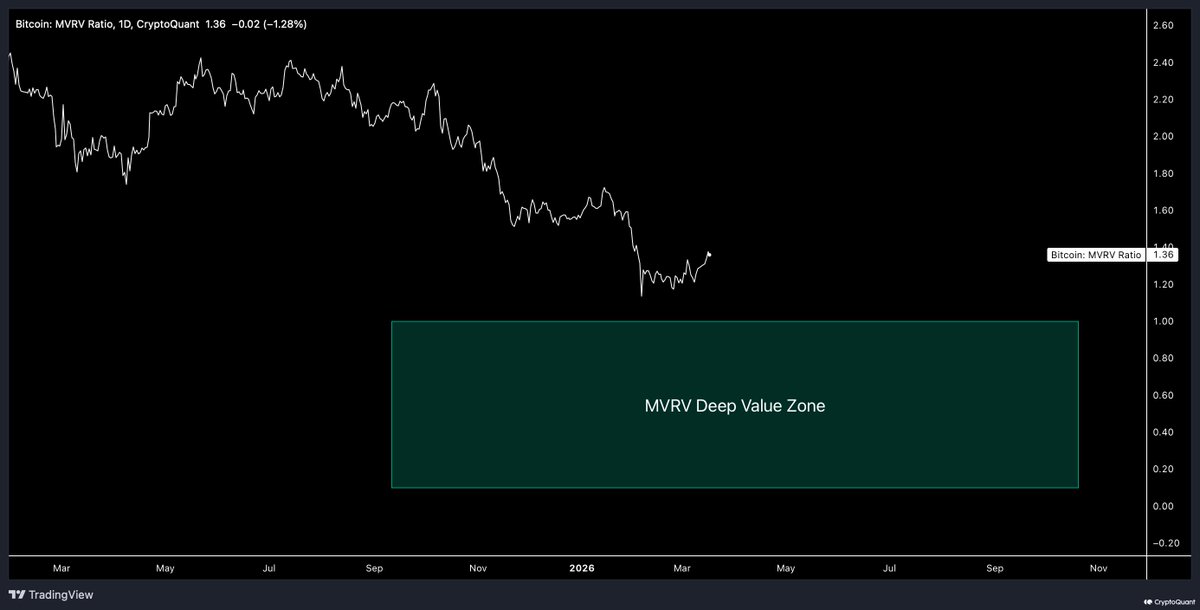
Bitcoin Close to Deep Value Zone [Bitcoin and Crypto-Related Stocks Resilient Amid the Chaos] Despite the geopolitical turmoil, Bitcoin has been exceptionally resilient during the past seven days, declining by only -3.8%. At the same time, there’s a divergence forming between Ethereum and Bitcoin, as the former has mainly moved sideways. At the same time, on-chain data shows increasing Binance whale activity. Quantitative analyst Juhani Savonen recently updated his model that shows global liquidity recovering. According to Juhani, many crypto-related stocks and DATs look attractive at the current valuations. [MVRV Approaching Deep Value Zone] As argued in the previous article, Bitcoin hasn’t met its real capitulation point yet, despite spot being -45% from the November highs. A true bottom indicator would be spot dipping deep into the realized price territory, in correlation with the 2020 and 2022 cycles. Bitcoin entering the realized price area would mean a drawdown of -20%. As Bitcoin trades lower, it’s also approaching the “MVRV deep value zone”, mirroring the market value to realized value indicator dropping below one (1). MVRV values of below one have historically been excellent Bitcoin entry points. [About MVRV] CryptoQuant's MVRV is an on-chain market indicator that measures Bitcoin's valuation by dividing its market capitalization (current price × circulating supply) by its realized capitalization (the aggregate value of all Bitcoin at the price when each coin last moved on-chain). A higher MVRV (historically >3.7) signals that Bitcoin is overvalued, often near market tops. A lower MVRV (below 1) indicates undervaluation, typically near market bottoms. [What’s Next?] The sentiment will likely remain cautious, as geopolitical risk remains sticky. However, Bitcoin’s MVRV approaching the deep value zone and lower spot offer a clear accumulation zone for committed investors. cryptoquant.com/quicktake/69c0…
oinonen_t tweet media
English
0
3
8
237
21metrics retweetledi
oinonen_t
oinonen_t@oinonen_t·
🎙️ @21metrics Podcast: Bitcoin's Realized Price. Shift crypto and tokenized gold with SideShift.ai.
English
0
3
10
188
21metrics retweetledi
oinonen_t
oinonen_t@oinonen_t·
Ethereum’s ELR Signals a New Liquidity Cycle (via @cryptoquant_com) [Bulls Are Back] Despite the volatile macro environment, cryptos are seeing a bullish reversal, with Bitcoin ascending 8.6% within seven days. Ethereum, as a higher-beta digital asset, has climbed 13.9% in a week. The recent move up clearly represents a risk-on shift, supported by strong ETF inflows, signaling institutional appetite. [Ethereum’s Estimated Leverage Ratio Returns to Growth Trajectory] The flash crash of October 10th represented a true leverage reset, reducing the Ethereum estimated leverage ratio (ELR) on Binance from 0.56 to 0.41, marking a -27% drop. The “10/10” will be known as the largest 24-hour liquidation event in crypto history. Over $19 billion in leveraged positions were forcibly liquidated within 24 hours. Since then, the Ethereum estimated leverage ratio on Binance has gradually recovered, reaching a value of 0.69 in mid-March. The new ELR growth trajectory signals fresh optimism towards digital assets, with investors looking for additional leverage. [About ELR] CryptoQuant's Ethereum estimated leverage ratio (ELR) is a market indicator that measures the average leverage used by traders in the Ethereum derivatives market. It is calculated as: ELR = open interest ÷ exchange ETH reserve. The ELR shows how much leverage traders are using on average, higher values mirror greater use of leverage (open positions growing faster relative to collateral/reserves), which often signals increased risk, higher trader risk appetite, and potential for elevated volatility or liquidations. On the other hand, lower values suggest more conservative positioning. [What’s Next?] The digital asset sentiment continues to improve, regaining the attention of traders. Bitcoin and Ethereum represent high-beta risk-on assets in this environment, while more conservative traders will likely accumulate gold-related tokens, including PAXG and XAUT.
oinonen_t tweet media
English
0
3
6
328
21metrics retweetledi
エックスウィンリサーチ 「市場変動を先読み、デジタル資産戦略の新基準を学ぶ」
oinonen_t @oinonen_t ビットコイン価格は現在、Realized Price(平均取得価格)に接近しており、市場の転換点になる可能性が指摘されています。 過去のサイクルでは、価格がRealized Price付近やその下に到達した局面が中長期的な買い場となるケースがありました。 一方で、Binanceへのクジラの資金流入は増加しており、大口の動きには引き続き注意が必要です。
エックスウィンリサーチ 「市場変動を先読み、デジタル資産戦略の新基準を学ぶ」 tweet media
日本語
0
4
6
265
21metrics retweetledi
oinonen_t
oinonen_t@oinonen_t·
Bitcoin Close to Realized Price, Marking an Inflection Point (via @cryptoquant_com) [Market Environment] The crypto market shows resilience despite the recent (geo)political turmoil, with Bitcoin and Ethereum both up over two percent in the past seven days. While the sentiment remains heavily “risk-off” and bitcoin has declined by -45% from its October all-time high, traders are increasingly looking for points of entry. [Bitcoin Approaching its Realized Price, Marking a Potential Pivot] Bitcoin’s realized price has historically been an indicator for undervaluation. As the attached chart shows, during early 2020 and late 2022 bitcoin’s spot price plunged under the realized price, mirroring a buying opportunity. It’s easy to see the pattern repeating in 2026: While quant models indicate bitcoin’s consolidation, a true bottom indicator would be spot dipping deep into the realized price territory, again. [About Realized Price] The realized price has been seen as the market's watershed, as it represents the average price of all bitcoin purchases. At the same time, spot price exceeding realized price shows that bitcoin investors are making a profit on their investments. Vice versa, spot below realized price indicates investors being at a loss. [Binance Whales Active] Bitcoin-related whale inflows to Binance have accelerated significantly, reaching a cumulative 30-day sum of $8.8 billion on March 1st. This metric specifically tracks large-holder deposits. CryptoQuant’s exchange whale ratio (ELR) has shown elevated values in recent months, hitting 0.85 in mid-February, indicating heavy whale presence. ELR is CryptoQuant’s native on-chain metric that measures the influence of large transactions (often associated with whales, or high-net-worth investors) on cryptocurrency exchanges. cryptoquant.com/quicktake/69b1…
oinonen_t tweet media
English
0
4
8
384
21metrics retweetledi
oinonen_t
oinonen_t@oinonen_t·
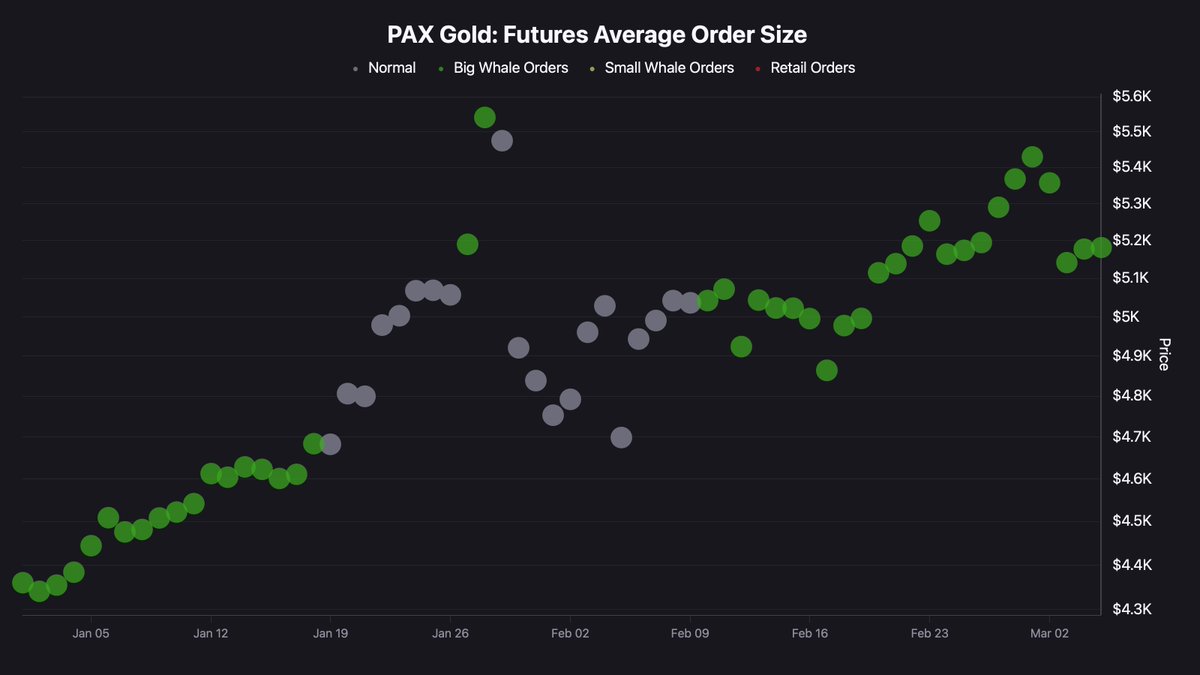
PAXG Whales Pushing Gold Higher (via @cryptoquant_com) [Tokenized Gold in High Demand] Gold has been experiencing significant growth recently, offering a 76.4% return to investors over the past 12 months. In correlation with physical gold, the crypto-related gold tokens are scaling fast. As Sentora Research stated in their recent report: ”Unlike traditional gold ETFs, tokenized gold offers 24/7 liquidity and instant composability, making it a superior hedge during high-stress news cycles that occur outside of banking hours.” The tokenized gold sector, led by Pax Gold (PAXG) and Tether Gold (XAUT), has exceeded $6 billion market capitalization, with PAXG often showing elevated large transfers and high trading volumes relative to its market cap. [Escalating PAXG Futures Average Order Size] According to CryptoQuant’s data, the average PAXG order sizes have been on a growth trajectory in early 2026, with daily whale-sized orders exceeding 559 PAXG on March 1st. The leading crypto platform Binance offers the PAXGUSDT perpetual futures contract, with data indicating a daily (24h) PAXG futures trading volume ranging from $200 million to $300 million USDT in recent periods. The rising futures average order size signals PAXG whales (including high-net-worth individuals, institutions, and funds) being increasingly active, likely accumulating or hedging amid macro uncertainty, positioning PAXG as preferred digital gold play rather than pure speculation. This could support further upside if/when the gold momentum continues. cryptoquant.com/quicktake/69a9…
oinonen_t tweet media
English
0
3
9
183
21metrics retweetledi
Juhani Savonen
Juhani Savonen@JSavonen1·
#cryptos #markets #altcoins #mstr Crypto market is close to the bottom. I have started buying and will continue buying. I see proper upside for treasury firms especially.
Juhani Savonen tweet media
English
0
2
9
625
21metrics retweetledi
oinonen_t
oinonen_t@oinonen_t·
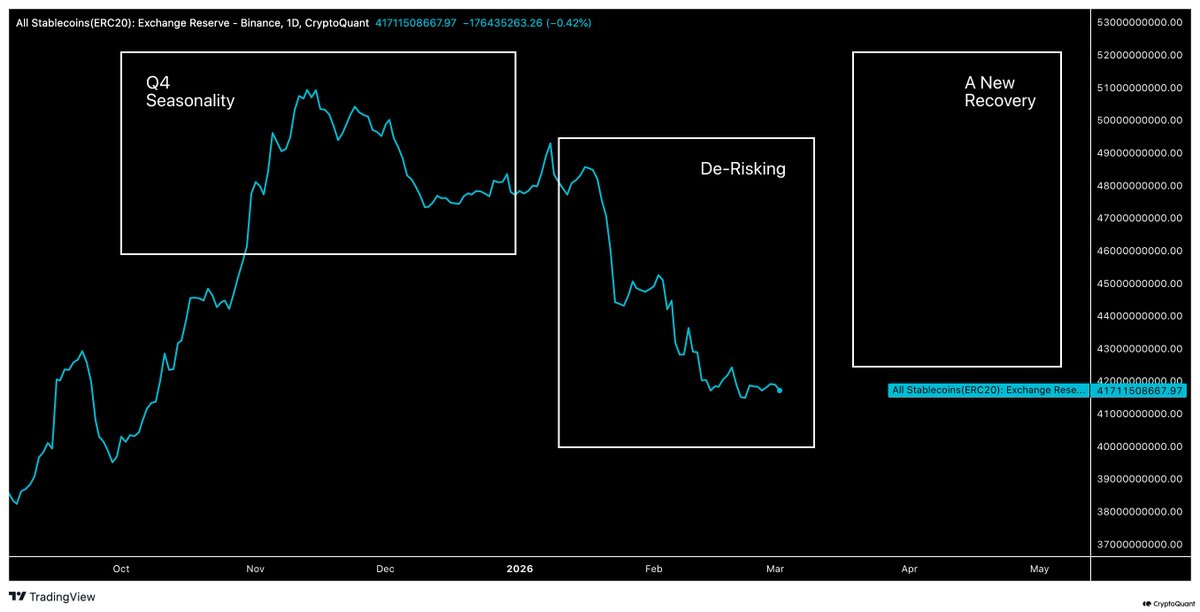
Binance's ERC-20 Stablecoin Reserves Signal a Recovery (via @cryptoquant_com) [A Volatile Environment] Despite the increasingly volatile macro environment, the leading cryptocurrency Bitcoin shows resilience, strengthening by 8.1% within the past seven days. While the sentiment remains in risk-off mode, Bitcoin still trades at $68,000. [Binance’s Stablecoin Reserves in Consolidation] After rising to 51 billion amid the Q4 seasonality, Binance’s stablecoin reserves declined to 41B in early March 2026, representing a larger de-risking move. Currently the reserves are consolidating again, signaling a macro-level recovery. [A New Wave of Liquidity] The declining amount of on-exchange stablecoins, as witnessed in January and February, usually means lower immediate buying pressure, contributing to subdued trading volumes and price consolidation. Now that the de-risking phase is over, the exchange stablecoin levels are likely to grow again, representing a new flow of liquidity. In 2026, the capital allocation will be more selective than before: Only premium-level tokens like Bitcoin and Ethereum will receive significant attention, alongside the renaissance of RWAs in the form of gold-related PAXG and XAUT. [Capital Stays in Crypto] The aggregated stablecoin reserves above 65 billion tells about the staying power of digital assets. At this point, cryptos are "too big to fail", and there's no immediate rotation to other asset classes. [Binance's Stablecoin Dominance] According to CryptoQuant's data, the combined exchange stablecoin reserves have reached 66 billion, while Binance's reserves amount to 42B, placing Binance's stablecoin dominance at 64%. As the most dominant exchange, Binance captures most liquidity amid outflows and inflows, while cementing its position as the most trusted crypto platform. cryptoquant.com/insights/quick…
oinonen_t tweet media
English
1
4
12
331
21metrics retweetledi
oinonen_t
oinonen_t@oinonen_t·
Nexo’s Cumulative Credit Withdrawals Reach an All-Time High (via @cryptoquant_com) [A Stabilizing Market] After undergoing a -48% correction between October and February, Bitcoin has stabilized, suggesting a market transition from sharp repricing to consolidation. In this steadier environment, @Nexo clients are withdrawing more credit than during previous months. [Nexo Retail Credit Withdrawals Escalating in January] While the Nexo client withdrawals declined through 2025, reflecting a broad risk-off behavior, the leveling off in late 2025 / early 2026 suggests retail participants have largely completed balance-sheet tightening. At the same time, CryptoQuant’s Estimated Leverage Ratio (ELR) has been resetting to healthier levels. From December 2025 to January 2026, the weekly retail withdrawals of Nexo users grew from 6.73 to 13.92 million, representing a ~107% growth. This new confidence among the Nexo investors reflects improved sentiment, and mirrors a weakening bitcoin-related selling pressure, as the leading cryptocurrency paves its way towards consolidation. [Cumulative Credit Withdrawals Reach an All-Time High] Nexo users' cumulative credit withdrawals have reached $863 million between 2025 and 2026. This figure reflects robust borrowing activity across market cycles, indicating ongoing demand for crypto-backed liquidity solutions. Recent data signals the end of deleveraging and emerging signs of renewed confidence and borrowing demand as the crypto market reaches a new equilibrium. [Looking Forward] The recent crypto deleveraging phase appears largely absorbed, with open interest declining from prior highs, funding rates normalizing, and liquidation volumes subsiding.  This potentially creates room for renewed borrowing activity should sentiment and liquidity conditions improve. Meanwhile, Bitcoin is consolidating and stabilizing near $67K, building a firm base after the recent volatility surge. cryptoquant.com/quicktake/6995…
oinonen_t tweet media
English
2
4
6
291
21metrics retweetledi
oinonen_t
oinonen_t@oinonen_t·
🎙️ @21metrics Podcast with Quant Juhani Savonen: Close to Capitulation, Buy Here? Shift crypto and tokenized gold with SideShift.ai.
English
3
4
9
407
21metrics retweetledi
Kvarn X
Kvarn X@KvarnX·
Kryptomarkkina on karhumarkkinassa ja sentimentti on heikko. Mutta juuri silloin syntyy usein mielenkiintoisimmat keskustelut. Uudessa jaksossa käydään läpi kryptomarkkinoiden nykytilaa, karhumarkkinan psykologiaa ja sitä, missä kohtaa sijoittajan kannattaa oikeasti olla hereillä. Vieraana Timo Oinonen, joka tuo keskusteluun datalähtöisen näkökulman Bitcoinista, vakaavaluutoista ja makrotaloudesta. Jaksossa puhutaan mm.: – vakaavaluuttojen roolista ja MiCA-sääntelystä – Bitcoinin mahdollisista pohjatasoista – DCA-strategiasta karhumarkkinassa – siitä, onko Bitcoin risk-on vai risk-off -omaisuusluokka Katso nyt: 👉YouTubessa: youtu.be/Tn7MrHyXgTY 👉Spotifyssa: open.spotify.com/episode/0NscOi…
YouTube video
YouTube
Kvarn X tweet media
Suomi
0
4
8
771
21metrics retweetledi
oinonen_t
oinonen_t@oinonen_t·
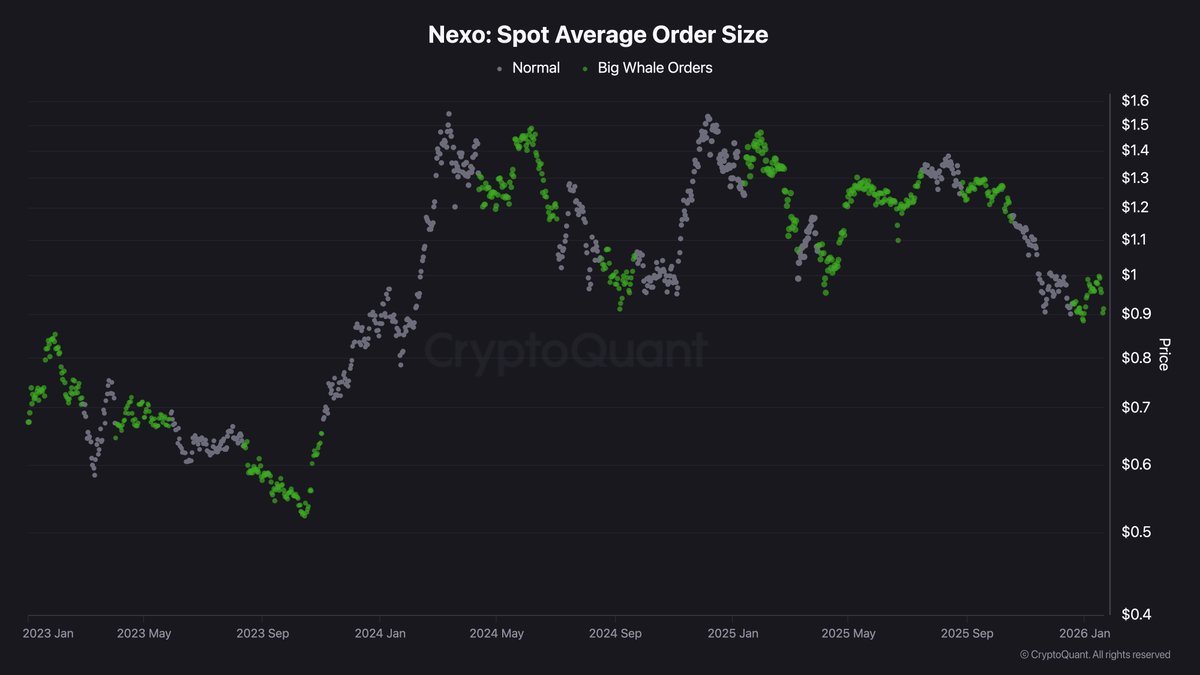
NEXO Whale Activity Increasing in January (via @cryptoquant_com) [A Billion Dollar Market Cap] Reaching a market capitalization of $1 billion in January, NEXO is the native ERC-20 utility token of the @Nexo platform, offering instant crypto-backed loans, trading, and a crypto card. [NEXO Whale Activity Increasing in January] According to CryptoQuant’s on-chain data, whales have been actively trading the NEXO token in January: As NEXO’s spot price declined beneath $1, whales have started an accumulation pattern, expecting a good entry point. NEXO traded between $0.90 and $1.00 in mid-January, with an uptrend structure intact, accompanied by short-term pullbacks (below EMA20). This whale-driven volume supports resilience. [Collateral Accumulation] Broader platform metrics show rising collateral accumulation, with collateral accumulation index at $1.52 million in mid-January, as pointed out by the CryptoQuant analyst Arab Chain. The index suggests that whales and institutions are depositing or using assets as collateral for loans rather than selling outright. This reduces spot selling pressure and signals confidence in the long-term outlook of NEXO. [About NEXO token] The NEXO token is the native cryptocurrency of Nexo, a leading digital assets platform for earning interest, borrowing against crypto, and trading. NEXO’s token supply is at 1 billion units, with no additional minting possible. This creates a capped and deflationary structure, supported by periodic buyback programs that reduce available supply over time. The reduced supply of NEXO represents digital scarcity, essential for future spot price appreciation. cryptoquant.com/quicktake/6978…
oinonen_t tweet media
English
0
4
6
275
21metrics retweetledi
oinonen_t
oinonen_t@oinonen_t·
On-Chain Data: Escalating Stablecoin Growth for 2026 (via @cryptoquant_com) [Market Environment] Bitcoin has gained new momentum during the first weeks of 2026, carrying BTCUSD to $97K. The sentiment remains optimistic, supported by institutional and whale-level buying, while retail stays cautious, as a contrast. [On-Chain Data: Escalating Stablecoin Growth for 2026] While cryptocurrencies search for a direction, stablecoins are set for a steady growth in 2026, as the amount of active stablecoin addresses has grown by 300% on a year-on-year basis. In January 2025, there were 150,000 active stablecoin-related addresses, compared to this month’s 600,000 addresses. [Why Are Stablecoin-Related Active Addresses Growing?] Active stablecoin address growth is closely related to the U.S. dollar (USD) being the most wanted (or dominant) global currency. The vast majority of stablecoins are pegged 1:1 to the USD. Their rapid expansion reflects and reinforces worldwide demand for dollar-based assets and access to the dollar, even in regions with limited traditional banking or unstable local currencies. Growth drivers include U.S. regulatory clarity (GENIUS Act), institutional/fintech integration (Stripe, PayPal's PYUSD, Revolut) emerging-market use for inflation hedging/remittances, and RWA/tokenized asset settlement. [Binance Stablecoin Reserves at $45 Billion] Binance’s ERC-20 stablecoin reserves have been uplifted from summer 2025’s $33 billion to the current level of $48B, rising by 45%, and indicating a significant amount of sidelined liquidity, ready for deployment. This record amount of unused capital will act as a catalyst for potential altcoin rallies in Q1 of 2026. [What’s Ahead?] Stablecoins have been decoupling from broader crypto volatility and growing through utility, not hype. As this trend continues, stablecoins could represent one of the clearest secular growth stories in fintech heading deeper into 2026. cryptoquant.com/quicktake/6968…
oinonen_t tweet media
English
1
3
10
192