
Carlos Tapia Ayuga
2.4K posts

@22CETA22
Ingeniero óptico. Colaborando en la UCM en instrumentación astronómica y contaminación lumínica. Fotógrafo en ratos libres.


Astronomers have identified what they describe as the most compact quadruple star system yet observed, a hierarchical configuration in which three stars orbit in close proximity and a fourth orbits at a greater distance but still more tightly bound than in previously known quadruple systems. The object, designated TIC 120362137, was detected through data from NASA’s Transiting Exoplanet Survey Satellite (TESS), which monitored its brightness over several years and revealed a pattern of dimming consistent with an eclipsing binary and additional eclipses that could only be explained by the presence of a third and ultimately a fourth star. The three innermost stars occupy a region roughly the size of Mercury’s orbit around the Sun, and they are more massive and hotter than the Sun, while the fourth star orbits farther out in a region comparable in scale to Jupiter’s orbit and is more similar in mass and temperature to the Sun. The orbital period of the outer star is about 1,045.5 days, the shortest recorded for an outer component in a hierarchical quadruple configuration, which makes this system unusually compact. The discovery provides a detailed case study of a rare dynamical arrangement that challenges models of how multiple star systems form and evolve. Simulations based on the current configuration suggest that in roughly 300 million years the three inner stars will merge into a single white dwarf, leaving two white dwarfs in a close binary with a period of about 44 days, an outcome that underscores the complex future evolution of hierarchical multiples. 👉 share.google/2QnRyOJNYfblHJ…


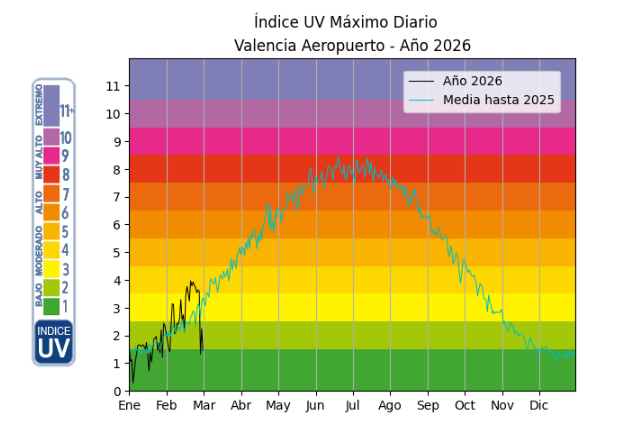
The UV index in Reading hit 2 for the first time this year yesterday - the last time was the 24th of October. Spring is here.

In approximately 1.35 million years, the orange dwarf Gliese 710 will pass at a distance of approximately 13,365 AU (≈0.21 light years or 2 trillion km) from the Sun—essentially through the inner regions of the Oort Cloud. At its closest approach, the star will become extremely bright: its apparent magnitude from Earth could reach approximately -2.7, comparable to the brightness of Jupiter. This event poses no threat to planets, but the star's gravity will significantly "shake up" icy objects distant from the Sun. Scientists estimate that up to 0.1% of comets could be ejected from our solar system, while approximately 0.01% will change orbits and head toward the inner Solar System. As a result, millions of years after the star's passage, the number of long-period comets could increase significantly.


🧵 El cambio climático antropogénico amplificó la virulencia y extensión de las tormentas asociadas a la catastrófica dana de Valencia de 2024. ➡️ Esta es la principal conclusión de un estudio publicado en @Nature en el que ha participado Aemet. 🔗 aemet.es/es/noticias/20…


EXPLODING TREES are possible in the Midwest and Northern Plains on Friday and Saturday, as temperatures are forecasted to fall 20 degrees BELOW zero!