Juza💧🐬 🦭/acc 📘

6.6K posts

Juza💧🐬 🦭/acc 📘 banner
Juza💧🐬 🦭/acc 📘

Juza💧🐬 🦭/acc 📘

@5ChariotStars

Crypto Enthusiast since 2021| SUI BagHolder 💧|

cryptospace Katılım Haziran 2021
1.8K Takip Edilen224 Takipçiler
Juza💧🐬 🦭/acc 📘 retweetledi

Soundness
Soundness@SoundnessLabs·
Legacy systems have been our cryptographic backbone for decades. One challenge in the PQ transition is finding approaches that integrate cleanly into the systems & flows already used today. That’s what @Mahdi_seda from @SoundnessLabs discussed at the PQTS #7 call last week. 🧵
asanso@asanso

x.com/i/article/2051…

English
43
63
147
5.7K
Juza💧🐬 🦭/acc 📘 retweetledi
Soundness
Soundness@SoundnessLabs·
Every quantum migration plan you have heard requires new addresses, a hard fork, or moving your assets somewhere else. Come find out more tomorrow at zkSummit14 in Rome. At 16:15 mainstage, @Mahdi_seda presents: “Proof of Seed: ZK-Based Quantum Migration Without Address Changes”
Zero Knowledge Podcast@zeroknowledgefm

zkSummit14 is happening in Rome on May 7th! Once again, we bring together the researchers, cryptographers, and builders in ZK for a day to catchup on the most cutting edge ideas in our space. We are about to sell out, so apply & get your ticket asap! zksummit.com

English
41
57
162
6.8K
Juza💧🐬 🦭/acc 📘 retweetledi
Inkray
Inkray@inkray_io·
Sui just turned 3 🎉 Time to onboard the next wave of creators who turn writing into on-chain opportunities. We’re giving away 50$ to 1 winner. How to enter: 🔷 Follow @inkray_io & @SuiNetwork 🔷 RT 🔷 Reply: I’m in Want an edge? Drop a quick take on why you’re bullish on Sui or why on-chain publishing matters. ⏳ 72h We’re building the native publishing & opportunity layer of Web3 on Sui using @WalrusProtocol technology. Don’t just watch. Be early.
English
491
513
601
13.8K
Juza💧🐬 🦭/acc 📘 retweetledi
Rex Salisbury
Rex Salisbury@rexsalisbury·
Just in - @ereborbank posted their 1st call report. In 7 weeks since opening, they've already hit $1.1 billion in deposits. unprecedented growth for a de novo (or fintech) For comparison - Grasshopper Bank (also a tech-focused NYC de novo) took 7 years to reach the same number, and only got there via acquisition - Square Financial Services, even with Block's enormous merchant base, sits at $495M after 5 years. - Mercury took 4 years - Chime took 6 At $1 billion this makes them ~1,000th largest bank in America (out of ~4,500). If they want to be a top 100 bank, thats ~$20 billion of deposits. 5% of the way there in 7 weeks. Next up...what do they do with those deposits? Will be watching how loans ramp from here!
English
28
37
500
249.6K
Juza💧🐬 🦭/acc 📘 retweetledi
Soundness
Soundness@SoundnessLabs·
The Coinbase Independent Advisory Board on Quantum Computing and Blockchain dropped a 50-page report on April 21. Section 4.3 walks through four strategies for migrating execution-layer signatures to PQ. Only one strategy gets a deployed example, by @SoundnessLabs
Soundness@SoundnessLabs

x.com/i/article/2047…

English
13
32
98
5.2K
Juza💧🐬 🦭/acc 📘
Juza💧🐬 🦭/acc 📘@5ChariotStars·
@WalrusProtocol Happy Birthday @WalrusProtocol 🥳 Here's my entry for the Birthday Challenge! Trust Is Not Enough: Data Must Be Verifiable in the Age of AI x.com/5ChariotStars/…
Juza💧🐬 🦭/acc 📘@5ChariotStars

Trust Is Not Enough: Data Must Be Verifiable in the Age of AI Enterprise adoption of AI is accelerating. From automating customer support with chatbots to streamlining workflows through document summarization, AI-driven efficiency gains are already reshaping how businesses operate. But the way we use AI is fundamentally shifting. We are moving from “AI that answers questions” to “AI that reasons over data and acts autonomously” — in other words, toward AI agents. Chatbot-style use cases only scale so far. The real challenge now is how deeply AI can be embedded into actual business operations. What AI-Era Systems Demand from Data What does it actually mean to integrate AI into operations? Simply feeding Slack messages or PDF documents into an AI system is not sufficient for sustained, reliable execution. These formats were designed for human consumption, not machine-driven action. They need to be transformed into structured formats that AI systems can process. But structure alone is not enough. If AI is expected to execute tasks autonomously, without human oversight, the data it relies on must satisfy three critical properties: - Existence — the data can be proven to exist - Integrity — the data has not been tampered with - Availability — the data remains continuously accessible Traditionally, these properties have been guaranteed by trusting the data provider or storage system. @WalrusProtocol takes a different approach: instead of relying on trust in a specific entity, it makes these guarantees cryptographically provable and independently verifiable. Why Verifiability Becomes Necessary In multi-agent environments or systems involving multiple independent parties, trust cannot be assumed to hold across all parties and systems. In high-stakes domains, “trusted data” is not enough. Only verifiable data enables reliable long-term operation. The reason is structural: AI systems operate at high speed and frequency. Even small inconsistencies in data can cascade through automated decisions, amplifying errors and leading to significant losses. That said, verifiability does not prevent AI from making mistakes. Models can still misinterpret data and take incorrect actions. Safeguards and guardrails are necessary, but they are inherently limited. Errors and unexpected situations are inevitable. In systems involving critical decisions, what matters is not just avoiding mistakes, but having the ability to verify and reconstruct what happened after an incident. Because ultimately, responsibility does not lie with the AI — it lies with the humans and organizations deploying it. That requires reproducibility of the decision process. Verifiability as the Foundation for Accountability AI is especially well-suited for domains like finance, healthcare, and law, where large volumes of data must be processed. At the same time, these domains require auditability and accountability when something goes wrong. AI cannot take responsibility. If verification depends on mutable logs, trusted cloud infrastructure, or centralized databases, accountability becomes impossible to establish. In a world where AI systems make decisions and take actions, it becomes a prerequisite that the responsible party can reproduce and verify those decisions. Traditional models that rely on trusting a single system or organization are insufficient to guarantee this level of reproducibility and verifiability. That is why data must be verifiable. @WalrusProtocol provides the cryptographic foundation to make that possible.

English
0
0
2
69
Walrus 🦭/acc
Walrus 🦭/acc@WalrusProtocol·
🦭 Walrus turns one and we want to hear YOUR voice. Write about why verifiable data matters–the tech, the use cases, the vision–for a chance to win up to $1000 in WAL. Share your take as a thread, article, or whatever format works for you. 🏆 Prizes 1st place: $1000 in WAL 2nd place: $600 in WAL 3rd place: $400 in WAL How to enter: 1. Write your take on why verifiable data matters (600 words minimum) 2. Post it to X as a thread, X article, or long form post 3. Reply to this post with a link to your submission 4. Tag @WalrusProtocol in your post Submit by April 17. Full details: 👇
English
640
250
1.3K
241.2K
Juza💧🐬 🦭/acc 📘
Juza💧🐬 🦭/acc 📘@5ChariotStars·
Trust Is Not Enough: Data Must Be Verifiable in the Age of AI Enterprise adoption of AI is accelerating. From automating customer support with chatbots to streamlining workflows through document summarization, AI-driven efficiency gains are already reshaping how businesses operate. But the way we use AI is fundamentally shifting. We are moving from “AI that answers questions” to “AI that reasons over data and acts autonomously” — in other words, toward AI agents. Chatbot-style use cases only scale so far. The real challenge now is how deeply AI can be embedded into actual business operations. What AI-Era Systems Demand from Data What does it actually mean to integrate AI into operations? Simply feeding Slack messages or PDF documents into an AI system is not sufficient for sustained, reliable execution. These formats were designed for human consumption, not machine-driven action. They need to be transformed into structured formats that AI systems can process. But structure alone is not enough. If AI is expected to execute tasks autonomously, without human oversight, the data it relies on must satisfy three critical properties: - Existence — the data can be proven to exist - Integrity — the data has not been tampered with - Availability — the data remains continuously accessible Traditionally, these properties have been guaranteed by trusting the data provider or storage system. @WalrusProtocol takes a different approach: instead of relying on trust in a specific entity, it makes these guarantees cryptographically provable and independently verifiable. Why Verifiability Becomes Necessary In multi-agent environments or systems involving multiple independent parties, trust cannot be assumed to hold across all parties and systems. In high-stakes domains, “trusted data” is not enough. Only verifiable data enables reliable long-term operation. The reason is structural: AI systems operate at high speed and frequency. Even small inconsistencies in data can cascade through automated decisions, amplifying errors and leading to significant losses. That said, verifiability does not prevent AI from making mistakes. Models can still misinterpret data and take incorrect actions. Safeguards and guardrails are necessary, but they are inherently limited. Errors and unexpected situations are inevitable. In systems involving critical decisions, what matters is not just avoiding mistakes, but having the ability to verify and reconstruct what happened after an incident. Because ultimately, responsibility does not lie with the AI — it lies with the humans and organizations deploying it. That requires reproducibility of the decision process. Verifiability as the Foundation for Accountability AI is especially well-suited for domains like finance, healthcare, and law, where large volumes of data must be processed. At the same time, these domains require auditability and accountability when something goes wrong. AI cannot take responsibility. If verification depends on mutable logs, trusted cloud infrastructure, or centralized databases, accountability becomes impossible to establish. In a world where AI systems make decisions and take actions, it becomes a prerequisite that the responsible party can reproduce and verify those decisions. Traditional models that rely on trusting a single system or organization are insufficient to guarantee this level of reproducibility and verifiability. That is why data must be verifiable. @WalrusProtocol provides the cryptographic foundation to make that possible.
English
0
0
2
145
Juza💧🐬 🦭/acc 📘 retweetledi
Soundness
Soundness@SoundnessLabs·
1/ Bitcoin's latest post-quantum migration proposal, BIP-361, would freeze quantum-vulnerable addresses once the sunset period starts. Freezing accounts is not ideal, but if you hold an HD wallet seed phrase, you'll still have a path to recover your funds after the freeze. Here's how 👇🏻
English
45
58
124
3.8K
Juza💧🐬 🦭/acc 📘 retweetledi
Soundness
Soundness@SoundnessLabs·
🔴Today is a big day for quantum threats against blockchains and crypto! What @GoogleQuantumAI is showing is pretty concrete: – ~20x improvement in Shor’s algorithm efficiency – breaking ECDSA keys potentially in minutes, not months – ~500K physical qubits to reach that level – and a 2029 timeline that now looks realistic, not conservative The gap between “theoretical risk” and “practical attack” is closing fast. The takeaway is simple: post-quantum is no longer something you prepare for later. Systems need to be built so they can transition without breaking; because when this hits, there won’t be time to redesign everything from scratch. That’s the direction we’re building at @SoundnessLabs.
Soundness tweet media
English
71
58
146
4.6K
Juza💧🐬 🦭/acc 📘 retweetledi
Soundness
Soundness@SoundnessLabs·
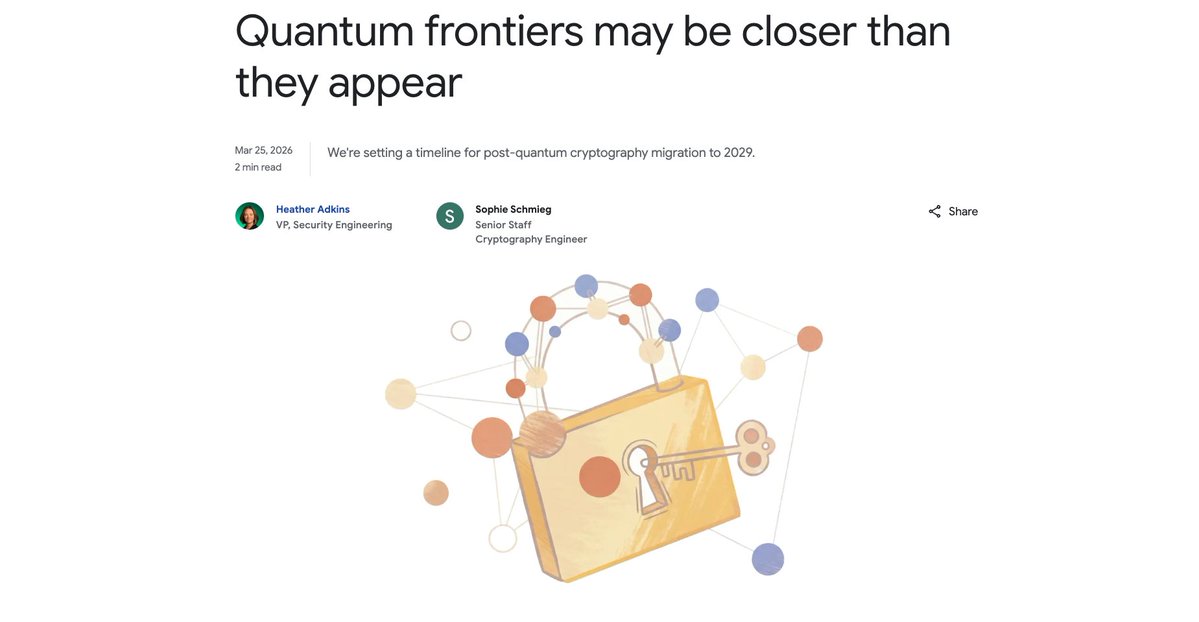
Google has set 2029 as a key milestone in its PQC migration timeline, with prioritizing PQC deployment for authentication services; a core component of online security and digital signature infrastructure. This is a strong signal for the blockchain ecosystem. Every onchain transaction is fundamentally an authentication event enforced by digital signatures. As quantum capabilities advance, Blockchain needs to get ready for that momentum. For systems designed to secure long-lived digital assets and immutable histories, delaying the transition at the authentication layer could introduce systemic risks. The quantum era is not just coming; it is already shaping security roadmaps. Read more here: blog.google/innovation-and… Soundness is building for this purpose with multiple practical solutions. Read our recent blogs here: soundness.xyz/blog
Soundness tweet media
English
58
67
160
5.5K
Walrus 🦭/acc
Walrus 🦭/acc@WalrusProtocol·
GM, on a mission to get 500 GMs today. Don't let us down. 🦭
English
170
10
215
8.1K
Walrus 🦭/acc
Walrus 🦭/acc@WalrusProtocol·
GM, on a mission to get 200 gm's today! 🦭
English
125
7
183
7.5K
Juza💧🐬 🦭/acc 📘 retweetledi
Stork
Stork@StorkOracle·
Stork and @Lighter_xyz: a DEX-oracle partnership built before day one. New case study on what that looks like in practice 🧵 👇
English
5
5
63
4.3K