
Sabitlenmiş Tweet
TAU Labs
1.1K posts


TAU Labs
@628Labs
Risk Management, Mechanism Design & Tokenomics Lab. Curating vault strategies across DeFi.
Worldwide Katılım Temmuz 2024
222 Takip Edilen796 Takipçiler
TAU + B20 tokens
Base Season is just getting started
Base Build@buildonbase
Most tokens are smart contracts deployed on top of a chain. B20 tokens are native to Base - built directly into the protocol. The B20 Native Token Standard explained 🧵
English

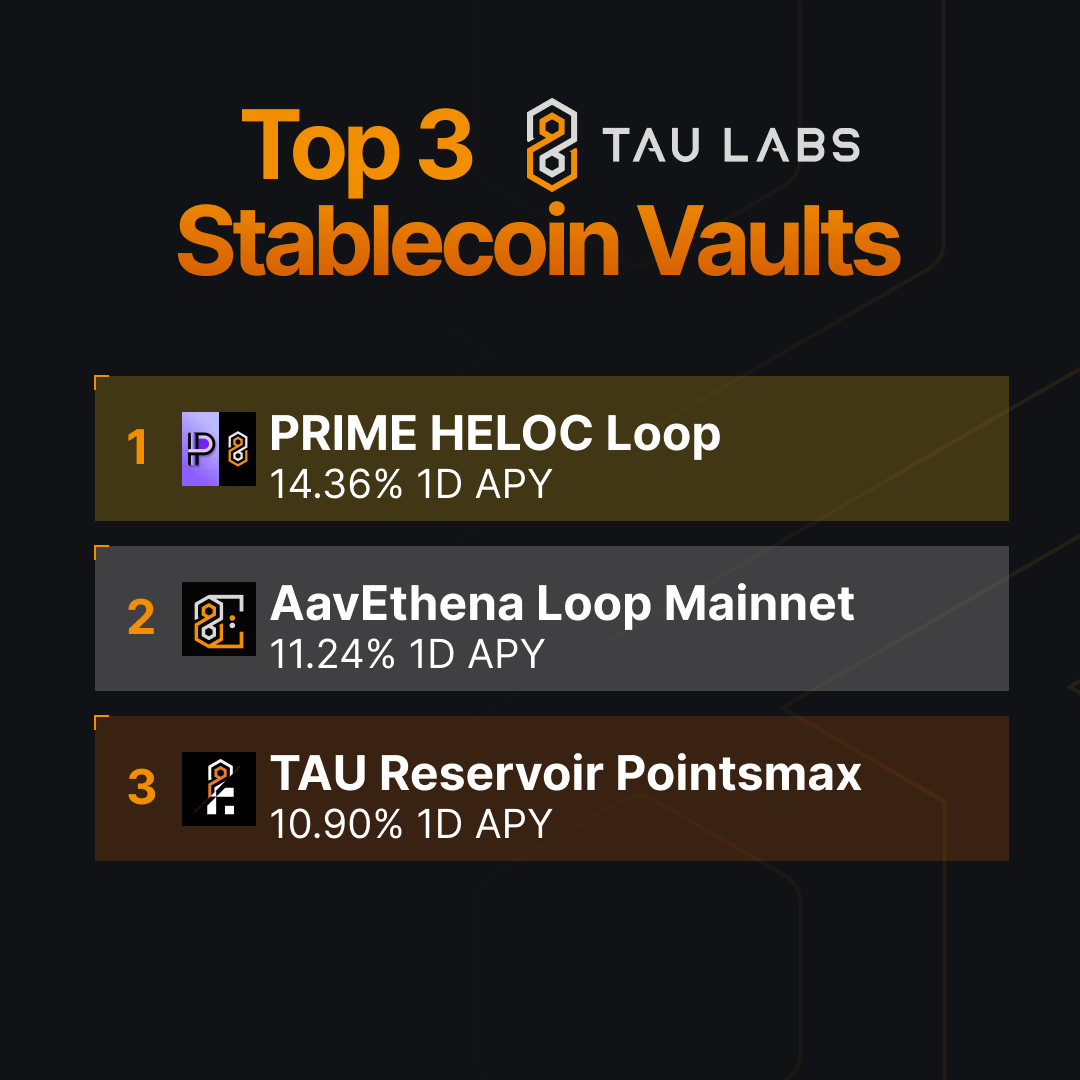
TAU Reservoir Pointsmax
The vault automates leveraged positioning in the srUSD/USDC market on Morpho and programmatically targets 10.53x leverage, while optimizing for a 90% utilization rate in the market.
app.ipor.io/fusion/ethereu…
English
AavEthena Loop Mainnet
TAU’s AavEthena Loop Vault provides capital and fee efficient exposure to the Ethena looping strategy on Aave’s Ethereum instance. The vault runs a leveraged yield strategy on USDe and sUSDe using Aave on Ethereum. The strategy’s collateral consists of 45% USDe and 55% sUSDe to borrow USDT and leverage up collateral positions to 9.5x (89.5% LTV). The collateral composition is chosen to be eligible for the Merkl rewards distribution.
app.ipor.io/fusion/ethereu…
English
We wrote about this topic in more detail here
taulabs.substack.com/p/a-holistic-v…
English
"End of the day, you will be left deciding how much of that goes into equity and how much into the token."
Agreed. This can become even more complex. For utility tokens (e.g. free access to compute, fee reduction), there are 3 stakeholders:
• Passive token holders
• Active token holders (token holder + user)
• Equity holders
Tips
1. Teams have to take a holistic view on how value is distributed among stakeholders. Value might be revenue share, but can also show up outside of it. For instance, token holders that receive free compute represent foregone revenue - it never shows up in the revenue numbers. Therefore, looking at how revenue is shared to token holders would underestimate the value active token holders get - and how much they dilute e.g. passive token holders (in case of token holders benefiting from a buyback program).
2. Conflicts of interest are inevitable because the company needs to have decision power to react to changing market conditions. But these decisions affect stakeholders differently. For example, giving more perks to active token holders directly reduces the revenue accruing to equity holders. Teams must transparently model how decisions dilute each group under different scenarios. Keeping the number of stakeholder groups small helps a lot here, e.g. not having a dual token <> equity structure
3. If token holders only get value when actively using the product, the market will reprice the asset accordingly as passive holders leave.
ivangbi 🦞@ivangbi_
Some random thoughts on the token <> equity value topic (not VVV specific, but a general discourse) after this video. PS, I've never interacted with @ErikVoorhees, but he seems like an aligned chad (his pro-crypto statements at tradfi interviews, decentralization, privacy, etc.) The issue is that alignment is no longer enough of a justification, given how many alignment stories fell through. So let's put that moral stuff aside and look at the arguments. First of all, there have been countless cases where there was a network token (staking, paying fees for usage as a license model granting access, etc.) + an equity company being one of the stakers / nodes working on adoption of the network. It's an old model which might feel like a symbiosis. A token granting usage of software over periods of time is not far from that. In all cases similar to this, clients & users would pass through a centralized equity company and pay money for some service in fiat - while the company would then buy the token, burn it, stake it for them, or pay fees on their behalf somehow else. 1. All things being equal, $100 of inflow is $100 of inflow. You can be coy with the market long enough, but the pie size is the same end of the day. End of the day, you will be left deciding how much of that goes into equity and how much into the token. 2. A company holding a lot of tokens is not a strong argument, I don't know how they make themselves believe that. Holding many tokens is the case for almost every company, that just means they can tap into 2 bags at the same time. And they will always get rid of the second tier citizen first (which is the token in case an equity structure is present). That's simply a must. Back to the model: it's potentially doable if new, other for-profit entities start working on adoption alongside the original company - and the eventual benefactor is then the network (token) itself. There is a bit of competition among such providers (most likely geo-focused, that was it's less cutthroat). But that must mean that the value clients pay for is in the network itself (and not obfuscated end-user products where clients don't ever see the network itself). Basically the value has to remain onchain, but that means that those for-profit entities are simply well-branded gateways (resellers) with little pricing power themselves. And eventually we are left with the same conclusion: conflict of interest, meaning equity + token is a bad model. Anyway, if I read it right, Erik kinda confirmed the issues which are tbd how to deal with: x.com/ErikVoorhees/s…. There are ways to deal with it, but each one of them assumes acting a little bit altruistic - and we all got burned by that already. All in all, this damage control video doesn't help (gg on being vocal about investments and trying to protect your founders engaging in discourse - but do the same for more questionable cases too). Haseeb is good at selling his own narrative. As itself, the VVV DIEM model is interesting (I dont hold any, this aint a shill). Would love to see AI compute markets be more onchain (with proper structures) and turn that part of the market financially-online.
English
TAU Labs retweetledi

Our flagship product, PRIME, brings U.S. home equity loan yield originated by @Figure to DeFi markets.
Launched alongside key partners like @kamino and @chainlink, it's now a foundational asset that powers structured yield products, RWA looping strategies, and borrow/lend markets.
A huge thanks to our ecosystem partners for helping us build PRIME into what it is today:
@solana @Morpho @SentoraHQ @strata_markets @628Labs @project0 @orca_so @Loopscale @privy_io @provenancefdn @artemis @gauntlet_xyz @RockawayX @pendle_fi
English
TAU Labs retweetledi



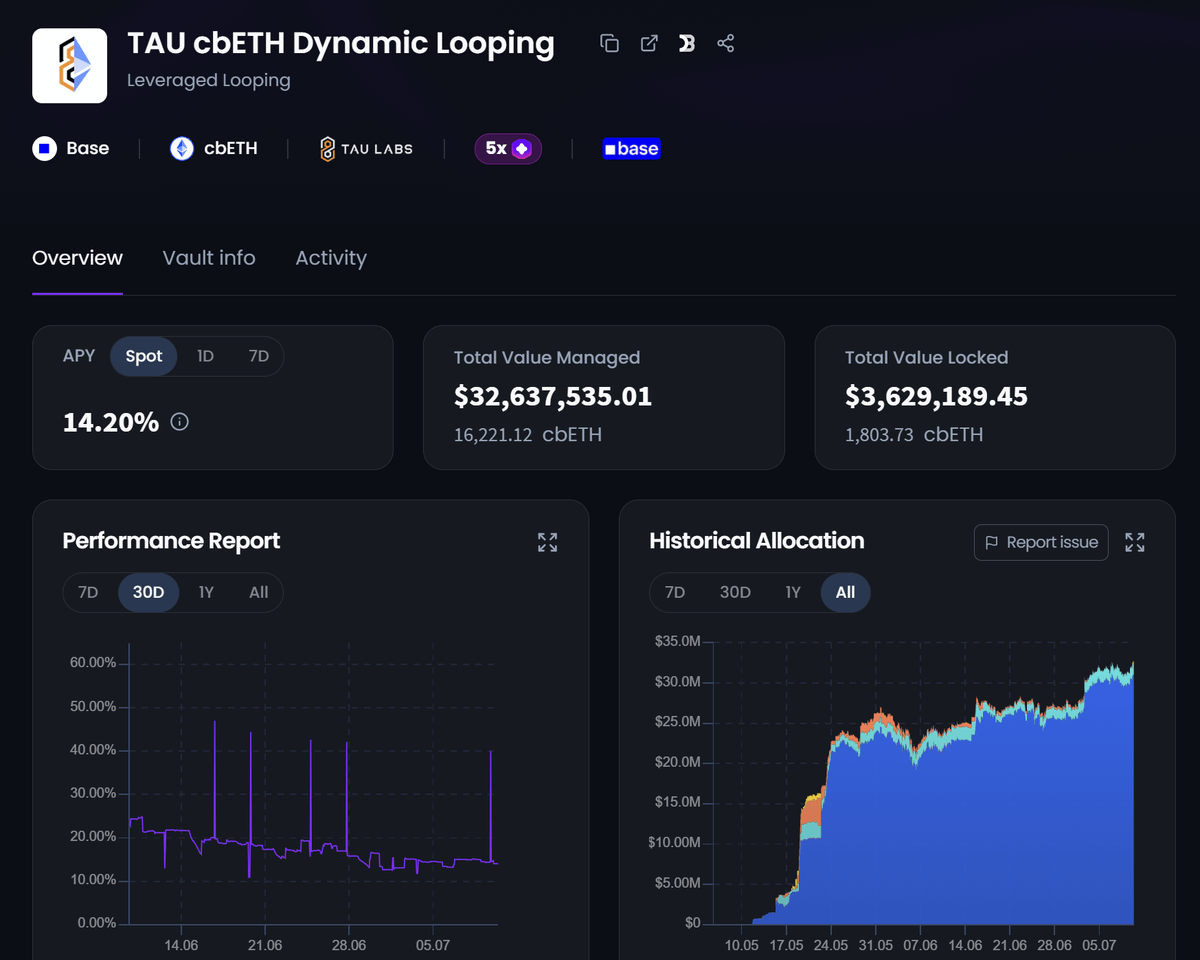
Just in time for a cap increase on our cbETH vault 🫡
Fusion (by IPOR)@ipor_io
Base supported rewards are now live on select Fusion strategies accessed through Porto by @Anchorage Digital Participants in eligible strategies can receive rewards, distributed through @merkl_xyz in addition to each strategy's prevailing output. The campaign starts now. Details below ↓
English
Prime HELOC Loop
TAU’s PRIME HELOC Loop Vault provides capital-efficient exposure to a PRIME looping strategy on the Morpho PRIME-pyUSD market. The vault converts deposited pyUSD into PRIME, supplies PRIME as collateral, and borrows pyUSD to reach 5.0x target leverage, or 80% LTV. PRIME provides exposure to Figure’s on-chain private credit infrastructure through Hastra, with yield generated from lending activity backed by Figure-originated HELOC collateral. The vault uses flashloan-based execution for efficient leverage management.
app.ipor.io/fusion/ethereu…
English
AavEthena Loop Mainnet
TAU’s AavEthena Loop Vault provides capital and fee efficient exposure to the Ethena looping strategy on Aave’s Ethereum instance. The vault runs a leveraged yield strategy on USDe and sUSDe using Aave on Ethereum. The strategy’s collateral consists of 45% USDe and 55% sUSDe to borrow USDT and leverage up collateral positions to 9.5x (89.5% LTV). The collateral composition is chosen to be eligible for the Merkl rewards distribution.
app.ipor.io/fusion/ethereu…
English
