SciTech Era@SciTechera
BREAKTHOUGH: Google's AI can now read 1 million DNA letters at once.
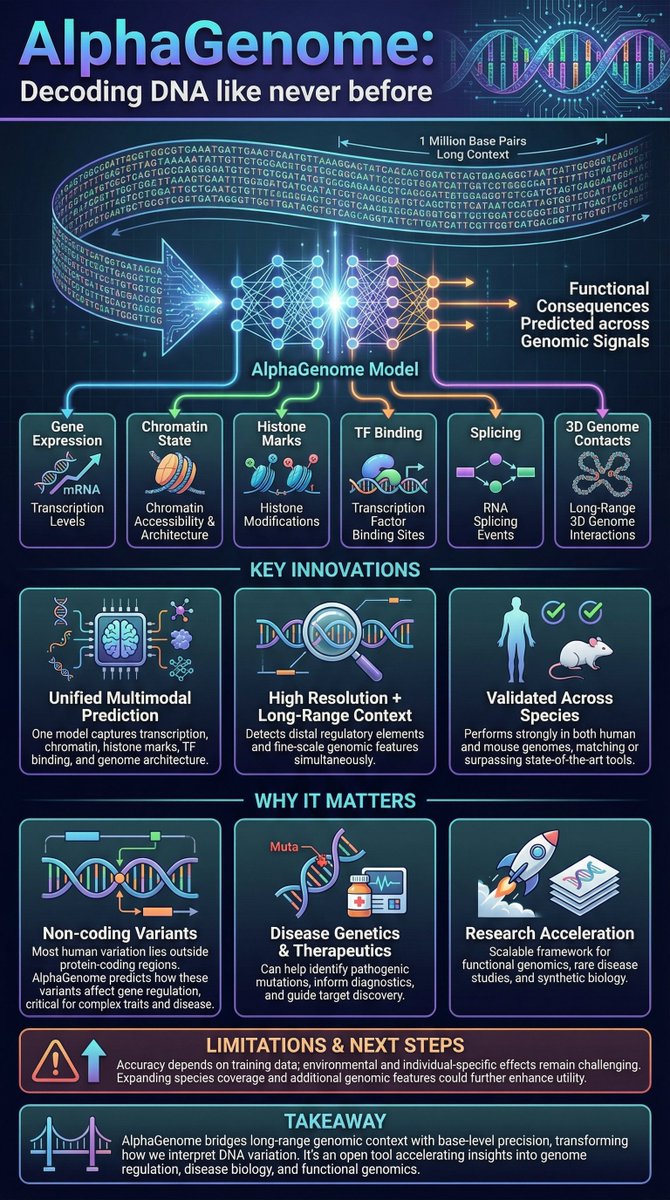
Google's DeepMind has unveiled a revolutionary deep learning model, AlphaGenome, which can analyze long sequences of DNA with remarkable accuracy.
A new peer reviewed study published in Nature, AlphaGenome can process up to 1 million base pairs (1 megabase) in a single input, capturing long range genetic interactions that previous models could not.
The system predicts how single letter DNA changes affect gene expression, RNA splicing, and chromatin regulation across 11 genomic signals, even within the 98% of the human genome that does not code for proteins. In benchmark tests, AlphaGenome matched or outperformed previous state of the art models at identifying functionally important genetic variants.
By making large sections of the non-coding genome interpretable, AlphaGenome could significantly accelerate disease variant discovery, cancer research, and precision medicine, moving genomics from sequence reading toward functional understanding.