Association for Mathematical Research

224 posts

Association for Mathematical Research banner
Association for Mathematical Research

Association for Mathematical Research

@AMathRes

The mission of the AMR is to support mathematical research and scholarship. Membership open to all : https://t.co/ft7Q5HbqD0

Katılım Nisan 2021
248 Takip Edilen1.1K Takipçiler
Association for Mathematical Research retweetledi

Alex Kontorovich
Alex Kontorovich@AlexKontorovich·
New paper on arxiv, with my Rutgers colleague Swee Hong Chan and Igor Pak of UCLA: arxiv.org/abs/2411.18782 We study numbers of spanning trees of graphs, answering a 55-year old question of Sedlacek. A graph is just a bunch of vertices connected by some edges. Here’s a pic of all the connected (that is, spanning all the vertices) graphs on 4 vertices. A “spanning tree” is a subgraph (drop some edges) that is still connected but has no cycles (no paths through the graph that come back to where they started). For a given graph, G, write τ(G) for how many spanning trees it has. This is a fascinating quantity that’s been studied since (at least) 1847, when it appeared in Kirchhoff’s work on resistance in electrical circuits (this is where he proved the "matrix-tree theorem", that τ can be computed as the determinant of a minor of the graph Laplacian). By happenstance, this quantity appears all over the place. In evolutionary biology, τ counts the number of possible phylogenic trees connecting sets of species based on genetic or evolutionary data. In the arithmetic of Ramanujan graphs (of Lubotzky-Phillips-Sarnak), τ coincides with class numbers of certain function fields. Etc etc. In the 60’s, Sedlacek started to ask a number of very natural questions about what values τ can take in different families, ordered by the number of vertices. For the size-4 graphs in the image, we see that the set of values taken by τ is: 1, 3, 4, 8, and 16. Of particular interest to us is the family of planar graphs. It’s easy to show from Euler characteristic that τ takes *at most* exponentially many values. Does the set of values also grow *at least* exponentially? Sedlacek could prove that they grow at least quadratically. Skipping a lot of intermediate results, the previous best growth rate was due to Stong, who showed in 2022 that the number of distinct values of τ on planar graphs with n vertices grows at least like exp(C n^{2/3}). One of the difficulties here is that there are only exponentially many planar graphs to begin with, and τ can have exponentially large multiplicity (for example, there are exponentially many trees, for whom τ is of course always 1). Nevertheless, we’re able in this paper to resolve the question (at least qualitatively), that τ indeed grows exponentially. In fact we show much more, namely, it looks like the set of values of τ will eventually be just *all* (sufficiently large) numbers, in an exponential range; we prove a positive proportion and outline how to prove density 1 (if you just want to show exponential growth, even less is needed). The method of proof is really fun, too, and happens in three steps: • We reduce the graph question to a question in Diophantine geometry, that smells a lot like Zaremba’s conjecture. • A decade ago, Bourgain and I made some progress on that problem, and that work (which has been extended now by Frolenkov, Huang, and especially Kan) applies to this context. It turns out that a key role is played by the Hausdorff dimension of a certain fractal, which needs to overcome a threshold value. The Diophantine problem is thus reduced to one in Thermodynamics. • To resolve the Thermodynamics, we have to rigorously compute this dimension, and (very luckily for us!) it turns out to indeed exceed the threshold, but just barely, in the hundredths place. This was a really fun project to work on. For more details, please see the paper.
Alex Kontorovich tweet media
English
3
36
181
11.4K
Association for Mathematical Research retweetledi
Iolo Jones
Iolo Jones@iolo_jones·
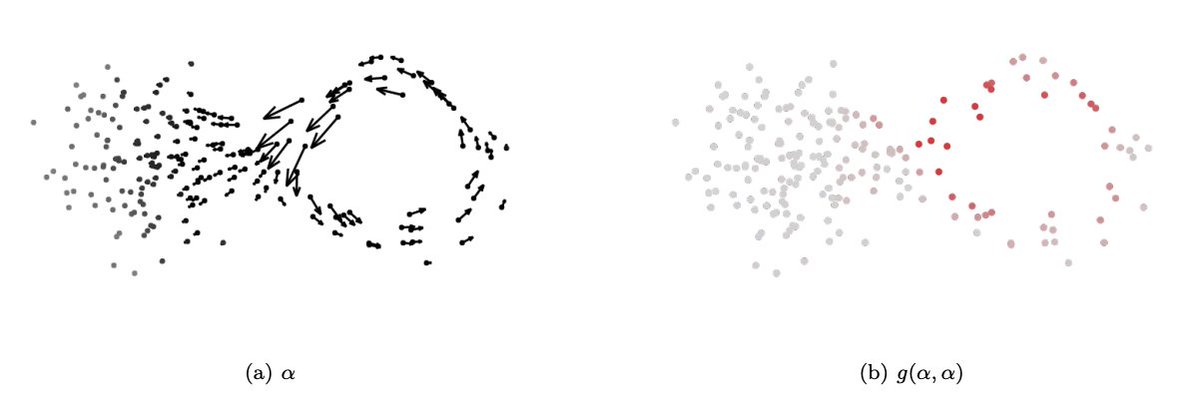
Really pleased to finally share my preprint: Diffusion Geometry (1/4) Diffusion geometry defines Riemannian geometry for data and probability spaces! arxiv.org/abs/2405.10858
Iolo Jones tweet media
English
19
84
538
70.2K
Association for Mathematical Research retweetledi
Plectics
Plectics@PlecticsLab·
On Thursday, November 14th, we are honored to host a lecture from Haynes Miller from MIT. Professor Miller will discuss the history of the proof of the Sullivan conjecture and its influence on subsequent research. Register for attendance at: discord.gg/TxKbTUb2wC
Plectics tweet media
English
0
3
10
2K
Association for Mathematical Research retweetledi
Eva Miranda
Eva Miranda@evamirandag·
Deeply honored to share that I’ve been awarded the Professur Gauss 2025! 🙏 Taking on Carl Friedrich Gauss' chair at the Göttingen Academy of Sciences is a true privilege, recognizing contributions in fields like astronomy, geophysics, math, and physics🌟 adw-goe.de/preise/kategor…
Eva Miranda tweet media
English
56
46
516
48K
Association for Mathematical Research retweetledi
Alex Kontorovich
Alex Kontorovich@AlexKontorovich·
A few weeks ago, we had our first All-Members meeting of the Association for Mathematical Research @AMathRes, where we described what we've been up to over the last year. Here's a summary of the meeting.
Alex Kontorovich tweet media
English
1
5
54
10.5K
Association for Mathematical Research retweetledi
Eva Miranda
Eva Miranda@evamirandag·
I totally identify with the description of deep moments in mathematical research coined by Voisin in this @QuantaMagazine article "The Rest of the World Disappears". Germans probably have a word for this... Die Deutschen müssen dafür ein Wort haben, aber ich kenne es nicht!
Eva Miranda@evamirandag

‘The Rest of the World Disappears’: Claire Voisin on Mathematical Creativity quantamagazine.org/a-mathematicia… via @QuantaMagazine

English
3
4
12
1.7K
Association for Mathematical Research retweetledi
APC5
APC5@AlbertPCarpent1·
A crisp 3D printed Roelofs nested knot. I also think of these as polyknots because they are analogous to Holden polylinks. #mathart #3dprinting @rinusroelofs #knots #knottheory
APC5 tweet media
English
0
3
24
1.3K
Association for Mathematical Research retweetledi
Timothy Gowers @wtgowers
Timothy Gowers @wtgowers@wtgowers·
How long will it be before a computer can get a gold medal in the International Mathematical Olympiad? Now that there is a big prize at stake, maybe not as long as it would otherwise have been ...
AIMO Prize@AIMOprize

Fields Medallists Timothy Gowers and Terence Tao appointed to the Advisory Committee for the Artificial Intelligence Mathematical Olympiad Prize, alongside Po-Shen Loh, Dan Roberts and Geoff Smith. aimoprize.com/updates/2024-0…

English
15
35
239
61K
Association for Mathematical Research
JEXPM publishes research articles in all branches of mathematics that feature experimental results with important implications. There are no strict page limits. A published article may be accompanied when appropriate by links to other media, such as repositories for code or data
Association for Mathematical Research tweet media
English
1
4
12
991
Association for Mathematical Research
the Journal of Experimental Mathematics is now published by the AMR as a diamond open-access journal, free to publish in and read
Association for Mathematical Research tweet media
English
4
32
125
26.3K
Association for Mathematical Research retweetledi
Eva Miranda
Eva Miranda@evamirandag·
My sunny days in California are over. Lovely math conversations, Colloquium at USC, and conference at @mathmoves. Inspiring sunlight and palm trees in LA, and mesmerizing views from SLmaths, I'll miss you!Talks available at CAMS youtube channel and: slmath.org/workshops/1054…
English
0
2
22
975
Association for Mathematical Research
new project in formalizing mathematics! (Prime Number Theorem in Lean)
Alex Kontorovich@AlexKontorovich

Terry Tao and I are pleased to announce the "Prime Number Theorem and Beyond" project, which you can find here: github.com/AlexKontorovic… with blueprint here: alexkontorovich.github.io/PrimeNumberThe… and dedicated stream in the Leanprover Zulip chat. The initial goal is to get the Prime Number Theorem formalized in Lean (of course it's been done a few times in other systems) via either/both Fourier and/or complex analysis (especially the latter, which can lead to the classical exp-root-log error -- which has *not*, to my knowledge, been formalized before), followed by things like Dirichlet's theorem, Chebotarev density, etc etc. This kind of project is ideal for distributed efforts. Contributions are welcome from people who know just math but not Lean (who can add to the blueprint), as well as people who know (even some) Lean but not the mathematical content. There's already a lot of very low-hanging fruit in the dependency graph - if you ever wanted to try to impress Terry Tao, here's your chance! :)

English
0
2
9
1.7K
Association for Mathematical Research retweetledi
The Royal Swedish Academy of Sciences
The Crafoord Prize 2024 – Mathematics💡 This year, the Crafoord Prize in Mathematics is awarded to Claire Voisin, Institut de Mathématiques de Jussieu, @CNRS, France “for outstanding contributions to complex and algebraic geometry, including Hodge theory, algebraic cycles, and hyperkähler geometry”. Read more: kva.se/en/news/this-y… #crafoordprize #Mathematics
English
6
103
244
64.1K
Association for Mathematical Research retweetledi
Robin Houston
Robin Houston@robinhouston·
ZXX
4
13
113
8K
Association for Mathematical Research retweetledi
Alex Kontorovich
Alex Kontorovich@AlexKontorovich·
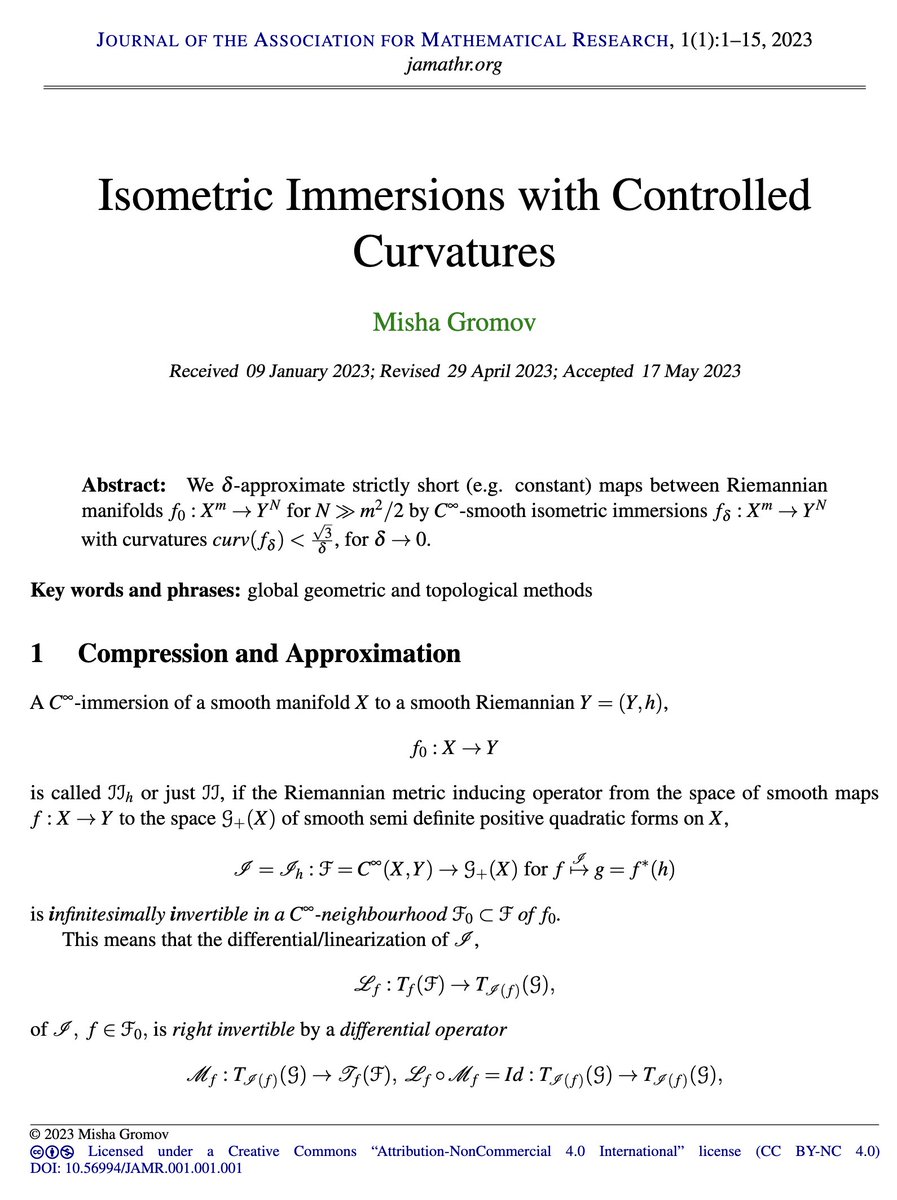
The first Issue of the Journal of the Association for Mathematical Research @AMathRes is live! jamathr.org/index.php/jamr… There are two papers, one by Gromov, and one by Entov-Verbitsky. I hope you enjoy reading high-quality Diamond Open Access mathematics!
Alex Kontorovich tweet mediaAlex Kontorovich tweet media
English
0
8
44
9.4K