AQPulse

2.7K posts

AQPulse banner
AQPulse

AQPulse

@AQPulse

Stop trading the bounce. AQPulse shows what can actually hold, where risk is building, and when relief is false.

United States Katılım Haziran 2025
356 Takip Edilen379 Takipçiler
AQPulse
AQPulse@AQPulse·
This is why the optics move matters. Since the Mar 2 NVIDIA validation, leadership inside AI has pushed deeper into the stack. LITE and AAOI kept separating from the Nasdaq 100, while the rest of the group followed with far less power. That tells you this is no longer just a broad AI beta trade. The market is paying up for the layer that helps compute actually scale: bandwidth, interconnect, and optical efficiency. The bullish signal is capex depth. The risk is that leadership is getting narrower as the move gets hotter.
AQPulse tweet media
English
0
1
0
437
The Kobeissi Letter
The Kobeissi Letter@KobeissiLetter·
Optical stocks have become the hottest trade in the AI space: Lumentum, $LITE, is up +1,137% over the last 12 months, the 2nd-best performing stock in the S&P 500. Over the same period, Applied Optoelectronics, $AAOI, is up +551%, Coherent, $COHR, +282%, Corning, $GLW, +223%, and Fabrinet, $FN, +176%. This marks a massive outperformance of the Nasdaq 100, which returned +23%. These companies make optical components that use light instead of traditional copper wiring to move data inside AI data centers. This technology has gained popularity as AI infrastructure demands faster and more efficient communication. In early March, Nvidia, $NVDA, announced it would invest $2 billion each in Lumentum and Coherent. Optical stocks are the latest beneficiary of the AI boom.
The Kobeissi Letter tweet media
English
135
234
2.1K
338.6K
AQPulse
AQPulse@AQPulse·
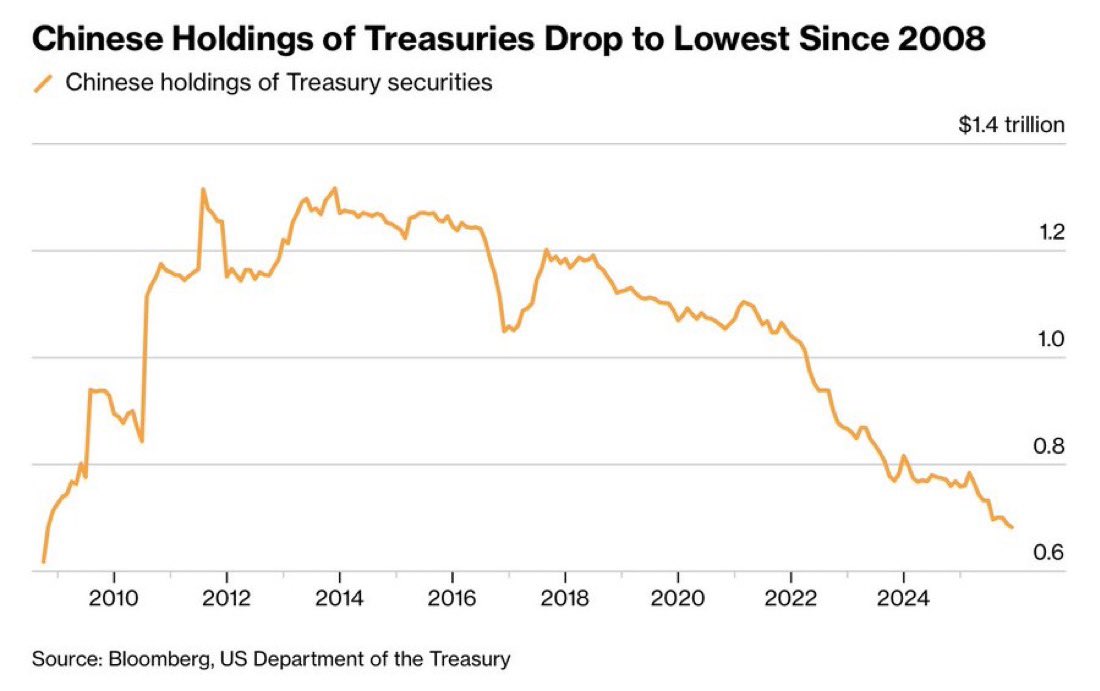
China cutting Treasury holdings is the headline. The deeper market question is who replaced that demand, and at what price. Japan and the UK now carry more of the stack than China. That means the story is shifting from reserve accumulation to buyer rotation. When the buyer mix changes, yield behavior can change with it. That is how a reserve story becomes a term premium story.
AQPulse tweet media
English
0
2
3
382
AQPulse
AQPulse@AQPulse·
That is where AQPulse starts reading. Most people wait for pressure to show up in earnings, margins, or a failed index move. AQPulse tracks it earlier: where pressure begins, how it spreads, which pockets capital trusts first, and what actually has to improve before a bounce deserves conviction. Last week looked better on the surface. Underneath, leadership still leaned toward selective pockets tied to energy sensitivity, real assets, and relative defense. This week’s Free Entry is here: aqpulse-newsletter.beehiiv.com/p/the-bounce-w…
English
0
1
1
46
AQPulse
AQPulse@AQPulse·
The most dangerous rebounds are the ones that arrive before trust does. Last week gave the market enough relief to feel better on the surface. What mattered more was the layer underneath. Oil stayed inside the macro chain. Inflation psychology stayed active. Rates pressure never fully cleared. Participation improved, but still did not widen enough to make the move feel easy. That is how people get trapped. They see movement and assume stability. The headline was the bounce. The structure was how little broad trust actually came with it.
AQPulse tweet media
English
1
1
0
61
Barchart
Barchart@Barchart·
Chinese Holdings of U.S. Treasuries plunge to lowest level since the Global Financial Crisis 🚨🚨
Barchart tweet media
English
62
365
1.3K
109.3K
AQPulse
AQPulse@AQPulse·
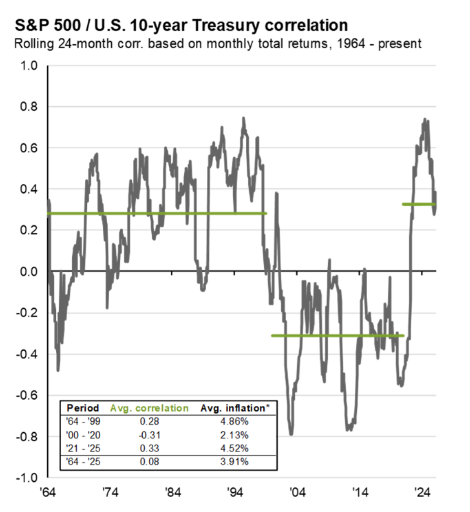
This is why last week’s bounce still felt incomplete. In an inflationary regime, stocks and bonds moving together weakens diversification right when oil stays elevated and inflation psychology keeps the rates backdrop tight. Price recovered. Trust still lagged underneath. That is the setup the market now has to carry into PCE, CPI, and confirmation week. aqpulse-newsletter.beehiiv.com/p/the-bounce-w…
English
0
0
0
53
Mike Zaccardi, CFA, CMT 🍖
Inflationary regime... stocks & bonds moving together JPMAM While that means less diversification, it also means higher bond yields vs the 2010s.. when bonds zigged when stocks zagged... it's a trade-off.
Mike Zaccardi, CFA, CMT 🍖 tweet media
English
5
10
42
4.1K
TrendSpider
TrendSpider@TrendSpider·
$SPY notched its best week since late November despite a 4-day trading week
TrendSpider tweet media
English
26
29
349
33.5K
AQPulse
AQPulse@AQPulse·
The deadline matters because the first move will hit the tape fast. The real tell comes right after. If Hormuz is still constrained after the cash open, this pressure can travel through oil, shipping risk, inflation expectations, yields, credit, and then equity leadership. Headlines can buy time. They cannot buy confirmation. AQPulse will be watching where the pressure spreads first. aqpulse-newsletter.beehiiv.com/p/the-bounce-w…
English
0
0
1
37
The Kobeissi Letter
The Kobeissi Letter@KobeissiLetter·
BREAKING: President Trump's "48-hour warning" to Iran to open the Strait of Hormuz expires at 10:05 AM ET on Monday, April 6th. This also happens to be 35 minutes after the US stock market reopens after the 3-day weekend. We will be covering the highly eventful next 48 hours.
English
442
964
8.9K
696.4K
AQPulse
AQPulse@AQPulse·
That is the real distinction. Iran is not closing the door. It is raising the bar for what counts as peace. For markets, that means the question stays the same: does this path actually remove the oil, shipping, and inflation premium, or just create another relief headline that fades on contact?
English
0
0
0
298
The Kobeissi Letter
The Kobeissi Letter@KobeissiLetter·
BREAKING: Iran's Foreign Minister Araghchi says Iran's position on peace talks in Pakistan is being "misrepresented by US media." "We are deeply grateful to Pakistan for its efforts and have never refused to go to Islamabad. What we care about are the terms of a conclusive and lasting END to the illegal war that is imposed on us," he says
English
180
483
4.7K
468.6K
AQPulse
AQPulse@AQPulse·
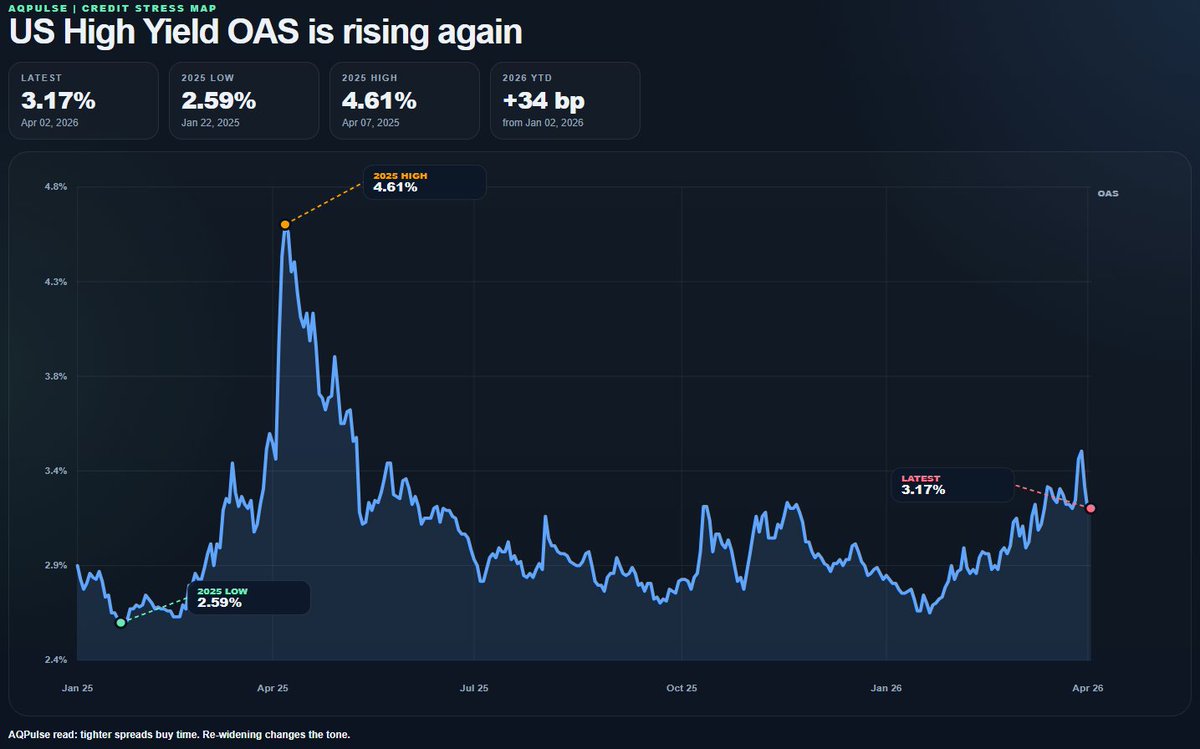
@KobeissiLetter CDS volume shows where demand for protection is going. HY OAS shows whether that stress is starting to appear in cash credit too. When protection demand surges and spreads begin widening again, defensive positioning stops looking tactical and starts looking structural.
AQPulse tweet media
English
0
0
1
49
The Kobeissi Letter
The Kobeissi Letter@KobeissiLetter·
Investors are hedging against corporate defaults at a record pace: Trading volume in the world's largest credit default swap (CDS) indexes surged +69% in Q1 2026, to $4.5 trillion, the highest on record. This exceeds the previous record set in Q2 2025 during the tariff turmoil by +36%. This is also +350% higher than the ~$1.0 trillion traded in Q4 2019, before the pandemic. The surge has been driven by the Iran War and growing concerns that AI could reshape entire industries and weaken their ability to service debt. In Europe, net investor positioning on credit indexes has turned bearish for the first time since 2018. Defensive positioning in the market is accelerating.
The Kobeissi Letter tweet media
English
99
216
1.1K
185.3K
AQPulse
AQPulse@AQPulse·
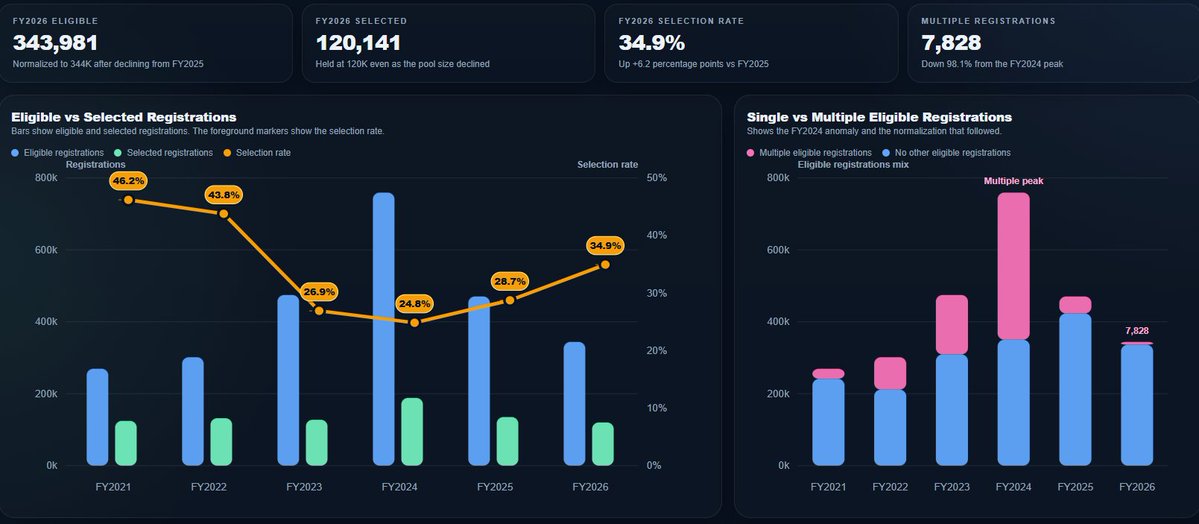
Layoffs can hide the bigger labor shift underneath. Oracle cutting U.S. jobs while still leaning on the H-1B channel tells you the workforce is being rebuilt, not just reduced. And with the FY2026 H-1B selection rate back up to 34.9%, that channel is getting easier to access again. The headline is layoffs. The structure is which roles capital still wants to keep buying.
AQPulse tweet media
English
0
3
7
2.9K
unusual_whales
unusual_whales@unusual_whales·
BREAKING: Oracle, the software company headquartered in Austin, Texas, has filed thousands of petitions for H-1B visas in the past two fiscal years, even as it lays off thousands of American workers as part of a broader organizational shift, per NationalToday
English
464
2.6K
19K
2.6M
AQPulse
AQPulse@AQPulse·
Export strength can hide a bigger macro signal underneath. When South Korea’s shipments, semiconductors, and China demand all accelerate together, it tells you global AI capex and trade flow are still carrying more momentum than many expected. The headline is growth. The structure is where you ask how long that strength can hold if oil, freight, and external pressure keep rising.
English
0
0
1
146
The Kobeissi Letter
The Kobeissi Letter@KobeissiLetter·
South Korea's economy is seeing unprecedented growth: South Korea’s exports surged +41.9% YoY in March, the 2nd-highest in at least 2 years. This follows +49.3% in February and +14.0% in January, marking the strongest quarter since at least 2023. The surge was driven by semiconductor exports, which soared +151.4% YoY, to a record $32.8 billion, fueled by global AI and data center investment demand. Meanwhile, shipments to China jumped +64.2% YoY, the highest since the aftermath of the 2008 Financial Crisis, and exports to the US rose +47.1%. South Korea is seeing historic economic momentum.
The Kobeissi Letter tweet media
English
94
267
1.7K
200.8K
AQPulse
AQPulse@AQPulse·
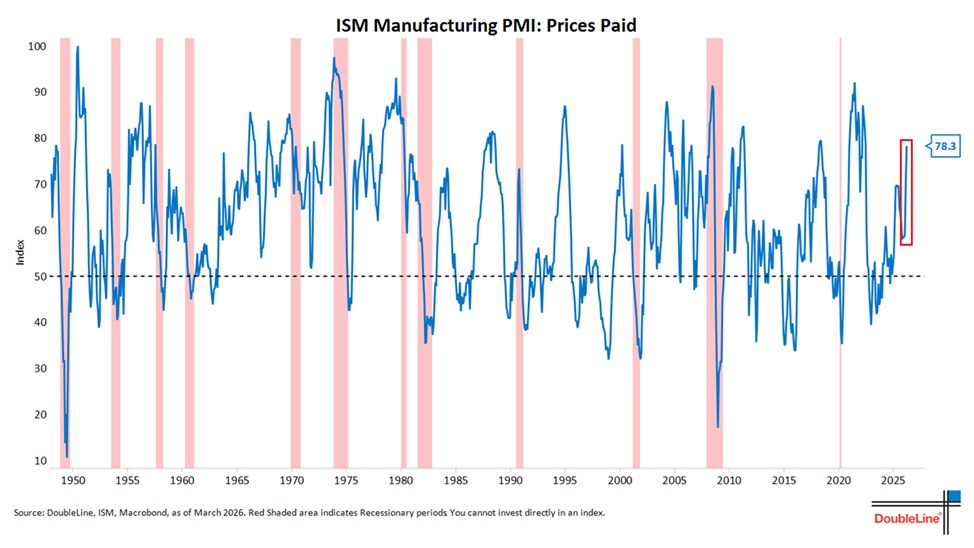
Manufacturing expansion can hide the bigger pressure underneath. Prices Paid at 78.3 and supplier deliveries at 58.9 tell you cost pressure is moving faster than growth. That means oil, shipping friction, and input inflation are pushing back into the pipeline all at once. The headline can look resilient. The structure is what matters.
English
0
0
0
83
The Kobeissi Letter
The Kobeissi Letter@KobeissiLetter·
Inflation pressures are surging in US manufacturing: The ISM Manufacturing PMI rose +0.3 points in March, to 52.7, the highest since August 2022. This marks the 3rd consecutive monthly expansion despite the Iran war. However, prices paid jumped +7.8 points, to 78.3, the highest since June 2022, driven by surging oil prices and supply chain disruptions. Prices paid have soared +19.3 points over the last 2 months, the biggest 2-month increase in at least 10 years. Furthermore, supplier delivery times surged +3.8 points, to 58.9, the highest since May 2022, as the war disrupts global shipping routes and ports. Manufacturing production costs are skyrocketing.
The Kobeissi Letter tweet media
English
94
151
957
141.2K
AQPulse
AQPulse@AQPulse·
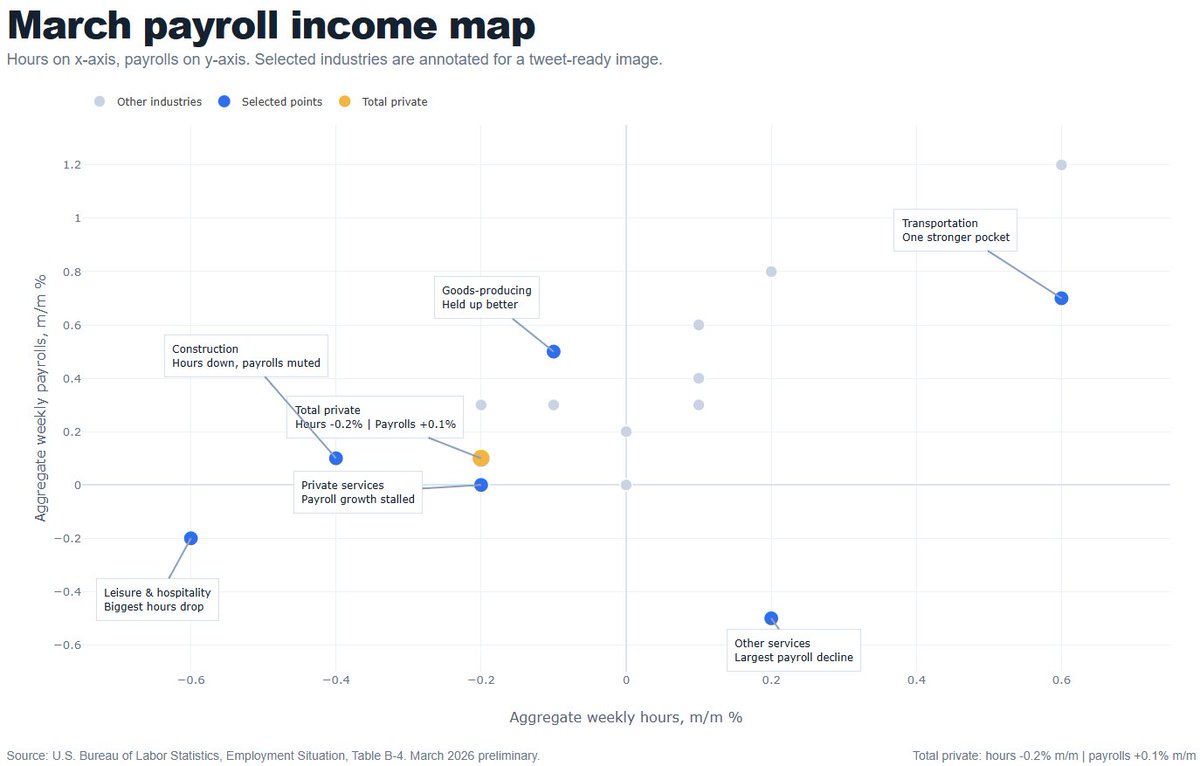
A strong payroll print can still carry a softer message underneath. In March, the average workweek fell, aggregate weekly hours slipped, and payroll income growth barely moved. The 12-month change in aggregate weekly payrolls eased to 3.9%. That is how the labor market starts losing cushion before the headline fully shows it.
AQPulse tweet media
Nick Timiraos@NickTimiraos

From the March payroll report: INCOMES: A drop in the average workweek in March led to very little growth in the index of aggregate weekly payrolls for private-sector workers (which combines hiring, wages, and hours). The 12-month change ticked down to 3.9%
English
0
0
0
74