Sabitlenmiş Tweet
FROSTICO
4.1K posts


[Modulr▪︎Social]
What It Is:
> A unified communication layer combining DMs, email, voice, video and communities under a shared identity and trust system.
Key Design:
• Shared receipts, policy and trust rails across all communication types
• Attention pricing for unknown contacts to reduce spam
• Forum style email threads instead of duplicated mailbox copies
• Developers integrate once and inherit messaging, voice, video and moderation infrastructure
Interesting Aspect:
> The platform treats attention as an explicit resource. Sponsored interactions are opt in, measurable and tied to user consent rather than traditional ad impressions.
Main Challenge:
>> The architecture is ambitious, but adoption remains the critical question. Communication platforms depend heavily on network effects, people join when their contacts are already there.
Overall, [Modulr▪︎Social] looks closer to a communications operating system than a conventional social network.
@Modulr_Robotics @Theundline @TheLiamDevlin

English

@Theundline @Modulr_Robotics Honestly I thought token burns might hurt the team’s working funds or something tied to operations, so this clears that confusion.
Love seeing Modulr being transparent and taking a responsible approach like this. 🫱🏻🫲🏼
English

Thanks for asking and in a strict sense, yeah, technically burning tokens reduces the number of tokens the project controls.
However, it doesn't impact our operating budget because Modulr has never sold team tokens for funding.
That's actually something we're very proud of.
Many projects rely on selling treasury tokens behind the scenes to fund operations. We've chosen not to do that. The burn is about reducing supply and aligning incentives with the community, not creating revenue for the team.
We believe trust is worth more than holding a larger treasury balance.
English

@ARPAANNN Solid breakdown of Modulr Social. Love the comms OS vision
English

@Modulr_Robotics Thanks for sharing that.
It's cool to hear about the kind of companies already building with Modulr. Looking forward to see more real world deployments in different sectors over time. 🫱🏻🫲🏼
English

@ARPAANNN Sorry we forgot to put this in the questions. The largest player that Modulr had been working with was Auki, who was doing amazing work with automating product inventory.
What we are seeing is interest in areas that are more hazardous like mining and industrial automation.
English

x.com/i/spaces/1NGar…
🚨 Modulr AMA 4 TOMORROW 🚨
Set your ⏰ 1 PM/ 5 PM GMT
Drop those questions below👇
English

Modulr Proof of Utility...Most digital systems today reward speculation, attention, or raw computational power.
But @Modulr_Robotics is exploring a different idea... what if networks rewarded measurable, useful work instead?. A thread 🧵

English

@eth_exy Following @Modulr_Robotics for awhile now.
You should def check it out. 👀
English

How Rialo Can Unlock Private & Complex Onchain Applications
One of the biggest limitations of traditional blockchains is that every validator must independently re execute computations to verify correctness.
This works well for simple transactions.
But what happens when applications become significantly more complex?
Think about:
• AI-powered applications
• Private financial systems
• Confidential enterprise workflows
• Prediction markets
• Machine learning models
• Advanced gaming logic
• Large scale data processing
These workloads require substantial computation and, in many cases, involve sensitive data that cannot simply be exposed to every validator in the network.
This creates a major challenge for traditional blockchain architecture.
To verify correctness, validators often need to reproduce the computation themselves.
That means:
1) More computational overhead
2) Higher costs
3) Reduced scalability
4) Limited privacy
As applications become more sophisticated, replicated execution becomes increasingly difficult to sustain.
This is where Proof Carrying Computation changes the equation.
Instead of requiring validators to re execute every computation, an application can:
1. Execute the computation offchain
2. Generate a cryptographic proof of correctness
3. Submit the proof and result onchain
4. Allow validators to verify the proof instead of repeating the work
The blockchain no longer needs to perform the heavy computation itself.
It only needs to verify that the computation was executed correctly.
This unlocks entirely new categories of applications.
Imagine:
1) AI models proving their outputs
2) Private computations verified without revealing sensitive inputs
3) Enterprise workflows settling securely onchain
4) Complex financial calculations verified cryptographically
5) Massive offchain workloads producing trustless onchain results
The result is a blockchain ecosystem capable of supporting applications that would otherwise be impractical to run through traditional replicated execution.
This is the opportunity that is targeting.
Rather than focusing on re executing computation, Rialo focuses on verifying proofs and securely settling the resulting state transitions.
Applications, provers, and zkVMs handle execution.
Rialo verifies correctness.
The network settles outcomes securely.
This separation between execution and verification creates a powerful foundation for scalable, privacy preserving, and computation heavy applications.
As blockchain infrastructure evolves, the ability to verify complex computations without repeating them may become one of the most important building blocks for the next generation of decentralized applications.

English

Stay connected with Modulr ⚡
We’ve added some new platforms to help everyone stay connected with Modulr across every channel.
Follow all of our official links below 👇
▶️ YouTube
@Modulr-Cloud" target="_blank" rel="nofollow noopener">youtube.com/@Modulr-Cloud
📸 Instagram
instagram.com/modulr_cloud
📘 Facebook
facebook.com/share/18vinMnA…

English

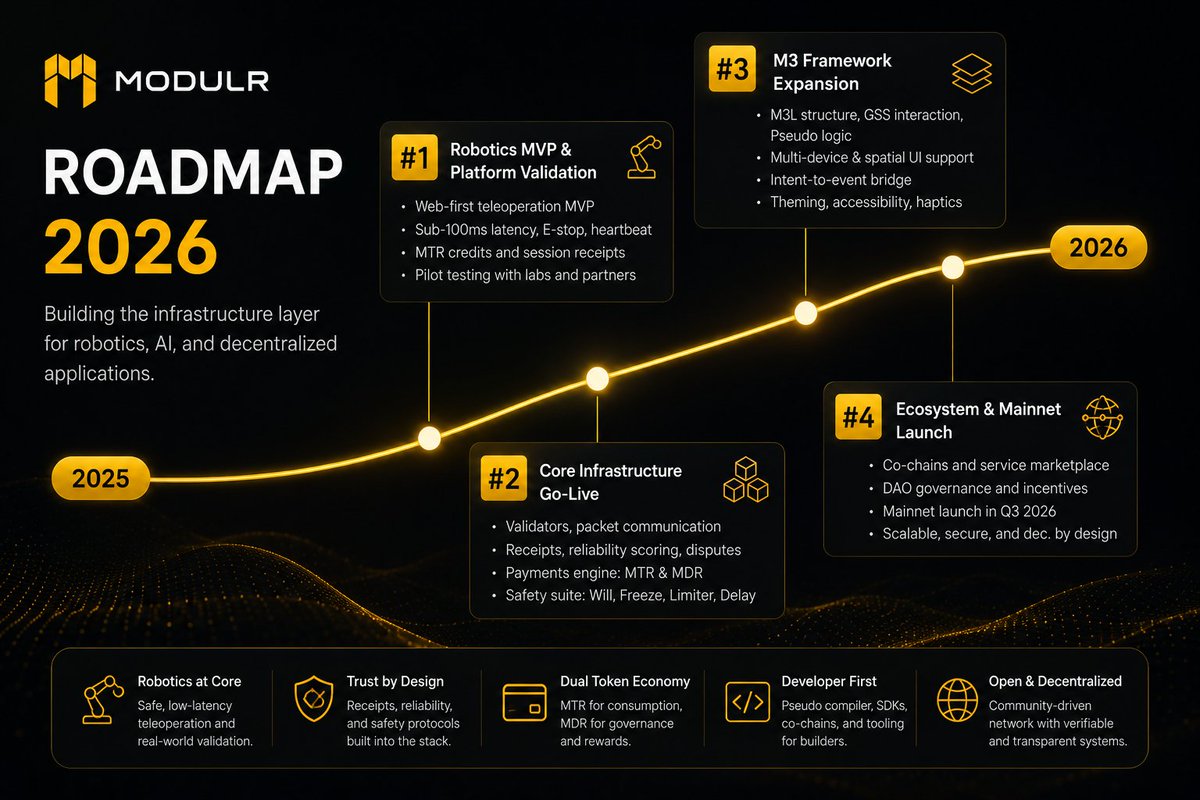
[My thoughts on the Modulr roadmap docs]
Roadmap Structure:
>The split between MVP, Core and M3 makes sense because MVP focuses on validating teleoperation and safety first through a hosted web stack, while Core later replaces those systems with decentralized infrastructure and receipts.
Receipts and Reliability:
>The part I found interesting is how much of the architecture revolves around receipts.
Sessions, disputes, validator activity, payments and reliability all become replayable records. It gives the system a more operational approach instead of only focusing on chain activity.
M3 Framework:
>The M3 framework looks more ambitious than a normal UI layer.
Separating structure, interaction and logic into M3L, GSS and Pseudo makes multi device and spatial interfaces easier to standardize later.
Execution:
>The overall scope is very large. Robotics, validators, compilers, rendering systems, and modules are all difficult systems individually.
The roadmap given is well detailed, with mainnet currently planned for Q3.
We also recently completed Modulr Mission #4, which was for early testing of the platform.
It will be interesting to see how the MVP transitions into the full Core infrastructure over time.
@Modulr_Robotics @Theundline @TheLiamDevlin

English

Just dropped my art submission for @lacertianseth .
Went with a chaotic little mutant vibe with the dragonfly sidekick .
Had a lot of fun creating this one.
Hope the community likes it .
Hope i get WL 🙌.

Lacertians@lacertianseth
A snapshot of WL PASS holders will be taken tomorrow at 3:00 PM GMT+0 📷 You can still get a WL PASS via OpenSea 👇 opensea.io/collection/lac… The Art Contest will close 2 hours before the mint The mint time will be announced after the snapshot This is your last chance to grab a piece of the Lacertian's tail 🦎 Like+RT and drop your wallet
English

[Modulr▪︎Create] is the development workspace built for writing and managing software inside the Modulr network.
The system is built around Pseudo, the native language inside [Modulr▪︎Create]. Modules go through compile time verification before they can run on the network.
The workspace includes:
• Script for writing and compiling code
• Forge for project tracking
• Sync for collaboration and AI agents
• Arch for visualizing software architecture
• Vault for repository and asset history
Example: A team building a multiplayer game can manage gameplay logic, milestones, AI generated assets, reviews and deployment history inside the same environment instead of splitting work across multiple tools.
Technical details:
• Built in compiler
• Compile time safety checks
• Shared workspace across all modules
• Architecture level dependency mapping
• Version tracking for code, images, audio and video assets
• Unified UI and workflow across the platform
@Modulr_Robotics @Theundline @TheLiamDevlin

English