Coach Austin Smith
215 posts

Coach Austin Smith
@ASmith0122
Texas Seminoles Recruiting Coordinator and Coach
Magnolia, TX Katılım Nisan 2013
67 Takip Edilen44 Takipçiler
Sabitlenmiş Tweet

What Are You Looking for in a Recruit? with Tim Corbin – Vanderbilt Univ. coachesinsider.com/baseball/what-… via @SiteTwitter
English
Coach Austin Smith retweetledi

The Scouting Classroom #𝟱
Thread 🧵 1/2
𝘗𝘈𝘙𝘛 𝘛𝘞𝘖 - MUST READ 👇
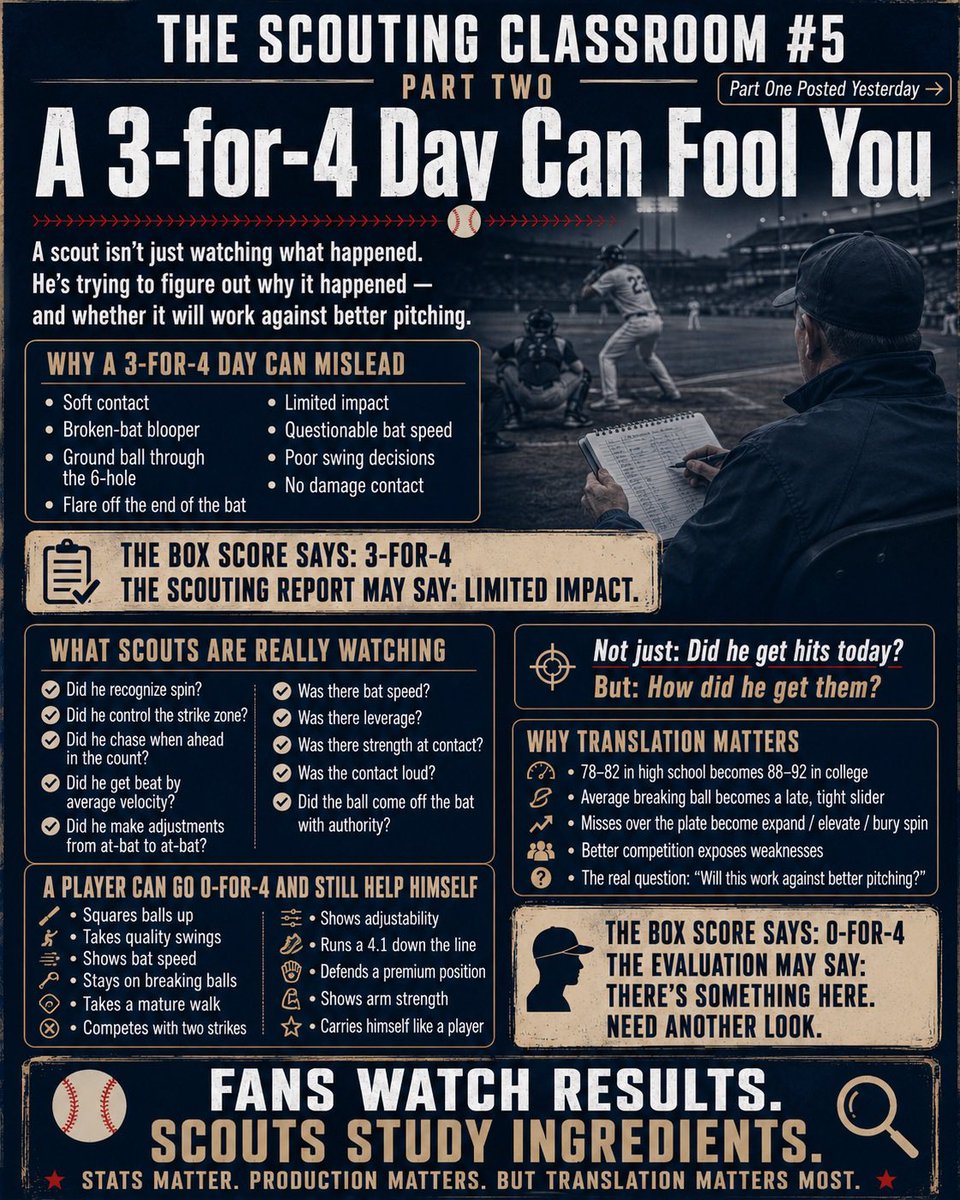
• A 3-for-4 Day Can Fool You
One of the hardest things for fans, parents, and even some young players to understand about scouting is this:
• A player can go 3-for-4 and still not move the needle for a scout.
That sounds crazy if you’re only looking at the box score.
But in scouting, the box score is only part of the story.
A scout isn’t just watching what happened.
He’s trying to figure out why it happened — and whether it will continue to happen as the competition gets better.
There’s a big difference.
A hitter can collect three hits in a game and still leave you with questions.
Maybe all three hits were soft contact.
Maybe one was a broken-bat blooper.
Maybe another was a ground ball through the six-hole.
Maybe the third was a flare off the end of the bat that found grass.
The stat line says:
3-for-4.
The scouting report may say:
Limited impact. Questionable bat speed. Poor swing decisions. No hard contact.
That’s why scouting requires more than reading numbers.
You’re watching the quality of the at-bat.
Did he recognize spin?
Did he control the strike zone?
Did he chase when ahead in the count?
Did he get beat by average velocity?
Did he make an adjustment from at-bat to at-bat?
Did the swing have looseness?
Was there bat speed?
Was there leverage?
Was there strength at contact?
Was the contact loud?
Did the ball come off the bat with authority?
Those things matter.
Because as a player climbs levels, the game exposes weaknesses.
The 78–82 mph fastball he can fight off in high school becomes 88–92 in college.
The average high school breaking ball becomes a late, tight slider at the next level.
The pitcher who misses over the plate today becomes the pitcher who can expand, elevate, bury spin, and change eye levels tomorrow.
That’s where the question becomes:
Will this work against better pitching?
That is the scouting question.
Not just, “Did he get hits today?”
But:
How did he get them?
There are also days when the opposite happens.
A player can go 0-for-4 and still make a scout want to come back.
He may square up two balls right at people.
He may take quality swings.
He may show bat speed.
He may stay on a tough breaking ball.
He may take a mature walk.
He may compete with two strikes.
He may show adjustability.
He may run a 4.1 down the line.
He may defend a premium position.
He may show arm strength.
He may carry himself like a player.
The box score says:
0-for-4.
The evaluation in a scouts head may say:
There’s something here. I need another look. I like what I see.
As a scout watches a player over time and follows the progress, they may not see full games just yet. They are bouncing in different directions, seeing hundreds of players, sifting through the coal, getting what I call “mini observations,”
Over time, with added history on a player, the picture in a scouts mind becomes clearer, until a more thorough full game look is needed.
Same goes for pitchers. As arms and bats are being collected in a scouts territory, a scout now knows who he really wants to bear down on.
That’s when a scout can line up his schedule and see a quality matchup of prospect pitcher vs. prospect hitter.
Because the “compete” box isn’t as clear when the prospect is facing non prospects. When it’s “many e mano”, you have created an environment with your evaluation, to now see each prospect compete and what end of the tunnel he comes out?
Does he wilt under the bright lights, or does he thrive?
That’s scouting!
You’re not just grading results.
You’re grading ingredients and for the makeup tool, environments!
Tools.
Actions.
Body.
Athleticism.
Swing traits.
Defensive value.
Makeup.
Adjustability.
Projection.
Translation to the next level.
2/2 Continued…Comments 👇

Hurricane, UT 🇺🇸 English
Coach Austin Smith retweetledi

Kobe’s 10 Rules of Success:
1. Get better every single day
2. Prove them wrong
3. Work on your weaknesses
4. Execute what you practiced
5. Learn from greatness
6. Learn from wins & losses
7. Practice mindfulness
8. Be ambitious
9. Believe in your team
10. Learn storytelling

Greg Berge@GregBerge
Your biggest opponent isn't across the court. It's the voice in your head telling you that you can't. Kobe didn't negotiate with that voice. Neither should you. Doubt is wasted energy. Use it elsewhere. 🐍

English
Coach Austin Smith retweetledi

Short but loud outing for Jude Huff (‘28). All FBs as he threw 7 of his 9 pitches for strikes, to close this one out. Sat 87-91. Lot more in the tank. Explosive look.
@MAGWESTdirtboys
#PGHS
English
Coach Austin Smith retweetledi

I want to thank TRF Facility Services and Chris Garrison for the new windscreen at Klein Forest. Looks great! Appreciate you working with us!
Chris Garrison@cgarr_62
A Big thanks to Head Baseball Coach Casey Westmoreland @westm30540 and Klein Forest Baseball for the opportunity to do this windscreen project for you. @KleinForestath @KleinForest #TRFacilityServices #Windscreens #Branding #Athletics #KF #FacilityWork

English
Coach Austin Smith retweetledi

Don Mattingly with a refreshingly simple, old school approach.
Why can’t we keep hitting this simple anymore? @ABCA1945
English