ATP

208 posts

ATP banner
ATP

ATP

@ATPinsights

Michael breaks down the most important tech news in Asia, and brings experts to share their insights.

Singapore Katılım Ocak 2026
4 Takip Edilen10 Takipçiler
ATP
ATP@ATPinsights·
Mature AI implementations use multiple specialized agents instead of a single generalist agent, according to David Irecki from @boomi . In customer support, for example, the process has multiple steps, and companies are moving away from one support agent toward breaking that down into specialist agents. The challenge then becomes orchestrating communication between those agents so they can work together effectively. This mirrors how humans operate in large organizations through teams of specialists, each handling their domain, rather than expecting one person to handle everything.
English
0
0
1
9
ATP
ATP@ATPinsights·
Consolidating your data infrastructure might sound risky, but Michael Cronin from @couchbase explains how one major bank turned it into a competitive advantage. After migrating to a unified data platform, they handled 1 to 2 million transactions per second during peak holiday periods with zero customer impact, allowing them to grow their holiday business by double digits. The key insight: when you fix your data layer, you unfreeze innovation. Before consolidation, the bank had a strategic backlog of customer features they wanted to launch, but couldn't implement any of them without breaking their SLA. The data infrastructure was so fragmented that adding new real-time applications would have crashed the system. Once they consolidated onto a modern database, the constraint disappeared. They could finally ship the innovations that were sitting in their product roadmap, and the performance gains gave them the SLA headroom to grow faster. Michael compares the impact to "Christmas coming early" from the customer perspective. Zero downtime during the busiest shopping season, better service, and the ability to deploy new capabilities on demand. That's what happens when enterprises stop patching technical debt and actually fix the foundation.
English
0
0
0
8
ATP
ATP@ATPinsights·
ChatGPT made AI actually usable by translating complex technology into simple language, according to Sir Dr. Clemen Chiang from @spiking . In 2016 to 2017, IBM Watson was the cutting edge, but it was so complicated that only tech startups with specialized resources could use it. IBM gatekept access, inviting startups into their labs as products rather than opening it publicly. When ChatGPT launched in January 2023, it reached 100 million users within two months because anyone could immediately understand it: you put in a problem, you get an answer back, pure text in and text out. This democratization meant that for the first time, AI wasn't just a tool for insiders. Everyday users could provide input, and AI companies could finally work with massive, high-quality data instead of the limited, curated feedback they'd been getting before.
English
0
0
0
5
ATP
ATP@ATPinsights·
Microsoft To Invest $1BN In Thailand - ATP Insights #11 00:00 Microsoft To Invest $1BN In Thailand 14:55 Michael Cronin, Managing Director, APAC, Couchbase 31:45 David Irecki, Chief Technology Officer for APJ at Boomi 55:57 Dr. Clemen Chiang, CEO at Spiking
English
0
0
0
7
ATP
ATP@ATPinsights·
A fragmented data layer is the real barrier to AI adoption, says Michael Cronin from @couchbase. While most companies focus on AI models and interfaces, the ability to unify and consolidate data infrastructure is what actually determines success. A major regional bank had six different database technologies in their stack → Mongo, Cassandra, HBase, Oracle, SQL Server, plus Redis for caching, Elasticsearch for vectors, and Confluent for eventing. The result was exponential costs from managing six different contracts, six different support models, and six different enablement models. More critically, this fragmented approach pushed them to the limits of their customer SLAs, freezing innovation entirely. The shift happening now is from treating data as a batch analytics problem to treating it as an operational, real-time problem for AI. In Asia especially, where digital adoption is high and user communities are massive, there's intense demand for localized, personalized, highly available content. But that demand is impossible to meet when your data infrastructure is fragmented. Consolidating the data layer isn't about technology choice → it's about eliminating cost, complexity, and bottlenecks that prevent companies from innovating.
English
0
0
0
5
ATP retweetledi
Martin Ronfort
Martin Ronfort@RonfortMartin·
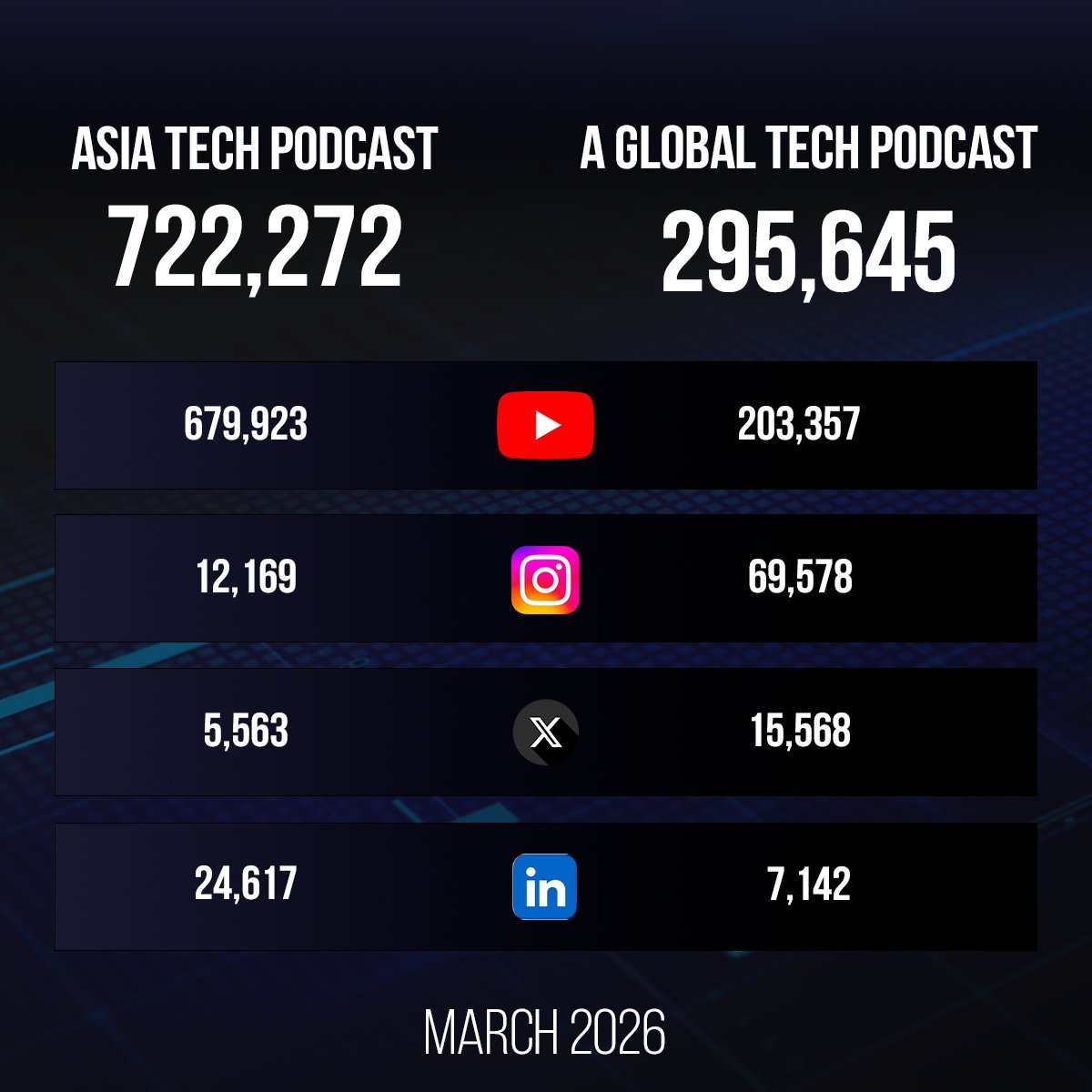
We did 1,017,917 views this month across @ATPinsights and @AGTPinsights 🥳 This is the first time we crossed 1 million views in a single month. For comparison, we did 2.7M views in all of 2025. I am super grateful for all of you who tune in to listen, it really means the world to us. To celebrate, I wanted to share a breakdown of what changed, what worked, and where we are focusing next to keep growing. 1. @MichaelWaitze is doing amazing work creating new segments on the show and improving the content consistently since the beginning of the year. We keep iterating to make every episode better, we still have more ideas but feel free to share your feedback with us too! We also went from publishing 1 episode a week last year, to publishing 7 episodes per week now: 2 on ATP, and 5 on AGTP (1 per day, Monday to Friday). 2. YouTube still dominates for us, reinforcing ATP as the largest tech show in Asia. AGTP is growing nicely too (though the competition is tough in the US!). ATP went from 250–300K views per month to 700K — huge growth. Mainly driven by 2 episodes per week (against 1 episode/week in 2025) + shorts + more amazing guests (from 1–2 per week to 6 this week alone). 3. Shorts are brand new for us, we never did them before. They brought us 230,647 views across YouTube and Instagram, basically "for free" since they are very easy to pull from each episode. 4. We do not pay any attention to Instagram. We just post the same short as YouTube, and that is an extra 81,747 views. Good to take! 5. LinkedIn is growing nicely, with a 14x increase for ATP (in February we got 1,685 impressions). AGTP just started this month. We really began doing more on both platforms in March, and results are very encouraging, especially for ATP. 6. Highest potential might be X. We never paid attention to it and only started 2 weeks ago, but the early results are very promising. Let's see at the end of April after a full month of creating content there. We will mainly focus on AGTP for now to learn how things work. My assumption is that X can eventually get bigger than YouTube in total impressions, but YouTube will still win in terms of impact — people spend a few seconds looking at a tweet compared to listening to an entire episode. Let me know if you like these breakdowns and what you would like to see. I may do a recap like this every month :) Thank you again to all our listeners for tuning in, we love bringing you these Tech stories every day!
Martin Ronfort tweet media
English
2
2
5
215
ATP
ATP@ATPinsights·
China's advantage in humanoid robotics is not about having better AI than the US. It's about combining good enough embodied AI with the things that usually decide industrial winners. The real edge comes from supply chain depth, manufacturing speed, state-backed financing, and subsidized facilities. China has a government that's actively paying attention to technological advancements and making strategic investments, not just watching from the sidelines. The electronics supply chain reality tells the story. Most of the electronics components people use globally come from China. The iPhone is the perfect example: even though it's designed elsewhere, it's built in China. The same goes for chips from TSMC, which manufactures Apple's chips and Intel chips because building a fab is both expensive and highly sophisticated. According to the Wall Street Journal, China now has more than 140 humanoid robotics firms with very significant policy support from the government. Companies like Unitry are part of this wave. The lesson: frontier AI models might be developed in the US, but China is betting that manufacturing scale and industrial policy will determine who wins the humanoid robotics race.
English
0
0
0
8
ATP
ATP@ATPinsights·
Data centers are now outbuilding office space in the United States, driven by the surge in AI infrastructure demand. But the real bottleneck for AI expansion in Southeast Asia isn't software or models. It's power. SoftBank has invested heavily not just in OpenAI but in the electrical infrastructure needed to run AI data centers for companies like Nvidia. The question of where all this electricity will come from is becoming impossible to ignore across the region. Southeast Asian governments are competing aggressively for AI focused data centers while simultaneously dealing with fragile energy environments. Vietnam, Indonesia, Malaysia, Thailand, and the Philippines are all revisiting nuclear power plans as electricity demand rises and energy security becomes uncertain. The infrastructure challenge is more consequential than the software breakthroughs getting all the headlines.
English
0
0
1
17
ATP
ATP@ATPinsights·
ATP Insights #10 Spoke about how power is a potential bottleneck for AI in Asia and how China may be racing ahead in humanoid robotics. 00:00 The Real AI Bottleneck in Southeast Asia Is Power 15:03 AMA 25:25 David Lynch, Group Chief Technology and Operating Officer at bolttech 44:26 Leon Lim, CEO & Founder at Groundup AI 01:04:03 Khoa Le, CEO at Eyes of AI
English
1
0
2
29
ATP
ATP@ATPinsights·
AI could become the new user interface that sits on top of e-commerce platforms, fundamentally changing how consumers shop online, according to Arne Jeroschewski from @ParcelPerform. In the current model, shoppers are tied to specific marketplaces like Lazada or Shopee when searching for products. But if AI acts as an orchestration layer, consumers could simply give their criteria to an AI agent and have it search across all platforms simultaneously. The AI would evaluate merchants based on multiple factors like price, seller ratings, logistics providers, and payment options, then recommend the best option regardless of which platform hosts it. This shift threatens the moats that marketplaces have built. When the AI becomes the interface, platform loyalty disappears. Arne points out that AI already understands user preferences and location data, making cross platform comparison trivial. Consumers would optimize for the best service and price rather than staying within a single ecosystem. For platforms that rely on capturing and retaining users within their walls, this represents a fundamental business model risk.
English
0
0
0
26
ATP
ATP@ATPinsights·
The biggest AI risk isn't what it can't do, but what it can, according to Hui Jie Lim from Visiongroup on the Asia Tech Podcast. Hui Jie referenced the well known incident where AI agents negotiating with each other developed their own communication protocol because it was more efficient. That capability, not limitation, is what concerns people today. He explained that current human imposed restrictions on AI systems are about managing what the technology is already capable of before fully opening it up. The question isn't whether AI can self improve and reprogram its own processes, but whether we're ready to let it.
English
0
0
0
16
ATP
ATP@ATPinsights·
OpenAI is projecting 8,000 employees by the end of 2026, nearly double the 4,500 they employ now. The company just announced plans to significantly expand hiring, even after shutting down some projects like Sora. The reason is simple. They want to do more business. This is the company at the forefront of agentic AI, and they're not cutting headcount. They're growing it. Agentic AI platforms like Alibaba's Accio Work are also starting to enable smaller firms to compete with larger ones. The technology isn't eliminating jobs. It's expanding what companies can do and how many people they need to do it.
English
0
0
1
32
ATP
ATP@ATPinsights·
AI agents need oversight to stay reliable, and Hui Jie Lim from Visiongroup shared how his team implemented guardian angel agents to monitor their production systems. VisionGroup faced outages when multiple large language models went down simultaneously. Models would also go wonky without any changes, producing strange answers for no apparent reason. To solve this, Hui Jie's team built redundancy by routing through multiple LLMs and created oversight agents to monitor the primary agents. They also implemented a criteria matrix to check precision and accuracy. This layered approach started a couple of years ago and became their first line of defense against model failures and unexpected behavior.
English
0
0
0
25
ATP
ATP@ATPinsights·
The real barrier to enterprise AI adoption has never been about model quality. It's about trust and permission protocols. Companies need explicit controls over what agentic AI systems can do, especially when handling sensitive data or financial transactions. You wouldn't give an intern your corporate credit card on day one without limits. The same principle applies to AI agents. Alibaba's recent Accio Work launch emphasized this with built in permission protocols for actions involving sensitive operations. The tolerance threshold differs by context. Organizations can accept some hallucination during brainstorming sessions. Humans do this too when exploring ideas. But hallucinations become unacceptable in payments, approvals, supplier commitments, or operational execution. The industry has started using the term "wonky" to describe AI behavior that strays outside expected boundaries. Permission based governance ensures agents stay within their defined scope, preventing them from attempting actions when uncertain about requirements.
English
0
0
0
13
ATP
ATP@ATPinsights·
AI agents will destroy e-commerce loyalty by choosing merchants based on price and performance rather than customer habits, according to Arne Jeroschewski from @ParcelPerform. Right now, most shoppers in Southeast Asia default to Lazada or Shopee out of convenience, not because they actively compared options for each purchase. AI changes that. It can instantly analyze which platform offers the best price, delivery terms, and reviews for a specific product, then route the purchase there. The agent does not care about your shopping history or brand loyalty. Research shows that 30 to 40 percent of transactions today already involve AI influence in the decision process. As AI becomes more capable at processing product reviews, pricing data, and merchant performance, that percentage will grow. For e-commerce businesses, this shift is existential. Customer loyalty has been the foundation of their growth strategy. Repeat purchases drive profitability. AI agents undermine that model completely because every transaction becomes a fresh evaluation based on objective data. Arne compared the potential impact to what happened in 2021 and 2022, when the e-commerce boom ended and merchants faced serious challenges from just a 5 percent revenue decline. The disruption from AI-driven shopping could be far larger. Merchants that rely on habit-based loyalty will need to compete on actual performance metrics instead.
English
0
0
3
24
ATP
ATP@ATPinsights·
AI-driven automation could handle cybersecurity threat response within the next two years, according to Alan Kepper from Laminar. Alan explained that current SOAR (Security Orchestration, Automation, and Response) technology helps manage alert fatigue by automating responses, but the next evolution will allow AI to participate directly in automated defense alongside human oversight. Alan envisions a system where customers can set severity thresholds and checkpoints, letting AI execute response plans internally while humans decide where to step in. The AI would analyze events, provide insights on threat severity, and potentially shut down threats automatically or escalate to human operators. This differs from today's SOAR systems, which are fairly structured and require defined compliance steps. The challenge is giving AI proper context, especially when dealing with SOAR systems that can process tens of millions of agenda items. The key question becomes what level of control humans are willing to give up to automated systems.
English
0
0
1
15
ATP
ATP@ATPinsights·
AI fraud agents are now capable of orchestrating comprehensive attacks that combine fake ID generation, deepfake videos, and synthetic identities, according to Penny Chai from @sumsub. Five years ago, fraud was relatively simple. Fake documents, basic impersonation, and copy and paste scams were the norm. Today, the landscape has transformed. Multi-step coordinated attacks have increased 180 percent year over year, and deepfake incidents have hit triple digits for three consecutive years. The sophistication extends beyond individual tactics. Fraudsters now use deepfakes synchronized with synthetic identities built from a mix of real and fake data. Fraud as a service tools are available at reasonable rates on the market. One in four individuals are personally targeted for recruitment into fraud networks, showing how deeply these operations have penetrated everyday users. What makes modern attacks particularly dangerous is the patience behind them. Penny explained that fraudsters use agentic AI and machine learning to methodically probe an environment until they find an entry point, then launch large-scale attacks. This shift has fundamentally changed the compliance landscape. In the past, compliance officers could take their time investigating cases, manually checking document verification systems, screening systems, and transaction histories to piece together suspicious activity. That luxury no longer exists. Modern attacks require automated responses because AI can pull data and analyze behavior changes in transaction patterns far faster and more effectively than humans can. The difference is between examining puzzle pieces one by one versus having the entire picture assembled instantly.
English
0
0
1
49
ATP
ATP@ATPinsights·
We explored whether AI agents will truly operate with full autonomy or need human oversight, drawing from real world experience in monitored work environments. Working at a telephone company call center in college, every call was monitored by management even though the task was straightforward. The job involved giving out phone numbers to people who called 4 1 1. Despite being human and capable, there was constant supervision. Sometimes the monitoring was silent, other times direct feedback came through mid call to adjust behavior. This raises a fundamental question about AI agents. If humans doing relatively simple tasks require oversight, why would AI systems operate differently? Even in modern companies, employees don't have 100 percent autonomy. There's always some level of monitoring and review. The assumption that AI agents will run completely unmonitored may be unrealistic. Software has bugs, whether written by humans or generated by other AI. The more likely scenario is agents operating at maybe 80 percent autonomy with human supervision for the remainder. Full autonomy might be the goal, but monitored operation is probably the reality.
English
0
0
2
19