Aaron Alex Vargas
119 posts

Aaron Alex Vargas
@AVenturousMind
Founder & CEO (Stealth) | AI Infrastructure Platform | AI Cost, AI Security, AI Governance
Katılım Kasım 2024
307 Takip Edilen30 Takipçiler

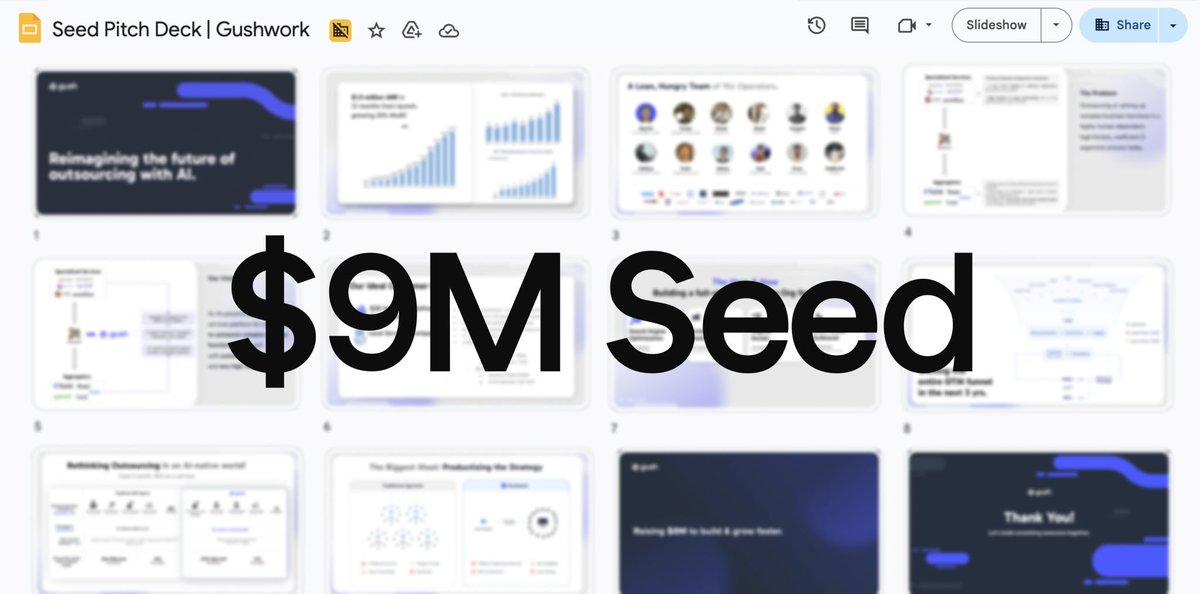
The exact pitch deck that helped us raise a $9M Seed Round
copy whatever you want
VCs that invested:
→ @SusquehannaVC (led)
→ @LightspeedIndia
→ @BCapitalGroup
→ Seaborne Capital
→ @beenextVC
→ @sparrowcapvc
→ @2point2club joined.
fundraising is hard enough without guessing what investors want to see.
so - I'm making our deck public.
if you're raising right now, take it and make it yours.
Reply 'deck' + follow (so I can DM it over)

English
Aaron Alex Vargas retweetledi

Business Insider: Anthropic safeguards lead resigns + posts warning letter (“the world is in peril”).
Signal: AI capability is scaling faster than control.
Link: businessinsider.com/read-exit-lett…
#AISafety #AIGovernance #AIInfrastructure #Security
English

@jimcramer Not a good take. AI and Claude Code are only fueling an explosion of software. The amount of software written this year with agentic coding compared to prior years in the world is monumental.
That said - silicon is the new gold. Quality AI silicon that is.
English

@daboigbae @jimcramer Almost always. Economies of scale favs Software. But try to spot which software companies are positioned to lead the next generation of advancement.
English


@pritopian @martin_casado Another big factor is derriving returns from the product. Notice how quickly global competitors release similar functioning models almost to the day. If more leading LLM companies wanted to race to the bottom they could but would lose a lot of revenue.
English

End-to-end models are winning today because the marginal dollar buys visible demonstrations that appear to imply full capability. And it’s easy to reward what’s visible, without accounting for the hidden difficulty of translating those models into tools the broader audience can actually use. Eg) In generative image workflows like ad creation that require true multimedia composition (text, images, logos, and SVGs stitched together), simply wrapping one-shot generators doesn’t work. You end up with a terminal file format like a PNG that’s extremely hard to work with for surgical edits.
You’re much better off allowing compositions in layers. For example, in ads, some layers like the background photos get mutated differently across channels, while others like the logo (SVG) gets different treatments. Good to allow for iterative edits to evolve differently with smaller models. Using prompts as the sole control surface to shape these assets, with no shared editable file format for human x AI agent collaboration, and hoping prompt-based regeneration will satisfy all constraints consistently in one shot, doesn’t work.
In creative use cases, this isn’t just about whether a single model can do it. It’s also about whether a single model becomes an impediment to how craft needs to look and evolve. A composition layer is inevitable. One that turns general-purpose models into specialized creative labor. As downstream SOTA models improve, this composition layer is where durable value accrues.
Last point, as AI expands human imagination and the demand to collapse that vision into pixels grows, what is expected in a single shot keeps shifting the goalposts.
English

The tension between the single end to end model and a composition of models is similar to that of science and engineering. The latter is a set of pragmatic steps to incrementally solve a problem and allow independent evolution of multiple solutions. The former is a single, elegant solution for the larger problem space.
Right now, the end to end model is dominant. But this is primarily due to access to capital vs engineering bottlenecks. Right now it just turns out to be a lot easier to raise 10x more capital than try and scale a more engineered solution. And interestingly today a major lab can raise more capital than all the companies directly downstream of it in aggregate.
This will likely continue until we hit SGI, or the top of the S curve for the value of raised dollars. In the former case, I guess none of this matters. In the latter we'll actually see how this tension plays out, elegance + capital access vs. pragmatism.
English

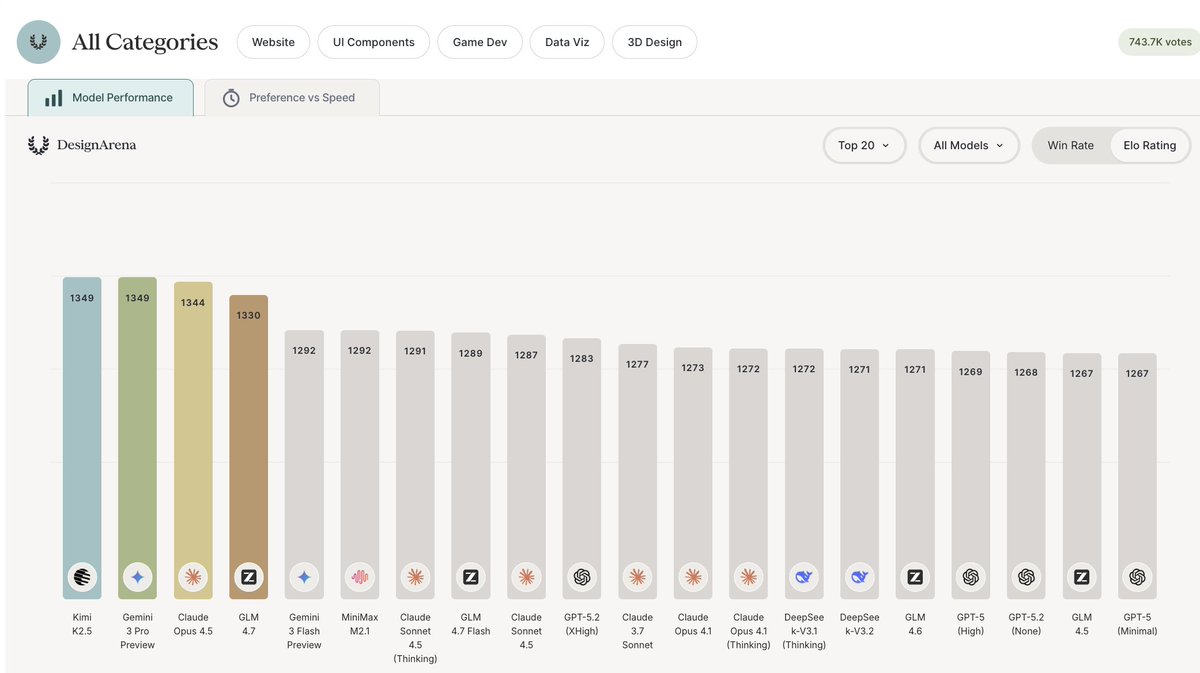
BREAKING: Kimi K2.5 is tied for #1 on Design Arena, in the same performance band as Gemini 3 and Opus 4.5.
This is a historic achievement: the highest-ranking model on Design Arena is, for the first time ever, an open model.
Congratulations to the @Kimi_Moonshot team for this remarkable advancement.

English
Aaron Alex Vargas retweetledi

@julesyoo The opportunity to improve Healthcare today is tremendous -- along the entire value chain. From Devices to Data to Medicines and Robotics. The age of cost-effective accessible Personalized Medicine is right around the corner.
English

Awesome discussions during my visit to DC this week around policy reforms to promote builders and healthy competitive markets:
⏺️ Payment paradigms for AI-based care models - how can we leapfrog the ills of our current reimbursement system and develop new ways to pay for services in a world of more AI-enabled labor abundance and consumer-directed spend (more to come on this!)
⏺️ HTI-5 - unleashing more market-driven competition in HCIT; for all of the vilification of payors and PBMs, those markets are way more competitive than certain HCIT markets!
⏺️ Interoperability in an AI context - as AI becomes a new site of care, the center of gravity of healthcare data is rapidly moving beyond just traditional medical records, and consumer-directed health engagement through AI apps is breaking the context under which legacy data sharing rules were defined.
⏺️ Affordability of big ticket therapies - novel CGT financing strategies, much of which could ultimately be generalized to other high-cost interventions with long ROI time horizons
⏺️ Healthtech infrastructure - are there ways the government can incentive the development of modern tech utilities enabling more real-time transactions
I’ve always viewed healthcare as an industry where (de)regulation can be a catalyst for category creation 👇, and this era is no different. Great to see how motivated DC leaders are to stay apprised of the work of healthtech builders across the country, and to use those insights to inform how our policy frameworks need to evolve to contemplate all the ways by which technology can benefit our healthcare system!
Julie Yoo@julesyoo
Regulation has its perils... but it can be a catalyst for category creation in healthcare too! Many great companies have been/are being built on the backs of the greatest hits of regulatory acronyms: ACA, MMA, ACO, HITECH/MU, etc - and in the case of @ZusHealthHQ and @TurquoiseHC, the 21st Century Cures Act and Price Transparency rules. Here @CF_Rom and I chat with the CEOs of those companies - @Jonathan_Bush, @crsevern - to hear more about how they've helped influence the crafting and implementation of those rules and regs, and what it means to build a sustainable competitive advantage in light of them.
English

@tanayj Great early insurance play for them. Especially since EU (and possibly others regions in future) plan to switch to domestic Saas tools like this on privacy concerns.
English

@tanayj Surprising. Especially with all the products they're rolling out on multiple fronts. Goes to show how much industry outsiders misunderstand the tech fueling growth.
English

Microsoft stock was down 10% today, losing ~$357B in market cap primarily because of Azure growth slightly decelerating, large capex spend and RPO concentration from OpenAI.
That's the second largest single day market cap wipeout in US history after NVIDIA's ~$590B wipeout last yr after Deepseek saga
English

@tanayj 100% correct. Especially as global competition heats up.
English

On current AI pricing, both things are true:
(1) The subscription plans ($20/mo, $200/mo) are currently heavily subsidized giving users access to 5-10x+ the usage if used to max compared to equivalent API costs
(2) Cost of intelligence will continue to decline (and competition between providers will still be intense) such that even without subsidies in a few years, users will have access to a higher volume of more intelligent models for the same amount
English

@tanayj Didn't the gaming industry do this 20 years ago? Interesting project but it sounds much more like noise than signal.
English

Open-weight race just moved upstream:
China Moonshot’s Kimi K2.5 ships a platform bundle—multimodal model + agent swarms + open-source Kimi Code (terminal/IDE).
Models → platforms, and the dev adoption loop race tightens.
techcrunch.com/2026/01/27/chi… #OpenSourceAI #AgenticAI
English

A 30-person startup (Arcee AI) just dropped a “permanently open” (Apache) 400B-parameter model (Trinity) — and claims it can edge Meta’s Llama 4 Maverick on some coding/math/reasoning tests (base model benchmarks).
Wild part: trained in ~6 months for ~$20M using 2,048 Nvidia Blackwell B300 GPUs. Open AI is accelerating again—and “open” is becoming a strategic moat.
Link: techcrunch.com/2026/01/28/tin…
#OpenSourceAI #LLM #AgenticAI #AIInfrastructure #MoE
English

AI agents are shifting from “answering” → acting.
That means the main risk moves from model accuracy → autonomy risk.
The winners won’t be the fastest to ship agents—
they’ll be the ones who can prove governed autonomy: transparent, accountable, secure.
Think Zero Trust for agents: identity, least privilege, logging, segmentation, evals + a real kill switch.
thomsonreuters.com/en-us/posts/te…
#AgenticAI #AIGovernance #AIsecurity #ZeroTrust #Cybersecurity
English

Goldman Sachs says AI companies may invest $500B+ in 2026 — and consensus is already at $527B. Q3 capex hit $106B (+75% YoY).
Market’s shifting from “spend more” → “prove ROI.”
goldmansachs.com/insights/artic… #AI #AIInfrastructure #Hyperscalers #DataCenters #Capex #CloudComputing #Compute #Semiconductors #ProductStrategy #FinOps
English

Barclays: the next wave of AI hits a hidden bottleneck — inference capacity.
As chatbots → agents → digital workers, each “request” becomes multiple model passes, multiplying compute demand. Costs drop, but GPU/ASIC capex still explodes.
ib.barclays/our-insights/3…
#AgenticAI #Inference #AICompute #AIInfrastructure
English

Business Insider: “Agentic AI” has a hidden tax — tokens (and compute).
→ Core message: The real cost multiplier for agents isn’t hype—it’s token volume. As agents “reason” through multi-step tasks, they can generate orders of magnitude more tokens than chatbots, which directly translates into higher inference spend and capacity constraints. Barclays investor notes warning that if AI agents take off, the industry may hit an inference-capacity wall—even if models keep getting “cheaper.”
Key cost details (why agents multiply spend)
-Barclays: agent products generate ~25× more tokens per query than chatbot products (because reasoning breaks work into more steps).
-Barclays estimates ChatGPT Pro ($200/mo) could generate ~9.4M tokens/year per subscriber (example scenario).
-“Super agent” pricing tiers rumored at $2,000–$20,000/mo were modeled at ~36M to ~356M tokens/year per user.
-Barclays: if agentic products really take off, we’ll likely need “many more inference chips,” and even repurpose training chips for inference.
The takeaway for product + finance teams:
Agents don’t just change UX—they change your unit economics. If you don’t design for token efficiency + guardrails, “cool demo” becomes runaway inference bill.
Link: businessinsider.com/ai-super-agent…
#AgenticAI #AIAgents #Inference #AICompute #AIInfrastructure #FinOps #EnterpriseAI #LLMOps #Automation #ProductStrategy
English