VC Funds for RIAs

3.3K posts

VC Funds for RIAs banner
VC Funds for RIAs

VC Funds for RIAs

@AaronGDillon

Venture Capital Funds for RIAs | Pre-IPO Stock Research | AG Dillon & Co

[email protected] Katılım Eylül 2011
1.3K Takip Edilen1.8K Takipçiler
Sabitlenmiş Tweet
VC Funds for RIAs
VC Funds for RIAs@AaronGDillon·
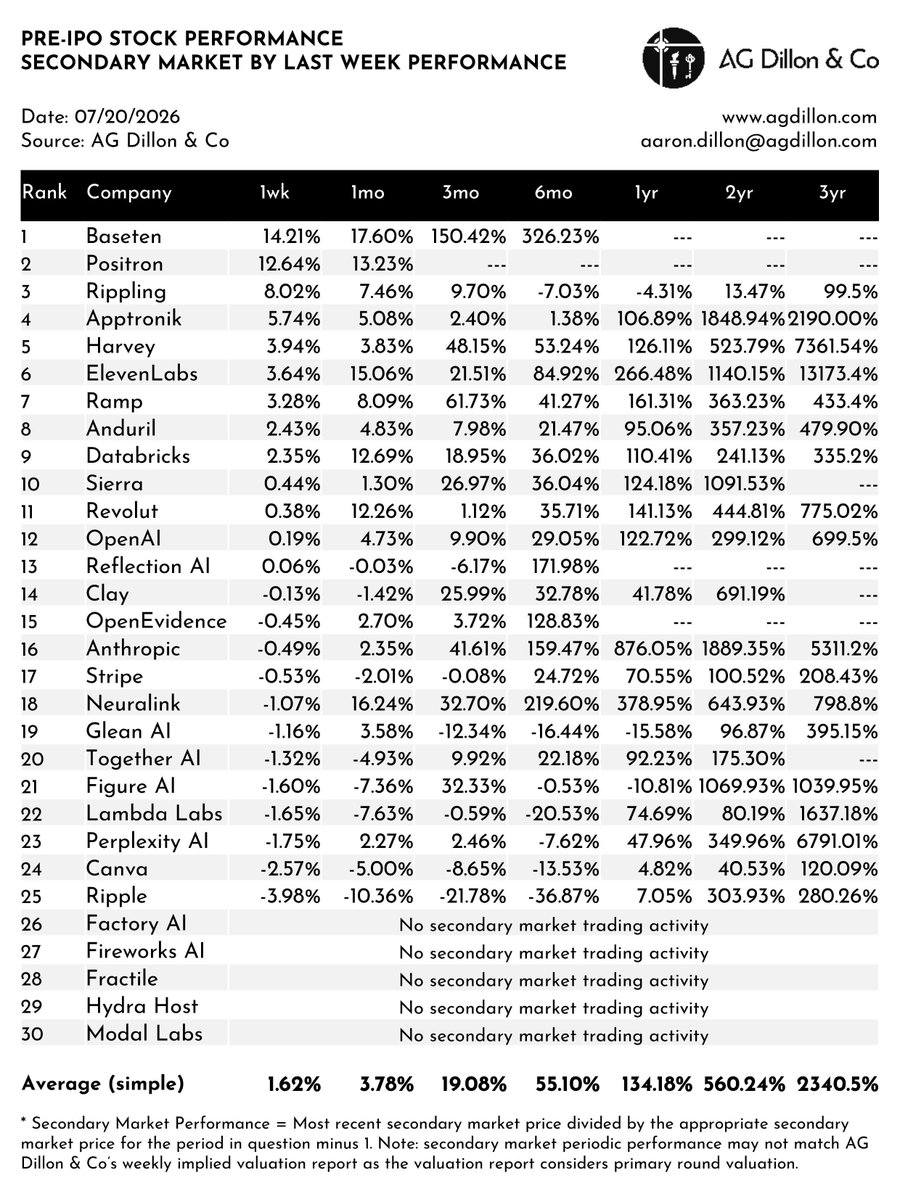
Pre-IPO Stock Secondary Market Update | as of Jul 16, 2026 | Blue Origin raising at $130B valuation + Economic prospects of space mining | Anthropic and OpenAI IPOs | Positron is post-revenue and compelling investment target Watch full video here = youtube.com/watch?si=g-5at… Blue Origin's $10 billion raise at a $130 billion valuation confirms that the space economy is no longer a single-company story, but the investable question is entry timing rather than whether Bezos and Blue Origin eventually execute. Reusable rockets are not yet in hand, and until they are, the revenue unlocks stay theoretical: constellations for communications, AI data centers in orbit, and the cadence SpaceX already runs at roughly three launches a day. The gap between here and there is funded by repeated capital raises, and an investor entering at $130 billion today could experience dilution approaching 80% before the business generates billions in revenue. That is survivable if the terminal outcome is a trillion-dollar company, which is precisely the SpaceX precedent that made a $200 billion mark look expensive at the time and cheap in hindsight. The longer-term prize is resource extraction rather than launch services, and the numbers there resist conventional underwriting: a Manhattan-sized iron ore asteroid within reach in perhaps 10 to 20 years carries a headline value near $10 quadrillion, helium-3 on the moon currently clears near $20 million per kilogram delivered, and Mars is an entire planet of unclaimed natural resources. China landing its own booster reinforces that the capability is diffusing rather than concentrating. Our view is that this is an exponential story priced by linear thinkers, which argues for owning the theme but sizing entry with discipline rather than conviction. On OpenAI and Anthropic, we do not think either company needs the public markets to raise equity, and the persistent IPO chatter is likely mis-framed. Private capital is available to both in effectively unlimited size, and management commentary points to no urgency, with the OpenAI CFO signaling the company is not ready while Altman appears more open to it. The more credible catalyst is debt-market access. Bond issuers and banks penalize opacity, and they want quarterly financials plus a governance structure that has been tested under public scrutiny before they price at their best levels. The spread between public-company and private-company funding costs can run into the hundreds of basis points, which is material when the use of proceeds is data center construction and compute capacity converts almost directly into revenue capacity. Issuing equity to fund that buildout dilutes existing holders for no strategic reason, while cheaper debt makes the same math work and leaves the cap table intact. If either company goes public, we would read it as a funding-cost decision rather than a liquidity event, and the timing question becomes art rather than science, with a clean 20% first-day move being the outcome underwriters actually want. Positron is the more actionable name this week, reportedly in talks to raise at roughly a $5 billion valuation as an inference-compute challenger to Nvidia. The architectural point common to this cohort, which includes Cerebras, SambaNova, Groq, and Etched, is memory on chip: keeping computation local rather than shuttling data between GPUs across a network cuts power consumption and raises speed, and the advantage compounds across sequential calculations. The macro tailwind is straightforward, because every incremental user and every incremental daily query is inference rather than training, so demand scales with adoption rather than with model development budgets. What separates Positron is that it is already post-revenue with a product customers are buying, which converts the bet from technology risk into execution and scale risk, a materially better place to underwrite in a sector where getting started is both expensive and hard. At a 20x revenue multiple, a billion dollars of revenue supports roughly a $20 billion mark, a 4x from $5 billion on a three to five year horizon, which sits in the zone we look for: real product-market fit, a growing end market, a competent management team, and a price that is neither speculative nor extended. The diligence that matters now is fab capacity and time allocation, since manufacturing at scale is what Groq solved domestically and what still separates the winners from the also-rans. We would hold more than one position across inference silicon, treat Etched as a smaller and earlier allocation given its pre-revenue status and lower valuation, and note that SambaNova at an $11 billion post-money carries a less attractive risk-adjusted setup along with aging investors who may push for a Cerebras-style listing to force liquidity.

YouTube video
YouTube
English
0
0
3
663
VC Funds for RIAs
VC Funds for RIAs@AaronGDillon·
Pre-IPO Stock Market Update | Jul 24, 2026 Defense tech startup landscape/prospects; Open-source AI models impact on Anthropic IPO; OpenAI's new personal hardware product Watch full video = youtube.com/watch?v=8rwIAV… Anduril's Thunder launch, arriving one week after its AWS partnership to push data center capability to the battlefield, matters less as a single product than as evidence of release cadence. The valuation framework here is straightforward. Raytheon carries a $261 billion market cap as the closest thing to a pure play defense prime, with Boeing at $166 billion, Lockheed Martin at $118 billion, General Dynamics at $100 billion, Northrop Grumman at $74 billion, and L3Harris at $52 billion. Anduril's implied valuation sits near $100 billion, which frames a $225 billion to $275 billion resting range post IPO if the company continues to serve sovereign militaries exclusively. That is roughly 2.25x to 2.75x from current marks over a two year horizon, and few investors would object to that outcome. The larger optionality is commercial. Raytheon finished 2025 on $88 billion of revenue, and public markets do not award hardware businesses generous multiples, whereas Palantir reached roughly 60x revenue precisely because it opened a commercial TAM (total addressable market). Management has not signaled a commercial pivot, though counter drone and autonomous surveillance for stadiums and corporate real estate are the obvious adjacencies, and demand is building from Ukraine, Israel, and Southeast Asia for frontier systems on frontier timelines. We remain constructive on Anduril and considerably more cautious on single product defense names, where selling one weapon system to a finite set of militaries caps growth and tends to end in acquisition by a prime rather than durable public compounding. Kimi K3 clearing frontier benchmarks on open weights is the most consequential AI development of the month, and it is being widely misread. Running a Chinese open weight model does not route data to China, because open weight models are files that are downloaded, run on local infrastructure, and send nothing back. The more useful question is why the best open weight models are Chinese, and the answer is constraint rather than talent alone. Chinese labs have been building without unrestricted GPU access, which forced software side innovation such as agent orchestration and dynamic routing to smaller specialized models, techniques that were novel six to seven months ago and are now standard practice. We expect 80% to 85% of global AI compute spend to run on open weights within five to ten years, against a current closed frontier share near 75% to 80%. That is not a bearish call on Anthropic. Compression to a 15% to 20% share of a pie growing exponentially still implies roughly 10x current revenue, and the reported October IPO timeline is the nearer catalyst: the business was at $4 billion of revenue in December against a run rate now reported near $100 billion, which likely prints closer to $40 billion to $50 billion on a GAAP quarterly basis. No frontier model provider has come public yet, with CoreWeave being infrastructure rather than a model business, so investors will see that revenue slope alongside a Fortune 500 client roster with no forward guidance permitted in the filing. We expect a strong debut with the usual post IPO volatility, and we would treat open weight competition as a narrative risk rather than a revenue risk. The Figma episode is the clearest available lesson in platform risk. Figma embedded its design tooling into Claude, and Anthropic subsequently launched Claude Design into the same category, which is ordinary platform behavior and precisely what shareholders should expect from an 800 pound gorilla. The investable conclusion is to own the layer beneath the AI platforms - AI infrastructure companies - and be very selective in the application layer sitting on top of AI platforms. Whether inference runs on a closed frontier model or an open weight model fine tuned in house, it runs on semiconductors, data centers, model routers, and inference providers, and names such as Baseten, Fireworks AI, and Factory AI occupy that metal layer at $5 billion to $15 billion valuations, which makes them midcap businesses in everything but listing status. Enterprises increasingly want to run their own model on their own data so that workflows and internal process remain proprietary rather than training a frontier lab's next release, and that behavior expands inference demand regardless of which lab wins. On pre-IPO portfolio construction, we continue to advocate tranching across vintages rather than a single entry, deploying annually and recycling year three to five liquidity into the next tranche, because time diversification matters as much as name diversification when technology cycles move this quickly. Nearly all of this opportunity set is private and largely uncovered by public market analysts, which is the source of the inefficiency. OpenAI's first hardware product, reported as portable, screenless, and voice native, should not be evaluated as an iPhone competitor. It is a step toward ambient capture, and we expect audio recording of everything a person says or hears to become near universal within 6 to 12 months with video following shortly after. The value is not in the device. It is in the proactive AI layer that sits on a complete personal data record so the AI personal assistant can surface what was missed, what is due, and what to do next. That implies multiple form factors rather than one dominant device, including stationary units in homes and offices, which is a modest extension of the Echo and Sonos install base already in place. The privacy objection is real but has historically not held, because consumers accept data capture when the value exchange is favorable, and enterprises already claim ownership of all employee work product by contract. We expect businesses to be the first adopters, recording meetings, calls, and screens, and eventually training on that corpus to retain institutional knowledge after employees depart. The terminal state is a direct neural interface, already functional in a limited clinical setting via Neuralink, though that is a ten to thirty year arc. For now the investable question is who owns the personal data layer, and Apple, Google, and Amazon remain better positioned than OpenAI and Anthropic to capture it.
YouTube video
YouTube
English
1
0
0
305
VC Funds for RIAs
VC Funds for RIAs@AaronGDillon·
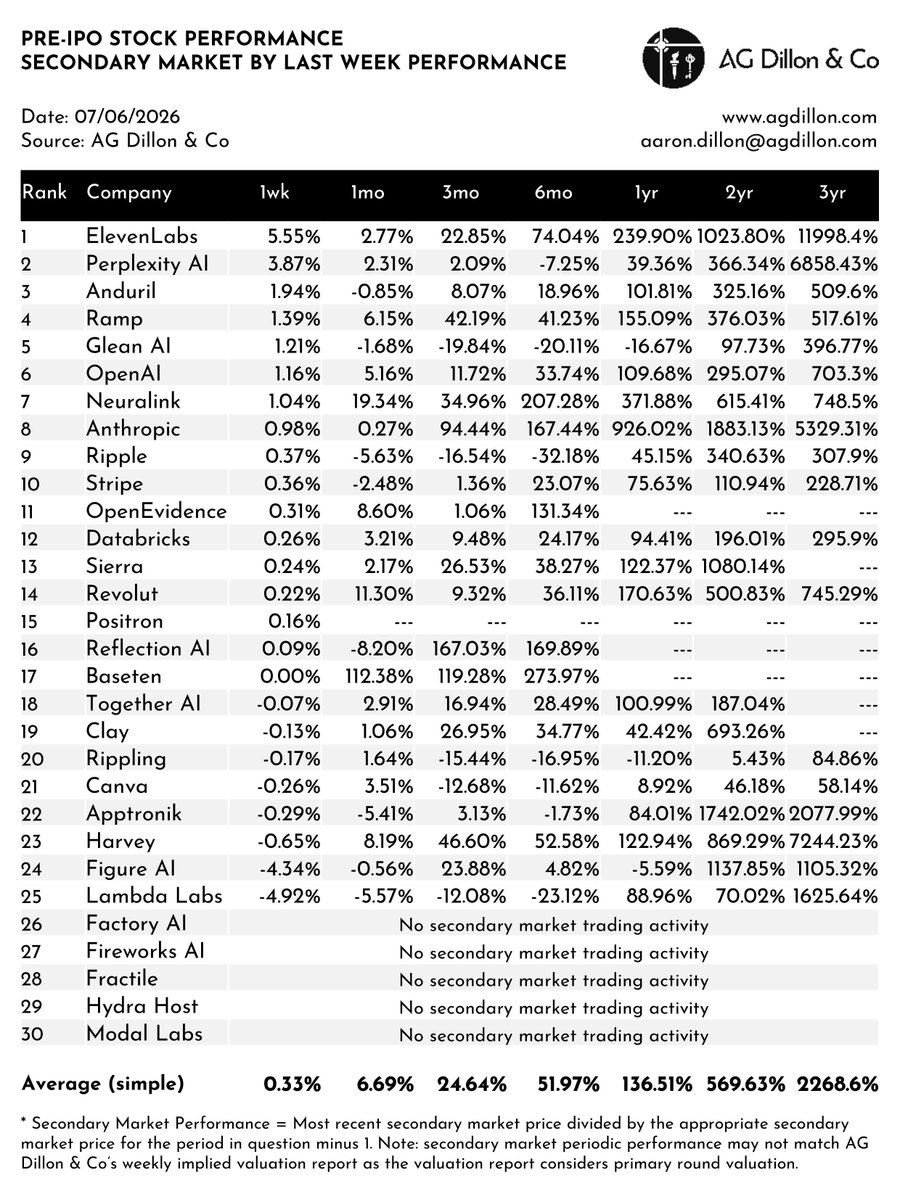
Pre-IPO Stock Secondary Market Update | Jul 9, 2026 | Nvidia competitor Etched, Timeline to small modular nuclear fission reactors, Growing demand for open source AI LLM models Watch full video = youtube.com/watch?v=RluOTV… The AI chip market is far from saturated, and Etched's climb to a $5 billion valuation is the clearest signal that inference, not training, is where the next wave of semiconductor value will be created. Two Harvard dropouts built a purpose-built chip aimed squarely at Nvidia's franchise, and the market is rewarding the bet well before mass production. Nvidia's own leadership has projected that 80 to 90% of the semiconductor market will eventually be inference rather than training, a structural shift that favors cheaper, easier-to-manufacture silicon over the monolithic GPU stack. Even the recursive self-learning that frontier models now perform is inference compute at its core, which widens the addressable market rather than narrowing it. We remain early enough in the cycle that the winning hardware architecture is not yet settled, and that uncertainty is precisely why the opportunity looks compelling rather than played out. Supply is not outrunning demand here, because the buildout is driven by hyperscalers responding to real customer forecasts rather than speculative capacity bets. The takeaway is that semiconductors sit at the base of the AI infrastructure stack, and inference chips are the segment with the most room left to run. Energy is emerging as the ultimate bottleneck in AI infrastructure, and nuclear, specifically small modular fission reactors, is shaping up as the cleanest answer on the table. Valar Atomics captures the theme, backed by Palmer Luckey and Palantir's Shyam Sankar, and it reportedly hit criticality last week while beginning to power Nvidia chips. The broader pre-IPO asset class benefits from marquee names such as Nvidia, Khosla Ventures, and Andreessen Horowitz standing behind companies at this stage, which lends real credibility, and defense-linked founders add further weight here. The discipline, however, is in the timing. A business valued near $5 billion today that investors believe can reach $200 billion carries a far higher probability of going to zero than one already valued at $190 billion, because the early company still lacks a finished product, mass production, and meaningful revenue. The rational entry point arrives once a company has a live product in the marketplace, is producing it at scale, and is generating revenue, which compresses downside while preserving upside. For investors with conviction on the theme, a position sized under 5% allows exposure to the grand-slam outcome without betting the portfolio on a company years from deployment. We favor fission and small modular reactors over more speculative approaches, and would catch the theme on its way up rather than trying to anticipate it. The most consequential call of the week is that open source models will command roughly 80% of market share in the long run, a striking prediction that reframes how enterprises will build with AI. The logic rests on proprietary data and workflows. A company that hands its data to a frontier lab risks having that advantage absorbed, much as platform owners once cloned the successful third-party apps they hosted. Instead, enterprises will take an open architecture base such as Kimi K2.5, layer in their own proprietary data and workflows, and run a bespoke model that services internal and external customers at a fraction of the cost. Figma's experience with Claude, where an integration preceded a competing native design product, illustrates the risk of leaning too heavily on a closed provider. The economic incentive is decisive, because an AI application company can deliver results equal to a frontier model at roughly one tenth the cost, keep the same outcome-based pricing, and capture the spread. Crucially, this expansion does not damage OpenAI or Anthropic in absolute terms, since falling costs drive a roughly tenfold increase in total usage and leave the frontier labs with a smaller share of a far larger pie. The house view is that infrastructure, from data centers to model routers, remains the lower-risk allocation, while enterprise AI application companies with deployed engineers, open model architecture, and outcome-based pricing offer the more speculative upside.
YouTube video
YouTube
English
0
0
3
631
VC Funds for RIAs
VC Funds for RIAs@AaronGDillon·
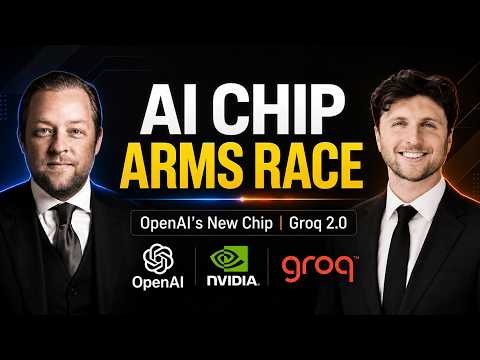
Pre-IPO Stock Secondary Market Update | as of Jul 3, 2026 | OpenAI's New AI Chip, Groq2.0, The Inference Compute Arms Race Watch full video = youtu.be/xQDlviVuTj0?si… OpenAI's decision to build Jalapeño, its first custom inference chip co-developed with Broadcom on a roughly nine-month design cycle and slated for its own data centers by year end, is the clearest signal yet that compute cost has become the central battleground of the AI era. The logic is straightforward once you look at the economics, because OpenAI lost around $21 billion in 2025, and inference, the work of actually running models rather than training them, is where that cost concentrates. Jensen Huang (Nvidia CEO) has argued that 80% to 90% of all compute will eventually be inference, so owning the silicon that serves it is a direct lever on gross margin and long-term profitability. The move also fits a broader pattern of the largest players going vertical to escape single-supplier dependence and take control of cost, security, and capacity. It matters strategically because model quality is converging and the practical gap between the leading chatbots is narrowing which pushes the durable moat down into infrastructure and unit economics. We read Jalapeño as a margin story more than a hardware story, and we expect Google, Microsoft, AWS, and OpenAI to keep integrating downward into their own chips. The takeaway is that the companies controlling inference cost, not just model performance, are the ones most likely to compound from here. Groq's ... or Groq2.0 ... newly closed $650 million financing round marks a credible second act for a company that many, ourselves included, once expected to become the next Nvidia. Founder Jonathan Ross built the business around the LPU, a processor purpose-built for inference, which is precisely the workload the market is now racing toward. The developer traction underscores the momentum, with Groq's base climbing from roughly 2.5 million to about 5.0 million, an addition of some 2.0 million in a relatively short window. Our house view is that demand for inference is effectively unbounded, and concerns that the sector is overheating the way the dot-com market did in 2001 or the credit market did in 2008 miss a key distinction. This buildout is thoughtful, in our opinion, and underlying usage is still growing at a healthy clip. Against that backdrop, Groq2.0 re-entering a market it helped define is a bet we think can work, provided execution keeps pace with the capital. We would watch closely whether the $650 million translates into durable share as the inference field grows more crowded. The most interesting frontier sits a layer below inference, in the emerging class of companies attacking the power and cost structure of AI directly. Unconventional AI, started by a former Databricks AI leader, is claiming it can cut the price of power by as much as a thousandfold, an ambitious figure we would treat as a thesis to test rather than a settled result. We expect more of these meta layer businesses to surface, names like Fireworks AI, Baseten, and Factory AI, which sit between the models and the customer and exist primarily to manage and lower cost through model routing and optimization. Positron is another infrastructure name we are actively researching and may look to back. The discipline we would stress is timing, because the sweet spot for entering these companies is around product market fit, typically the Series A, once the technology has proven it scales rather than at the earliest and most speculative stage. We would also note that much of the return in the well-known later-stage names is likely to accrue in the public markets, which argues for patience there and sharper focus on earlier stage (sub-$15B valuation) infrastructure and application companies. The practical approach is to put these names under research coverage, track them, and step in when the product, the pipeline, and the capital needs line up.
YouTube video
YouTube
English
0
0
7
1.1K
VC Funds for RIAs
VC Funds for RIAs@AaronGDillon·
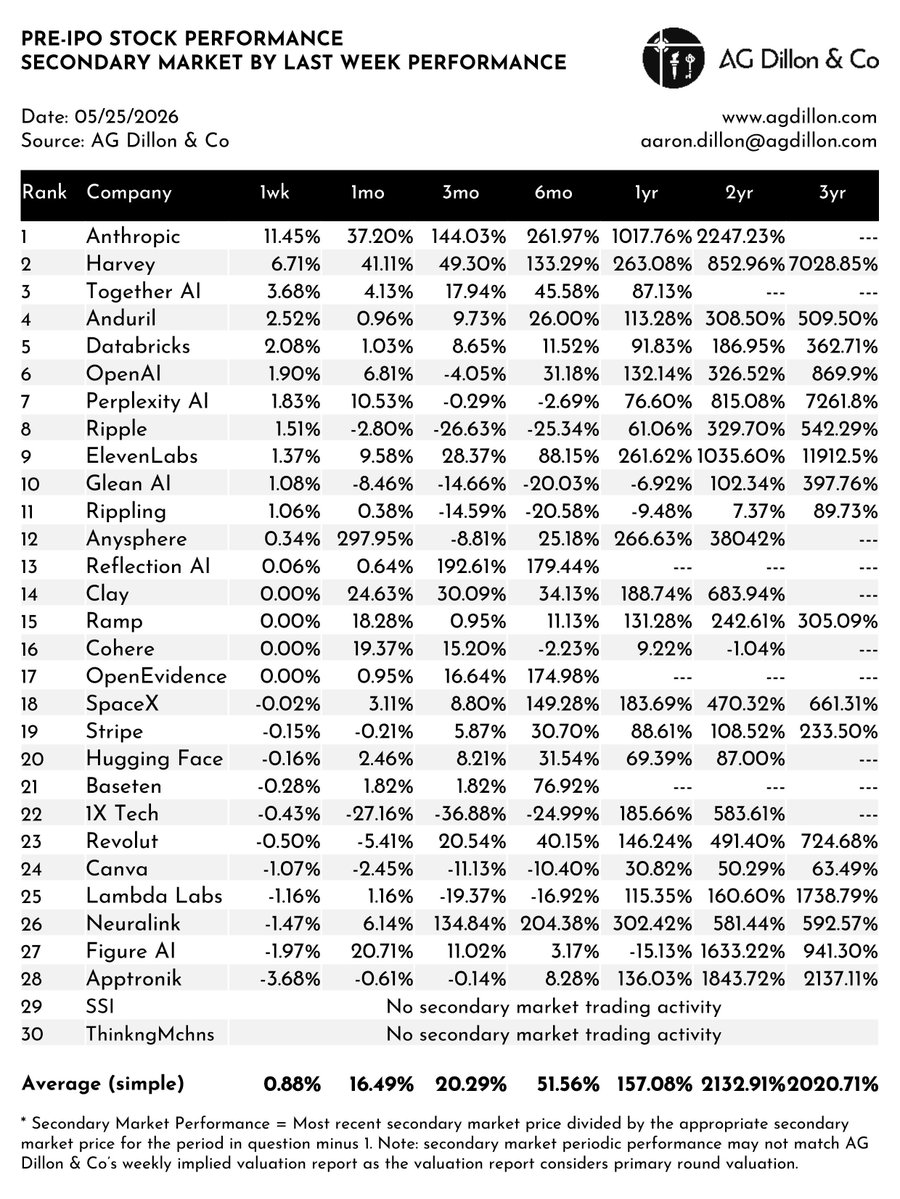
Pre-IPO Stock Market Update -- AI optimization, tokenmaxing, and the future of open-sourced AI large language models | Jun 24, 2026 | Watch full video = youtu.be/q_gJOUzDZp8?si… The AI industry is undergoing a real-time capital efficiency reckoning, and the numbers define the pressure. OpenAI is burning through approximately $3.7 billion per quarter, a run rate that becomes unsustainable the moment the company pursues public markets. The market response is already visible: enterprise customers are hitting budge and compute caps with closed frontier providers, forcing a rapid evolution toward multi-model strategies, fallback architectures, and cost-optimized routing. Businesses that have successfully dialed in AI automation now face a second-order problem: the model that powers their profitable workflow may no longer be available at scale, or the unit economics may deteriorate faster than the revenue justifies. This is the dynamic creating durable demand for AI infrastructure intermediaries, the Basetens, Together AIs, Fireworks AIs, and Lambda Labs of the world, companies that help enterprises find and allocate cheaper compute across providers. The sophistication of the enterprise buyer is rising fast, and that sophistication is the engine behind the ecosystem buildout now underway. The dominance of Chinese open-source models is less a geopolitical story than a market structure story, and the distinction matters for investors. Enterprises are not choosing DeepSeek because it is Chinese; they are choosing open-source because self-hosted inference costs a fraction of what closed frontier APIs charge, and DeepSeek happens to be the highest-quality model available under an open-source license. Crucially, deploying an open-source model on enterprise infrastructure does not route data back to China; the model weights are downloaded, security-checked by providers, and run entirely within the customer's environment, the same way one edits a local copy of a Word document with no connection back to the original author. The more important trend is what comes next: AI application companies with two-plus years of deployment data are now training open-source models on proprietary vertical datasets and outperforming frontier models on domain-specific tasks. Salesforce's acquisition of a sales-AI company for $3.6 billion and Harvey's legal model, trained on workflows from 150 top-tier law firms, illustrate the structural shift. The backbone of these vertical champions will be open-source models, and the winners in the US will be determined by which providers offer the best combination of model quality, support infrastructure, and trust. The investment opportunity in AI is not concentrated in OpenAI and Anthropic; it is distributed across three concentric rings of the ecosystem, and most retail investors are looking at the wrong ring. The first ring is infrastructure: chips, data centers, and the meta-layer platforms that sit between raw compute and enterprise workloads. The second ring is AI application companies, vertically specialized businesses that are accumulating proprietary data and translating it into defensible model advantages. The third ring, opportunistic but high-conviction, is physical world AI: world models and robotics, where the hardware constraint is already solved and the binding variable is the AI that controls the physical system. Nuclear energy sits in the infrastructure ring as an enabling asset, specifically small modular fission reactors (proven submarine-grade technology now awaiting regulatory clearance rather than engineering breakthroughs) that can deliver dedicated power to remote data centers. The risk-adjusted entry point for nuclear is not today's seed-stage bets but rather the moment a company has cleared regulatory approval, built its first production facility, and is raising capital to replicate that factory at scale. That inflection mirrors the SpaceX analogy: the window after the first successful rocket landing, not before the first successful orbit.
YouTube video
YouTube
English
1
0
6
1.3K
VC Funds for RIAs
VC Funds for RIAs@AaronGDillon·
PRE-IPO STOCK MARKET UPDATE - JUN 17, 2026 | Enterprises are moving to AI LLM open architecture solutions; Large language models vs world models and how to pick some winners; Exponential vs linear growth in technology will yield incredible investment opportunities Click to watch = youtube.com/playlist?list=… An AI price war is now reshaping the economics of the entire sector, and the pressure is coming from the cost side rather than the demand side. OpenAI has been optimizing to maximize token spend, but a wave of inference optimization across both software and hardware is forcing frontier labs to bring per-token prices down or cede share. Open-source models are the lever, with the strongest options today coming out of China (DeepSeek, Kimi K2.5) and US application companies increasingly willing to route everyday workloads to them. Several AI application CEOs now expect to run almost entirely on open source within one to two years, reserving frontier closed-source models for only the most complex tasks where they can cost roughly 50 times more per token. A new category of model routers, exemplified by Factory AI, is emerging to match each query to the cheapest and best-suited model, turning model selection itself into a margin lever. At least one US open-source contender is already carrying a $25 billion valuation, Reflection AI. The takeaway is that the next super cycle is an optimization cycle, and value is migrating toward whoever compresses inference cost without sacrificing output quality. Jeff Bezos has stepped directly into the frontier-model race with Project Prometheus, which raised $12 billion at a $41 billion valuation to build what it calls artificial general engineers. The structure is notable for how much institutional capital has lined up behind a company that has not yet shipped a product. The thesis is that AI can be pointed at engineering itself, designing and then stress-testing systems such as rocket engines inside virtual environments before anything is physically built. That ambition places Prometheus squarely in the world-model camp, where simulated environments substitute for expensive real-world iteration. A $41 billion pre-product valuation is aggressive on any conventional basis, and it signals that investors are underwriting the category rather than current revenue. We would treat the raise as a marker of how much capital is now willing to chase applied AI at the engineering layer, and as confirmation that compute-rich incumbents intend to compete on their own terms. Decart released a new world model that goes after the single biggest bottleneck in generative AI, video generation. One large provider was spending roughly $15 million a day to output clips that still took a long time generate, far from instant. Decart lifted a video-generation model off its original setup and onto an AWS Trainium chip, increasing inference output by 8 times while cutting cost by 2 times. AI world models extend well beyond entertainment into self-driving (Tesla), humanoid robotics (1x and Figure AI), and industrial/manufacturing. These AI models are becoming core infrastructure, and the companies that optimize the hardware-to-model fit will capture a disproportionate share of the value. Robotics scaling now looks exponential rather than linear. Once a humanoid robot learns a task, that skill can be copied across an entire fleet, and one Figure AI robot has already run a single task for three days straight without stopping. The next unlock is robots building other robots, which turns factory output into a compounding curve while a fleet-wide data flywheel, much like Tesla's cars, makes every unit more capable over time. The near-term applications are concrete, spanning factory logistics, household tasks, and elder care, where a home robot could let aging parents stay in their own homes one to three years longer at a lower expense vs a human at-home care nurse. The investment framing is that robotics is 12 to 18 months away from a 6 to 9 month window in which it has its ChatGPT moment, after which valuations could re-rate sharply, with a 5 to 10 times move possible before the shift becomes obvious. We would position at the beginning of that window, with particular attention to humanoid platforms, their proprietary world models, and the AI infrastructure layer that all of this runs on. Note that this is a high-conviction, long-duration thesis, and the timeline carries real execution and capital risk that argues for sizing exposure accordingly.
VC Funds for RIAs tweet media
English
2
2
5
737
VC Funds for RIAs
VC Funds for RIAs@AaronGDillon·
Pre-IPO Stock Secondary Market Valuations | as of Jun 15, 2026 | Download full report = agdillon.com/reports * Note: initiated research coverage on Sierra, Fireworks AI, Baseten, Modal Labs, Positron, Factory AI, Fractile, Hydra Host
VC Funds for RIAs tweet media
English
0
1
6
646
VC Funds for RIAs
VC Funds for RIAs@AaronGDillon·
Pre-IPO Stock Secondary Market Performance | as of Jun 15, 2026 | Download full report = agdillon.com/reports * Note: initiated research coverage on Sierra, Fireworks AI, Baseten, Modal Labs, Positron, Factory AI, Fractile, Hydra Host
VC Funds for RIAs tweet media
English
0
0
1
301