Aaron Ray

222 posts

Aaron Ray banner
Aaron Ray

Aaron Ray

@AaronRay517

Sienna Heights University Alum, March of Dimes Regional Advocate. Stock novice, NIXXY🚀Love my circle, proud father to some amazing kids! Opinions are my own.

Jackson, MI Katılım Temmuz 2015
234 Takip Edilen102 Takipçiler
StockAuthority
StockAuthority@StockAuthority·
$VMAR I’m gonna call them today and tell them they need to do some form RWs! I suggest you contact them too telling them to withdraw those S1s now that they are flush with cash! * Bruce Nurse – Investor Relations * Email: bn@v-mti.com * Phone: +1 (303) 919-2913 They also list these additional IR contacts: * Jean-François Ruel – Investor Relations * Email: ir@v-mti.com For U.S. institutional investor inquiries, they also use: * Gateway Investor Relations * Sean McGowan and Tom Colton * Email: VMAR@gateway-grp.com
English
2
1
11
2.5K
M1tanker
M1tanker@M1tanker1966·
$NIXX 🫡
GIF
QME
1
1
11
554
M1tanker
M1tanker@M1tanker1966·
$NIXX anyone get shaken out?
English
8
0
5
1K
Aaron Ray
Aaron Ray@AaronRay517·
@777stock777 Stock is bleeding out pretty bad today. They’re in a transition so they may not have lot come out.
English
0
0
4
109
Stock777777
Stock777777@777stock777·
Hopefully $NIXX CEO is not a dumb ass and we will not lose a base we are created at this level!
English
2
0
7
708
Aaron Ray retweetledi
Antonio Costa
Antonio Costa@ACInvestorBlog·
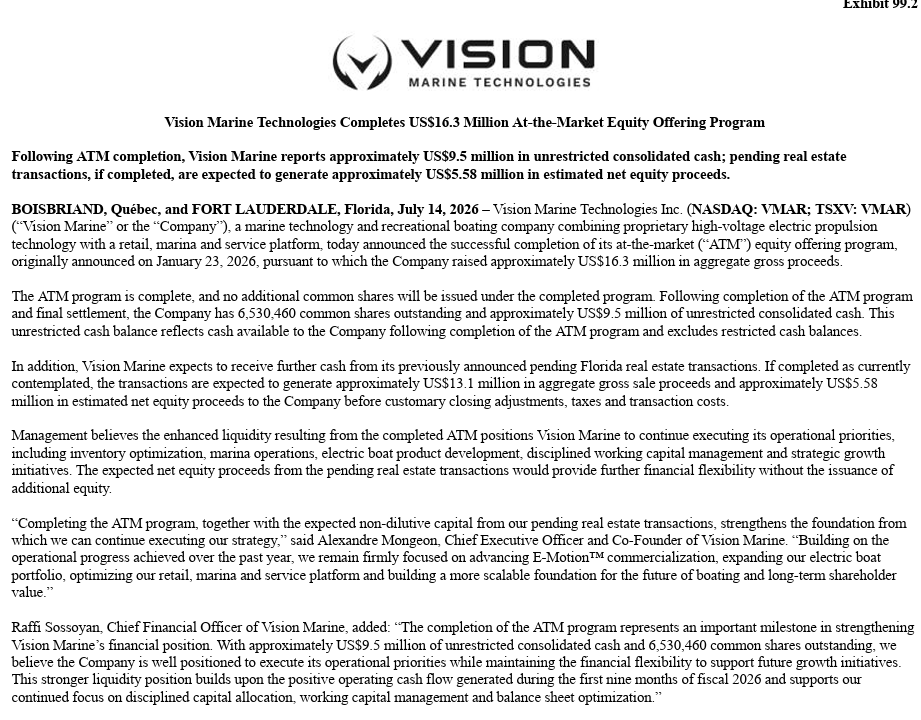
$VMAR Vision Marine Technologies Completes US$16.3 Million At-the-Market Equity Offering Program
Antonio Costa tweet media
English
1
2
9
10.4K
StockAuthority
StockAuthority@StockAuthority·
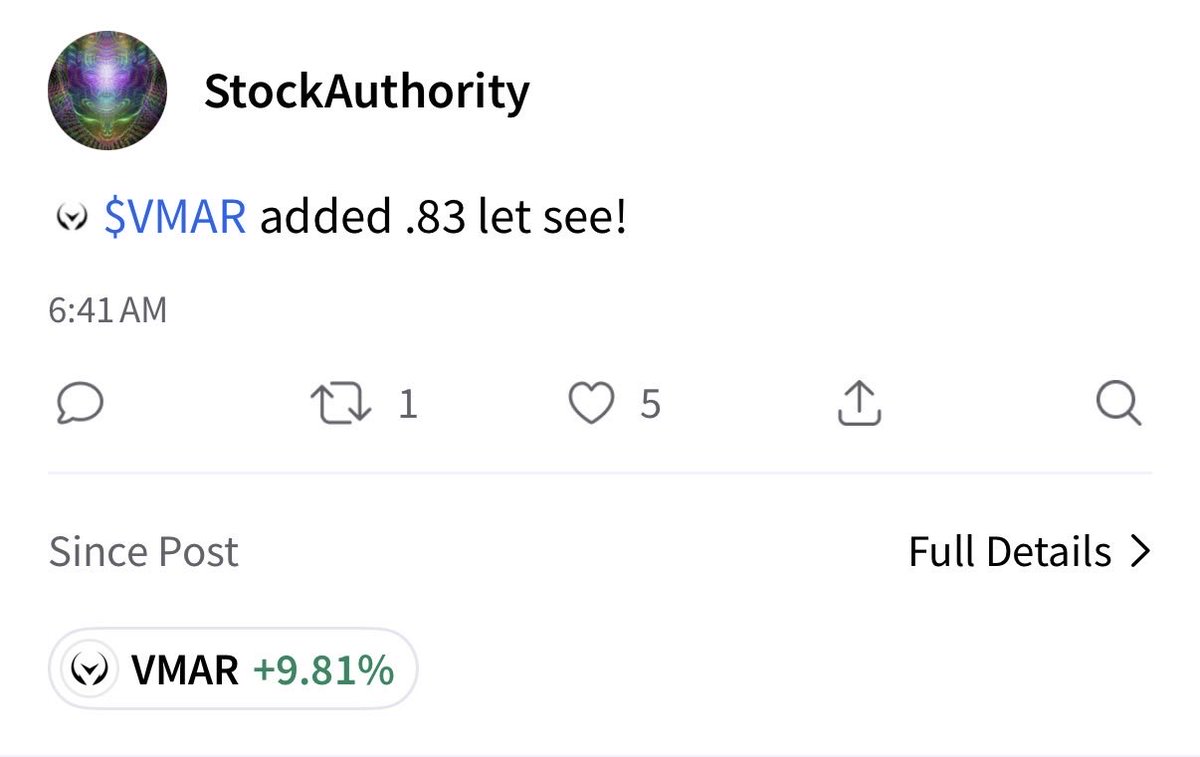
$VMAR 10% up from loading zone I mentioned in the morning. And hit the gap fill as expected. Still undervalued imo and should be trading well above $1
StockAuthority tweet media
English
3
4
15
3.2K
Aaron Ray retweetledi
BigPlaySnipers
BigPlaySnipers@BigPlaySnipers·
$NIXX posted the other day by the new CEO of tachynon9, could see official updates soon.
BigPlaySnipers tweet media
English
1
6
22
3K
Aaron Ray
Aaron Ray@AaronRay517·
@gjourneyy Be some big upcoming days for $HIMS like that one!
English
0
0
0
57
Aaron Ray
Aaron Ray@AaronRay517·
$ZETA , $HIMS, $NIXX my big holdings are back green, it’s a miracle😂. Key word: relax, let it ride!!
GIF
English
1
1
8
754
BreakoutOps
BreakoutOps@Breakout_Ops·
@AaronRay517 A-Aron!!!! My man! 😂 Yeah, just joking on the full port… but I am putting a large amount (for me) i to $NIXX. Hope it works out.
English
1
1
6
414
BreakoutOps
BreakoutOps@Breakout_Ops·
So in this market… I feel like the best thing we can do collectively is full port $NIXX
English
2
0
10
1.1K
DAA
DAA@daaapollo908·
I love $NIXX but never full port anything. You’re still trading in the most corrupt sector there is and that’s penny land! Stories are bought and tickets are sold before anyone figures out the walls are closing in and the story you bought was BS. I’ve been doing this 34 plus years and the more the story sounds like a can’t lose and people start talking $70 a share be careful! Again I’m not saying this is the case here but it very well can be because I’ve seen it 100s of times in the past ! My point keep it real and don’t get out over your skis.
English
1
0
11
892
Aaron Ray
Aaron Ray@AaronRay517·
Successful execution will be made within the details!! North Dakota!! $NIXX
Aaron Ray tweet media
Eric levine@Ericlev90955261

$nixx North Dakota stands out as a prime location for data centers—especially AI/HPC ones—due to abundant, low-cost power from stranded natural gas, a cold climate for efficient cooling, available land, supportive policies, and the ability to build behind-the-meter generation that avoids straining the existing grid. This is particularly relevant now, as many other states face pushback and are delaying or considering bans/moratoriums on large data centers (e.g., New York’s recent one-year moratorium on facilities ≥50 MW, proposals in Georgia, Virginia, Arizona, Colorado, and others) over concerns like grid strain, rising utility bills for residents, water use, noise, land impacts, and tax incentives. Why North Dakota? •Stranded/Excess Natural Gas and On-Site Power Generation: The Bakken formation produces significant natural gas as a byproduct of oil. Export pipelines are constrained, leading to potential flaring or underutilization. Data centers can anchor local power generation (gas-fired, sometimes with hydrogen pathways or carbon capture), turning “stranded” energy into reliable, behind-the-meter supply for gigawatt-scale campuses. This bypasses traditional grid interconnection queues and transmission bottlenecks plaguing other regions. Projects like Applied Digital’s facilities and the proposed Nixxy/Tachyon9 Nakota campus (up to 1 GW, starting with 100-150 MW phases) leverage this directly. •Cheap Electricity: Commercial rates around 7.5¢/kWh (well below the U.S. average of ~14¢/kWh), plus excess generation that can actually lower rates for local ratepayers when data centers use otherwise unused power (e.g., credits/rebates reported in places like Ellendale). •Cold Climate Advantages: Free or low-cost cooling for 200-220+ days/year reduces energy use for chillers by 25-30% compared to hotter states like Texas or Arizona. This boosts efficiency and cuts operating costs significantly. •Land, Water, and Infrastructure: Plenty of affordable land, available water (often with closed-loop systems to minimize consumption), existing energy infrastructure, and a regulatory environment experienced with large energy projects. •Economic and Policy Support: Pro-business stance with tax policies favoring qualified data centers, efforts to attract big loads without burdening residents, and economic development focus on utilizing energy resources in-state. Companies like Applied Digital, NextEra/Basin Electric (planning gas plants for data centers), and others are actively building or expanding. Contrast with Other States In places like Virginia, Georgia, Texas, Arizona, and the Northeast/Midwest, rapid data center growth has led to: •Grid overload and higher bills for everyone. •High water demand amid droughts. •Local opposition over noise, traffic, and farmland loss. •Debates over tax breaks vs. benefits. North Dakota largely sidesteps these by co-locating generation with demand, using excess resources, and demonstrating benefits like stable/lower rates for residents. In short, North Dakota solves AI’s biggest current bottleneck—reliable, scalable, affordable power—while turning an energy surplus challenge into an economic opportunity. This positions it as a growing hub (e.g., Applied Digital’s Polaris Forge campuses, Nakota project) amid national constraints.

English
0
1
10
314
Aaron Ray retweetledi
Eric levine
Eric levine@Ericlev90955261·
$nixx North Dakota stands out as a prime location for data centers—especially AI/HPC ones—due to abundant, low-cost power from stranded natural gas, a cold climate for efficient cooling, available land, supportive policies, and the ability to build behind-the-meter generation that avoids straining the existing grid. This is particularly relevant now, as many other states face pushback and are delaying or considering bans/moratoriums on large data centers (e.g., New York’s recent one-year moratorium on facilities ≥50 MW, proposals in Georgia, Virginia, Arizona, Colorado, and others) over concerns like grid strain, rising utility bills for residents, water use, noise, land impacts, and tax incentives. Why North Dakota? •Stranded/Excess Natural Gas and On-Site Power Generation: The Bakken formation produces significant natural gas as a byproduct of oil. Export pipelines are constrained, leading to potential flaring or underutilization. Data centers can anchor local power generation (gas-fired, sometimes with hydrogen pathways or carbon capture), turning “stranded” energy into reliable, behind-the-meter supply for gigawatt-scale campuses. This bypasses traditional grid interconnection queues and transmission bottlenecks plaguing other regions. Projects like Applied Digital’s facilities and the proposed Nixxy/Tachyon9 Nakota campus (up to 1 GW, starting with 100-150 MW phases) leverage this directly. •Cheap Electricity: Commercial rates around 7.5¢/kWh (well below the U.S. average of ~14¢/kWh), plus excess generation that can actually lower rates for local ratepayers when data centers use otherwise unused power (e.g., credits/rebates reported in places like Ellendale). •Cold Climate Advantages: Free or low-cost cooling for 200-220+ days/year reduces energy use for chillers by 25-30% compared to hotter states like Texas or Arizona. This boosts efficiency and cuts operating costs significantly. •Land, Water, and Infrastructure: Plenty of affordable land, available water (often with closed-loop systems to minimize consumption), existing energy infrastructure, and a regulatory environment experienced with large energy projects. •Economic and Policy Support: Pro-business stance with tax policies favoring qualified data centers, efforts to attract big loads without burdening residents, and economic development focus on utilizing energy resources in-state. Companies like Applied Digital, NextEra/Basin Electric (planning gas plants for data centers), and others are actively building or expanding. Contrast with Other States In places like Virginia, Georgia, Texas, Arizona, and the Northeast/Midwest, rapid data center growth has led to: •Grid overload and higher bills for everyone. •High water demand amid droughts. •Local opposition over noise, traffic, and farmland loss. •Debates over tax breaks vs. benefits. North Dakota largely sidesteps these by co-locating generation with demand, using excess resources, and demonstrating benefits like stable/lower rates for residents. In short, North Dakota solves AI’s biggest current bottleneck—reliable, scalable, affordable power—while turning an energy surplus challenge into an economic opportunity. This positions it as a growing hub (e.g., Applied Digital’s Polaris Forge campuses, Nakota project) amid national constraints.
English
3
2
20
1K